Proof of Stake (PoS) is a blockchain consensus mechanism that selects validators to create and confirm new blocks based on the amount of cryptocurrency they lock up as collateral – called a stake – rather than on the computational energy they burn. This design slashes energy consumption by over 99% compared to Proof of Work, lowers the hardware barrier to participation, and aligns validator incentives with network health through automatic financial penalties for dishonest behavior. As of Q1 2026, over 35.8 million ETH is staked on the Ethereum network alone, with more than 1.1 million active validators securing a system whose economic security exceeds $100 billion.
What Is Proof of Stake and How Does It Differ from Proof of Work?
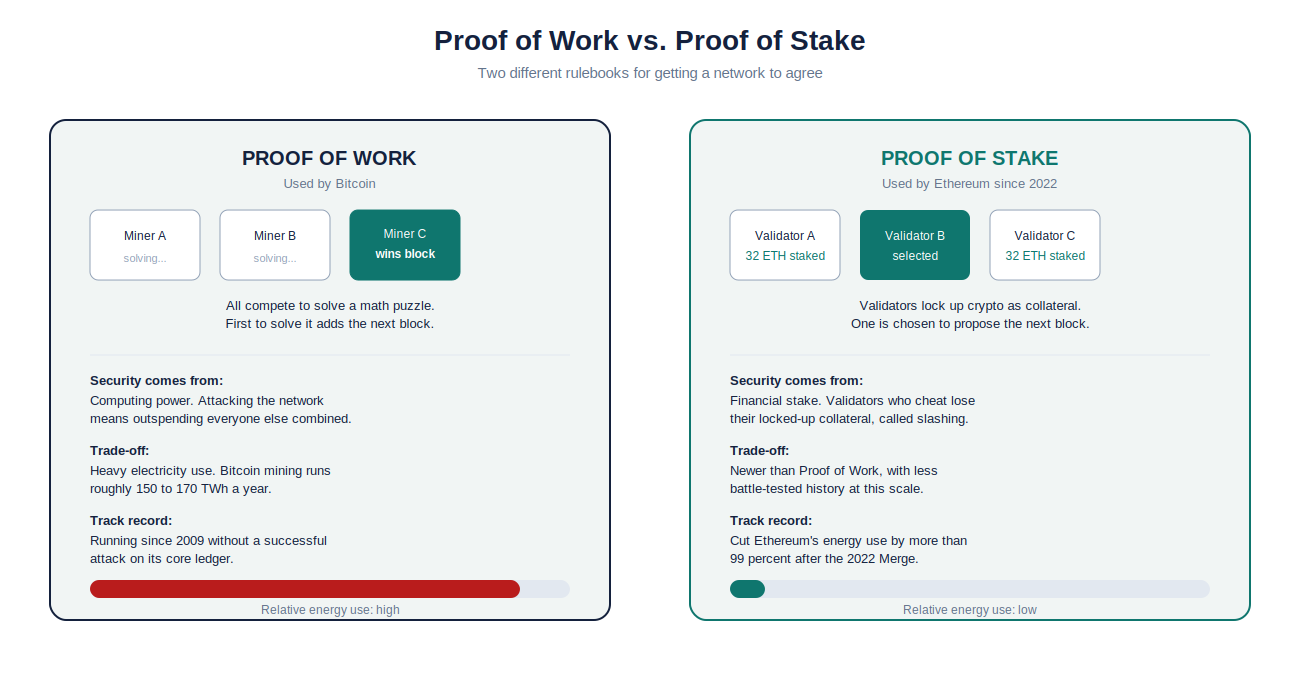
Blockchains need a way for independent nodes to agree on which transactions are valid without trusting a central authority. دليل العمل (بو), used by Bitcoin, achieves this by requiring nodes to burn electricity solving cryptographic puzzles. The node that solves the puzzle first earns the right to add the next block and collect the reward.
Proof of Stake replaces computational competition with economic commitment. Participants lock a defined amount of cryptocurrency into a smart contract – their stake – and the protocol uses a weighted random selection process to choose which validator proposes the next block. Other validators then attest to the block’s validity. Stake size influences selection probability, but most modern PoS implementations add randomization and committee structures to prevent a pure wealth-dominance dynamic.
The practical difference in energy use is enormous. As of 2026, major PoW networks collectively consumed an estimated 97,100 GWh of electricity annually, while comparable PoS systems used roughly 500 GWh – a greater-than-99% advantage for stake-based validation.
The mechanism operates through several coordinated components that together produce secure, decentralized block production.
What Role Do Validators Play?
Validators are the backbone of any PoS network. To participate, a node operator locks up the required minimum stake – on Ethereum, this is 32 ETH – into a deposit contract. From that point, the validator is eligible to be selected by the protocol’s pseudorandom algorithm to propose new blocks. When selected, the validator broadcasts a candidate block to the network. A committee of other validators then votes to approve or reject it.
Validators earn rewards for honest participation: block proposal rewards, attestation rewards, and in Ethereum’s case, priority fees and MEV (Maximal Extractable Value). In the first half of 2026, Ethereum validators achieved an average annualized yield of approximately 3.15–3.3% APY, with network-wide validator participation consistently above 99%.
What Is Slashing and Why Does It Matter?
The mechanism that keeps validators honest is called slashing. If a validator tries to double-sign a block, vote on conflicting chain forks, or otherwise behave maliciously, the protocol automatically destroys a portion of their staked funds and forcibly ejects them from the active validator set. This makes attacks economically irrational: an attacker would need to accumulate a controlling share of all staked tokens, then forfeit much of that value if caught.
Slashing transforms security from a hardware arms race into an economic game. The cost of attacking a PoS network scales directly with the market value of the staked asset – higher token prices make attacks more expensive, a self-reinforcing property that PoW does not share in the same way.
What Is the “Nothing at Stake” Problem?
Critics of early PoS designs pointed to a theoretical flaw: because validators spend no real-world resources to vote on blocks, they could theoretically vote on every competing fork simultaneously without cost, making chain splits harder to resolve. This is known as the “nothing at stake” problem.
Modern implementations address it directly. Ethereum’s Casper protocol applies slashing conditions to validators who sign contradictory messages, making multi-fork voting financially destructive. أوروبوروس كاردانو protocol uses cryptographic sortition to prevent the same issue at the design level.
What Did the Ethereum Merge Prove About Proof of Stake at Scale?
When Ethereum transitioned from Proof of Work to Proof of Stake in September 2022 – an event called “The Merge” – it became the largest real-world test of PoS on a high-value, production blockchain. The results confirmed what proponents had long argued.
Ethereum’s annualized electricity consumption dropped by more than 99.988% overnight. The carbon footprint of a single Ethereum transaction fell from approximately 109.71 kg CO2 to around 0.01 kg. The entire global Ethereum network now consumes roughly 0.0026 TWh per year – less than many mid-sized office buildings use annually.
As of Q1 2026, over 35.8 million ETH is staked, representing approximately 28.9% of the total supply. More than 1.1 million active validators secure the network. Staking yields average 3.3% APY when combining consensus-layer rewards with MEV and priority fees. The restaking ecosystem – protocols that allow staked ETH to simultaneously secure additional services – reached a total value locked of over $16.2 billion by early 2026, reflecting the expanding capital efficiency of the PoS model beyond basic block production.
Very high (97,100+ GWh/yr across major PoW chains)
Very low (~500 GWh/yr for comparable PoS systems)
متطلبات الأجهزة
Specialized ASICs or GPUs; industrial scale
Standard consumer hardware
تكلفة الهجوم
Acquiring 51% of hash rate
Acquiring 33–51% of staked supply
Validator incentive
Block reward + transaction fees
Staking yield + fees (with slashing risk)
سجل
16+ years (Bitcoin since 2009)
Growing fast; Ethereum PoS since September 2022
سقف قابلية التوسع
Lower – mining bottleneck limits throughput
Higher – compatible with sharding and rollups
الملف البيئي
بصمة كربونية عالية
Near-zero carbon footprint
What Are the Advantages of Proof of Stake?
كفاءة الطاقة: Eliminating computational mining removes the need for warehouses of specialized hardware running continuously at full power. This makes PoS chains far more defensible on environmental grounds and reduces blockchain infrastructure’s overall carbon footprint to a fraction of its PoW equivalent.
Lower barriers to participation: Running a validator requires a computer, an internet connection, and a staking deposit – not racks of ASICs costing tens of thousands of dollars. This opens network participation to individuals rather than only industrial operations with access to cheap electricity.
إمكانية التوسع: Without mining bottlenecks, PoS networks can process thousands to millions of transactions per second depending on their additional scaling architecture. Ethereum’s roadmap targets 100,000+ TPS through a combination of PoS and Layer 2 rollups.
Economic security alignment: Validators have direct financial skin in the game. Their staked tokens lose value if they attack the network they are supposed to secure, creating a natural alignment between validator self-interest and overall network health.
What Are the Risks and Criticisms of Proof of Stake?
تركيز الثروة: Validators with larger stakes have higher selection probability and earn proportionally more rewards, which can compound over time. Critics argue this creates a feedback loop where already-wealthy participants accumulate disproportionate influence over block production. Delegated and nominated PoS variants attempt to distribute this power more broadly, but the underlying tension remains.
Initial distribution challenges: For a new PoS network, the genesis distribution of tokens largely determines who controls the chain at launch. Poorly distributed token sales can result in a small group of insiders holding enough stake to dominate validation from day one – a criticism leveled at several early DPoS networks.
Less battle-tested than PoW: Bitcoin’s Proof of Work has operated continuously since 2009 without a successful 51% attack on the main chain. PoS security arguments are mathematically sound, but the historical record is far shorter. Ethereum’s PoS has now operated for over three years without a successful consensus-layer attack, which is encouraging – but that remains a shorter track record than PoW’s sixteen-year run.
تعقيد التنفيذ: Modern PoS protocols with slashing conditions, attestation committees, and finality gadgets are significantly more complex to implement correctly than PoW mining. Bugs in consensus-layer code can have catastrophic, irreversible consequences for funds and chain integrity.
Practical Tips for Getting Started with Proof of Stake
Start with liquid staking if you hold less than 32 ETH. Protocols like Rocket Pool and Lido let you earn staking yield on any amount without running validator software or managing infrastructure.
Understand the exit queue before committing. Ethereum has an exit queue for validators; withdrawal wait times vary based on network demand. Check current estimates on beaconcha.in before locking funds for solo staking.
Research slashing conditions before running a validator. Misconfigured validator software – such as running duplicate keys on two machines simultaneously – can trigger accidental slashing. Use a dedicated machine and never run the same validator key in parallel.
Compare staking APY across networks while adjusting for risk. A 15% yield on a low-liquidity token carries far more risk than a 3% yield on ETH. Factor in token volatility, protocol age, smart contract audit history, and whether the yield is denominated in a stable or speculative asset.
Monitor validator performance with dedicated tools. Services like beaconcha.in and rated.network provide real-time data on validator uptime, reward rates, and slashing incidents across the Ethereum network.
Evaluate restaking protocols carefully before depositing. Restaking protocols offer additional yield by using staked ETH to secure other services, but they introduce additional smart contract risk and slashing conditions beyond the base Ethereum protocol. Read audits and understand what you are securing before committing capital.
How much ETH do I need to become an Ethereum validator?
Solo staking on Ethereum requires exactly 32 ETH. Pooled staking services like Lido and Rocket Pool allow participation with any amount by aggregating deposits from multiple users and distributing rewards proportionally. Liquid staking tokens such as stETH represent a staked position that can be freely traded or used as DeFi collateral while the underlying ETH continues earning validator rewards. As of Q1 2026, Lido holds approximately 24–28% of all staked ETH market share.
هل آلية إثبات الحصة أكثر أماناً من آلية إثبات العمل؟
The two mechanisms offer different security profiles rather than a clear hierarchy. Proof of Work has the advantage of a longer proven track record and attack costs tied to real-world hardware and energy that cannot be conjured on short notice. Proof of Stake ties attack costs directly to the market value of staked tokens and uses slashing to impose automatic financial punishment for misbehavior. As of Q1 2026, Ethereum’s PoS has operated for over three years without a successful consensus-layer attack – encouraging, though still a shorter history than Bitcoin’s PoW record.
What happens if a validator behaves dishonestly?
A validator that signs contradictory blocks or equivocates during committee voting triggers slashing: the protocol automatically destroys a percentage of that validator’s staked funds and forcibly ejects it from the active set. The severity of slashing scales with how many validators misbehave simultaneously – a feature designed to heavily penalize coordinated attacks while treating isolated configuration errors more leniently. Minor individual slashing events typically destroy a small fraction of stake; coordinated attacks involving many validators can result in far larger losses.
What is liquid staking and why has it grown so fast?
Liquid staking allows users to stake cryptocurrency and receive a tradeable token representing that staked position. Instead of locking 32 ETH with an exit queue wait, a user deposits ETH into a protocol like Lido and receives stETH, which can be freely traded, used as loan collateral, or supplied to lending markets while still earning staking yield. As of Q1 2026, liquid staking protocols hold over 30% of all staked ETH, and the broader restaking ecosystem – which layers additional yield opportunities on top of staked assets – has reached a total value locked exceeding $16 billion.
Can Proof of Stake lead to blockchain centralization?
Centralization risk is a genuine and ongoing concern. Validators with larger stakes earn proportionally more rewards, which can gradually widen the gap between large and small participants. In practice, Ethereum’s validator set of over 1.1 million nodes is among the most distributed of any major blockchain – but a significant fraction of that stake flows through a small number of liquid staking protocols, meaning the effective decision-making power is more concentrated than the raw validator count suggests. Protocol governance and design choices continue to shape how this tradeoff evolves.
How does delegated PoS differ from pure PoS?
In delegated Proof of Stake (DPoS), token holders vote for a fixed set of delegates who take turns producing blocks. This concentrates validation in a smaller group – typically 21 to 101 delegates depending on the network – which can significantly increase transaction throughput and reduce block times. The trade-off is that only elected delegates produce blocks, making the active validator set far smaller than pure PoS systems like Ethereum, where any node meeting the minimum stake requirement can participate directly in block production.
أيوديجي أكينغباد كاتب محتوى متمرس، أمضى سنوات في شرح المواضيع المالية المعقدة، والعملات المشفرة، والاستثمارات بأسلوب سهل الفهم. وهو شغوف بالتداخل بين المال والتكنولوجيا، وكيف يمكن للأفراد تحقيق أهدافهم من خلال الاستخدام الاستراتيجي للموارد المتاحة.
يسعى أيوديجي جاهدًا لإنشاء محتوى غني بالمعلومات وجذاب. سواءً كان الموضوع استراتيجيات تداول العملات المشفرة أو نصائح للاستثمار العقاري، فإن كتاباته تضمن للقارئ شعورًا بالاستفادة من وقته. في أوقات فراغه، يستمتع أيوديجي بإعداد عروض تسويقية لعملاء العقارات أو تشجيع فريقه المفضل لكرة القدم.
تنويه : هذه المقالة مُخصصة لأغراض إعلامية فقط، ولا تُعتبر نصيحة استثمارية أو تجارية. لا يُفسر أي شيء وارد فيها على أنه نصيحة مالية أو قانونية أو ضريبية. ينطوي التداول أو الاستثمار في العملات الرقمية على مخاطر خسارة مالية كبيرة. لذا، يُرجى إجراء بحث دقيق قبل اتخاذ أي قرارات استثمارية أو تجارية.
التداول مع إثبات الاحتياطيات
تنشر بورصة UEEx عمليات تدقيق شهرية وتحقق من طرف ثالث في كل سوق مدرج.