Modern investors seeking to maximize returns and manage risk efficiently must understand how to build a dual-asset trading strategy. After the federal government allocated significant resources to the Strategic Bitcoin Reserve in March 2025, the border between traditional and digital finance was finally broken.
The two similar trading institutions have finally crossed paths, and smart investors are taking advantage of the broken barrier to make profits. This article explains the critical differences between the two types of trading and also emphasizes the nuances of execution on brokers and native crypto platforms.
لا يوجد دعوة للعمل مع المعرف رقم 0.
الوجبات السريعة الرئيسية
Traditional stocks provide systemic security via SEC oversight, clear bankruptcy protections, and cash-flow-driven compounding.
Always build your core wealth foundation in diversified equity indexes before allocating capital to unbacked digital assets.
Financial advisors recommend capping digital holdings to small single-digit percentages (ideally 5% or less) to capture outsized asymmetry while completely protecting your total net worth from terminal token drawdowns.
While stock brokerages streamline tax tracking via Form 1099-B, crypto compliance has intensified with the mandatory roll-out of Form 1099-DA.
Remember that every single token-to-token swap is a legally taxable event requiring independent cost-basis software reconciliation.
What is Stock and Crypto Trading?
تداول الأسهم revolves around buying a fraction of ownership (equity) in a central public corporation with cash flows, physical assets, and rigorous control over corporate governance.
Crypto trading refers to exchanging native digital assets or programmatic tokens secured by cryptography with value derived from their utilization, liquidity provision, supply engineering, and decentralized consensus.
The 10 Core Differences Between Stock Trading and Crypto Trading
Here are 10 differences between both types of trading:
ما يمكنك شراؤه
Stock trading gives you the opportunity to buy assets in companies, gaining access to a share of physical products, intellectual property, cash flow, and voting rights.
With crypto trading, you buy cryptographic tokens or coins, each of which is a decentralized unit of value.
In other words, by buying the crypto asset, you receive the right to use the technology on which it is based but not the ownership of any physical assets. For example, Apple’s stock (AAPL) gives you the right to divide the value of the iPhone, MacBook, and iTunes in your share, while Bitcoin (BTC) offers you programmatic access to settlement.
ساعات التداول
Stock trading has limited trading hours: the market opens at 9:30 a.m. and closes at 4:00 p.m. Eastern Time, Monday through Friday, with no trading on official holidays.
Crypto trading has no limits: the market is open 24/7, with no weekends or breaks.
تطاير
Stock trading has relatively tight volatility: for the S&P 500 index, an annual standard deviation rarely exceeds 20%.
For crypto trading, volatility is the norm. This is especially evident in price fluctuations of small-cap coins, which often reach 10-15% daily. Bitcoin itself had a significant swing in mid-2025, breaking through $124K, then sharply falling due to programmatic sales.
اللائحة
Stock trading is highly regulated because the SEC protects investors and provides insurance against broker fraud up to $500,000.
At the same time, crypto trading is in a gray area because the SEC and CFTC continue to fight jurisdictional battles. On the other hand, the GENIUS Act passed in July 2025 established a sand-box regulation for stablecoins.
سيولة
Stock trading is a centralized asset type: most of the trading flows are concentrated on the NYSE and Nasdaq. Therefore, large-volume trades (over $1M) are executed instantly at close to the market price with almost no slippage. This is especially important for large-cap stocks.
With crypto trading, liquidity is fragmented: trading flows are distributed among tens of centralized exchanges, AMMs, pools, and OTC desks. Therefore, a $1M order in an on-chain alt-coin pool will most likely cause significant slippage.
رسوم التحويل
With stock trading, you do not pay any transaction fees for online trades: the broker business model is fully based on the spread.
For crypto trading, fees vary from exchange to exchange but are generally higher than for stocks. The fees include maker-taker differences at CEXs and network fees at on-chain trading platforms. At the same time, many brokerage apps do not allow transparent trading: they hide additional costs in the form of a 1-2% spread.
Leverage & Derivatives
Traditional stock trading provides tightly regulated overnight leverage under Regulation T (Reg T), which restricts retail investors to borrowing a maximum ratio of 2:1. Furthermore, following a historic regulatory shift, the SEC and FINRA officially abolished the legacy Pattern Day Trader (PDT) rule and its rigid $25,000 equity minimum requirement.
Under the modern framework, accounts holding over the standard $2,000 margin entry minimum are completely free from trade-counting restrictions. They can execute unlimited intraday round-trips, with individual brokerages evaluating buying power using dynamic, real-time risk engines rather than arbitrary transaction limits
On the other hand, offshore crypto platforms offer leveraged trading with a ratio of up to 125:1 on some asset pairs. However, crypto traders are also limited by the lack of circuit breakers and forced liquidation protocols.
دخل
With stock trading, the investor receives income in the form of dividends, which are distributed to shareholders from the company’s cash reserves. Dividend yields are relatively low but stable.
With crypto trading, the investor has two ways to generate income: staking rewards and asset lending.
Staking is a method of generating income through PoS chain participation when the investor locks his tokens to validate transactions. Staking yields range from 3% to over 10% for the largest coins. At the same time, the tax system treats crypto income as ordinary income, counting the exact moment of receipt.
الحراسة والأمن
With stock trading, the investor has no choice: he is obliged to store his shares with a custodian, a trusted third party. At the same time, the investor has full compensation guarantees if the broker steals the assets or the custodian goes bankrupt.
With crypto trading, the investor can choose where to keep his assets. He can keep them on a custodian exchange or, for more security, keep them in cold storage: private software or hardware. The phrase “not your keys, not your crypto” vividly tells about the risks of crypto custodians.
الالتزامات الضريبية
With stock trading, brokers take care of all tax details: they provide a 1099-ب النموذج الضريبي at the end of the year, showing the cost basis and proceeds for each trade.
With crypto trading, tax liabilities have become very complicated: after the change in regulations in 2026, crypto exchanges now provide 1099-DA forms so that their users can track all their gains and losses. Every token swap (e.g., selling Solana for a stablecoin) is now a taxable event. At the same time, when rebalancing the stock portfolio in a brokerage IRA account, no taxes are withheld.
لا يوجد دعوة للعمل مع المعرف رقم 0.
الميزات
الأسهم
العملات الرقمية
Winner For Beginners
تطاير
Low-Moderate (15-20% annualized)
Intense (10-15% daily swings)
الأسهم
ساعات التداول
Rigid (Mon-Fri, 6.5 hours/day)
Continuous (24/7/365)
العملات المشفرة (For flexibility)
اللائحة
Total institutional oversight (SEC/SIPC)
Evolving hybrid (GENIUS stablecoin rules)
الأسهم
الحد الأدنى كابيتال
$1 via fractional equity routing
$1 via atomic satoshi/gwei division
كرافت
هيكل الرسوم
$0 baseline commissions
0.1-1.0% maker/taker + on-chain gas
الأسهم
تأمين الأصول
SIPC protected up to $500,000
None (Smart contract & custody risk)
الأسهم
ملف العائد
Corporate Dividends (1.5-2.0%)
Protocol Staking (3.0-10.0%+)
العملات المشفرة (For higher yield)
المشهد الحالي
S&P 500: Structural uptrend (~6,466 YTD baseline)
Bitcoin: Post-all-time-high consolidation
العملات المشفرة (For asymmetry)
Tax Mechanics
Unified Form 1099-B tracking
Comprehensive Form (1099-DA mandate)
الأسهم
منحنى التعلم
منخفضة إلى متوسطة
Exceptionally Steep (Keys, AMMs, Wallets)
الأسهم
Government Regulations in Stock Trading and Crypto Trading
The current regulatory environment is the opposite of what it was a year ago. After an uncompromising campaign to promote the United States as the most attractive country for crypto businesses, federal regulators have transitioned to a phase of organizing the market and promoting systematic asset accumulation.
Major Regulatory Changes in Crypto Trading
To understand the differences between the two markets, you need to know the regulatory changes of this year.
GENIUS Act (July 2025)
The Guidance and Establishment of a National Innovation for U.S. Stablecoins Act sets out strict federal oversight requirements for dollar-backed stablecoins. At the moment, there are two options for crypto issuers: the قانون GENIUS gives them the choice between a direct federal charter and compliance with state laws.
The main argument in favor of this act is the reduction in smart contract depegging risk: in case there is an emergency, stablecoins will be able to provide sufficient liquidity to prevent a mass exodus of depositors.
At the moment, the biggest stablecoin issuers are preparing to meet the requirements of the new regulations. All of them have an 18-month transition period ahead of them to adopt the necessary changes.
CLARITY Act (July 2025)
استخدم قانون وضوح سوق الأصول الرقمية makes the separation between the SEC and CFTC explicit. It establishes clear criteria for categorizing digital assets as commodities or investment contracts. Another positive aspect of this act is that it removes the possibility of regulators labeling altcoins as securities. This means this law insulates investors from the threat of a sudden SEC crackdown on their assets.
The good news is that the clarity act has already been passed by the House of Representatives. The Senate is now working on the final wording of the law, which will define the boundaries between crypto and traditional finance.
SEC “Project Crypto” (July 2025)
The SEC’s internal project to update securities laws and embrace digital assets has led to the creation of a new set of rules for crypto trading. At the moment, the staff of SEC Chair Paul Atkins is working on a few critical amendments.
One of the most important changes is the introduction of a “الملاذ الآمن” for innovation tokens. Under this تنفيذ المشاريع , decentralized networks will have a longer period to introduce their own utility tokens without the burden of securities regulations.
Also, a large number of altcoins are preparing to enter the SEC-regulated market. The creation of spot ETFs on Solana and various on-chain indexes will be facilitated by this regulatory relaxation, which will allow institutional investors to accumulate more assets.
Strategic Bitcoin Reserve (March 2025)
In 2025, the federal government acknowledged the status of the decentralized network as national infrastructure. To do this, it created the احتياطي البيتكوين الاستراتيجي, which aggregates all federal crypto assets in one treasury. This means all property in the form of Bitcoin, Ethereum, Solana, Cardano, and XRP confiscated or purchased by federal authorities has become consolidated in the new reserve.
This is a signal that the market infrastructure in the form of decentralized networks is now recognized at the level of national security. As a result, states’ pension funds, as well as corporate treasuries, have begun to allocate funds to purchase digital assets.
While the crypto market’s volatility is infamous, the system of regulating stock trading is no less chaotic. Irrespective of the jurisdiction, almost all localized securities acts cover the following four areas:
الإفصاح عن المواد
Prior to appearing on a local exchange (London Stock Exchange, Tokyo Stock Exchange, NYSE, etc.), companies are obligated to submit to authorities financial reports, prospectuses, and other data about relevant events occurring in the firm.
Anti-market abuse laws
Insider trading (buying/selling securities on the basis of non-public information) and wash trading (falsifying trading volumes by simultaneously buying/selling securities) are illegal in all major financial centers.
Broker-dealer clearance
Individual investors are prohibited from directly engaging in exchange trading. Instead, they are required to utilize securities firms as middlemen who, in turn, have to comply with specific regulations (capitalization requirements, client money segregation rules, KYC/AML rules, etc.).
Central counterparty clearance
To ensure the stability of the system, clearinghouses act as counterparties to all trades, which means that the obligations of broker-dealers are transferred to them. Authorities mandate that all transactions settle through a clearinghouse in order to prevent defaults at the infrastructural level.
Where to Trade Stocks and Crypto: Multi-Asset Brokers or Crypto-Native Platforms?
نوع النظام الأساسي
المنظومة
1099-DA Cost Basis Compliant?
Supported Asset Classes
أفضل استخدام ل
متعدد الأصول
UEx
No (UEEx operates globally and also uses the U.S MSB license, however, users have to manually export their data for tax reporting.)
Broad crypto spot with over 230 crypto assets, high-leverage preps, copy trading
Perfect for cross-assets traders looking for a platform with high-leverage derivatives
متعدد الأصول
Robinhood
نعم (آلي)
Stocks, Options, ETFs, Select Crypto Primitives
Retail traders demanding a single, unified interface for equities and liquid spot tokens.
متعدد الأصول
Interactive Brokers (IBKR)
Yes (Via Paxos execution)
Global Equities, Futures, Options, Bonds, Institutional Crypto
Professional cross-asset traders looking to leverage equity margins against spot exposures.
التشفير الأصلي
کوین بیس
Yes (Full cost-basis tracking)
Full Crypto Staking, Base L2 Web3 Access
On-chain traders who require the deepest domestic liquidity pools and clean audit trails.
التشفير الأصلي
كراكن
Yes (U.S. Compliant Entity)
Broad Crypto Spot, Staking, Proof-of-Reserve
Advanced crypto-first traders focused on high-uptime execution and protocol staking.
DeFi / DEX
Uniswap / Aerodrome
No (Self-Custody / Exempt)
On-Chain Tokens, Liquidity Pools, Synthetics
Sovereign Web3 users utilizing non-custodial wallets; requires manual software logging.
The regulators’ changes in 2025 and 2026 gave rise to two camps of trading platforms, which are the traditional multi-asset brokers and crypto-native venues. In general, the 2025-2026 reforms are a response to the need to organize the crypto market within the framework of federal oversight.
To ensure the security of deposits and avoid potential difficulties with tax audits, it is critical to choose a platform that provides automated tax form generation (1099-DA). At the moment, major multi-asset brokers such as Interactive Brokers and Fidelity offer full crypto trading services and tax assistance.
On the other hand, traditional stock market platforms like Charles Schwab & Co. and Edward Jones do not provide crypto custody or trading services, further proving that the legacy broker industry is fragmented, with little uniformity in how crypto trading is incorporated.
Tier 1: Multi-Asset Brokers
These legacy platforms have fully integrated the regulatory mandates, providing a completely hands-off compliance experience for traders.
UEx: A multi-asset global platform and high-leverage exchange, bridging into traditional stock markets. Unlike the standard domestic US brokers, it doesn’t offer automated tax forms such as the 1099-B or 1099-DA. Whereas it does hold a FinCEN Money Services Business (MSB) registration for strict AML/CFT purposes, it’s still a non-custodial entity for fiat and operates globally. As such, the platform will not be tracking/reporting your crypto cost basis or gross proceeds to the IRS directly.
Users are left to pull their own trade histories and transaction logs via CSV exports to calculate their cost basis, capital gains and losses via a third party crypto tax calculator. The application is notable for its deep liquidity for over 230 crypto spot pairs, massive leverage up to 125x on perpetual contracts, a copy trading feature and the unique ability to trade U.S. and Hong Kong equities fully funded via stablecoins.
الربوة: A great multi-platform application that serves as an excellent bridge between traditional and crypto assets. It allows you to report to the IRS using the 1099-B form for stocks and نموذج 1099-DA لأصول التشفير.
The application will help you track the cost basis of crypto assets bought on the platform and report the gross proceeds to the IRS. At the same time, for crypto transferred to the application from other wallets, the user will have to reconcile the cost basis using a crypto tax calculator from third-party providers. The app offers $0 commission for stocks and a decent spread for major crypto assets. However, there is a lack of alternative assets and dApps support.
الوسطاء التفاعليون (IBKR): An advanced trading terminal designed for institutional-level algorithmic trading. The platform offers custodianship partnerships (Paxos Trust and Zero Hash) to clear trades, ensuring compliance with cost-basis reporting rules and providing consolidated tax statements. It has low stock margin rates, low crypto trading fees, and offers a combined view of crypto and equity assets. Users can send and receive crypto assets through the Crypto Plus portal to external self-custody platforms (hardware wallets). However, the interface has a steep learning curve, and crypto transfers from external custodians require extra enrollment steps.
Tier 2: Crypto-Native Platforms
At the moment, a large number of crypto-native platforms have entered the market offering their users better yields, lower fees, and a wider choice of services. Among the most popular are Coinbase, Kraken, UEx, Gemini, and Binance.
However, when choosing between these platforms, you need to consider liquidity provision mechanisms, custody options, and trading fees. The more liquidity a protocol has, the lower the slippage on large trades; on the other hand, a large pool of liquidity providers means a larger potential for theft by malicious actors.
کوین بیس: The gold standard for secure, retail-to-institutional digital asset trading in the United States. Fully adapted to the Form 1099-DA mandate, it tracks, computes, and reports your full cost basis across all trades, making it as tax-compliant as a traditional brokerage.
It supports hundreds of tokens and features smooth onboarding to Web3 or Layer-2 ecosystems via Coinbase Wallet. However, it charges higher base trading fees unless utilizing Advanced Trade, and automated staking rewards trigger immediate ordinary income tax liabilities.
Kraken (U.S. Division): A reliable, high-performance platform preferred by active day traders and security purists. Operating in accordance with the GENIUS Act parameters for stablecoin settlement, it is fully compliant with IRS cost-basis reporting via automated 1099-DA delivery. It offers an exceptional security architecture backed by publicإثبات الاحتياطيات alongside highly competitive trading fees. However, it features geographic restrictions in states like New York and can occasionally incur bank-wire processing lags.
Tier 3: Decentralized Protocols
Uniswap / Aerodrome / Jupiter: Non-custodial smart contracts operating entirely on public blockchain infrastructure (Ethereum, Base, and Solana). They are exempt from direct Form 1099-DA reporting because they never take custody of your assets.
They offer total sovereignty, no KYC verification, and direct access to 100% of on-chain liquidity pools with zero broker counterparty risk.
However, they carry extreme smart-contract execution risks, zero consumer protections, and force the entire accounting data burden onto you. You must manually use third-party software to reconcile wallet addresses and build your own cost-basis trail.
The trading scene in 2026 is fully integrated, as there is no longer a distinction between traditional Wall Street securities and crypto-economic assets.
Driven by both the passage of the GENIUS Act in favor of الأصول المدعومة بالعملات المستقرة and the increased scrutiny from the IRS concerning Form 1099-DA obligations, trading venues now provide universal services to crypto-native traders while remaining compliant with securities regulations.
For active traders, the ability to apportion capital between traditional equities and digital assets within a single account is now a necessity. The brokerage industry is fragmented into three major categories:
Unified platforms: brokerage accounts that allow investors to buy both traditional public stocks and physical crypto assets within a single interface
Crypto-native platforms: digital asset exchanges offering custody, derivatives, staking, and node operator services
Stock-only platforms: traditional investment accounts focused on equities, bonds, mutual funds, futures, and options
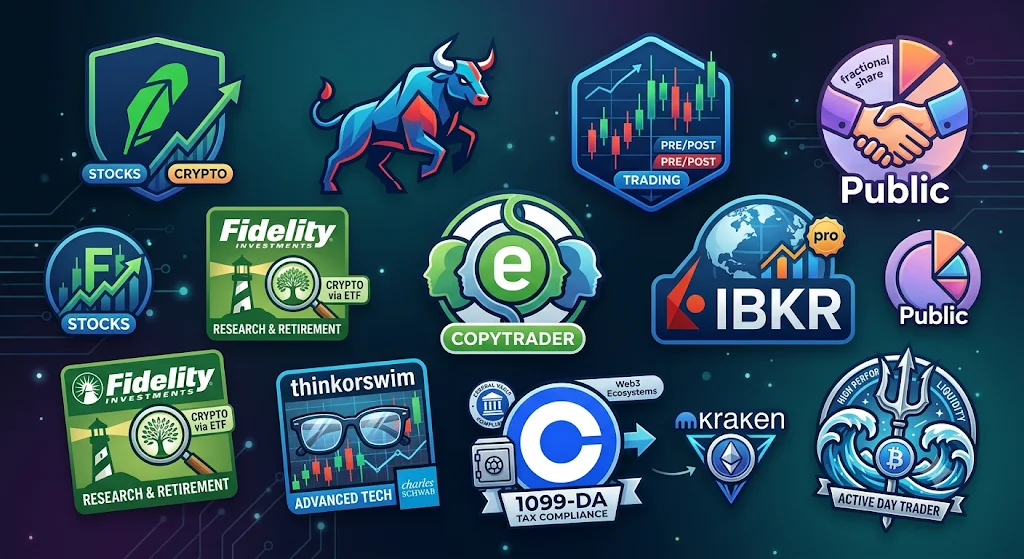
Trading platforms that permit investors to allocate funds between equities and digital assets offer substantial convenience advantages to investors. Let’s review the major unifying venues of 2026:
Hybrid Stock Plus Crypto Trading Platforms
Robinhood
Robinhood is a good option for those who want to build a diversified portfolio that includes both conventional assets and crypto. The service provides free-of-fee trading of more than 5,000 stocks, ETFs, and options, as well as crypto. Over 20 large-cap coins are available alongside traditional securities.
The platform also offers mobile accessibility, automated cash sweeps to high-yield accounts, built-in cost-basis tracking, and day-trade counters, all of which contribute to its ease of use. Equity trading is بدون عمولة, whereas crypto involves a markup of 0.5-1%. Margin accounts still carry broker-set equity requirements, and the crypto offering is smaller than on Web3 platforms, which is another limitation.
ويبول
Webull is focused on active day traders and swing traders who need to analyze charts frequently. In terms of assets, the platform covers more than 6,000 stocks, ETFs, options, and 50+ cryptoassets.
Stock trading is commission-free, and crypto has relatively low fees. The terminal provides advanced tools such as pre/post-market trading, level 2 data, and a built-in paper-trading simulator to practice. The learning curve is relatively steep due to the abundance of features, but they are tailored for active trading rather than for long-position holding.
إي تورو
eToro is a social trading network where users can interact and copy deals made by verified professional traders. Over 5,000 traditional stocks, ETFs, fiat trading pairs, and 100+ cryptoassets are available for commission-free trading on the platform, with crypto involved in a markup of 1.00%.
A unique feature of eToro is CopyTrader, which allows one to set up automatic copying of allocations of expert investors in real-time, as well as track their news and sentiment. The platform lacks a mobile app, and fiat deposits are subject to a $5 withdrawal fee. Additionally, crypto offerings are limited for users located in the United States.
التفاعلية وسطاء
Interactive Brokers is a multi-asset brokerage designed for institutional players and serious day traders. The platform supports trading in stocks, options, futures, bonds, forex, and crypto globally, with fees depending on trade volumes and no more than 1% for crypto.
The desktop version, محطة عمل التاجر, offers advanced charting and technical analysis tools, as well as algorithmic VWAP, TWAP, and other order type executions. The broker also provides low rates for margin borrowing. On the flip side, Interactive Brokers has a complex interface and is not suited for small-time traders. Additionally, there is no hardware wallet support for crypto trading.
عام
Public is an investing platform that allows one to build a diversified multi-asset portfolio using fractional shares for conventional stocks, ETFs, bonds, alternative assets, and crypto assets. Stock trading is commission-free, crypto involves a regular markup, and the platform highlights transparency of its PFOF and offers social media-type interaction and automated cash sweeps to high-yield accounts.
The learning curve is gentle owing to an intuitive interface, but technical charting and analysis tools are limited, which is not suitable for active day-traders.
لا يوجد دعوة للعمل مع المعرف رقم 0.
Top Stock Trading Platforms with Crypto Exposure
الإخلاص للاستثمار
Fidelity Investments is a traditional brokerage known for a strong focus on research, customer service, and retirement accounts. The firm does not support direct on-chain trading of cryptoassets.
Yet, Fidelity offers spot Bitcoin and Ethereum ETFs and crypto platform services to buy and sell Bitcoin, Ethereum, Litecoin, and other major coins. It is a good option for those who want to build a long-term investment portfolio and benefit from tax-saving retirement accounts.
تشارلز شواب
Charles Schwab is another traditional brokerage with a wide range of conventional assets and crypto-exposure via select products. The company offers thinkorswim, a professional trading platform involving advanced technical analysis tools for options and charting.
Schwab does not support self-custody of cryptoassets, but one can purchase crypto ETFs and CME Bitcoin and Ether futures to gain exposure to crypto. It is a good option for serious long-term investors and active options traders.
Top crypto-native platforms for 2026
Best crypto-native exchanges that provide OTC liquidity, staking services, derivatives, custody, and exchange trading for digital assets.
UEx
UEEx is a global crypto-native trading platform with isolated cold/hot wallets for holding users’ funds. The exchange is a أعمال الخدمات المالية (MSB) registered in the U.S. and Canada to meet anti-money laundering regulations. UEx offers a liquid trading environment for over 200+ cryptoassets, perpetual swaps with up to 125x leverage, and access to traditional market stocks through derivatives or synthetics.
The exchange levies a هيكل رسوم تنافسي, with a 0.09% maker/taker fee on spot and margin trading and a 0.05% charge on futures derivatives. Over 1,000,000 users are registered on the platform as of now. Cross-product liquidity pools are at the core of the exchange’s day-trading, copy-trading, and institutional OTC fiat gateway operations.
کوین بیس
Coinbase is a federal crypto custodian that provides effortless IRS tax reporting for crypto-native assets. The platform offers an easy way to purchase crypto, stablecoins, and tokenized fiat, but the conversion fees on standard accounts are unreasonably expensive. Meanwhile, Pro membership implies 0.4% maker and 0.6% taker fees.
With 120 million monthly visitors, one of the highest trading volumes, and billions in annual revenue, Coinbase is best suited for traditional investors who want to buy crypto with confidence.
كراكن
Kraken is a crypto-native exchange renowned for its high-performance liquidity solutions, deeply popular among day traders. The platform offers the largest selection of digital assets, covering over 543 cryptoassets and 11,000+ US-listed stocks and ETFs for international clients. Institutional taker and maker fees start at 0.16% and 0.26%, respectively.
Additionally, Kraken has one of the highest trading volumes and liquidity rankings globally. Overall, the exchange is perfect for active traders who value transparency since it publicly reports reserves.
binance.us
Binance.US is a domestic crypto exchange that provides access to over 150 major crypto assets with maker-taker fees rarely exceeding 0.1%. Backed by the mighty Binance Group, this platform has one of the most substantial transaction processing capabilities globally, with nearly 40% of on-chain spot trading volume.
As a result, it is well-suited for day-traders who seek to execute large-volume trades while keeping slippage at a minimum. Note that the exchange is only available to US residents and faces severe regulatory challenges.
الجوزاء
Gemini is a crypto-native exchange known for institutional custody services, offering trading access to over 100+ major cryptoassets. The platform implements a volume-based fee schedule, with ActiveTrader pricing ranging from 0.2% to 1%.
Furthermore, Gemini has one of the highest trading volumes on the market, often ranking inside the top five spot exchanges globally. Overall, Gemini is best suited for institutional traders who seek to custody assets with one of the most reliable custodians in the business.
Bybit
Bybit is an international crypto-native exchange popular for its perpetual swap products. The platform offers access to over 100+ spot and perpetual token pairs with a flat 0.1% fee for spot trading and has gained popularity among active traders. With a user base of over 70 million registered customers globally, Bybit is one of the largest derivatives exchanges by volume. However, the exchange is completely unavailable to US citizens and was plagued by a major exchange hack at the beginning of 2025.
مصفوفة مقارنة المنصات
المنظومة
Stocks Access
الوصول إلى العملات المشفرة
Stock Fees
رسوم التشفير
Flagship Feature
أفضل ل
Robinhood
5,000+
أكثر من 20 قطعة نقدية
$0
0.5% – 1.0% Spread
بسيطة، واجهة نظيفة
Cross-Asset Beginners
ويبول
6,000+
أكثر من 50 قطعة نقدية
$0
Competitive Tiered
Pro Charting Suite
Technical Chartists
إي تورو
نعم
أكثر من 200 قطعة نقدية
$0
1.0% رسوم ثابتة
CopyTrader Network
المتعلمين الاجتماعيين
IBKR
تجوال حول العالم
4 Coins Only
منخفضة للغاية
1.0% Value Cap
التنفيذ الخوارزمي
Professional Allocators
إخلاص
كتالوج كامل
3 Coins Only
$0
غير متوفر (داخلي)
Retirement Infrastructure
الثروة طويلة الأجل
کوین بیس
لا
أكثر من 200 قطعة نقدية
لا يوجد
0.4% – 0.6% Tiered
Direct Base L2 Bridge
مبتدئو العملات الرقمية
كراكن
11,000+
أكثر من 543 قطعة نقدية
$0
0.16٪ - 0.26٪
إثبات الاحتياطيات
Crypto Professionals
binance.us
لا
أكثر من 150 قطعة نقدية
لا يوجد
0.1% رسوم ثابتة
Easy to understand Trading interface for native US traders
Both Low- and High-Volume Scalpers
UEx
لا
أكثر من 200 قطعة نقدية
لا يوجد
0.05%future/0.09%spot
Lowest Transaction Costs
High-Volume Scalpers
Strategic Guide to Choosing Your Investment Platform
When choosing a trading platform, it is essential to match your financial goals, technical skill set, and execution preferences to a particular venue’s offerings. Below are the recommendations of what to choose, depending on your personal circumstances.
If You Are a Total Beginner
The All-in-One Rookie’s Guide (Robinhood): The first crypto platform to choose, if one aims to gain experience in the market, is Robinhood. The main benefits of using this solution are its intuitive interface and zero fees. In particular, they allow one to store both ordinary shares and crypto assets in one place, diversifying the portfolio and reducing the barriers to entry.
The Crypto-Only Rookie’s Guide (UEEx): UEEx is a specialized crypto-native platform optimized for high-frequency traders and scalpers. It features a competitive fee structure of 0.09% for بقعة و تداول الهامش and 0.05% for futures derivatives, coupled with 125x leverage and isolated wallet security, making it highly effective for those seeking low transaction costs and deep liquidity for rapid execution.
If You Want to Learn Socially and Copy the Pros
eToro: If social media is your preferred way to discover new projects and you want to keep track of your idols’ performance in real-time, eToro is the best choice among crypto brokers. The Copy Trader feature allows keeping a close eye on the more experienced market participants’ trades and copying them with just one click. In particular, one can go through their trading history, analyze the volumes and the risk-reward ratios, and decide whether their trading style suits you or not.
If You Are an Active Day Trader Looking to Make Substantial Profits
For Traditional Stock Day Trading (Webull): When it comes to day trading in traditional stock markets, Webull is the most suitable broker software. It offers an advanced charting tool, which includes all the necessary المؤشرات الفنية, as well as Level 2 quotes and extended-hours trading. All of that is available for day traders who strive to execute as many trades as possible without paying extra fees to the broker.
For Cryptocurrency Scalping (Binance.US): When it comes to scalping and high-frequency trading in crypto, the most suitable broker is Binance.US. It offers the lowest possible fees for active traders, such as 0.1% on maker orders and 0.25% on taker orders, and has a high-performance engine that minimizes the slippage on market orders.
If Your Portfolio is Worth More than $25,000
Interactive Brokers (IBKR): When the portfolio size reaches more than $25,000, Interactive Data Corp becomes a superior solution, compared to the rest. The main advantage of the IBKR trading platform is its access to diverse liquidity pools for stocks, options, futures, forex, and bonds, as well as the lowest possible margin rates for leveraged trading. Using its محطة عمل التاجر, one can execute market orders with greater precision, utilizing the smart routing technology to get the best prices across all the exchanges.
If Your Primary Objective is to Save for Retirement in a Tax-Advantaged Account
Fidelity Investments or Charles Schwab: When the investment horizon is long, spanning several decades, and the main objective is to save for retirement in a tax-advantaged account, the best crypto brokers are Fidelity Investments and Charles Schwab. Both offer IRA accounts, which allow investing in crypto and traditional assets, utilizing the tax-deferment regime. In particular, one can choose between the Roth, SEP, or Traditional IRA and diversify their portfolio with crypto-based ETFs or individual coins.
What To Do Before Trading Stocks and Crypto
Before funding your account and placing the first trade, it is essential to complete all the mandatory security-related tasks. In addition, you may also want to go over several key tax-reporting-related recommendations. In particular, you should:
إعداد المصادقة الثنائية
To increase your account’s security, it is essential to equip it with an additional layer of protection in the form of يومين عامل مصادقة (2FA). In practice, it means that one needs two keys to enter the account: something that you know (a password) and something that you have (a mobile device).
Some of the crypto brokers that offer this feature are Robinhood, eToro, Coinbase, UEEx, Binance, etc. However, in some cases, 2FA is disabled by default. Thus, it is essential to check whether you can enable it in your account settings or contact the customer support to do that.
Enable Withdrawal Approval for Trusted Devices and IPs
Another critical step is to enable withdrawal approvals for trusted devices and IP addresses. In practice, it means that you will be required to approve every withdrawal request via another device or a location that the account owner did not use to log in. This feature minimizes the chances of being hacked and having the funds stolen by unauthorized third parties.
تمكين إشعارات تسجيل الدخول
It is also advisable to receive the notifications about failed login attempts, since they can be a signal about potential malicious activity. It is better to double-check whether the suspicious activity occurred or not. Although there is always a chance that the notifications might be a false alarm, it is better to be safe than sorry. It is possible to do that on most crypto broker platforms, usually located at the account security tab.
How to Start Trading Stocks and Crypto on Your Chosen Exchange Platform
Here is a step-by-step guide to trading stocks and crypto:
Pass KYC Verification
By federal law, banks are mandated to perform مكافحة المال laundering (AML) checks against all prospective accountholders through تعرف عميلك (KYC) procedures. As such, you must prepare the following:
A government-issued photo ID that is valid and not expired (driver’s license, state ID, or passport)
Your legal full name, current physical address, social security number/individual taxpayer identification number (SSN/ITIN), and date of birth
Some exchanges and brokers require you to submit a proof of address (POA), which could entail uploading a utility bill or other financial documents as evidence of your address. In addition, you may be asked to take a selfie for a facial recognition scan to confirm your identity.
Designate a Funding Source
To avoid extra fees when depositing money, it is advisable to link your primary brokerage account to a funding bank account using an account linking service like Plaid or fund the account directly through an Automated Clearing House (ACH) transfer.
However, avoid using credit or debit cards when making deposits because card-linked transfers usually come with convenience fees (around 2-5 bps). If you need to move large sums of money, consider using domestic wire transfers, as they are often faster and more secure than conventional ACH transfers.
Enable Strong Two-Factor Authentication
It is important to secure your brokerage account with military-grade two-factor authentication (2FA) protocols to protect it from being taken over by hackers or other bad actors. Here are the recommended measures:
Disable SMS authentication because phone numbers are vulnerable to SIM swapping by malicious hackers.
Instead, use an authentication app like Google Authenticator, Authy, or 1Password to generate time-based one-time passwords (TOTPs).
As an additional measure, you can use hardware security keys like Yubikey to further protect your account using FIDO2/WebAuthn security standards. This way, you will be able to thwart attacks that attempt to steal your credentials using phishing.
Understand Commissions and Fees
It is important to understand the fee schedule of a brokerage before depositing and making any trades. Here are the typical fees that you should be aware of:
Maker and taker fees: Every exchange usually levies رسوم الصانع والمشتري on every trade. Maker orders usually have lower fees because they add liquidity to the market, whereas taker orders usually have higher fees since they remove liquidity from the market. As such, it is always advisable to use limit orders rather than market orders when trading.
Withdrawal and network fees: If you are using a crypto exchange, it is important to check whether there are any withdrawal and network fees associated with transferring cryptocurrencies to your custodial wallet.
Inactivity and deposit fees: Most exchanges levy deposit and/or withdrawal fees, especially when using traditional fiat money. Some platforms also charge maintenance/wire receipt fees if you fund your account using domestic wire transfers. Besides that, some exchanges also levy inactivity fees if you do not make any trades for an extended period of time.
Practice with Paper Trading
Before opening a live brokerage account, it is always advisable to start with paper trading to gain an in-depth understanding of how the platform works. For example, you can use Webull or Interactive Brokers Paper Trading to practice paper trading.
During this stage, it is important to make sure that you understand the concepts of limit orders, أوامر السوق, وقف الخسائر, and take profits. It is always advisable to paper trade extensively before using real money to execute actual trades.
Complete Tax Forms
When completing tax forms, it is essential to provide accurate information to ensure that your trading activities are correctly reported to the tax authorities. First, make sure you complete the relevant (W-9 or W-8BEN or other applicable forms for non-US taxpayers) form during the initial account-opening procedure.
Secondly, make sure that the brokerage provides tax forms (such as 1099-B for stocks and 1099-DA for crypto) or offers tax-automation services like those available at CoinTracker to assist you in preparing your taxes.
The integration of landmark regulatory structures, highlighted by the GENIUS Act’s stability on the stablecoin ecosystem and the IRS’s strict cost-basis surveillance via Form 1099-DA, has officially institutionalized digital assets.
The goal for the modern investor is no longer to find a standalone “winner” asset class but rather to master the intersection of both. Navigating this cross-asset frontier safely requires leaving behind speculative Web3 retail hype and deploying professional portfolio discipline.
Capital efficiency can be maximized by using unified multi-asset brokerages to centralize your operations, and risk can be mitigated by enforcing strict, programmatic rules like mechanical quarterly rebalancing, hard stop-losses, and calculated wallet custody migration.
By maintaining a clear operational separation between productive corporate equity and algorithmic network scarcity, you can protect your baseline while positioning your capital to capture the upside of global digital adoption.
الأسئلة الشائعة
Which asset class is better for absolute beginners: stocks or crypto?
Stocks are always the safer choice for novice investors. Traditional stocks have stood the test of time, with a well-established body of law governing them, extensive regulations, and protections like SIPC insurance, which protects up to $500,000 against brokerage failures. Crypto, on the other hand, is an unproven asset class with little or no protection. The beginner’s playbook presumes an 80/90 percent stock allocation to help learn the ropes with less risky products before allocating smaller percentages to crypto.
Can I legally trade both stocks and cryptocurrencies inside the same account?
Yes. You can legally trade both assets in the same account. Unified platforms now allow smooth trading in both asset classes. The lineup includes Robinhood (5,000+ stocks, 20+ crypto); Webull (6,000+ stocks, 50+ crypto); and Interactive Brokers (global stocks and primary crypto tokens via Paxos), among others. While convenient, crypto-specific exchanges like Coinbase or Kraken offer deeper liquidity in the crypto space and direct blockchain withdrawal options.
How much capital should I allocate to crypto vs. traditional stocks?
Keep your crypto allocations small. At most, allocate no more than 5 percent of your overall net worth to crypto. That way, you can participate in the potential upside on offer if a crypto asset takes off while limiting losses if a particular token crashes. The following three strategic models can serve as a reference: Conservative: 90 percent stocks / 10 percent crypto (max). This is best for individuals with low risk tolerance who prefer mainstream blue-chip crypto tokens. Moderate: 70 percent stocks / 30 percent crypto. This is ideal for those with moderate risk tolerance. Aggressive: 50/50 stocks/crypto. This is for young investors with a high risk tolerance who want maximum exposure to the upside.
Are stock market profits and crypto trades taxed the exact same way?
Yes and no. Both assets are considered property for tax purposes, and as such, both are subject to capital gains tax. Short-term gains (assets held for less than a year) are taxed at ordinary income tax rates, which range from 10 to 37 percent. Long-term gains (assets held for more than a year) are subject to lower tax rates, which range from 0 to 20 percent. The key difference when it comes to taxes pertains to how profits and losses are realized. Specifically, any trade involving selling one crypto token for another (e.g., selling Bitcoin in favor of Ethereum) is a taxable event that requires you to report the cost basis to the IRS. On the other hand, rebalancing your stock positions inside an IRA incurs no tax cost. The following applies to stock trading: Equity brokerages report your annual proceeds to the IRS using Form 1099-B. For crypto, exchanges report your annual gross proceeds to the IRS using Form 1099-DA.
What is the Pattern Day Trading rule, and does it restrict crypto execution?
The Pattern Day Trading (PDT) rule only ever applied to stocks, and it no longer applies at all. The SEC approved its removal in April 2026 and the change took effect in June 2026, retiring both the $25,000 equity minimum and the four-trades-in-five-days counter. Margin accounts above $2,000 now get intraday buying power set by the broker’s own risk model instead. There is no equivalent restriction for crypto, as trading in crypto markets is exempt from the jurisdiction of FINRA. As such, exchanges offering crypto services do not enforce a PDT rule. Additionally, because crypto markets are open 24/5, day trading in crypto is much more accessible, with some exchanges allowing you to open trades with as little as $100 in your account. However, day trading is generally not recommended for beginner traders.
تنويه: This article is for educational purposes only and does not constitute financial, investment, tax, or legal advice. Rules differ by jurisdiction and change often, and figures cited reflect conditions as of September 2026. Always do your own research and consult a licensed professional before acting on anything described here.
بيس كاتبة محتوى خبيرة في مجال العملات المشفرة، وتقنية البلوك تشين، والأهم من ذلك، تقنيات الويب 3. بفضل خبرتي الواسعة في صياغة محتوى مُحسّن لمحركات البحث ومُوجّه للجمهور، أجيد تحليل مفاهيم العملات المشفرة المعقدة إلى سرديات شيقة وسهلة الفهم. بفضل عملي مع العديد من بوابات دفع العملات المشفرة، وخدمات تطوير البلوك تشين، ومنصات العملات المشفرة المدعومة بالذكاء الاصطناعي، أنشأتُ مقالات ومدونات ومواد تسويقية قيّمة تُشجع على التفاعل وتبني الثقة في منظومة الويب 3.
تنويه : هذه المقالة مُخصصة لأغراض إعلامية فقط، ولا تُعتبر نصيحة استثمارية أو تجارية. لا يُفسر أي شيء وارد فيها على أنه نصيحة مالية أو قانونية أو ضريبية. ينطوي التداول أو الاستثمار في العملات الرقمية على مخاطر خسارة مالية كبيرة. لذا، يُرجى إجراء بحث دقيق قبل اتخاذ أي قرارات استثمارية أو تجارية.
التداول مع إثبات الاحتياطيات
تنشر بورصة UEEx عمليات تدقيق شهرية وتحقق من طرف ثالث في كل سوق مدرج.