Un carnet d'ordres crypto est un registre numérique en temps réel affiché sur une plateforme d'échange de cryptomonnaies qui répertorie tous les ordres d'achat (offre) et de vente (demande) actifs pour une paire de trading spécifique, telle que BTC/USDT.
Lorsque vous cliquez sur « Acheter » pour une transaction Bitcoin, un algorithme appelé moteur de correspondance analyse le carnet d'ordres en temps réel, trouve un vendeur au meilleur prix disponible et exécute la transaction en quelques millisecondes.
Tout ce qui se passe en une fraction de seconde est piloté par des données que vous pouvez voir en ce moment même sur votre écran de trading, si vous savez les interpréter.
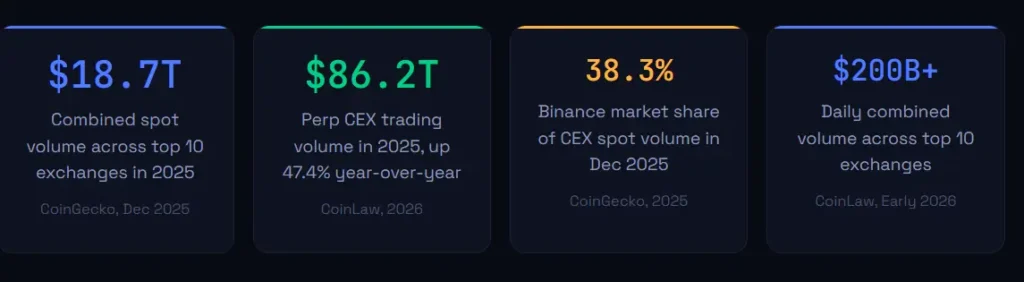
En 2025, les dix principales plateformes d'échange de cryptomonnaies centralisées ont traité un volume d'échanges au comptant combiné de 18 700 milliards de dollars. Binance, à elle seule, a traité 7 300 milliards de dollars via son système de mise en relation.
Derrière chaque transaction se cache un carnet d'ordres qui organise les échanges entre acheteurs et vendeurs. La maîtrise de ce mécanisme est indispensable à quiconque s'intéresse sérieusement au trading de cryptomonnaies ; elle est fondamentale.
Quels sont les éléments clés d'un carnet d'ordres de cryptomonnaies ?
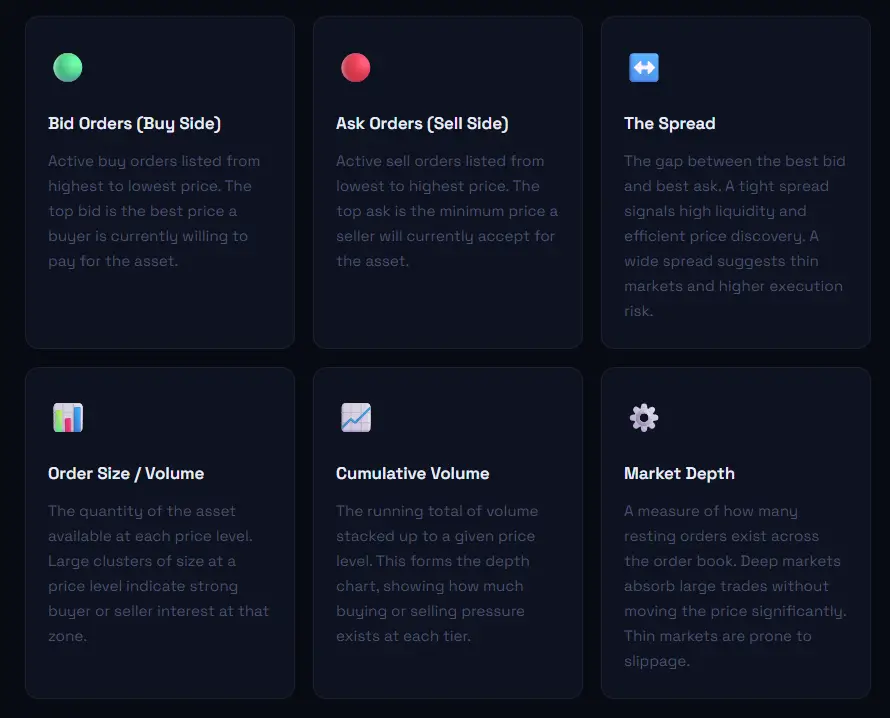
Avant de pouvoir utiliser efficacement un carnet d'ordres, il est essentiel de comprendre la signification de chaque colonne et de chaque ligne. La présentation varie légèrement d'une bourse à l'autre, mais les éléments de base restent les mêmes.
À quoi ressemble concrètement un carnet d'ordres de cryptomonnaies ?
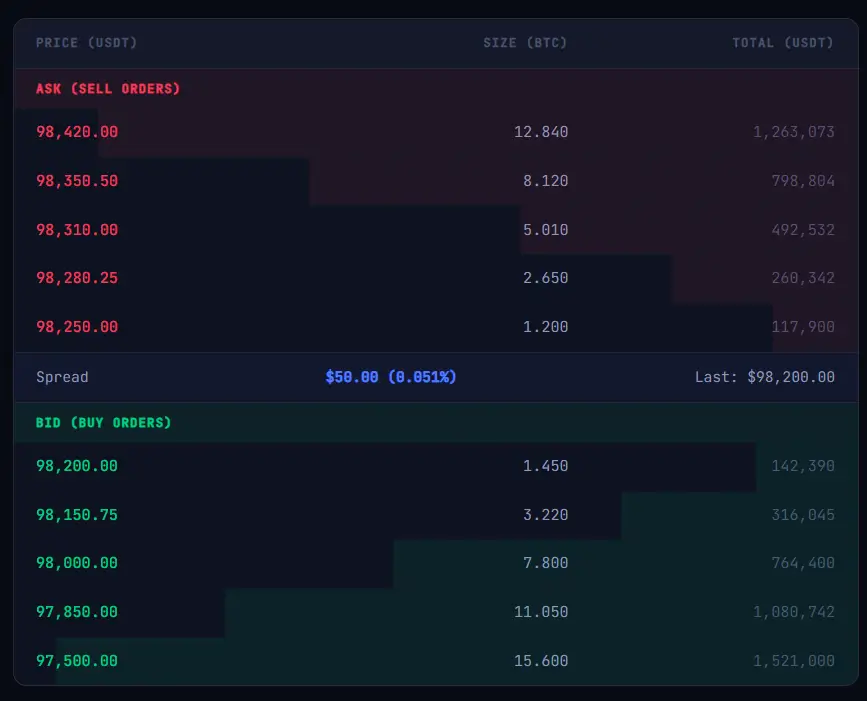
Voici un exemple simplifié de ce à quoi pourrait ressembler le carnet d'ordres BTC/USDT sur une plateforme d'échange majeure. Le prix de vente apparaît au-dessus du spread et le prix d'achat en dessous, bien que certaines plateformes inversent cet ordre.
Remarquez le grand nombre d'ordres d'achat qui s'accumulent à 97 500 $ et 97 850 $.
Les opérateurs interprètent ce type de concentration comme une zone de support potentielle, un niveau de prix où une demande importante pourrait empêcher de nouvelles baisses. À l'inverse, un fort regroupement de vendeurs aux alentours de 98 420 $ pourrait faire office de résistance à court terme.
Rejoignez l'UEEx
Découvrez la plateforme de gestion de patrimoine numérique leader au monde
Quelle est la différence entre un ordre au marché et un ordre à cours limité ?
Un ordre au marché est exécuté immédiatement au meilleur prix disponible dans le carnet d'ordres. Si vous passez un ordre d'achat au marché de 5 BTC, le système l'exécute en fonction des ordres de vente les moins chers disponibles : d'abord celui à 98 250 $, puis à 98 280 $, puis à 98 310 $, et ainsi de suite jusqu'à ce que votre ordre soit entièrement satisfait.
Si vous achetez en grande quantité sur un marché peu liquide, chaque niveau de prix atteint fait monter le prix d'exécution. C'est ce qu'on appelle le slippage , et c'est l'une des leçons les plus coûteuses que les traders apprennent.
Un ordre à cours limité, en revanche, est inscrit dans le carnet d'ordres au prix que vous spécifiez. Il n'est exécuté que si le prix du marché atteint ce niveau.
Un ordre d'achat à cours limité placé à 97 500 $ s'ajoute simplement à la file d'attente des ordres à ce niveau de prix et attend. Les ordres à cours limité ajoutent de la liquidité au carnet d'ordres. Les ordres au marché la consomment.
Cette distinction est à la base de la façon dont les bourses classent les makers (ordres à cours limité) et les takers (ordres au marché), et explique pourquoi les frais des maker sont généralement inférieurs à ceux des takers sur la plupart des plateformes.
Que sont les murs d'achat et les murs de vente dans le carnet d'ordres ?
Un mur d'achat est un ordre d'achat très important ou un groupe d'ordres d'achat à un niveau de prix spécifique, visible comme un bloc surdimensionné du côté des offres dans le carnet d'ordres.
Cela indique qu'un acteur majeur, souvent une institution ou un teneur de marché, est prêt à absorber une pression à la vente importante à ce prix.
Si les murs d'achat peuvent signaler un véritable soutien, les traders avertis surveillent également les murs qui disparaissent juste avant que le prix ne les atteigne, une tactique appelée manipulation d'ordres, que les régulateurs ont de plus en plus ciblée en 2025 dans le cadre de cadres élargis de lutte contre la manipulation de marché.
Un mur de vente est l'image inversée d'une forte concentration d'ordres de vente à un prix spécifique, créant ainsi une résistance. Lorsqu'un mur de vente est franchi, c'est-à-dire lorsque la pression acheteuse du marché absorbe toute l'offre à ce niveau, cela déclenche souvent une hausse rapide des prix à mesure que la résistance disparaît.
Comment se comparent les différents types de carnets d'ordres de cryptomonnaies ?
Les carnets d'ordres ne sont pas tous structurés de la même manière. Les différentes bourses et environnements de négociation utilisent des modèles différents, chacun présentant des caractéristiques distinctes qui influent sur la liquidité, la transparence et la qualité d'exécution.
La plupart des traders particuliers et institutionnels
Livre de commandes de niveau 3 (L3)
Coinbase, Bitso (natif)
Le plus profond
Complet (commande par commande)
Trading haute fréquence, algorithmique et quantitatif
Carnet de commandes agrégé
Plateformes multi-échange
Inter-lieux
Combiné à partir de sources multiples
Détection d'arbitrage, meilleure exécution
AMM (DEX)
Uniswap, Curve, Aérodrome
Pool-based
Sur la chaîne, transparent
Utilisateurs de DeFi, jetons à longue traîne
Hybride (CEX + AMM)
dYdX, Hyperliquid
Plantes en croissance
Correspondance partielle (hors chaîne)
Les négociants de contrats perpétuels recherchent une exécution décentralisée
Il convient de noter que les plateformes d'échange décentralisées (DEX) n'utilisent pas de carnets d'ordres traditionnels. Elles utilisent plutôt des protocoles de teneurs de marché automatisés (AMM), où les prix sont déterminés par une formule mathématique basée sur le ratio des actifs dans un pool de liquidités.
Les volumes mensuels des DEX sur des plateformes comme Uniswap ont atteint 86 milliards de dollars au quatrième trimestre 2025, mais le modèle du carnet d'ordres reste dominant pour les paires liquides à forte capitalisation sur les échanges centralisés.
Comment un trader peut-il lire un carnet d'ordres de cryptomonnaies ?
La lecture d'un carnet de commandes est une compétence qui demande de la pratique, mais le principe est simple.
Voici une procédure étape par étape pour extraire des informations pertinentes du carnet d'ordres de n'importe quelle bourse majeure.
1. Identifier la meilleure offre et la meilleure demande
Commencez par le haut de chaque côté. La meilleure offre correspond au prix le plus élevé qu'un acheteur est actuellement disposé à payer. La meilleure demande correspond au prix le plus bas qu'un vendeur est prêt à accepter.
L'écart entre ces deux cours est appelé spread, et sa valeur indique immédiatement la liquidité du marché. Un spread inférieur à 0.05 % sur une paire majeure comme BTC/USDT témoigne d'une excellente liquidité.
2. Rechercher les amas de grand volume
Faites défiler vers le bas du côté des offres et recherchez les niveaux de prix où la taille de l'ordre est nettement supérieure à celle des niveaux environnants.
Ces zones de regroupement servent souvent de supports, car un volume important d'achats doit être absorbé avant que le prix ne chute. Appliquez la même logique aux cours vendeurs pour identifier les résistances.
3. Évaluer la profondeur du marché avant de passer des ordres importants
Avant de prendre une position importante, calculez la profondeur du carnet d'ordres à votre prix cible.
Si vous souhaitez acheter 10 BTC et que le carnet d'ordres n'affiche que 3 BTC disponibles dans une fourchette de prix de 0.1 %, votre ordre au marché passera par plusieurs niveaux de prix.
Il est généralement préférable de diviser votre ordre en plusieurs ordres à cours limité plus petits, placés à différents niveaux de prix.
4. Suivez le flux des commandes en temps réel
Le carnet de commandes n'est pas une image fixe, c'est une vidéo en direct. Observez la rapidité avec laquelle les commandes importantes apparaissent et disparaissent.
Des ordres d'achat importants et soutenus, qui se maintiennent même lorsque le prix s'en approche, témoignent d'une demande réelle. Les ordres qui disparaissent avant que le prix ne soit atteint suscitent le scepticisme.
5. Recoupement avec l'historique commercial
La plupart des bourses affichent un journal des transactions à côté du carnet d'ordres, une liste chronologique des transactions récemment exécutées.
Si vous constatez l'apparition d'ordres d'achat importants dans le carnet d'ordres tandis que le flux de transactions montre simultanément d'importantes ventes atteignant les prix d'achat, les deux signaux racontent des histoires contradictoires.
Leur conciliation permet de dresser un tableau plus précis du véritable sentiment du marché.
« Chaque fois que le prix des cryptomonnaies augmente, les gens commencent à dépenser beaucoup plus. » — Erik Voorhees, fondateur de Shapeshift
Quelles bourses ont la plus grande liquidité de carnet d'ordres ?
La liquidité n'est pas répartie uniformément sur le marché des cryptomonnaies, et la qualité d'exécution dépend énormément de l'endroit où vous effectuez vos transactions.
Un rapport de liquidité de CoinGecko de 2025 analysant huit grandes plateformes d'échange a révélé des différences significatives de profondeur, même pour des paires majeures comme BTC/USDT et ETH/USDT.
Binance a dominé la liquidité du BTC à tous les niveaux de profondeur en 2025, détenant environ 8 millions de dollars de liquidités à la fois à l'achat et à la vente dans une fourchette de prix de 100 dollars autour du prix du marché.
Pour Ethereum, Bitget a détrôné Binance en tant que leader de la liquidité dans la fourchette de prix la plus étroite, bien que Binance ait réaffirmé sa domination à des niveaux de prix plus élevés.
Pour le XRP, la liquidité était concentrée sur Bitget, Binance et Coinbase, qui contrôlaient ensemble environ 67 % de la profondeur de marché disponible.
Rejoignez l'UEEx
Découvrez la plateforme de gestion de patrimoine numérique leader au monde
Pour les traders exécutant des ordres importants (de plus de 50 000 $ à 100 000 $ en valeur notionnelle), choisir une bourse avec une plus grande profondeur de marché n’est pas une préférence, mais une nécessité financière.
Un carnet d'ordres peu fourni signifie que votre ordre au marché traverse plusieurs niveaux de prix, ce qui produit un prix d'exécution moyen inférieur au prix affiché.
Ce coût est appelé impact sur les prix, et il est invisible pour les traders qui n'étudient pas la profondeur du carnet d'ordres avant de trader.
Rejoignez l'UEEx
Découvrez la plateforme de gestion de patrimoine numérique leader au monde
Risques liés au recours exclusif aux données du carnet de commandes
Bien que l’analyse du carnet de commandes puisse fournir des informations précieuses, il est important de reconnaître ses limites :
Ordres fictifs : Le spoofing ou le wash trading peuvent fausser l’image réelle du sentiment du marché, amenant les traders à prendre des décisions basées sur de fausses données.
Krachs éclairs : des mouvements de prix rapides et inattendus peuvent provoquer un afflux soudain d’ordres de marché, rendant difficile de se fier uniquement au carnet d’ordres pour la prise de décision.
Trading algorithmique : Les robots de trading haute fréquence peuvent exécuter des transactions plus rapidement que les traders humains, créant des mouvements artificiels dans le carnet d’ordres qui peuvent induire en erreur les traders manuels.
Notez que la fiabilité des carnets d'ordres de cryptomonnaies varie selon la plateforme ou la plateforme d'échange choisie, ainsi que selon votre stratégie de trading. Il est essentiel de comprendre que si les carnets d'ordres peuvent fournir des informations précieuses, le trading de cryptomonnaies comporte des risques inhérents.
Cependant, les carnets d'ordres ne sont qu'un outil parmi d'autres pour guider les décisions de trading. Pour prendre des décisions éclairées, il est recommandé de compléter les données des carnets d'ordres par d'autres ressources, telles que l'analyse technique et les tendances du marché.
La fiabilité d'un carnet d'ordres dépend de la réputation, de la liquidité et des mesures de sécurité de la plateforme d'échange qui l'héberge. Assurez-vous toujours d'utiliser une plateforme fiable pour limiter les risques.
Rejoignez l'UEEx
Découvrez la plateforme de gestion de patrimoine numérique leader au monde
Dans le monde du trading, on aime dire : « La tendance est votre amie », mais si vous voulez vraiment connaître la vérité brute, vous devez consulter le carnet d'ordres.
La plupart des traders particuliers s'enlisent à courir après des bougies en retard et des informations obsolètes, mais les professionnels savent mieux que quiconque.
Abeeb est un rédacteur de contenu axé sur les objectifs, fort de plus de 4 ans d'expérience dans la création de contenus captivants et pertinents dans divers genres, notamment la technologie, l'actualité, le divertissement et la blockchain. Reconnu pour sa capacité à tisser des liens solides avec ses clients et ses parties prenantes, Abeeb s'attache à produire des textes clairs, concis et percutants qui captivent son public.
Avertissement : Cet article est fourni à titre informatif uniquement et ne constitue en aucun cas un conseil en matière de transactions ou d’investissement. Les informations qu’il contient ne sauraient être interprétées comme des conseils financiers, juridiques ou fiscaux. Investir dans les cryptomonnaies comporte un risque important de perte financière. Il est impératif de toujours effectuer vos propres recherches avant de prendre toute décision d’investissement.
Transactions avec preuve de réserves
UEEx publie des audits mensuels et des vérifications par des tiers pour chaque marché coté.
Analyses de marché, stratégies de trading, informations sur les contrats à terme et alertes de sécurité, chaque semaine. Plus de 10 000 traders de cryptomonnaies lus par ces abonnés.