WordPress database di errore: [Si è verificato un errore nella sintassi SQL; consultare il manuale corrispondente alla versione del server MariaDB in uso per la sintassi corretta da utilizzare vicino a '' alla riga 1] SELECT * FROM wp_mica_ecta WHERE cta_id =
WordPress database di errore: [Si è verificato un errore nella sintassi SQL; consultare il manuale corrispondente alla versione del server MariaDB in uso per la sintassi corretta da utilizzare vicino a '' alla riga 1] SELECT * FROM wp_mica_ecta WHERE cta_id =
WordPress database di errore: [Si è verificato un errore nella sintassi SQL; consultare il manuale corrispondente alla versione del server MariaDB in uso per la sintassi corretta da utilizzare vicino a '' alla riga 1] SELECT * FROM wp_mica_ecta WHERE cta_id =
WordPress database di errore: [Si è verificato un errore nella sintassi SQL; consultare il manuale corrispondente alla versione del server MariaDB in uso per la sintassi corretta da utilizzare vicino a '' alla riga 1] SELECT * FROM wp_mica_ecta WHERE cta_id =
WordPress database di errore: [Si è verificato un errore nella sintassi SQL; consultare il manuale corrispondente alla versione del server MariaDB in uso per la sintassi corretta da utilizzare vicino a '' alla riga 1] SELECT * FROM wp_mica_ecta WHERE cta_id =
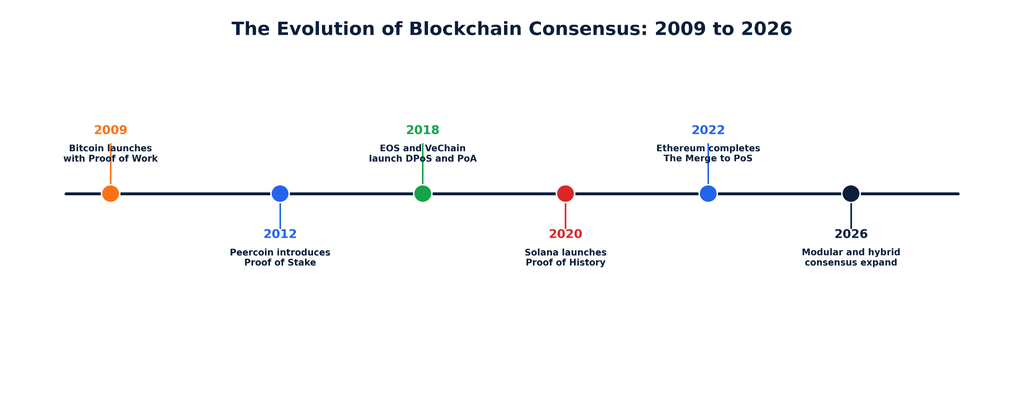
Ethereum’s 2022 Merge marked a major milestone, transitioning the network from Proof of Work (PoW) to Proof of Stake (PoS) and cutting energy consumption by over 99% without disrupting operations.
The event highlighted the importance of blockchain consensus mechanisms, which determine a network’s security, speed, cost, and level of decentralization. Today, different blockchains use different approaches to solve the same challenge of validating transactions.
Bitcoin continues to rely on PoW, Ethereum now uses PoS, Solana combines Proof of History (PoH) with PoS, while many enterprise blockchains adopt Byzantine Fault Tolerance (BFT) variants. Each consensus mechanism offers unique strengths and trade-offs depending on the network’s goals and design.
This guide walks through every major blockchain consensus mechanism in plain language, with real numbers, real examples, and a simple framework for picking the right one.
Non c'è alcuna Call To Action con l'ID #0.
Punti chiave
There is no perfect consensus mechanism. Every one of them trades off between security, speed, and decentralization.
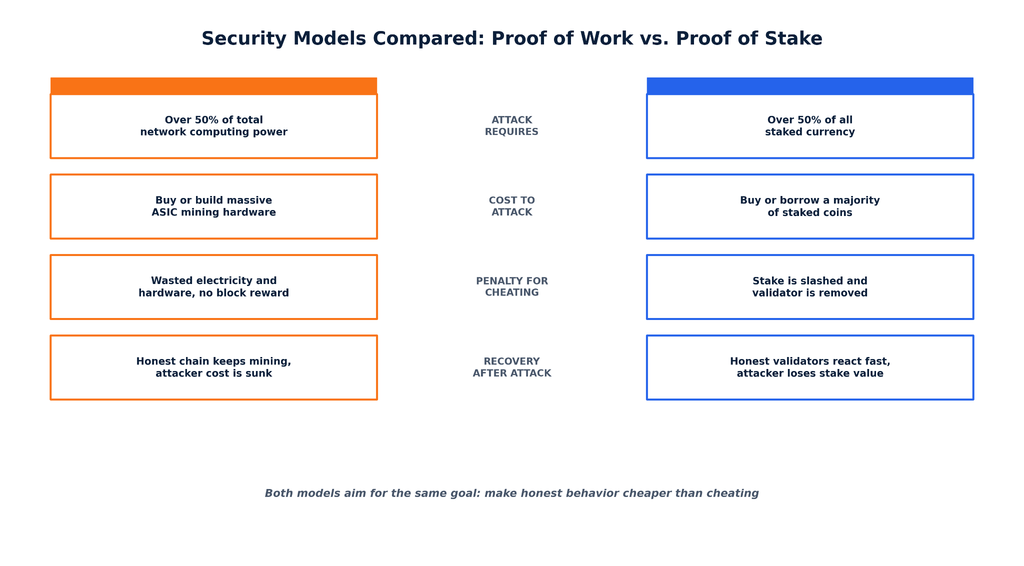
Proof of Work earns security through computing costs, while Proof of Stake earns it through financial cost. Both aim for the same goal: making cheating too expensive to bother with.
Energy use has become a real factor in adoption. Regulators and institutions increasingly favor low-energy models.
The right mechanism depends on the job. A store of value like Bitcoin needs battle-tested security. A DeFi platform needs speed and low fees, while an enterprise supply chain needs known, accountable validators.
The industry is moving toward modular designs, where consensus, transaction execution, and data storage are handled by separate, specialized layers instead of one blockchain doing everything.
What Is a Blockchain Consensus Mechanism?
A blockchain consensus mechanism is a set of rules that lets computers spread around the world agree on one shared record of transactions, without anyone in charge. It stops the same coin from being spent twice and keeps the network safe from attackers, using rewards and penalties instead of a central authority.
Bitcoin uses PoW, while Ethereum uses PoS. Many enterprise blockchains use Byzantine Fault Tolerance. Think of it like a group project with no teacher. Everyone needs to agree on the final answer, nobody can be trusted by default, and some people might try to cheat. Consensus mechanisms are the rulebook that makes agreement possible anyway.
If you’re new to how blockchains work at a basic level, our Fondamenti di Blockchain Guide is a good place to start before going deeper here.
Il problema dei generali bizantini
This whole field traces back to a thought experiment from the 1980s called the Byzantine Generals Problem. Picture several army generals surrounding a city, each one commanding a separate group of soldiers. They can only communicate by messenger, and some of those messengers, or even some of the generals, might be traitors sending false orders.
The generals need to agree on one plan, attack or retreat, even though they cannot fully trust every message they receive. This is exactly the problem a blockchain network faces. Thousands of computers, called nodes, need to agree on one version of the transaction history, even though some of those nodes might be run by bad actors trying to trick the rest.
A consensus mechanism is the tool that lets honest nodes reach agreement despite this, as long as the dishonest ones stay under a certain share of the network, usually below a third or a half depending on the design.
Core Objectives of Consensus Mechanisms
Every consensus mechanism, no matter how different it looks on paper, is built to hit four goals:
Accordo: Every honest computer on the network ends up with the same version of the ledger.
Validità: Only real, correctly signed transactions get added. No one can add fake ones.
Terminazione: The network reaches a decision in a reasonable amount of time, not never.
Tolleranza di errore: The system keeps working even if some computers crash, go offline, or actively try to cheat.
Why Consensus Mechanisms Matter
The consensus model a network picks shapes almost everything about it:
It removes the need for a bank, government, or company to sit in the middle and vouch for every transaction.
It decides who is allowed to help run the network. Public blockchains let anyone join, while private ones only allow approved parties.
It sets the pace. Some mechanisms confirm transactions in under a second, while others take minutes.
It determines how much electricity the network burns through, which has become a real regulatory issue. Rules like the EU’s MiCA framework now push blockchain operators to disclose their energy footprint.
A network’s consensus mechanism is really its constitution. Everything else, speed, cost, and who can join, gets written on top of that one foundational choice.
The Blockchain Trilemma: Why No System Gets Everything Right
Let’s explore what the blockchain trilemma is all about
Vitalik Buterin’s Trilemma Explained
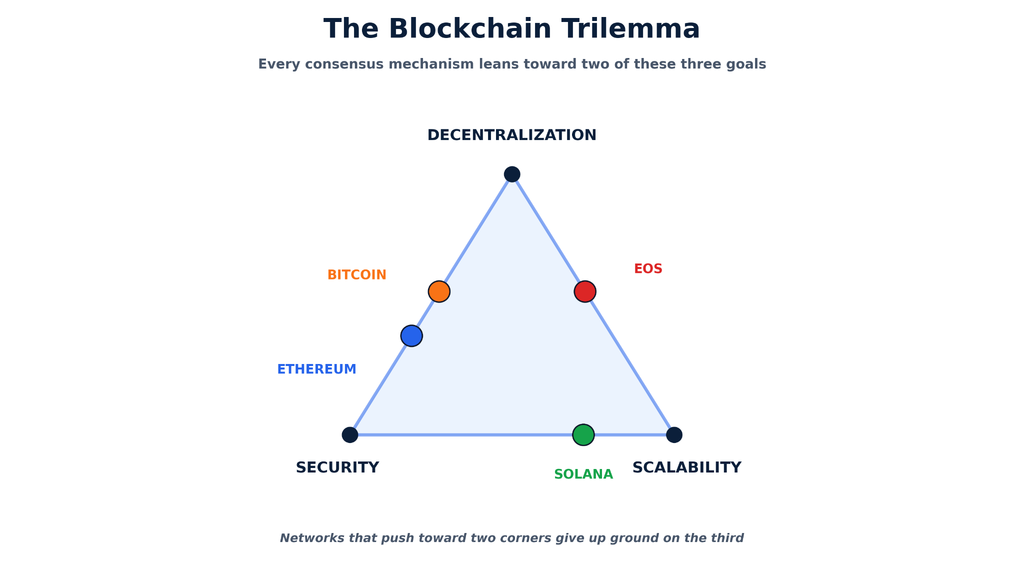
Ethereum co-founder Vitalik Buterin coined a term that anyone building or studying blockchains needs to know: the blockchain trilemma. It says a blockchain can be strong in two of these three areas but usually struggles with the third:
Decentramento: How spread out is control across many independent participants?
Sicurezza: How expensive and difficult is it to attack the network?
Scalabilità: How many transactions can the network handle, and how fast?
How Consensus Mechanisms Trade Off
No consensus mechanism in production today has fully solved all three at once. Here is how that plays out in the real world.
Bitcoin picks decentralization and security and gives up speed. Its Proof of Work model runs on tens of thousands of independent nodes and has never been successfully attacked in over fifteen years.
However, the cost is throughput. Bitcoin handles roughly 7 transactions per second on its base layer, which is why solutions like the Lightning Network exist to handle everyday payments off-chain.
Solana picks security and speed and gives up some decentralization. Its Proof of History design can process thousands of transactions per second with sub-second block times.
But running a validator takes serious hardware, which has shrunk the validator set. Independent trackers put Solana’s active validator count in the 800 to 1,600 range through 2026, down sharply from the 2,500-plus validators the network had in 2023.
Early Delegated Proof of Stake systems picked decentralization and speed and gave up some security. With only 21 to 100 block producers voted in by token holders, these networks move fast, but a small group of validators colluding is a real risk.
How Modern Networks Are Working Around the Trilemma
Scalabilità del livello 2: Instead of forcing the base blockchain to do everything, networks push transactions to a second layer that settles back to the main chain later. Our Soluzioni di scalabilità di livello 2 guide covers this in depth.
Modular blockchains: Projects like Celestia separate the job of ordering transactions from the job of executing them, letting each layer specialize.
sharding: Splitting the network into parallel pieces that each handle a portion of the transaction load.
Consenso ibrido: Combining two mechanisms, like Decred’s mix of Proof of Work and Proof of Stake, so an attacker has to beat both systems at once.
Very high (real-world throughput in the low thousands of TPS)
Scalabilità e sicurezza
Polkadot
Proof of Stake nominata
Alto
Alto
Alto
Approccio equilibrato
EOS
Prova legale delegata
Basso
Medio
Molto alto
Scalabilità e velocità
The 6 Major Consensus Mechanisms Explained
Below are the six major consensus mechanisms
1. Prova di lavoro (PoW)
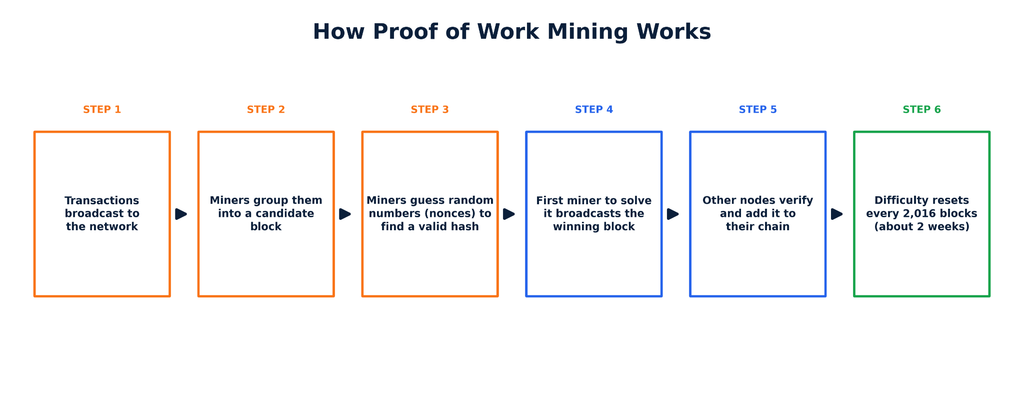
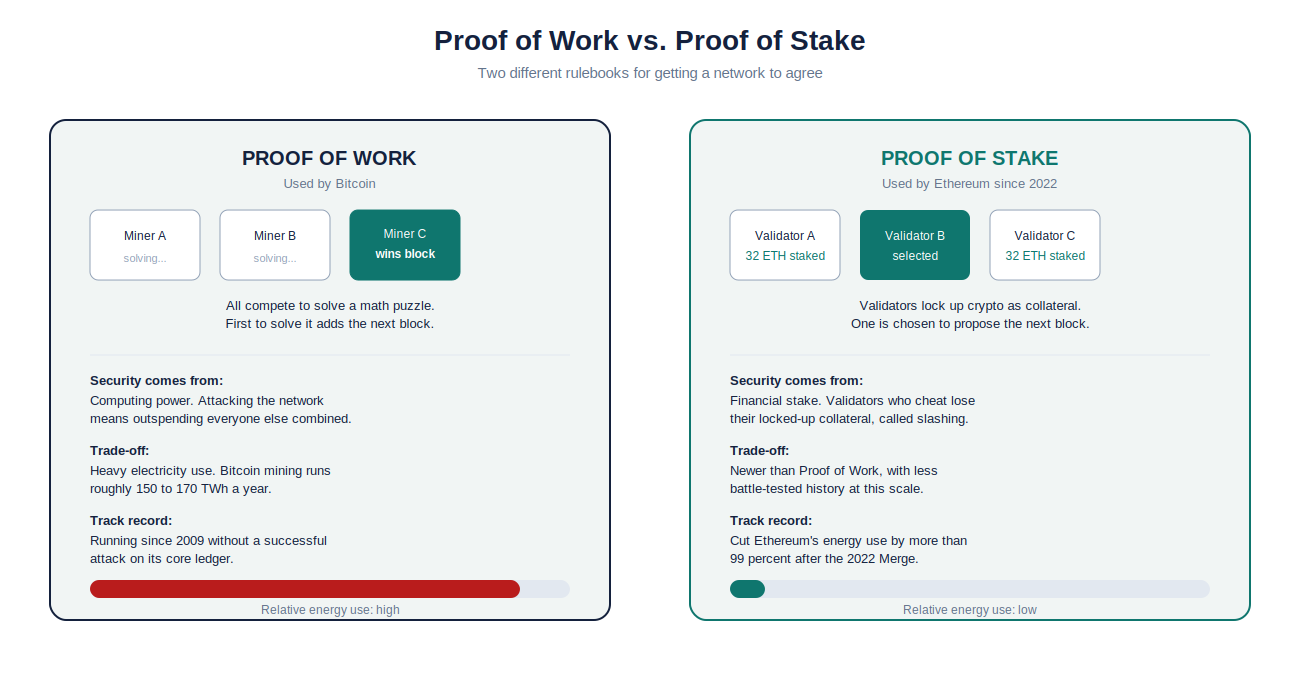
Come funziona: Miners race to solve a cryptographic puzzle by guessing random numbers, called nonces, until one produces a hash below a target value. Whoever finds it first gets to add the next block and collects the reward. The network automatically adjusts how hard that puzzle is every 2,016 blocks, roughly every two weeks, to keep new blocks arriving about every 10 minutes.
Non c'è alcuna Call To Action con l'ID #0.
Esempio del mondo reale:
Bitcoin: Launched by Satoshi Nakamoto in January 2009, Bitcoin remains the largest and most battle-tested Proof of Work network.
Its hash rate, a measure of total computing power securing the chain, has climbed to roughly 850 to 900 exahashes per second through September 2026, an all-time high, even as mining difficulty adjusted upward to match it.
The current block reward sits at 3.125 BTC following the 2024 halving, on top of transaction fees. According to the Indice di consumo di elettricità di Cambridge Bitcoin, Bitcoin’s annual energy use is comparable to that of a mid-sized country.
vantaggi:
Proven security over more than 15 years with no successful network-level attack
Truly permissionless; anyone with hardware and electricity can mine
No theoretical weaknesses around validators having “nothing at stake”
svantaggi:
Heavy energy use draws regulatory and public criticism
Mining has concentrated into large pools and regions with cheap electricity
Low throughput and slower confirmation times compared to newer designs
Chi lo usa: Bitcoin, Litecoin, Bitcoin Cash, Monero, Ethereum Classic. For more on how mining actually works, see our Cryptocurrency Mining Explained guida.
2. Prova di partecipazione (PoS)
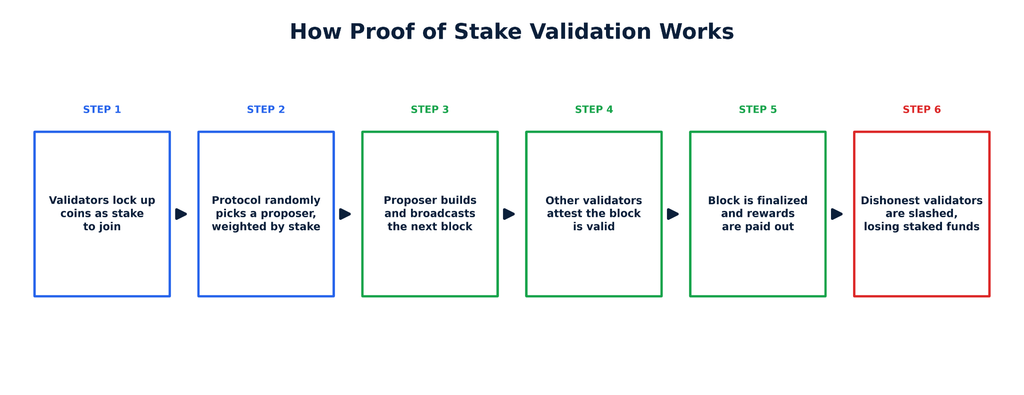
Come funziona: Instead of competing with computing power, validators lock up, or “stake,” their own cryptocurrency as collateral. The network randomly picks a validator to propose the next block, weighted by how much they have staked, and other validators check the block is valid. Validators earn rewards for honest work and can lose part of their stake, a penalty called slashing, for cheating or going offline too often.
Esempio del mondo reale:
Ethereum: Ethereum completed its move from Proof of Work to Proof of Stake on September 15, 2022, an upgrade known as The Merge. That single change cut the network’s energy consumption by more than 99%. By September 2026, Ethereum has somewhere between 880,000 and 1 million active validators, staking over 30% of all circulating ETH, following the Pectra upgrade that let large stakers consolidate multiple validators into fewer accounts.
Ethereum’s design combines two systems, Casper FFG for finality and LMD-GHOST for choosing the correct chain, together known as Gasper. You can read the technical breakdown directly on Ethereum.org’s consensus mechanism documentation.
Variations of Proof of Stake:
Pure PoS: Algorand, where proposers are chosen at random
Nominated PoS: Polkadot, where token holders back validators they trust
Liquid PoS: Tezos, which allows delegation without locking funds
Bonded PoS: Cosmos, which uses a waiting period before unstaked funds are released
vantaggi:
Cuts energy use by well over 99% compared to Proof of Work
No specialized mining hardware needed
Finality, meaning transactions become permanent, happens in seconds to minutes rather than hours
svantaggi:
Larger holders can compound their advantage over time
Requires careful design to keep large staking pools from centralizing power
Newer than Proof of Work, so it has less long-term track record
Chi lo usa: Ethereum, Cardano, Polkadot, Cosmos, Algorand, Tezos.
3. Proof of Stake delegata (DPoS)
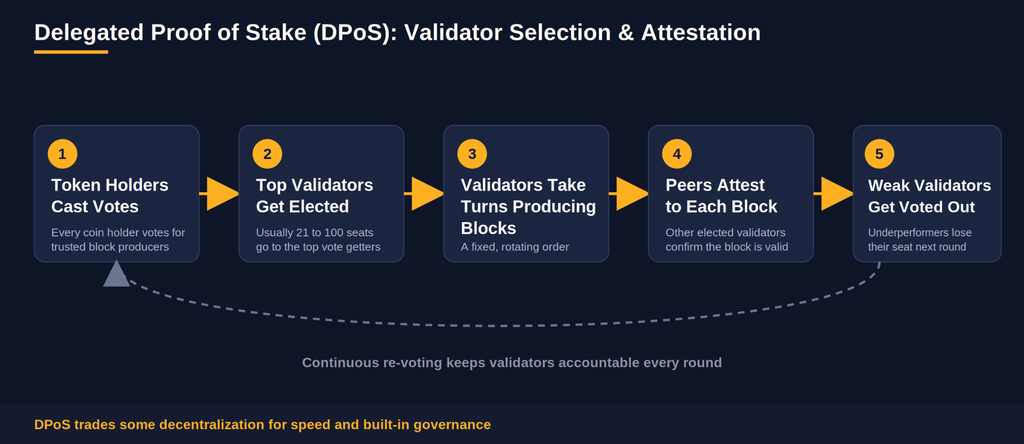
Come funziona: Instead of every token holder validating directly, they vote for a small number of trusted block producers, often between 21 and 100. Those elected validators take turns producing blocks. Poor performers can be voted out at any time.
Esempio del mondo reale:
EOS: Launched in 2018, EOS uses 21 active block producers with block times around half a second, giving it a theoretical capacity of thousands of transactions per second. The trade-off showed up quickly. Voter turnout was often low, which let a handful of large stakeholders steer the network, and in 2019 concerns arose about a concentration of voting power among a few large mining pools.
vantaggi:
Very high throughput and fast confirmation times
Basso consumo energetico
Governance is built directly into the consensus process
svantaggi:
Centralization risk since only a small set of validators are active at once
Low voter turnout can let a few whales control outcomes
Vote buying and validator collusion are ongoing concerns
Chi lo usa: EOS, Tron, Lisk, BitShares.
4. Practical Byzantine Fault Tolerance (PBFT)
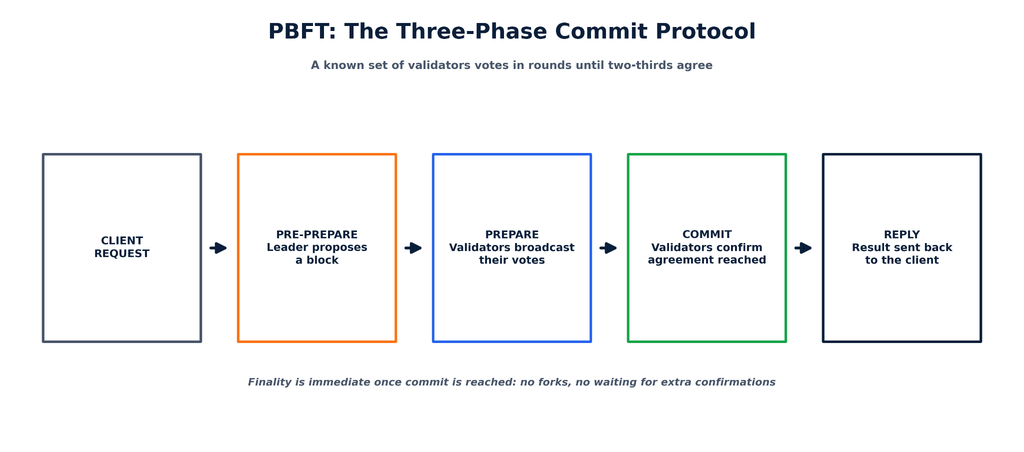
Come funziona: A known, fixed group of validators votes on each block through three rounds of messaging: pre-prepare, prepare, and commit. As long as fewer than one third of the validators are dishonest, the network keeps agreeing correctly, and once a block is committed, it is final immediately. No waiting for extra confirmations.
Esempio del mondo reale:
Tessuto Hyperledger: Used widely in enterprise settings such as supply chain tracking for IBM Food Trust and Walmart’s food traceability system, Hyperledger Fabric networks typically run with a small number of known validators, often between 4 and 20, and can hit throughput above 3,000 transactions per second in optimized setups.
vantaggi:
Instant, deterministic finality with no forks
High throughput when the validator set stays small
Energy efficient and well suited to regulated industries
svantaggi:
Requires a permissioned setup with known identities, so it isn’t censorship resistant
Communication overhead grows quickly as more validators are added
A compromised leader validator can be a single point of failure
Chi lo usa: Hyperledger Fabric, Zilliqa, and Tendermint-based chains, including Cosmos.
5. Prova della storia (PoH)
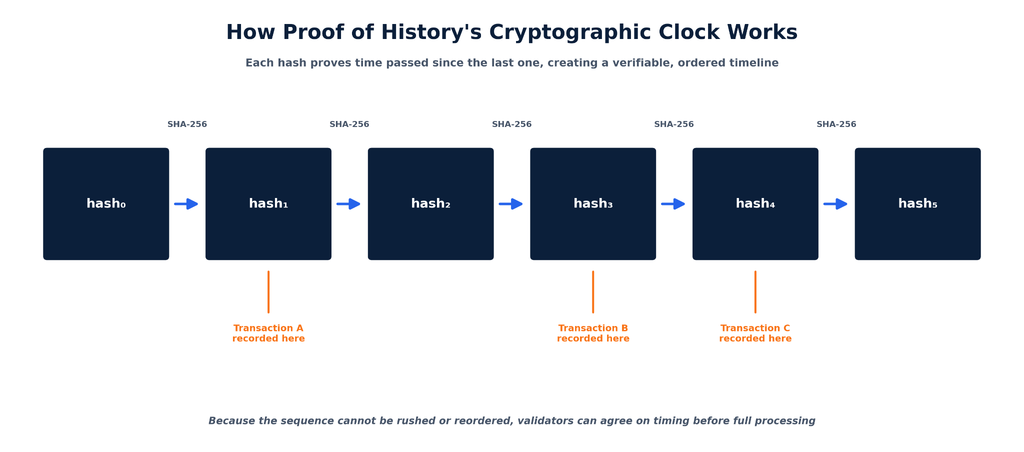
Come funziona: This is less a full consensus mechanism on its own and more a clock. It creates a chain of hashes where each one proves that a certain amount of time passed before the next was created.
Because that sequence can’t be rushed or skipped, validators can agree on the order of events before they even finish processing them, which allows much of the network’s work to happen in parallel. Solana pairs this timing system with PoS to handle actual security.
Esempio del mondo reale:
Solarium: Launched in March 2020, Solana advertises a theoretical peak of 65,000 transactions per second, though real, sustained throughput excluding validator vote traffic typically runs in the low thousands, based on multiple independent trackers through 2026. Meanwhile, block times sit around 400 milliseconds.
The trade-off for that speed is hardware. Running a competitive validator now calls for high core count processors and hundreds of gigabytes of memory, which is part of why Solana’s validator count has fallen from roughly 2,500 in 2023 to under 1,600 by 2026. You can read Solana’s technical design directly in the Documentazione Solana.
vantaggi:
Very high theoretical throughput and low latency
Efficient parallel transaction processing
Energy use stays low since security still comes from Proof of Stake
svantaggi:
High hardware requirements push out smaller, independent validators
The network has experienced multiple outages in years past tied to consensus and resource issues
Still newer and less proven than Bitcoin or Ethereum’s models
Chi lo usa: Solana is the primary large-scale implementation of Proof of History.
6. Prova di autorità (PoA)
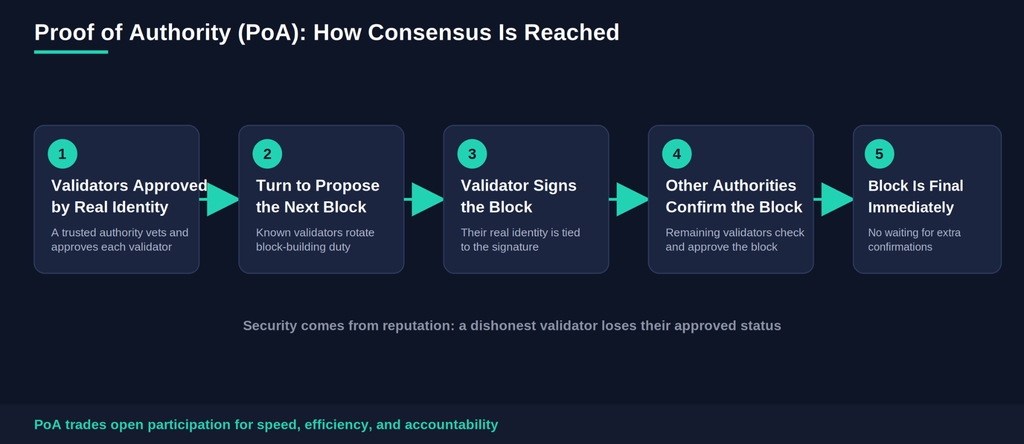
Come funziona: A small, pre-approved group of validators, chosen by identity and reputation rather than stake or computing power, takes turns producing blocks. Because their real-world identity is tied to their role, they have a reputation to lose if they act dishonestly, which serves as the security incentive.
Esempio del mondo reale:
VeChain: Launched in 2018 and used for supply chain tracking with partners like Walmart China and BMW, VeChain runs on a set of around 101 known authority masternodes approved by the VeChain Foundation, giving it high throughput and instant finality.
vantaggi:
Very high throughput with immediate finality
Energia efficiente
Well suited for compliance-heavy use cases where accountability matters
svantaggi:
Centralized by design, since validators are pre-approved
Requires trust in the organization selecting validators
Not resistant to censorship in the way public, permissionless chains are
Chi lo usa: VeChain, POA Network, and various private Ethereum-based networks.
Non c'è alcuna Call To Action con l'ID #0.
Advanced and Hybrid Consensus Mechanisms
Beyond the six core models, a few newer designs are worth knowing.
Consenso valanghe
This mechanism works through repeated random sampling. Each node asks a small, random group of peers what they believe and adopts the majority answer once enough rounds agree. This lets the Avalanche network reach finality in one to two seconds while scaling smoothly as more nodes join.
Prova di spazio
This mechanism is used by Chia Network and has “farmers” allocate spare hard drive space instead of burning electricity on computation. It cuts energy use dramatically compared to Proof of Work, though it shifts the resource cost onto storage hardware instead.
Hybrid Proof of Work plus Proof of Stake
This mechanism is used by Decred; it has miners produce blocks the traditional way, then has stakeholders vote to approve or reject those blocks. An attacker would need to overpower both systems at once, which raises the cost of any attack significantly.
The next generation of consensus design isn’t about picking one mechanism and forcing it to do everything. It’s about splitting the job up so each layer can specialize in what it does best.
Tabella comparativa estesa
Meccanismo
Uso di energia
Decentramento
Throughput
Finalità
Il più adatto
Prova di lavoro
Molto alto
Alto
Basso
probabilistico
Public, permissionless networks
Proof of Stake
Basso
Media altezza
Medio
Economic
Public networks focused on efficiency
Prova legale delegata
Basso
Basso-medio
Alto
Connessione
Governance-driven networks
PBFT
Molto basso
Basso
Alto
Immediato
Enterprise and private networks
Prova della storia
Basso
Medio
Molto alto
Connessione
Applicazioni ad alta velocità
Prova di autorità
Molto basso
Molto basso
Molto alto
Immediato
Consortium and private networks
How to Choose a Consensus Mechanism
If you’re evaluating consensus models for a project, or just trying to understand why a network you use works the way it does, this framework helps.
Step 1: Define what you actually need.
Public or private network?
How many transactions per second do you realistically need, not just want?
Do you need instant finality, or is probabilistic finality acceptable?
Are there energy or ESG requirements you need to meet?
How much do you care about censorship resistance and decentralization?
Step 2: Look at the security model.
What would it actually cost an attacker to take over the network?
Proof of Work needs control of the majority of computing power. Proof of Stake needs control of the majority of staked value. Permissioned systems need control of a majority of known validators.
Step 3: Weigh the operational reality.
What hardware does a validator need?
How many validators does the network realistically have?
Is governance handled on-chain or off-chain through community discussion?
Matrice decisionale
Usa caso
Recommended Consensus
Perché
Digital gold or long-term store of value
Prova di lavoro
Longest track record, highest attack cost
General-purpose smart contract platform
Proof of Stake
Balance of security, speed, and efficiency
High-speed trading, gaming, or NFTs
Proof of History or DPoS
Prioritizes raw throughput
Enterprise supply chain or private consortium
PBFT or PoA
Immediate finality with known participants
Governance-heavy community project
DPOS
Voting is built into the consensus layer
Sustainability-focused project
Proof of Stake or PoA
Lowest energy footprint
If you’re building anything in DeFi on top of these networks, it’s worth pairing your consensus choice with strong operational practices.
Energy Consumption and the Environment in 2026
Energy has become one of the biggest factors in how consensus mechanisms are judged, both by regulators and by everyday users.
Energy Consumption by Consensus Mechanism
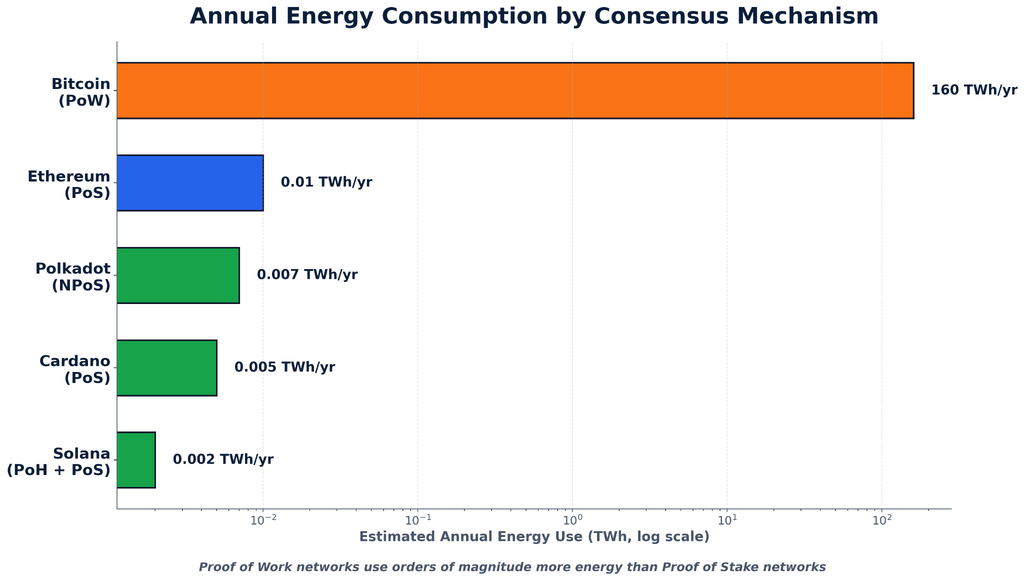
Bitcoin’s Proof-of-Work remains the most energy-intensive consensus model, consuming an estimated 160 TWh of electricity annually, comparable to the power usage of a mid-sized country.
Although a Bitcoin transaction is often estimated to consume around 1,700 kWh, this figure is frequently debated because mining secures the entire blockchain rather than individual transactions.
The industry’s energy mix is also becoming cleaner. Recent i dati del settore mostrano that more than half of Bitcoin mining now relies on zero-emission energy sources, including renewables and nuclear power, as miners continue relocating to regions with abundant low-cost renewable energy.
Ethereum (Proof-of-Stake)
In contrast, Ethereum’s transition to Proof-of-Stake reduced its electricity consumption by approximately 99.95%, bringing annual usage down to around 0.01 TWh. Each transaction consumes only about 0.02 kWh, making Ethereum one of the most energy-efficient major blockchains.
Other PoS-based networks perform similarly well. Cardano consumes roughly 0.005 TWh annually, Polkadot around 0.007 TWh, and Solana’s hybrid Proof-of-History and Proof-of-Stake mechanism uses only about 1,500 MWh per year. This places it among the industry’s most energy-efficient blockchain networks.
ESG and Regulatory Pressure
Environmental performance is becoming an increasingly important factor for regulators and institutional investors. The I mercati delle criptovalute (MiCA) dell'Unione Europea framework requires sustainability disclosures for crypto-assets, encouraging greater transparency around blockchain’s energy consumption.
At the same time, many large enterprises, including Microsoft and IBM, continue to favor PoS and permissioned blockchain networks because they better align with corporate sustainability and ESG objectives.
Non c'è alcuna Call To Action con l'ID #0.
Counterarguments to Proof-of-Work Energy Criticism
Despite criticism, PoW supporters argue that Bitcoin mining also provides measurable benefits:
Bilanciamento della rete: Miners can rapidly reduce electricity consumption during peak demand, helping stabilize power grids.
Utilizing stranded energy: Mining increasingly uses excess hydropower, flared natural gas, and other energy sources that would otherwise go to waste.
Renewable energy incentives: Constant demand for inexpensive electricity encourages investment in renewable generation and improves project economics.
Security through energy: PoW’s energy consumption is considered a security feature, making attacks on the network prohibitively expensive by anchoring blockchain security to real-world energy costs.
Future Trends and Innovations in Blockchain Consensus
Below are the future trends to look forward to concerning blockchain consensus mechanisms
1. Quantum-Resistant Security
Quantum computing poses a long-term challenge to blockchain security because powerful quantum computers could eventually break the Elliptic Curve Digital Signature Algorithm (ECDSA), a cryptographic method used to generate digital signatures, using L'algoritmo di Shor. While experts believe cryptographically relevant quantum computers are still years away, the blockchain industry is already preparing.
Gli sviluppi chiave includono:
Crittografia post-quantistica (PQC) using lattice-based and hash-based signature schemes.
NIST finalized its first PQC standards in 2024 and continues expanding the standardization process with additional algorithms such as HQC.
Migliori Ethereum Foundation launched a dedicated post-quantum security team in 2026 and is targeting a gradual migration toward quantum-safe cryptography by around 2029.
2. AI-Powered Consensus
Artificial intelligence is becoming an important tool for improving blockchain efficiency without replacing decentralized consensus.
Le potenziali applicazioni includono:
Smarter validator selection that optimizes network performance.
Rilevamento anomalie in tempo reale to identify malicious validators and suspicious transactions.
Predictive network monitoring that reduces downtime and congestion.
However, developers must ensure AI models remain decentralized to avoid introducing new centralization risks.
3. Modular Blockchain Architecture
Modern blockchain networks increasingly separate consensus, execution, and data availability into specialized layers rather than combining everything into one chain.
Gli esempi includono:
Celestia for consensus and data availability.
Carburante per l'esecuzione.
Ethereum come strato di insediamento.
This modular approach improves scalability, lowers costs, and allows each layer to evolve independently.
4. Cross-Chain Consensus
As the blockchain ecosystem expands, secure interoperability is becoming essential. Cross-chain consensus enables assets and data to move smoothly between independent networks.
Le principali innovazioni includono:
Cosmo IBC for blockchain communication.
Polkadot’s shared security model through parachains.
Swap atomici for trustless cross-chain asset exchanges.
Together, these technologies are laying the foundation for a more connected, scalable, and secure multi-chain ecosystem.
Non c'è alcuna Call To Action con l'ID #0.
Conclusione
Consensus mechanisms remain the foundation of blockchain security, but 2026 shows there is no universal winner.
Bitcoin continues to rely on Proof-of-Work for reliable, permissionless security, while Ethereum’s Proof-of-Stake demonstrates how networks can dramatically reduce energy use, cutting consumption by about 99.95% since the Merge.
Instead of solving the blockchain trilemma with one mechanism, the industry is taking a more specialized approach. Layer 1 networks focus on security and decentralization, while Layer 2s and modular architectures handle scalability and throughput.
Proof-of-Stake has become the most widely observed consensus model, but PoW and hybrid designs remain relevant for different use cases.
Domande frequenti
What is the most secure consensus mechanism?
Bitcoin’s PoW has the longest, most tested track record of any consensus mechanism, having run without a successful network-level attack since 2009. Meanwhile, security in Proof of Stake networks like Ethereum comes from economic cost instead of computing cost and is considered comparably strong, though with a shorter real-world history.
Why did Ethereum switch from Proof of Work to Proof of Stake?
Ethereum moved to Proof of Stake in September 2022 mainly to cut energy use, which dropped by more than 99%, while also improving long-term scalability options and removing the need for specialized mining hardware.
Can Proof of Stake be as secure as Proof of Work?
Yes, in a different way. PoW makes attacks expensive by requiring huge amounts of computing power. PoS makes attacks expensive by requiring huge amounts of staked currency, plus the threat of losing that stake through slashing if a validator misbehaves. Both aim to make honest behavior the cheaper option.
Do all blockchains need a consensus mechanism?
Any blockchain with more than one participant validating transactions needs some form of consensus to keep everyone’s copy of the ledger in agreement. A single-node private database technically doesn’t need one, but at that point it isn’t really functioning as a blockchain in the way the term is normally used.
Disclaimer: This article is for educational purposes only and does not constitute financial, legal, or investment advice. Blockchain and cryptocurrency markets are volatile and carry real risk, including total loss of funds. Always do your own research and consult a licensed professional before making financial decisions.
Disclaimer : Questo articolo ha scopo puramente informativo e non deve essere considerato un consiglio di trading o di investimento. Nulla di quanto contenuto nel presente documento deve essere interpretato come consulenza finanziaria, legale o fiscale. Il trading o l'investimento in criptovalute comporta un considerevole rischio di perdita finanziaria. Effettuate sempre le dovute verifiche prima di prendere qualsiasi decisione di trading o di investimento.
Scambi commerciali con prova delle riserve
UEEx pubblica audit mensili e verifiche di terze parti su ogni mercato quotato.
Analisi di mercato, strategie di trading, approfondimenti sui future e avvisi di sicurezza, consegnati settimanalmente. Letto da oltre 10,000 trader di criptovalute.
Niente spam. Puoi disiscriverti in qualsiasi momento.