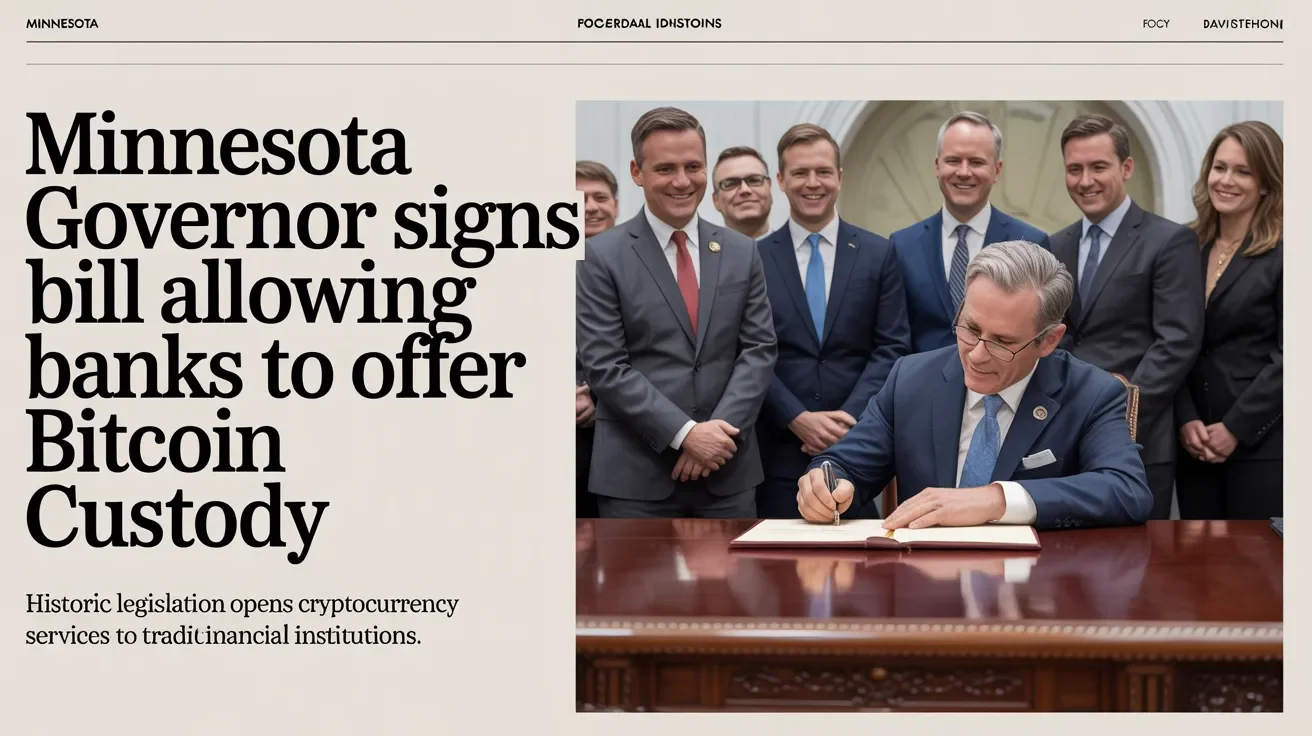
Minnesota Governor Tim Walz has signed a new law allowing state chartered banks and credit unions to provide Bitcoin and digital asset custody services, adding another U.S. state to the growing list of jurisdictions opening the door for regulated crypto banking services.
The legislation, House File 3709, takes effect on Aug. 1, 2026, and gives financial institutions legal authority to hold cryptocurrencies and private cryptographic keys on behalf of customers. The move is designed to provide a regulated framework for digital asset storage while giving traditional financial institutions a clearer path into the crypto sector.
Under the law, banks and credit unions can safeguard virtual currencies, manage private keys, and work with third party custodians if customer assets remain legally separated from the institution’s own holdings. Institutions must also notify the Minnesota Commissioner of Commerce at least 60 days before launching custody services.
Minnesota se junta a estados como Wyoming, Nova York, Nebraska e Virgínia no estabelecimento de estruturas legais para a custódia de criptomoedas por meio de instituições financeiras regulamentadas.
Principal Takeaway
- Minnesota signed a new law allowing state-chartered banks and credit unions to offer Bitcoin and crypto custody services starting August 2026.
- The law lets institutions hold digital assets and private keys for customers under state supervision.
- Banks can use third-party custodians but must keep customer assets separate from company holdings.
- The framework requires cybersecurity, risk management, and compliance policies before launch.
- Critics say the law’s nonfiduciary structure could limit customer protections if assets are lost or hacked.
Why the Nonfiduciary Structure Matters
One of the most closely watched parts of the legislation is its nonfiduciary structure. The law allows banks and credit unions to provide custody services without assuming full fiduciary responsibility over customer assets.
That distinction could significantly limit institutional liability in cases involving hacks, lost keys, frozen funds, or operational failures. Supporters of the bill argue that reduced liability exposure makes it easier for banks to enter the crypto custody market without taking on risks that many institutions still consider difficult to manage.
Critics, however, say the structure could leave customers with fewer protections compared to traditional fiduciary arrangements. While the law requires institutions to maintain written policies and compliance programs, some industry observers argue that operational safeguards are not the same as direct legal accountability.
Rep. Bernie Perryman, one of the bill’s lead sponsors, said the legislation is intended to prevent Minnesotans from relying on offshore or unregulated crypto platforms for custody services.
“For too long, credit unions and community banks in Minnesota have been operating in a regulatory gray zone where the absence of clear guidance was itself a barrier to action,” said Chase Larson of St. Cloud Financial Credit Union.
Banks Must Meet Compliance and Cybersecurity Standards
Financial institutions offering custody services will still face a range of compliance obligations under the new law.
A legislação exige políticas escritas que abranjam segurança cibernética, gestão de riscos, controles internos, procedimentos de resposta a emergências e conformidade regulatória antes do lançamento de produtos de custódia.
Customer assets must also remain operationally and legally segregated from institutional funds. Banks and credit unions cannot treat customer crypto holdings as their own property.
The rules are designed to address one of the biggest concerns in crypto custody: private key security. Private keys act as ownership credentials for Ativos digitais, and losing them can permanently lock users out of their funds.
St. Cloud Financial Credit Union had already begun offering digital asset custody before the law officially passed. The institution launched its CU-Digital Asset Vault earlier this year and said members currently custody approximately 13.5 BTC through the platform.
A infraestrutura de custódia opera por meio de um modelo de guarda colaborativa, no qual nenhuma das partes controla de forma independente os ativos do cliente.
Traditional Finance Pushes Deeper Into Crypto Custody
Minnesota’s legislation arrives as banks, asset managers, and crypto firms continue expanding into digital asset custody and settlement services.
At the federal level, crypto companies including Kraken parent company Payward have sought national trust charters from the Office of the Comptroller of the Currency to provide institutional custody services. The Office of the Comptroller of the Currency has also reaffirmed that crypto custody is a permissible activity for national banks, helping reduce uncertainty around institutional participation in the sector.
The broader custody market has become increasingly important following the rapid growth of spot Bitcoin ETFs and rising institutional demand for secure storage solutions. Traditional financial institutions are now competing with crypto-native firms for custody market share, particularly among institutional investors seeking regulated service providers.
Minnesota’s approach differs from states such as Wyoming, which created specialized banco de criptografia charters. Instead, the new framework focuses on allowing existing banks and credit unions to expand their services under state oversight.
The law could also strengthen competition among regional financial institutions looking to retain customers interested in digital assets without forcing them toward external trocas de criptografia.
The Real Test Begins After August 1
While the legislation creates a legal pathway for crypto custody, it does not require banks or credit unions to launch services. The next phase will depend on whether institutions believe there is enough customer demand to justify the operational, cybersecurity, and compliance costs tied to digital asset custody.
Os participantes do setor estarão acompanhando de perto para ver quais instituições notificarão primeiro os órgãos reguladores estaduais e quais tipos de produtos de custódia surgirão após a entrada em vigor da lei em agosto.
Caso a adoção ganhe força, Minnesota poderá se tornar mais um exemplo de como a legislação estadual está moldando a integração do Bitcoin e dos ativos digitais ao sistema bancário tradicional.
Artigos relacionados:
- Shiba Inu SHIB registra perdas apesar de alta de 144% na métrica otimista
- Genesis concorda com acordo de US$ 2 bilhões em caso de fraude do "Programa Gemini Earn"
- O Sandbox dá as boas-vindas à Kantana para construir o futuro do entretenimento no Metaverso
- Metaplanet aumenta investimentos em Bitcoin com nova compra de US$ 1.2 milhão, ações sobem 21%
- Relatório DappRadar: dApps baseados em IA superam jogos blockchain em participação de mercado Web3