权益证明(PoS)是一种区块链共识机制,它根据验证者锁定的加密货币数量(称为权益)而不是他们消耗的计算能量来选择验证者创建和确认新区块。 This design slashes energy consumption by over 99% compared to Proof of Work, lowers the hardware barrier to participation, and aligns validator incentives with network health through automatic financial penalties for dishonest behavior. As of Q1 2026, over 35.8 million ETH is staked on the Ethereum network alone, with more than 1.1 million active validators securing a system whose economic security exceeds $100 billion.
什么是权益证明?它与工作量证明有何不同?

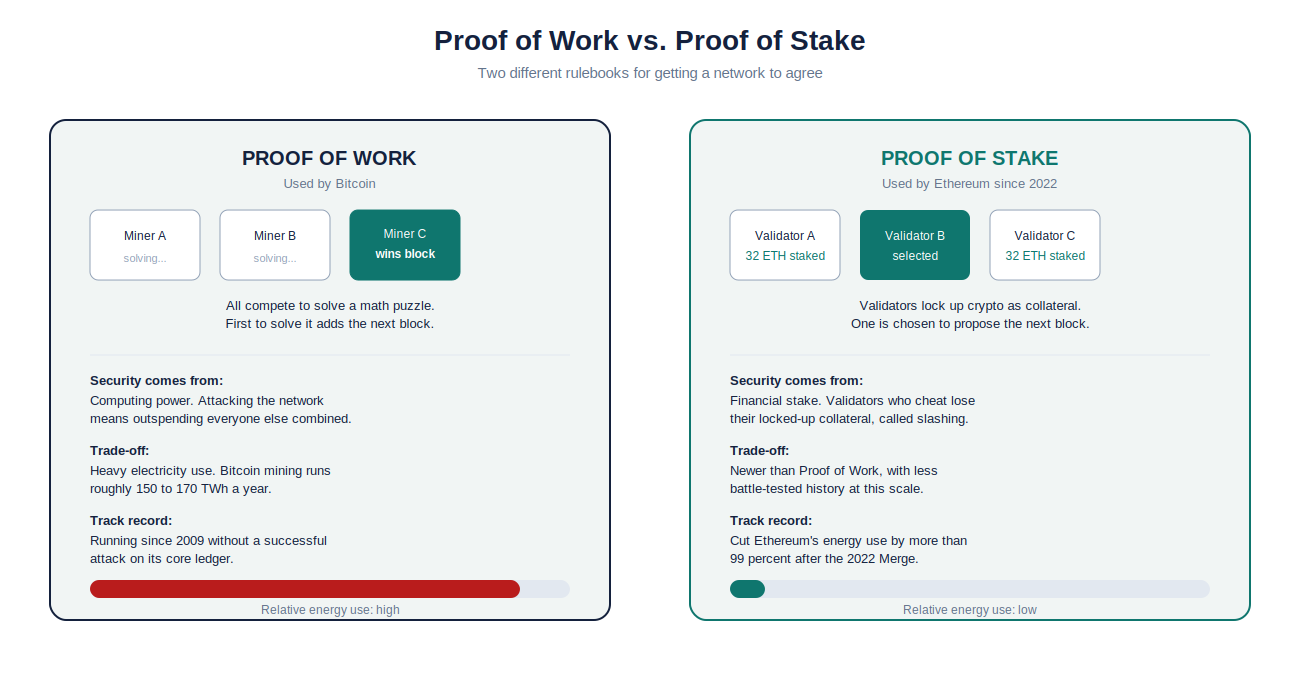
区块链需要一种方法,让独立的节点在不信任中央机构的情况下,就哪些交易有效达成一致意见。 工作证明(PoW), used by Bitcoin, achieves this by requiring nodes to burn electricity solving cryptographic puzzles. The node that solves the puzzle first earns the right to add the next block and collect the reward.
Proof of Stake replaces computational competition with economic commitment. Participants lock a defined amount of cryptocurrency into a smart contract – their stake – and the protocol uses a weighted random selection process to choose which validator proposes the next block. Other validators then attest to the block’s validity. Stake size influences selection probability, but most modern PoS implementations add randomization and committee structures to prevent a pure wealth-dominance dynamic.
The practical difference in energy use is enormous. As of 2026, major PoW networks collectively consumed an estimated 97,100 GWh of electricity annually, while comparable PoS systems used roughly 500 GWh – a greater-than-99% advantage for stake-based validation.
How Does Proof of Stake Actually Work?
该机制通过多个协调的组件共同实现安全、去中心化的区块生产。
验证者扮演什么角色?
Validators are the backbone of any PoS network. To participate, a node operator locks up the required minimum stake – on Ethereum, this is 32 ETH – into a deposit contract. From that point, the validator is eligible to be selected by the protocol’s pseudorandom algorithm to propose new blocks. When selected, the validator broadcasts a candidate block to the network. A committee of other validators then votes to approve or reject it.
Validators earn rewards for honest participation: block proposal rewards, attestation rewards, and in Ethereum’s case, priority fees and MEV (Maximal Extractable Value). In the first half of 2026, Ethereum validators achieved an average annualized yield of approximately 3.15–3.3% APY, with network-wide validator participation consistently above 99%.
什么是砍价?为什么砍价很重要?
The mechanism that keeps validators honest is called slashing. If a validator tries to double-sign a block, vote on conflicting chain forks, or otherwise behave maliciously, the protocol automatically destroys a portion of their staked funds and forcibly ejects them from the active validator set. This makes attacks economically irrational: an attacker would need to accumulate a controlling share of all staked tokens, then forfeit much of that value if caught.
Slashing transforms security from a hardware arms race into an economic game. The cost of attacking a PoS network scales directly with the market value of the staked asset – higher token prices make attacks more expensive, a self-reinforcing property that PoW does not share in the same way.
什么是“无利害关系”问题?
Critics of early PoS designs pointed to a theoretical flaw: because validators spend no real-world resources to vote on blocks, they could theoretically vote on every competing fork simultaneously without cost, making chain splits harder to resolve. This is known as the “nothing at stake” problem.
Modern implementations address it directly. Ethereum’s Casper protocol applies slashing conditions to validators who sign contradictory messages, making multi-fork voting financially destructive. Cardano’s Ouroboros protocol uses cryptographic sortition to prevent the same issue at the design level.
另请参阅: 什么是UTXO模型?比特币交易架构详解
What Are the Main Variants of Proof of Stake?
| 变种 | 选择方法 | 主要特点 | 示例网络 |
| 纯 PoS | Weighted random by stake | Direct validator participation; no intermediaries | Ethereum, Algorand |
| 委托 PoS (DPoS) | Token holder votes elect delegates | Higher throughput; smaller, fixed validator set | EOS, TRON |
| Nominated PoS (NPoS) | Nominators back validators with their stake | Distributed stake exposure across validators | Polkadot, Kusama |
| Liquid PoS | Stake tokenized, remains tradeable | Capital efficiency combined with staking rewards | Lido (stETH), Rocket Pool |
| Extended PoS (Ouroboros) | Cryptographic sortition | Provably secure randomness; academic peer review | 卡尔达诺 |
What Did the Ethereum Merge Prove About Proof of Stake at Scale?
When Ethereum transitioned from Proof of Work to Proof of Stake in September 2022 – an event called “The Merge” – it became the largest real-world test of PoS on a high-value, production blockchain. The results confirmed what proponents had long argued.
Ethereum’s annualized electricity consumption dropped by more than 99.988% overnight. The carbon footprint of a single Ethereum transaction fell from approximately 109.71 kg CO2 to around 0.01 kg. The entire global Ethereum network now consumes roughly 0.0026 TWh per year – less than many mid-sized office buildings use annually.
As of Q1 2026, over 35.8 million ETH is staked, representing approximately 28.9% of the total supply. More than 1.1 million active validators secure the network. Staking yields average 3.3% APY when combining consensus-layer rewards with MEV and priority fees. The restaking ecosystem – protocols that allow staked ETH to simultaneously secure additional services – reached a total value locked of over $16.2 billion by early 2026, reflecting the expanding capital efficiency of the PoS model beyond basic block production.
另请阅读:加密货币挖矿类型详解:方法、硬件及2026年盈利能力
How Does Proof of Stake Compare to Proof of Work?
| 维度 | 工作证明 | 股权证明 |
| 能源使用 | Very high (97,100+ GWh/yr across major PoW chains) | Very low (~500 GWh/yr for comparable PoS systems) |
| 硬件要求 | Specialized ASICs or GPUs; industrial scale | Standard consumer hardware |
| 攻击费用 | Acquiring 51% of hash rate | Acquiring 33–51% of staked supply |
| Validator incentive | Block reward + transaction fees | Staking yield + fees (with slashing risk) |
| 跟踪记录 | 16+ years (Bitcoin since 2009) | Growing fast; Ethereum PoS since September 2022 |
| 可扩展性上限 | Lower – mining bottleneck limits throughput | Higher – compatible with sharding and rollups |
| 环境概况 | 高碳足迹 | Near-zero carbon footprint |
What Are the Advantages of Proof of Stake?
能源效率: Eliminating computational mining removes the need for warehouses of specialized hardware running continuously at full power. This makes PoS chains far more defensible on environmental grounds and reduces blockchain infrastructure’s overall carbon footprint to a fraction of its PoW equivalent.
Lower barriers to participation: Running a validator requires a computer, an internet connection, and a staking deposit – not racks of ASICs costing tens of thousands of dollars. This opens network participation to individuals rather than only industrial operations with access to cheap electricity.
可扩展性潜力: Without mining bottlenecks, PoS networks can process thousands to millions of transactions per second depending on their additional scaling architecture. Ethereum’s roadmap targets 100,000+ TPS through a combination of PoS and Layer 2 rollups.
Economic security alignment: Validators have direct financial skin in the game. Their staked tokens lose value if they attack the network they are supposed to secure, creating a natural alignment between validator self-interest and overall network health.
What Are the Risks and Criticisms of Proof of Stake?
财富集中度: Validators with larger stakes have higher selection probability and earn proportionally more rewards, which can compound over time. Critics argue this creates a feedback loop where already-wealthy participants accumulate disproportionate influence over block production. Delegated and nominated PoS variants attempt to distribute this power more broadly, but the underlying tension remains.
Initial distribution challenges: For a new PoS network, the genesis distribution of tokens largely determines who controls the chain at launch. Poorly distributed token sales can result in a small group of insiders holding enough stake to dominate validation from day one – a criticism leveled at several early DPoS networks.
Less battle-tested than PoW: Bitcoin’s Proof of Work has operated continuously since 2009 without a successful 51% attack on the main chain. PoS security arguments are mathematically sound, but the historical record is far shorter. Ethereum’s PoS has now operated for over three years without a successful consensus-layer attack, which is encouraging – but that remains a shorter track record than PoW’s sixteen-year run.
实现复杂度: Modern PoS protocols with slashing conditions, attestation committees, and finality gadgets are significantly more complex to implement correctly than PoW mining. Bugs in consensus-layer code can have catastrophic, irreversible consequences for funds and chain integrity.
另请参阅: 区块链分片如何提高可扩展性和效率
Which Blockchains Use Proof of Stake in 2026 and 2026?
By Q1 2026, over 60% of major blockchains by transaction volume use PoS or a PoS variant. The leading networks include:
- Ethereum- Pure PoS with Casper finality; 1.1 million+ validators; 35.8M ETH staked; restaking ecosystem TVL above $16B
- Cardano- Ouroboros extended PoS; delegated stake pools; extensive academic peer-review backing
- Solana- Tower BFT (a PoS variant) with Proof of History clock; high-throughput focus
- Polkadot- Nominated PoS; shared security model across parachains
- Avalanche- Snowball consensus layered over PoS; sub-second finality on C-Chain
- Tezos- Self-amending PoS with on-chain governance; continuous protocol upgrades without hard forks
- Algorand- Pure PoS with cryptographic sortition; no delegation required for participation
Practical Tips for Getting Started with Proof of Stake
- Start with liquid staking if you hold less than 32 ETH. Protocols like Rocket Pool and Lido let you earn staking yield on any amount without running validator software or managing infrastructure.
- Understand the exit queue before committing. Ethereum has an exit queue for validators; withdrawal wait times vary based on network demand. Check current estimates on beaconcha.in before locking funds for solo staking.
- Research slashing conditions before running a validator. Misconfigured validator software – such as running duplicate keys on two machines simultaneously – can trigger accidental slashing. Use a dedicated machine and never run the same validator key in parallel.
- Compare staking APY across networks while adjusting for risk. A 15% yield on a low-liquidity token carries far more risk than a 3% yield on ETH. Factor in token volatility, protocol age, smart contract audit history, and whether the yield is denominated in a stable or speculative asset.
- Monitor validator performance with dedicated tools. Services like beaconcha.in and rated.network provide real-time data on validator uptime, reward rates, and slashing incidents across the Ethereum network.
- Evaluate restaking protocols carefully before depositing. Restaking protocols offer additional yield by using staked ETH to secure other services, but they introduce additional smart contract risk and slashing conditions beyond the base Ethereum protocol. Read audits and understand what you are securing before committing capital.
另请阅读:默克尔树:你需要知道的一切
关于权益证明的常见问题
How much ETH do I need to become an Ethereum validator?
Solo staking on Ethereum requires exactly 32 ETH. Pooled staking services like Lido and Rocket Pool allow participation with any amount by aggregating deposits from multiple users and distributing rewards proportionally. Liquid staking tokens such as stETH represent a staked position that can be freely traded or used as DeFi collateral while the underlying ETH continues earning validator rewards. As of Q1 2026, Lido holds approximately 24–28% of all staked ETH market share.
权益证明比工作量证明更安全吗?
The two mechanisms offer different security profiles rather than a clear hierarchy. Proof of Work has the advantage of a longer proven track record and attack costs tied to real-world hardware and energy that cannot be conjured on short notice. Proof of Stake ties attack costs directly to the market value of staked tokens and uses slashing to impose automatic financial punishment for misbehavior. As of Q1 2026, Ethereum’s PoS has operated for over three years without a successful consensus-layer attack – encouraging, though still a shorter history than Bitcoin’s PoW record.
What happens if a validator behaves dishonestly?
A validator that signs contradictory blocks or equivocates during committee voting triggers slashing: the protocol automatically destroys a percentage of that validator’s staked funds and forcibly ejects it from the active set. The severity of slashing scales with how many validators misbehave simultaneously – a feature designed to heavily penalize coordinated attacks while treating isolated configuration errors more leniently. Minor individual slashing events typically destroy a small fraction of stake; coordinated attacks involving many validators can result in far larger losses.
What is liquid staking and why has it grown so fast?
Liquid staking allows users to stake cryptocurrency and receive a tradeable token representing that staked position. Instead of locking 32 ETH with an exit queue wait, a user deposits ETH into a protocol like Lido and receives stETH, which can be freely traded, used as loan collateral, or supplied to lending markets while still earning staking yield. As of Q1 2026, liquid staking protocols hold over 30% of all staked ETH, and the broader restaking ecosystem – which layers additional yield opportunities on top of staked assets – has reached a total value locked exceeding $16 billion.
Can Proof of Stake lead to blockchain centralization?
Centralization risk is a genuine and ongoing concern. Validators with larger stakes earn proportionally more rewards, which can gradually widen the gap between large and small participants. In practice, Ethereum’s validator set of over 1.1 million nodes is among the most distributed of any major blockchain – but a significant fraction of that stake flows through a small number of liquid staking protocols, meaning the effective decision-making power is more concentrated than the raw validator count suggests. Protocol governance and design choices continue to shape how this tradeoff evolves.
How does delegated PoS differ from pure PoS?
In delegated Proof of Stake (DPoS), token holders vote for a fixed set of delegates who take turns producing blocks. This concentrates validation in a smaller group – typically 21 to 101 delegates depending on the network – which can significantly increase transaction throughput and reduce block times. The trade-off is that only elected delegates produce blocks, making the active validator set far smaller than pure PoS systems like Ethereum, where any node meeting the minimum stake requirement can participate directly in block production.