A 51% attack happens when a single entity gains control of more than half of a blockchain network’s mining power (hash rate), allowing them to rewrite transaction history, reverse payments they already sent, and block competing miners from adding new blocks. This does not let attackers create coins from nothing or drain unrelated wallets – but it destroys the trust that makes a public blockchain function. As of Q1 2026, smaller proof-of-work networks remain the most exposed, while Bitcoin’s sheer scale makes a successful attack economically impossible for any realistic attacker.
Wichtige Erkenntnisse
Ein 51%-Angriff liegt vor, wenn eine Gruppe oder eine einzelne Entität mehr als 50% der Hash-Rate (Rechenleistung) einer Blockchain oder der eingesetzten Token kontrolliert.
Angreifer können Transaktionen doppelt ausgeben, neue Blöcke zensieren und die jüngste Transaktionshistorie rückgängig machen, aber sie können keine Gelder aus Wallets stehlen, die ihnen nicht gehören, oder Münzen aus dem Nichts erschaffen.
Die Durchführung eines 51%-Angriffs ist bei großen Netzwerken wie Bitcoin (die Hashrate erreichte im Oktober 2025 einen Höchstwert von 1,160 EH/s) eine Herausforderung, aber kleinere Blockchains mit niedrigen Hashraten bleiben die Hauptziele.
Jede Proof-of-Work-Blockchain follows one rule above all others: the longest valid chain wins. Miners compete to add new blocks, and the network accepts whichever chain carries the most cumulative computational work. This rule works perfectly when no single party controls the majority of Bergbaukraft. The moment someone crosses the 51% threshold, that same rule becomes a weapon.
Treten Sie UEEx bei
Erleben Sie die weltweit führende digitale Vermögensverwaltungsplattform
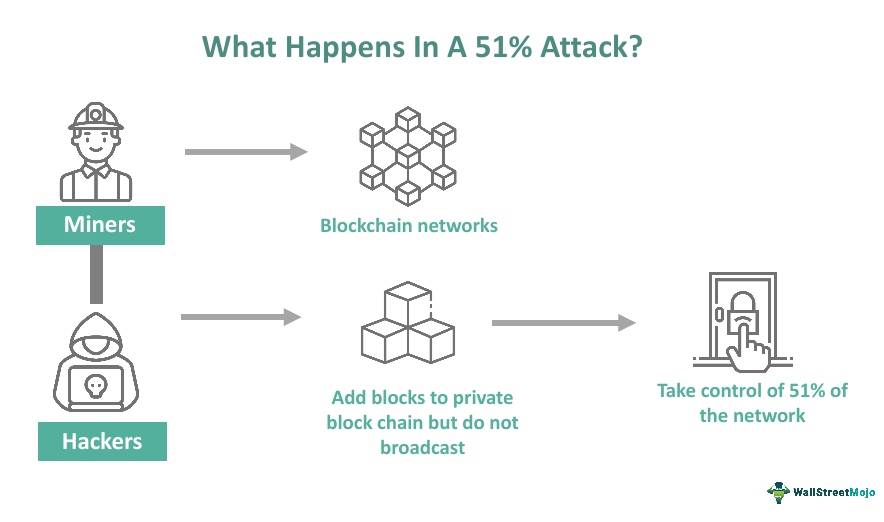
With majority hash rate, an attacker can mine blocks faster than the honest network and build a longer chain in secret. Once that private chain is long enough, they broadcast it. The network – following its own rules – accepts it as valid, and any transactions recorded only on the discarded chain disappear. That is the core mechanic.
The “51%” label is a slight simplification. An attacker needs to sustain a hash rate above 50% long enough to outpace the honest chain. Briefly crossing 50% does not guarantee success. The longer they maintain dominance, the more blocks they can rewrite and the larger the window for double-spending.
How Does a 51% Attack Work Step by Step?
The mechanics clarify both the threat and its limits.
The attacker acquires a majority hash rate. This can mean owning enough mining hardware, renting hash power through platforms like NiceHash, or – as seen in 2026 – a mining pool accumulating too large a share of a smaller network’s total power.
The attacker mines a secret chain. While the public network builds the main chain, the attacker mines a parallel private chain that omits their own spend – meaning they keep their coins in the rewritten version of history.
The attacker spends coins on the public chain. They deposit cryptocurrency to an exchange, convert it, and withdraw. The exchange sees multiple confirmations and considers the transaction final.
The attacker releases the secret chain. Because their private chain is longer (more hash power behind it), the network accepts it. The original deposit to the exchange vanishes from history. The attacker keeps both the withdrawn funds and the original coins.
Honest miners are orphaned. Any blocks mined by honest participants on the discarded chain become invalid, wasting their energy and forfeiting their block rewards.
Beyond double-spending, an attacker with majority control can also censor specific transactions by refusing to include them – effectively freezing a target’s funds indefinitely. They can run a sustained denial-of-service against competing miners by orphaning every block those miners produce.
The financial cost of executing an attack is the most important deterrent on major networks. As of 2026, a 24-hour attack on Bitcoin would require sustaining over 350 exahashes per second – hardware and energy costs running into the billions of dollars. Ethereum Classic, a much smaller network, costs roughly $144,000 for a 24-hour attack window. That gap explains exactly why large networks survive while smaller ones face repeated incidents.
Netzwerk
Estimated 24-Hour Attack Cost (2026)
Konsensmechanismus
Historical Attack?
Bitcoin (BTC)
Billions (not practically feasible)
Arbeitsnachweis (SHA-256)
No successful attack
Ethereum (ETH)
Unzutreffend
Proof of Stake (post-Merge 2022)
No – PoS changes the model entirely
Ethereum Classic (ETC)
~ $ 144,000
Der Nachweis der Arbeits
Yes – 2020 ($5.6M double-spent)
Bitcoin Gold (BTG)
Niedrig
Proof of Work (Equihash)
Yes – 2018 ($18M double-spent)
Monero (XMR)
Moderat
Proof of Work (RandomX)
Yes – August and September 2026
For Bitcoin, buying enough ASICs to outpace the honest network would cost tens of billions of dollars. Even renting is practically impossible: no hash power marketplace has remotely enough supply to match Bitcoin’s total hash rate, which as of early 2026 exceeds 700 exahashes per second.
Which Real-World Attacks Have Happened?
51% attacks are not theoretical. They have caused real, documented financial losses across multiple networks.
Was Bitcoin Gold the First Major Victim?
Bitcoin Gold used the Equihash algorithm, chosen specifically to resist ASIC mining and keep the network open to GPU miners. That same design made it cheap to attack. In May 2018, an attacker double-spent approximately $18 million worth of BTG, targeting exchanges that accepted large deposits before the reorg window. The damage to BTG’s credibility was severe and permanent.
What Happened to Ethereum Classic in 2020?
Ethereum Classic suffered one of the most well-documented attacks in blockchain history. In August 2020, an attacker double-spent roughly $5.6 million worth of ETC across a series of chain reorganizations, reshuffling thousands of blocks across multiple attempts. The development team responded by adopting a modified proof-of-work algorithm and coordinating with miners to improve real-time monitoring.
Did Ghash.io Actually Attack Bitcoin?
Not every near-miss was malicious. In 2014, the Ghash.io mining pool – then one of the largest Bitcoin pools – accidentally controlled more than 55% of Bitcoin’s total hash rate for a brief period. No attack was carried out, and the pool voluntarily capped its share, but the incident exposed how pool concentration alone could threaten even the largest network.
What Was the 2026 Monero Attack?
In August and September 2026, a mining pool connected to Qubic – a Layer-1-Blockchain – acquired more than 50% of Monero’s hash rate and executed chain reorganization attacks. The attacker pushed through a longer chain that erased approximately 18 Blöcke, sending roughly 117–118 transactions back to the mempool and disrupting payments. The incident renewed debate over RandomX’s resistance to coordinated pool attacks and whether smaller privacy chains face structurally higher risk.
Why Are Smaller Blockchains at Higher Risk?
The economics are direct: a chain’s security is proportional to the cost of attacking it. Smaller networks have fewer miners, lower total hash rates, and less market value to protect. An attacker targeting a small chain needs far less capital than one targeting Bitcoin. On many smaller chains, the potential profit from a successful double-spend can easily exceed the attack cost – making the attempt rational from a purely financial standpoint.
Hash power rental markets worsen this dynamic. An attacker does not need to own hardware. They can rent enough hash power for a few hours, execute a double-spend, and disappear – a pattern that has appeared in multiple small-chain attacks since 2018.
How Do Blockchains Defend Against 51% Attacks?
Several approaches have been developed at both the protocol and operational level.
Does Switching to Proof of Stake Solve It?
PPfahldach replaces hash rate competition with economic stake. Attacking a PoS network requires controlling more than 50% of all staked coins. For Ethereum, that means billions of dollars worth of ETH – and the protocol slashes (permanently destroys) the stake of any validator caught acting maliciously. This makes attacks economically self-defeating. Ethereum’s 2022 Merge to proof of stake was partly motivated by exactly this security argument.
How Do Longer Confirmation Times Help?
Exchanges and merchants can require more block confirmations before crediting deposits. For a small PoW chain, waiting for 100 confirmations instead of 6 forces the attacker to maintain their private chain far longer – dramatically increasing rental costs. This is a practical defensive measure that exchanges already apply selectively to higher-risk assets.
What Are Checkpointing and Finality Mechanisms?
Some networks implement checkpointing – locking blocks as permanently valid after a certain depth, even if a longer chain appears later. Others borrow finality gadgets from Byzantine fault-tolerant consensus designs. These approaches make chain reorganizations impossible beyond a fixed depth, removing the core mechanic that makes 51% attacks work.
Can Real-Time Monitoring Stop an Attack?
Services including MIT’s Digital Currency Initiative operate real-time monitoring tools for known vulnerable networks. When hash rate anomalies appear – such as a single pool approaching 45% of total power – alerts go out to exchanges and mining communities. Early warning does not stop an attack already underway, but it gives exchanges time to raise confirmation requirements before damage occurs.
Do Algorithm Changes Provide Long-Term Protection?
Some networks switch mining algorithms to prevent ASIC dominance or pool concentration. Monero has changed its algorithm multiple times for this reason. The 2026 Monero incident shows algorithm changes are not a permanent fix – determined attackers with rented CPU and GPU capacity can still accumulate majority hash rate on proof-of-work networks with lower security budgets.
Can Bitcoin Be 51% Attacked?
In practical terms, no – not in any way that would be profitable. Bitcoin’s hash rate as of early 2026 exceeds 700 exahashes per second, and acquiring 51% of that would require hardware spending in the tens of billions of dollars, plus ongoing energy costs that would dwarf any plausible double-spend profit. Even nation-state actors with significant resources would struggle to execute this without it being detected far in advance.
The 2014 Ghash.io incident also demonstrated an important social defense: the community responded before any attack happened. Miners voluntarily left the pool to protect Bitcoin’s decentralization. This kind of social coordination is less reliable than protocol-level guarantees, but it has functioned historically when it was needed.
Practical Tips for Staying Safe from 51% Attack Risks
Check the network’s Hash-Rate-Verteilung before transacting. Sites like Blockchain.com and Minerstat publish real-time data on pool concentration. If one pool holds more than 40% of a network’s hash rate, treat that chain as elevated-risk.
Wait for more confirmations on smaller chains. For Bitcoin, 6 confirmations is the standard. For less-secure PoW networks, require 30–100 confirmations before treating a large payment as final – this raises the cost of a double-spend against you considerably.
Prefer proof-of-stake networks for high-value transactions. When an asset is available on a PoS chain, the structural security advantages are real. Attacking a large PoS network costs far more than attacking a small PoW chain.
Watch for chain reorganization alerts. Services like Etherscan (for EVM chains) and dedicated monitoring tools report chain reorgs in near-real time. A sudden large reorg on a small chain is a warning to pause deposits immediately.
Avoid holding large balances on small-cap PoW assets on exchanges. If an exchange is successfully double-spent against, users’ funds can be put at risk through the exchange’s policy response or solvency position.
Stay updated on algorithm changes for chains you use regularly. Networks that have been attacked often change their mining algorithm in response. These transitions temporarily reduce hash rate, briefly increasing exposure – a window some attackers have actively targeted.
Track the security budget of any chain you use. A network’s block reward (miner revenue) determines how much honest hash power defends it. Chains with declining block rewards and no fee revenue replacing that income become progressively easier to attack over time.
FAQ: 51% Attacks Explained
Can a 51% attacker steal coins from any wallet?
No. A 51% attack only allows the attacker to manipulate the transaction history on the chain they control. Private keys, wallet encryption, and coins in unrelated addresses are all untouched. The attack is specifically limited to double-spending coins the attacker already owns and to censoring or reversing transactions within the rewritten block window.
Does a 51% attack affect everyone on the network?
The immediate financial harm falls on parties who accepted payments the attacker later reversed – typically exchanges and merchants. Every other user is indirectly affected because a successful attack damages confidence in the chain, usually triggering a sharp price decline. The Ethereum Classic 2020 attack was followed by a significant drop in ETC’s market price.
How long does a 51% attack take?
It depends on the network size and the attacker’s hash rate advantage. On a very small network, an attacker with 60% of the hash rate could build a longer private chain within minutes. On a larger network, a sustained attack might take several hours. The attacker typically plans around exchange deposit confirmation windows: long enough for a deposit to clear, short enough that hash power rental costs stay below the profit margin.
Is proof of stake completely immune to 51% attacks?
Not entirely – but the nature of the attack changes completely. On a proof-of-stake network, an attacker needs to own more than 50% of all staked tokens, which is astronomically expensive on large chains. Slashing mechanisms mean a caught attacker loses their entire stake, making the attack economically irrational. Smaller PoS networks with low total stake values remain theoretically exposed.
Has Bitcoin ever suffered a 51% attack?
No successful 51% attack has ever been carried out against the Bitcoin main chain. The closest incident was the Ghash.io pool briefly crossing 55% of hash rate in 2014, with no malicious action taken and the pool self-correcting shortly after. As of Q1 2026, Bitcoin’s scale makes a successful 51% attack essentially impossible with any realistic set of resources.
What should crypto users do to protect themselves?
Individual users have limited direct control, but they can stick to networks with strong security track records, avoid holding large balances on small-cap PoW assets on exchanges, and wait for more confirmations before treating a transaction as final. For exchanges and businesses, raising confirmation requirements on higher-risk chains and monitoring hash rate concentration in real time are the most reliable active defenses.
Hallo, ich bin preciousRuby. Ich bin Content-Marketerin und Autorin und unterstütze Startups und kleine Unternehmen leidenschaftlich gerne dabei, ihre Marketingziele durch organisches Marketing zu erreichen. Wenn ich nicht arbeite, schlafe ich oder schaue einfach Filme.
Haftungsausschluss : Dieser Artikel dient ausschließlich Informationszwecken und stellt keine Anlage- oder Handelsberatung dar. Die hierin enthaltenen Informationen sind nicht als Finanz-, Rechts- oder Steuerberatung zu verstehen. Der Handel mit Kryptowährungen birgt ein erhebliches Risiko finanzieller Verluste. Führen Sie stets eine sorgfältige Prüfung durch, bevor Sie Handels- oder Anlageentscheidungen treffen.
Handel mit Nachweis von Reserven
UEEx veröffentlicht monatliche Prüfberichte und Bestätigungen von Drittanbietern für jeden gelisteten Markt.
Wöchentlich erhalten Sie Marktanalysen, Handelsstrategien, Einblicke in den Futures-Markt und Sicherheitswarnungen. Gelesen von über 10,000 Krypto-Händlern.