AI governance in blockchain refers to the frameworks, policies, and technical mechanisms – including smart contracts, immutable audit trails, and decentralized identity systems – that ensure artificial intelligence models are developed, deployed, and monitored in alignment with ethical standards, legal requirements, and human rights principles. By recording every data access event and model update on a tamper-proof ledger, blockchain gives regulators, developers, and users a verifiable chain of accountability that centralized systems cannot reliably provide. As of Q1 2026, this intersection has moved from academic theory to active regulatory enforcement, with the EU AI Act’s first major prohibitions in force and a growing set of production deployments demonstrating what auditable, governed AI looks like in practice.
La gobernanza de la IA garantiza que los sistemas de inteligencia artificial funcionen de manera transparente, justa y ética, respaldados por marcos globales y políticas nacionales.
Blockchain mejora la supervisión de la IA al asegurar la integridad de los datos, permitir un control descentralizado y proporcionar registros de auditoría transparentes para el cumplimiento.
Las implementaciones en el mundo real de plataformas como nChain, EQTY Lab y Ocean Protocol demuestran el uso práctico de blockchain para la gestión ética de la IA.
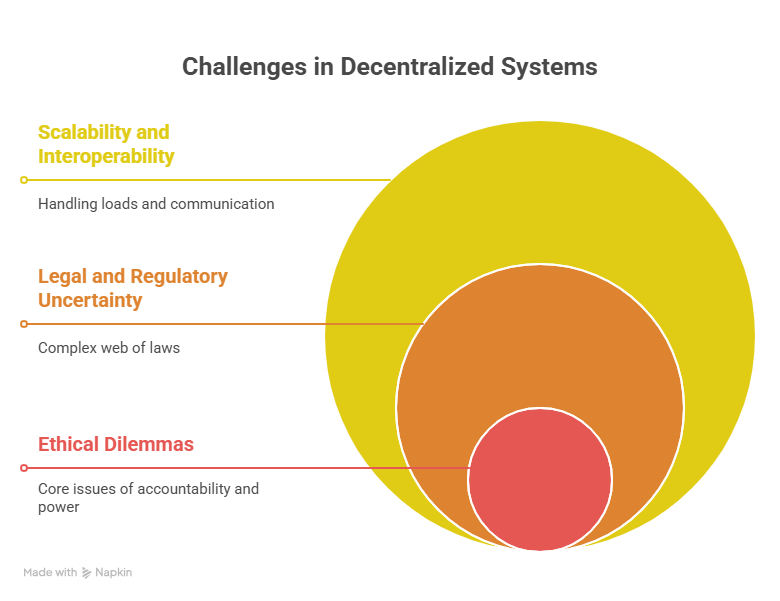
Los desafíos clave en la integración de blockchain e IA incluyen la escalabilidad, la incertidumbre jurídica y las preocupaciones éticas en los sistemas descentralizados de toma de decisiones.
El futuro de la supervisión de la IA basada en tecnología reside en herramientas de cumplimiento automatizadas, estándares transfronterizos, infraestructura descentralizada y tecnologías que preserven la privacidad.
Why Did AI Governance Become Urgent?
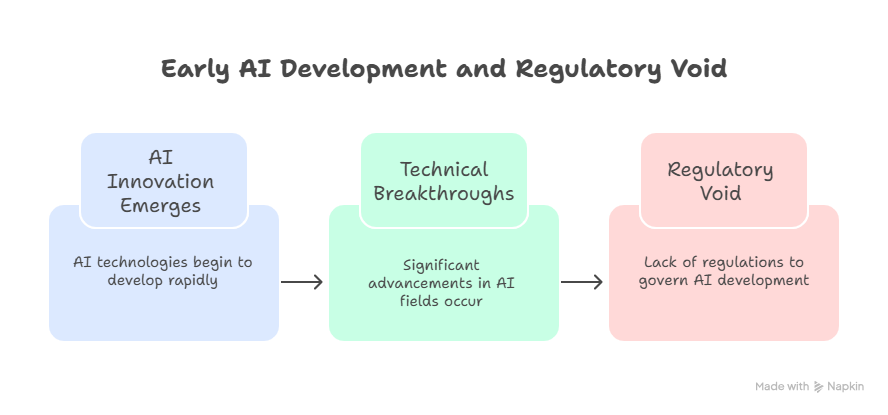
The scale of AI’s growth made governance gaps unavoidable. Between 2010 and 2022, total AI publications nearly tripled – from roughly 88,000 per year to more than 240,000 – while regulatory frameworks struggled to keep pace with the technology they were meant to oversee.
The consequences were concrete and documented. Facial recognition algorithms showed error rates of up to 34.7% para mujeres de piel más oscura, compared to under 1% for lighter-skinned men, as MIT Media Lab research found. Amazon’s internal AI recruiting tool systematically favored male candidates. The COMPAS recidivism scoring system – used by US courts to inform sentencing – showed measurable racial bias against Black defendants. Each case pointed to the same structural problem: AI systems operating without meaningful external oversight.
Policy responses followed, though unevenly. The OECD released its Principles on AI in 2019. The EU published its Ethics Guidelines for Trustworthy AI the same year. The United States issued its Blueprint for an AI Bill of Rights in 2022, followed by NIST’s AI Risk Management Framework in 2023. The EU AI Act – the most legally binding of these efforts – entered into force on 1 August 2024.
Únase a UEEx
Experimente la plataforma líder mundial de gestión de patrimonio digital
El Ley de IA de la UE operates on a phased enforcement schedule. As of 2 de Febrero de 2026, prohibitions on unacceptable-risk AI systems took full effect. These cover social scoring systems, real-time biometric surveillance in public spaces, and AI that manipulates behavior by exploiting psychological vulnerabilities.
Desde 2 de septiembre de 2026, governance infrastructure requirements apply – including obligations for providers of general-purpose AI (GPAI) models, who must now maintain technical documentation, register with the EU AI Office, and comply with copyright transparency rules. The highest-risk tier, covering AI in employment, credit, education, and law enforcement, becomes fully enforceable on 2 de septiembre de 2026. Non-compliance penalties reach up to €35 million or 7% of worldwide annual turnover for the most serious violations.
For blockchain-based AI systems, the EU AI Act does not create a separate compliance track. Blockchain infrastructure is evaluated based on the risk level of the AI it supports. A smart contract enforcing ethical rules on a high-risk AI model faces the same scrutiny as any other high-risk deployment. Legal analysis published in 2026 confirms that decentralized architecture does not grant automatic compliance – each system is assessed case by case.
Blockchain’s core properties – immutability, transparency, and decentralization – address three specific weaknesses in conventional AI governance: opaque data provenance, unverifiable audit trails, and centralized control that creates single points of failure or manipulation.
How Do Immutable Audit Trails Work for AI Models?
Every time an AI model accesses a dataset, updates its parameters, or generates a decision, that event can be recorded as a transaction on a blockchain. The record is timestamped and cryptographically sealed – no party can alter it after the fact without invalidating the entire chain.
This creates what AI governance specialists describe as a “forensic-grade audit log.” Instead of trusting a company’s internal records, regulators can query a public or permissioned ledger directly. The healthcare company BurstIQ applies this model to patient data used in AI-driven diagnostics, ensuring every dataset used to train a clinical AI system is verifiably sourced and unmodified.
How Can Smart Contracts Enforce Ethical Rules Automatically?
Smart contracts are self-executing programs that run on a blockchain when predefined conditions are met. Applied to AI governance, they can automate compliance in ways that manual oversight cannot match for speed or consistency.
Las aplicaciones prácticas incluyen:
Blocking an AI model’s access to sensitive user data unless explicit consent has been cryptographically confirmed
Automatically pausing a model’s deployment if its measured bias score exceeds a defined threshold
Enforcing licensing terms in decentralized AI marketplaces – releasing payment to model creators only when usage conditions are satisfied
Generating auditable records of every governance decision, showing which rule triggered which action at exactly which timestamp
Revoking a model’s operating permissions if it produces outputs inconsistent with its declared training parameters
Projects like Fetch.ai integrate autonomous AI agents with smart contract governance layers, allowing AI systems to operate within pre-coded ethical boundaries without requiring human intervention for each individual decision.
What Role Does Decentralization Play in AI Oversight?
Centralizing AI governance in a single institution creates an obvious structural problem: what governs the governor? Decentralized infrastructure distributes this responsibility across many nodes. Ocean Protocol and SingularityNET both build on this principle, hosting AI models across peer-to-peer networks rather than on proprietary servers controlled by a single entity.
Research published in 2026 on decentralized governance highlights that distributing control removes the ability of any single actor – including regulators themselves – to retroactively alter governance rules. For AI systems that must remain neutral across jurisdictions, this is a meaningful structural guarantee, though it introduces its own accountability questions when things go wrong.
Which Organizations Are Applying These Principles in Production?
As of 2026, several organizations have moved from proof-of-concept to live deployments across multiple industries.
Organización
Blockchain utilizado
Mecanismo de gobernanza
Key Compliance Alignment
nChain
BSV
Immutable timestamping of every AI lifecycle phase – from data sourcing through deployment
NIST AI RMF, EU AI Act documentation requirements
Laboratorio EQTY
Múltiple
Tokenized ethical attestations; blockchain-based fairness and explainability scoring; staking with penalties for breaching ethical thresholds
EU Ethics Guidelines for Trustworthy AI
Demuestra que la IA AG
Custom DLT
Zero-knowledge proofs for algorithm verification; decentralized behavior registries; real-time compliance checks without exposing proprietary model internals
GDPR, EU AI Act transparency requirements
Protocolo Oceánico
Ethereum
Data tokens managing access and traceability; compute-to-data architecture for AI training without direct data exposure; on-chain licensing enforcement
Ocean Protocol’s collaboration with the German Federal Ministry of Education and Research on AI mobility systems is particularly significant. It shows that decentralized AI governance has reached national government adoption for sensitive infrastructure – not just commercial experimentation.
What Challenges Still Limit Blockchain-Based AI Governance?
The combination is promising but not without friction. Four challenges appear consistently in technical and policy literature in 2026.
Is Blockchain Fast Enough for Real-Time AI Decisions?
Throughput is the first obstacle. Ethereum’s base layer processes approximately 15 to 30 transactions per second. Visa processes over 24,000 TPS. Real-time AI applications in trading, medical diagnostics, or autonomous vehicles require governance decisions in milliseconds – a timeline no current public blockchain supports at the base layer.
Layer-2 scaling solutions and proof-of-stake mechanisms narrow this gap but add architectural complexity. Ocean Protocol’s compute-to-data model is one practical workaround: AI models are sent to the data rather than the data being sent to the AI, reducing on-chain transaction volume while maintaining verifiability. These are engineering adaptations, not complete solutions.
What Legal Ambiguities Remain Unresolved in 2026?
Contratos inteligentes are legally enforceable in some jurisdictions and contractually ambiguous in others. Layered on top of this is GDPR’s “right to be forgotten” – a right that collides directly with blockchain’s permanent immutability. If personal data is recorded in an on-chain governance log, deleting it on request may be technically impossible without breaking the chain’s integrity.
Liability assignment in decentralized networks presents a related challenge. When a DAO-governed AI system causes harm, identifying the legally responsible party is genuinely unclear under existing law. INATBA’s 2026 policy analysis identifies this as one of the most pressing unresolved questions for lawmakers worldwide.
Do Decentralized Governance Systems Introduce Their Own Biases?
Tokenized voting systems carry their own fairness risks. When governance power is proportional to token holdings, wealthy participants gain disproportionate influence over ethical rules – a dynamic that mirrors the concentrated power structures decentralization aims to replace. Token-majority decisions can disadvantage minority groups in ways that are technically legitimate but ethically problematic.
Blockchain audit trails record what an AI did and when, but they cannot explain why a neural network weighted certain features over others. Interpretability remains a separate, unsolved challenge that governance infrastructure alone cannot address.
Únase a UEEx
Experimente la plataforma líder mundial de gestión de patrimonio digital
What Is the Future Direction of AI Governance on Blockchain?
The trajectory for 2026 and beyond points toward automation, standardization, and privacy-preserving verification.
Automated compliance monitoring – tools that continuously track AI model performance and flag anomalies without human review of every event – will become standard in enterprise AI deployments. The Stanford Blockchain Governance Summit in 2026 highlighted DAOs, regulatory frameworks, and AI-blockchain integration as the central themes shaping the next generation of governance infrastructure. Combining blockchain verifiability with automated monitoring removes the manual bottleneck that currently makes real-time AI oversight impractical at scale.
Global standards alignment is accelerating. The G7 Hiroshima AI Process and the Council of Europe’s Framework Convention on AI (2024) – the first legally binding international AI treaty – signal a shift from fragmented national rules toward interoperable cross-border standards. Blockchain infrastructure that meets these emerging standards will carry both competitive and regulatory advantage.
Privacy-preserving computation – federated learning, differential privacy, and homomorphic encryption – will allow AI systems to be governed and audited without exposing sensitive training data. The combination of these techniques with blockchain-based audit trails resolves much of the tension between GDPR-style privacy obligations and the transparency requirements of AI governance frameworks.
Frequently Asked Questions About AI Governance in Blockchain
What is AI governance in blockchain, in plain terms?
It is the use of blockchain technology to create verifiable, tamper-proof records of how AI systems are built, trained, and used. Smart contracts can automatically enforce ethical rules – blocking access to data, pausing models that exceed bias thresholds, or revoking permissions when compliance conditions are breached – while immutable ledgers give regulators and users a trustworthy record of every decision. The goal is making AI accountability as auditable and transparent as possible.
How does blockchain help detect AI bias?
Blockchain does not prevent bias inside an AI model – that requires fair training data and sound algorithmic design. What blockchain does is make bias detectable and provable. When a governance log records every input, output, and model update, auditors can trace exactly when bias emerged and what data contributed to it. Smart contracts can also automatically pause a model’s deployment if measured demographic error rate differentials cross a defined threshold, converting a manual review process into an automated enforcement action.
Is the EU AI Act relevant to blockchain-based AI systems?
Yes. As of 2 February 2026, the EU AI Act’s prohibitions on unacceptable-risk AI are in force across all EU member states, regardless of whether the underlying infrastructure is centralized or decentralized. Providers of general-purpose AI models face additional obligations from August 2026. Blockchain architecture does not grant exemption from these requirements – each system is assessed individually based on the risk category of the AI it supports, with penalties reaching up to €35 million for the most serious violations.
What is the biggest technical obstacle in combining AI and blockchain?
Transaction throughput is the most immediate barrier. Public blockchains currently process far fewer transactions per second than real-time AI applications require. Ethereum’s base layer handles 15 to 30 TPS; production AI systems in trading or diagnostics need governance decisions in milliseconds. Layer-2 solutions and off-chain computation with on-chain verification – such as Ocean Protocol’s compute-to-data model – narrow this gap partially, but no solution yet fully closes it for the most latency-sensitive use cases.
Practical Steps for Teams Building Governed AI on Blockchain
Map your AI’s risk tier under the EU AI Act before selecting infrastructure. High-risk AI in employment, credit, education, or law enforcement faces documentation and audit requirements that must be designed into your blockchain architecture from day one. Retrofitting governance infrastructure after deployment is significantly harder than building it in initially.
Use cryptographic hashing to timestamp model versions at training completion. Register a hash of each model version on-chain when training finishes. This creates verifiable prior-art proof, simplifies version control, and gives auditors a reliable baseline for comparing model behavior over time.
Design smart contract governance rules conservatively at first. Start with narrow, testable rules – for example, “pause deployment if demographic error rate differential exceeds 5%” – before attempting broader autonomous governance. Overly broad smart contracts produce unpredictable enforcement outcomes that can be harder to explain to regulators than manual processes.
Keep personal data off-chain, with only cryptographic references on the ledger. Full personal data should never appear on a blockchain record. Store hashes, access events, and governance decisions on-chain; keep raw data in GDPR-compliant off-chain storage. This structure satisfies both immutability requirements and the right-to-erasure obligations that the GDPR imposes.
Build for interoperability from the start. The emerging global AI governance standards – through the G7, the Council of Europe Framework Convention, and EU-US AI coordination – will require cross-platform compliance reporting. Choosing blockchain infrastructure with well-documented APIs and participation in cross-chain governance working groups positions your systems for the regulatory environment of 2026 and beyond, not just today’s requirements.
Akindele T. Francis es una redactora de contenido versátil con amplia experiencia en diversos sectores. Especializada en publicaciones de blog, contenido web, páginas de servicios, textos de venta atractivos, etc., Akindele ha colaborado con numerosas agencias para ofrecer material escrito atractivo y eficaz. Con una atención al detalle y una pasión por crear narrativas impactantes, Akindele supera constantemente las expectativas de sus clientes, impulsando resultados y mejorando el mensaje de marca en diversas plataformas.
Descargo de responsabilidad : Este artículo tiene fines exclusivamente informativos y no debe considerarse asesoramiento comercial ni de inversión. Nada de lo aquí expuesto debe interpretarse como asesoramiento financiero, legal o fiscal. Operar o invertir en criptomonedas conlleva un riesgo considerable de pérdida financiera. Realice siempre la debida diligencia antes de tomar cualquier decisión de inversión.
Comercio con comprobante de reservas
UEEx publica auditorías mensuales y verificaciones de terceros sobre cada mercado cotizado.
Análisis de mercado, estrategias de trading, perspectivas sobre futuros y alertas de seguridad semanales. Leído por más de 10 000 traders de criptomonedas.