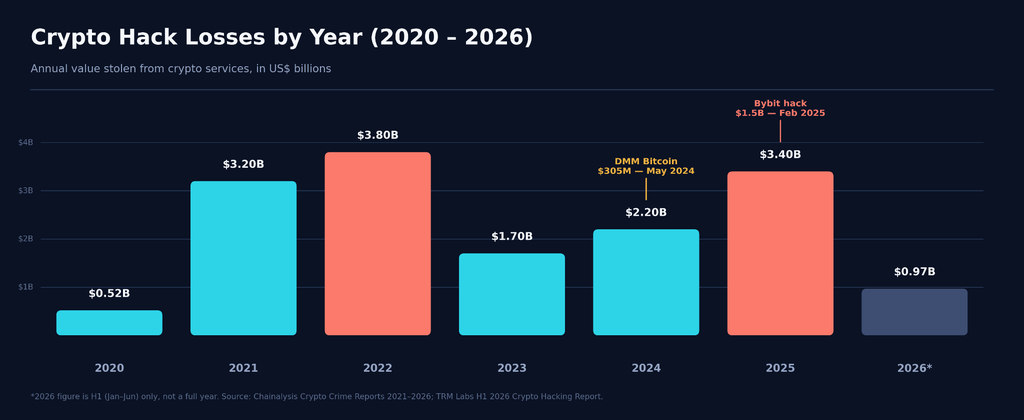
Mercados de criptomonedas lost more money to hackers in 2025 than the entire GDP of some small nations. One single attack on Bybit wiped out $1.46 billion in a few hours. And yet, most people holding crypto today have no insurance backup if something similar happens to them.
This guide breaks down the best crypto insurance providers of 2026, what they actually cover, how much they cost, and how to pick one that fits your situation. We looked at coverage limits, claims history, regulatory standing, and real user reviews to build this list.
If you’re an individual holder, a DeFi trader, or a business running a custody operation, you’ll find a fit here.
Únase a UEEx
Experimente la plataforma líder mundial de gestión de patrimonio digital
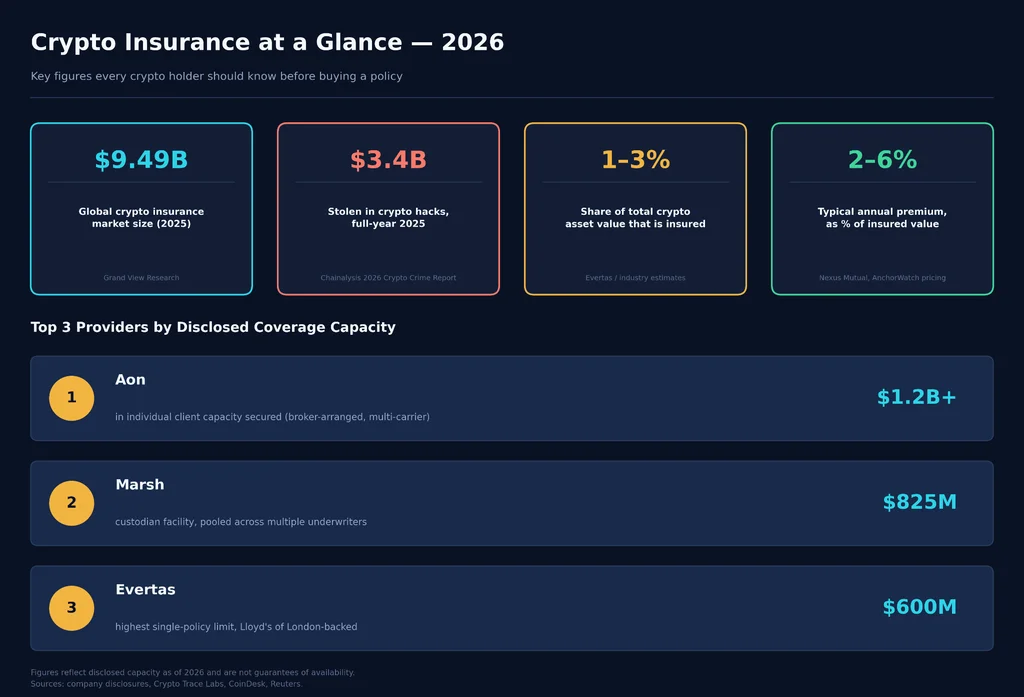
Only a small slice of crypto holdings is insured today. Most estimates put the insured share of the total market at 1% to 3%, leaving a massive protection gap.
Evertas and Canopius lead traditional coverage for large institutions, while Nexus Mutual and InsurAce lead decentralized coverage for DeFi users.
No crypto insurance policy covers market losses. Coverage only kicks in for theft, hacks, custody failure, or specific contract exploits, so read the exclusions before you buy.
What Is Crypto Insurance?
Crypto insurance protects digital asset holders against losses from hacks, wallet theft, exchange failures, and smart contract exploits. Traditional providers like Evertas and Canopius get their backing from established insurance markets such as Lloyd’s of London. Decentralized options, like Nexus Mutual, use member-funded pools on the blockchain instead of a traditional insurance company. Either way, coverage does not extend to price drops. It only pays out when your crypto is stolen, lost, or made inaccessible through no fault of your own.
Here’s the part most people miss: crypto insurance is not one product. It’s a group of narrow, specific coverages, and each one protects against a different risk.
Main Types of Coverage Available
Custody insurance (protects assets held by a custodian or exchange)
Smart contract insurance (protects against exploits in DeFi protocol code)
Exchange or crime insurance (protects against hacks and internal theft)
Directors and officers (D&O) coverage for crypto company leadership
Cyber liability insurance for data breaches and operational failures
A real example makes this clearer. When Bybit lost about $1.46 billion in February 2025, no single policy could have covered a loss that size. Even Evertas, which now offers up to $600 million per policy, would have needed multiple syndicates stacked together to come close. That gap is exactly why the market is racing to build bigger and smarter coverage products in 2026.
Types of Crypto Insurance Providers
Here are the different types of insurance providers
Seguro Tradicional
Traditional providers like Evertas and Canopius work through licensed underwriters (an underwriter evaluates and measures financial risk), usually backed by Lloyd’s of London syndicates. They offer the highest coverage limits in the industry, sometimes into the hundreds of millions of dollars per policy, and they come with regulatorios recognition that institutions need. The tradeoff is a slower, more paperwork-heavy underwriting and claims process.
Seguros descentralizados
Platforms like Nexus Mutual and InsurAce run on contratos inteligentes. Members pool capital, vote on claims, and everything is visible on-chain. Premiums tend to run lower than traditional policies, and claims can pay out in days instead of months. The catch is that coverage is limited to crypto-native risks, mostly smart contract failures, and capital pools are much smaller than what traditional insurers can offer.
Modelos híbridos
Coincover and AnchorWatch blend traditional insurance backing with crypto-specific technology, like key recovery tools and custody infrastructure. These providers focus heavily on preventing losses before they happen, not just paying out after the fact.
Cobertura Especializada
Some risks need a narrower tool. Munich Re built a dedicated product for staking slashing risk. Other niche products cover NFTs or use parametric triggers, meaning the payout happens automatically once a defined on-chain event occurs; no claims adjuster is required.
Tipo
Apoyo
Límite típico
Velocidad de reclamaciones
Mejor ajuste
Tradicional
Lloyd’s syndicates, reinsurers
Up to $600M+ per policy
Semanas a meses
Exchanges, custodians, large institutions
Descentralizada
Member capital pools
Tens of millions per protocol
Días
DeFi users, protocol treasuries
Híbrido
Insurer-backed tech platforms
Varía según el nivel
Días a semanas
Retail holders, wallet providers
Servicios
Reinsurers, MGAs
Personalizado
Semanas
Stakers, miners, NFT holders
Why Crypto Insurance Matters in 2026
Here are the reasons why crypto insurance is important:
The Hack Problem Isn’t Slowing Down
In 2025, hackers stole an estimated $2.87 billion across nearly 150 separate incidents, according to TRM Labs, with the February Bybit breach alone responsible for 51% of that total. North Korea’s Lazarus Group, blamed for Bybit, stole more than $2 billion in crypto across 2025, its most successful year on record, largely to fund weapons programs.
At the same time, recovery rates remain low. Most stolen crypto is never returned to victims, which is exactly the gap insurance is designed to fill.
Regulators Are Pushing Providers to Get Insured
Under the EU’s Markets in Crypto-Assets Regulation (MiCA), Article 67 requires crypto-asset service providers to hold prudential safeguards equal to the higher of a minimum capital requirement or one quarter of the prior year’s fixed overheads.
Providers can meet this through their own capital, an insurance policy covering EU territories, or a comparable guarantee. This has pushed a wave of European insurers to build MiCA-aligned crypto products.
El mercado está creciendo rápidamente
The global crypto insurance market was valued at roughly $9.49 millones de dólares en 2025 and is projected to reach nearly $192.72 billion by 2033, according to Grand View Research, driven by rising institutional custody, DeFi growth, and tightening regulation.
“Digital infrastructure has become one of the most important and capital-intensive asset classes in the global economy,” -said Joe Peiser, CEO of Risk Capital at Aon, describing how demand for large-scale specialty coverage keeps climbing across digital markets.
Best Crypto Insurance Providers 2026: Full Comparison
Below is the deep review of our top 10 crypto insurance providers
1. Evertas
Source: evertas.com
Tipo: Traditional, Lloyd’s of London-backed
Cobertura máxima: Up to $600 million per policy
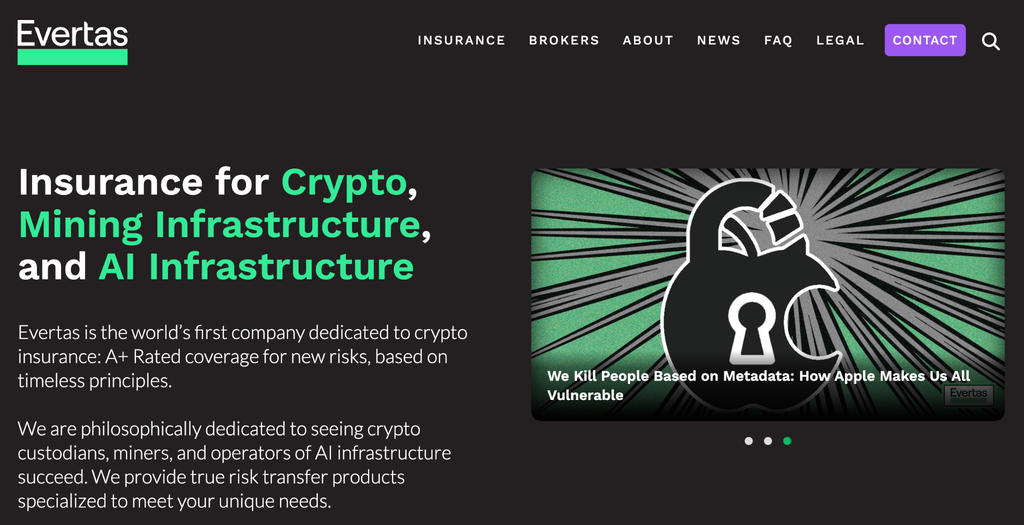
Evertas calls itself the world’s first company built only for crypto insurance, and the claim holds up. It’s a Lloyd’s of London coverholder, meaning it can underwrite policies backed by Lloyd’s syndicates like Arch, with an A+ (Superior) rating on many of its products. Its per-policy limits have grown enormously since 2023, when the cap was just $5 million.
Ventajas:
Highest publicly disclosed per-policy limits in the crypto insurance market
Underwriters with deep crypto-specific technical knowledge, not generalists
Covers a wide range of assets: custody, mining hardware, and D&O (Directors and Officers Liability Insurance)
Desventajas:
Built for institutions, not individual retail holders
Custom pricing means you won’t get an instant quote online
Underwriting can take longer than decentralized alternatives
Ideal para: Exchanges and custodians managing large asset pools who need the highest available per-incident limits.
2. Nexo mutuo
Fuente: nexusmutual.io
Tipo: Decentralized mutual, built on Ethereum
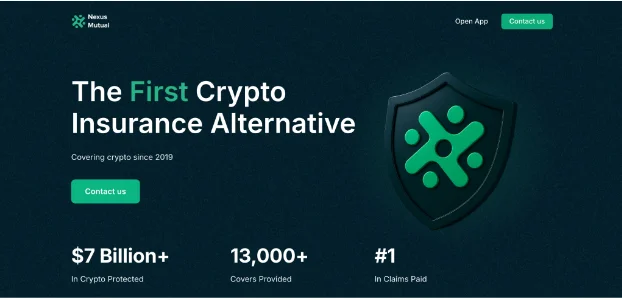
Cobertura: Backed by a member-owned capital pool, it has covered more than $7 billion in value since 2019 across 13,000+ covers provided.
Nexus Mutual pioneered decentralized crypto cover back in 2019 and remains the dominant player in that niche. Members deposit ETH, USDC, or cbBTC to mint NXM tokens, which represent a stake in the shared capital pool.
That pool then backs cover for smart contract exploits, custody failures, slashing events, and stablecoin depegs.
Nexus Mutual’s founder, Hugh Karp, has been blunt about the scale of the problem, telling CoinDesk that “less than 2% of DeFi’s TVL is covered or insured” today, and calling that gap one of the biggest barriers to mainstream DeFi adoption.
Ventajas:
Longest track record of any decentralized crypto cover provider
Fully transparent claims history and capital pool, all on-chain
Faster claims process than most traditional insurers
Desventajas:
Requires KYC for full membership (though wrapped NXM cover purchases can skip this)
Coverage caps are far smaller than traditional providers can offer
Cover is legally a discretionary mutual product, not a regulated insurance contract
Ideal para: DeFi-native users who want transparent, community-governed protection against protocol-level risk.
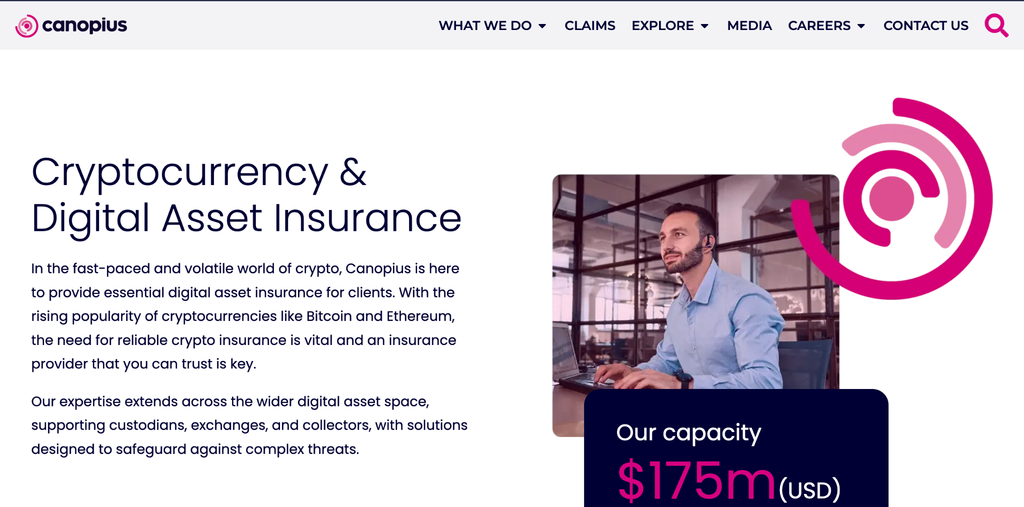
3. Canopius
Fuente: canopius.com
Tipo: Traditional, Lloyd’s Syndicate 4444
Cobertura: Individual line sizes up to $130 million-plus, with record global committed capacity
Canopius has built one of the largest footprints in digital asset custody insurance globally, with underwriting operations spanning the UK, US, Bermuda, Singapore, and Hong Kong.
It was the first carrier to launch a digital asset custody product on the Lloyd’s Asia platform, and it recently expanded into Hong Kong through a partnership with MGA Qubit.
Ventajas:
Wide geographic reach with local coverholders in multiple regions
Coverage spans custody, cyberattacks, and fraudulent transactions in one product line
Strong track record of new institutional partnerships throughout 2025 and 2026
Desventajas:
Focused almost entirely on institutional clients, not individuals
Terms and pricing require broker involvement, not self-serve
Coverage details vary heavily by region and coverholder
Ideal para: Exchanges and custodians operating across multiple jurisdictions that need compliance-ready coverage.
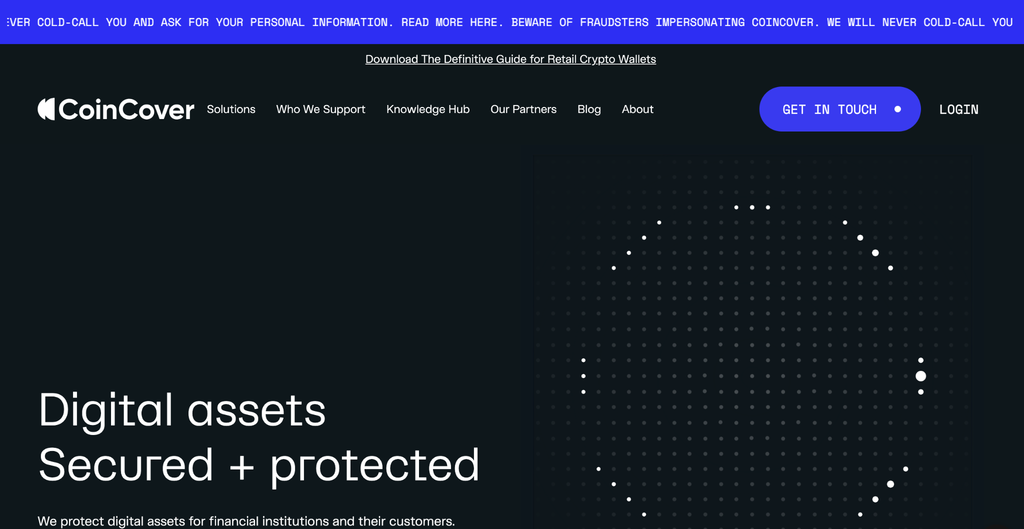
4. Coincover
Fuente: coincover.com
Tipo: Hybrid, Lloyd’s-backed protection and recovery
Cobertura: Protects more than $300 million in crypto across 15,000-plus wallets
Coincover, founded in Cardiff in 2018, blends insurance with security technology. Its policies are underwritten through Lloyd’s syndicates, including Atrium, TMK, and Markel. The product line splits into Coincover Protect, which screens transactions and flags suspicious activity, and Coincover Recover, which handles clave cifrada backup and disaster recovery.
Ventajas:
Combines active theft prevention with a real insurance backstop
Strong recovery infrastructure for lost private keys, a gap most competitors don’t fill
Works with over 550 companies and secures tens of millions of wallets globally
Desventajas:
Total insured value is modest compared to Evertas or Canopius
Best features are aimed at businesses and are less useful for casual retail holders
Pricing requires a custom quote for most products
Ideal para: Exchanges and wallet providers that want built-in recovery tools alongside their insurance.
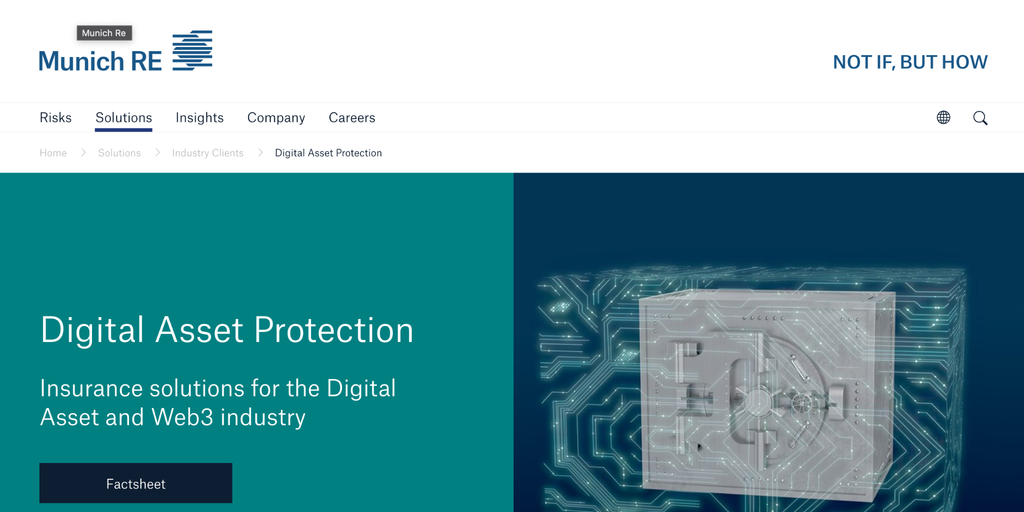
5. Munich Re
Fuente: munichre.com
Tipo: Traditional reinsurance, specialized products
Cobertura: Custom institutional limits
Munich Re, one of the world’s largest reinsurers, has built out a genuinely specialized crypto lineup: a Digital Asset Comprehensive Crime Policy, Smart Contract Risk Insurance, and a Staking Risk Insurance product aimed specifically at slashing events on proof-of-stake networks like Ethereum. Its 2023 partnership with Boerse Stuttgart Digital was one of the first fully insured institutional staking offerings in Europe.
Ventajas:
One of the only major reinsurers offering dedicated slashing coverage
Backed by one of the largest balance sheets in global insurance
Covers both custodial and non-custodial digital asset liabilities
Desventajas:
Products are aimed squarely at institutions and platforms, not individuals
No public self-serve quote tool
Coverage terms vary significantly by partner and jurisdiction
Ideal para: Staking providers and institutional DeFi platforms that need slashing-specific protection.
6. SEGURO
Fuente: Google pics
Tipo: Decentralized, multi-chain protocol
Cobertura: More than 140 protocols across 20-plus chains
InsurAce launched in 2020 with a portfolio-based pricing model designed to lower premiums by spreading risk across many protocols at once.
It now covers smart contract exploits, stablecoin depegs, and custodian risk across chains, including Ethereum, BNB Chain, Polygon, and Avalanche. Its biggest real-world test came during the Terra collapse in 2022, when it paid out roughly $12 million in claims tied to the UST depeg.
Ventajas:
Broadest multi-chain coverage among decentralized providers
Portfolio-based pricing tends to run cheaper than single-protocol covers
Has a real history of paying claims during a major market event
Desventajas:
Smaller capital pool than traditional insurers, which limits payout size
Governance and claims decisions are community-driven, which can be slower in disputed cases
Coverage cannot be modified once purchased, only cancelled for a partial refund
Ideal para: Multi-chain DeFi users who want one policy covering several protocols at once.
Cobertura: Backs most major traditional crypto insurers on this list
Lloyd’s isn’t a single insurer. It’s a marketplace where syndicates like Arch, Atrium, Beazley, and Canopius underwrite crypto risk. Lloyd’s was the first major insurance institution to back crypto coverage, starting in 2019, and it remains the backbone behind Evertas, Coincover, Canopius, and AnchorWatch. Its policies carry a strong financial security rating from AM Best and Standard & Poor’s (prominent credit rating agencies).
Ventajas:
Backs the highest-rated crypto policies available anywhere
Centuries of claims-paying history and financial strength
Broad global reach through its network of coverholders
Desventajas:
You typically can’t buy directly from Lloyd’s, only through a coverholder or broker
Terms vary wildly by which syndicate is underwriting your specific policy
Not built for individual retail holders without a broker relationship
Ideal para: Anyone comparing providers who wants to check whether a policy’s underlying backing is credible.
8. Aon
Fuente: aon.com
Tipo: Global insurance broker
Cobertura: More than $1.2 billion in individual client capacity secured
Aon isn’t an underwriter. It’s a broker that pieces together coverage from multiple insurers on a client’s behalf, and its Digital Asset & Blockchain practice has been active since some of the earliest crypto crime policies existed.
In 2025, Aon arranged $120 million in crime and specie insurance for Crypto.com’s Custody Trust Company, sourced through Lloyd’s. Aon has also started testing stablecoin-based premium payments with clients like Coinbase and Paxos.
Ventajas:
Access to a broad network of insurers, not locked into one carrier
Deep experience negotiating large, custom institutional programs
Early mover on innovations like on-chain premium payment
Desventajas:
Not a direct insurer, so pricing and terms depend on which carriers Aon can access for you
Built for large clients, not individual policyholders
Requires a direct relationship and negotiation, not a quote-and-buy process
Ideal para: Large exchanges and custodians that need a broker to assemble a bespoke, multi-carrier insurance program.
9. Pantano
Source: marsh.com
Tipo: Global insurance broker
Cobertura: Facility offering up to $825 million in capacity for digital asset custodians
Marsh, one of the largest insurance brokers in the world, built a dedicated facility that can provide up to $825 million in insurance capacity for digital asset custodians, pulling from multiple underwriters at once. This kind of stacked capacity is exactly what large custodians need, since no single Lloyd’s syndicate can cover losses on the scale of a Bybit-sized hack alone.
Ventajas:
Among the largest aggregate capacity facilities in the crypto insurance market
Strong relationships across traditional insurers entering the crypto space
Deep experience structuring large, multi-layered institutional programs
Desventajas:
Aimed at large custodians and financial institutions, not individuals or small businesses
Requires broker negotiation rather than a self-serve quote
Underlying carrier terms vary depending on how the program is structured
Ideal para: Custodians and financial institutions that need very large, stacked coverage limits.
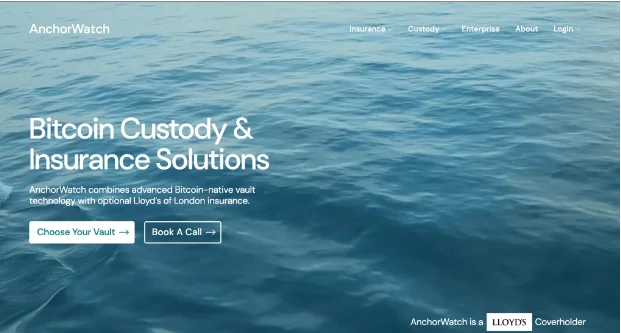
10. AnchorWatch
Fuente: anchorwatch.com
Tipo: Hybrid, Lloyd’s-backed Bitcoin custody and insurance
Cobertura: Up to $500 million per customer, with a $100 million per-vault standard limit
AnchorWatch is one of the newer entrants on this list, but it fills a real gap: insured Bitcoin custody built specifically for individuals and businesses holding between roughly $250,000 and $100 million, not just large institutions.
It’s a Lloyd’s of London coverholder, working with Arch Insurance, and it uses a multi-institution custody model that splits key control across AnchorWatch, BitGo, and CoinCorner so no single party can move funds alone. Insurance pricing starts around $4,000 per $1 million of coverage annually.
Ventajas:
One of the few providers offering named, individual insurance policies to retail Bitcoin holders
Multi-institution custody design removes single points of failure
Transparent, published pricing calculator, rare in this industry
Desventajas:
Bitcoin-only, so it won’t help holders of other crypto assets
Newer company with a shorter track record than Lloyd’s veterans like Evertas
Some features, like Qualified Custody, are still rolling out through 2026
Ideal para: Individual Bitcoin holders and small businesses who want a named insurance policy, not a pooled corporate fund.
Traditional vs. Decentralized Crypto Insurance
The core tradeoff comes down to speed and transparency versus scale and legal recognition.
Choose traditional insurance if:
You’re a business, exchange, or custodian that needs regulatory-grade coverage
Your asset value exceeds what any decentralized pool could realistically pay out
You need a licensed insurance contract for compliance reasons, like MiCA
Choose decentralized insurance if:
You’re a DeFi user primarily worried about smart contract exploits
You want full transparency into the capital backing your coverage
You’re comfortable with community-based claims decisions instead of a formal adjuster
¿Puedes usar ambos? Yes, and many sophisticated holders do. A common approach is to insure custodial holdings through a traditional provider and cover active DeFi positions separately through a decentralized pool. This layered approach matches each type of risk to the provider best suited to handle it.
How Much Does Crypto Insurance Cost?
Premiums vary a lot depending on the type of provider and what’s being insured.
DeFi protocol cover: Roughly 2 to 6% of the insured value per year on decentralized platforms like Nexus Mutual
Bitcoin custody insurance: AnchorWatch prices this at around 0.40% to 0.80% annually, translating to roughly $4,000 per $1 million insured
Custodia institucional: Custom pricing, typically negotiated through a broker like Aon or Marsh based on security posture and claims history
What drives your premium up or down:
Total asset value and how it’s stored (cold storage generally costs less to insure than hot wallets)
Security controls in place, including multi-signature setups and audit history
Claims history, both yours and the protocol’s
Coverage limit and deductible you choose
Geographic and regulatory factors, since MiCA-compliant policies in the EU may carry different pricing than US policies
A rough rule of thumb: cold storage with strong security controls is one of the cheapest things to insure in crypto, while carteras calientes and unaudited smart contracts sit at the expensive end.
What Crypto Insurance Does Not Cover
This is the section most people skip, and it’s the one that causes the most disappointment later. No policy on this list, traditional or decentralized, covers the following:
Volatilidad del mercado: If your crypto’s price drops, that’s not a covered loss under any provider.
Error de usuario: Sending funds to the wrong address or losing a seed phrase without a recovery service usually falls outside standard coverage.
Suplantación de identidad: Most policies treat phishing losses as a user responsibility unless you specifically bought a product like Coincover’s that screens for it.
Pre-existing vulnerabilities: A smart contract bug that existed before you bought cover typically won’t be paid out.
Regulatory seizure or sanctions violations: These fall under standard force majeure and compliance exclusions.
War and similar large-scale events: Standard exclusion language across the insurance industry, not unique to crypto.
Understanding these exclusions matters more than picking the “best” provider, because a mismatched policy that doesn’t cover your riesgo real is close to worthless. Before buying, always read the full policy wording, not just the marketing page.
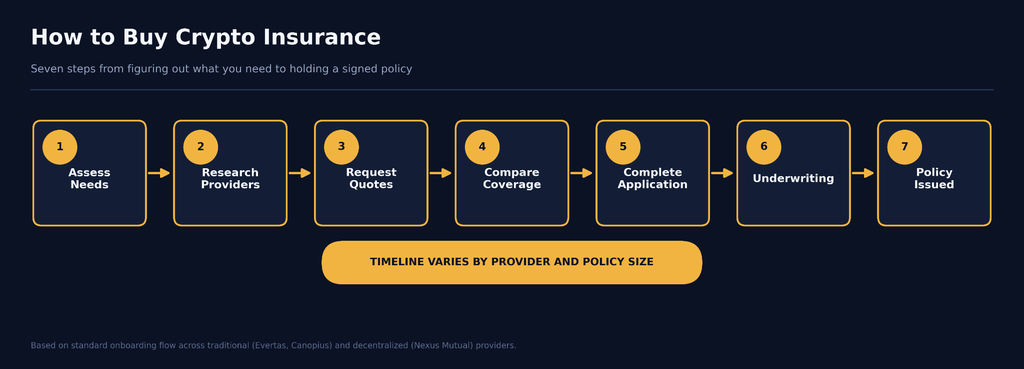
How to Buy Crypto Insurance: Step-by-Step
Buying crypto insurance starts with identifying the risks you actually need to protect against.
1. Evalúe sus necesidades de cobertura
Before contacting providers:
Document your holdings: Record assets, values, wallet addresses, exchanges, and DeFi protocols.
Review your custody setup: Identify risks across self-custody wallets, exchanges, custodians, and staking platforms.
Define the risks: Decide whether you need protection against hacks, smart-contract failures, depegging, custody losses, or slashing.
Set a premium budget: Compare the potential loss against the cost of coverage.
Proveedores de investigación: Compare traditional insurers with on-chain providers such as Nexus Mutual and other DeFi cover platforms.
Verifique la elegibilidad: Confirm that the provider supports your jurisdiction, asset, blockchain, and protocol.
2. Get Quotes and Compare Policies
Request quotes from several suitable providers where possible. Review:
Coverage limits and duration
Primas y deducibles
Covered events and exclusions
Claim requirements and payout conditions
Provider regulation or underwriting model
KYC and security requirements
Never buy based on price alone. Read the complete policy wording and verify exactly what triggers a payout. For example, Nexus Mutual currently offers cover periods from 28 to 365 days, with pricing determined by the specific product and risk.
3. Complete Application and Underwriting
Traditional insurers may assess your custody arrangements, security controls, transaction history, and risk exposure before approving coverage.
On-chain providers can use a different model. For example, Nexus Mutual requires membership and KYC before users can purchase cover, while its capital model relies on NXM stakers providing underwriting capacity.
Complete any required identity verification, connect the appropriate wallet, provide requested information, and wait for approval if underwriting applies.
4. Activate and Manage Your Policy
Una vez aprobado:
Pay the premium and confirm the coverage is active.
Save your policy documents, cover wording, and transaction records.
Record the expiry and renewal dates.
Review your coverage whenever your holdings, custody arrangements, or risk exposure changes.
Keep evidence that could support a future claim.
For on-chain cover, verify the policy directly on the provider’s platform. Nexus Mutual tokenizes purchased cover as an NFT, making the coverage details accessible from the member’s wallet.
5. Know How Claims Work
If a covered loss occurs, follow the provider’s claim procedure immediately. Requirements can include proof of ownership, transaction records, wallet signatures, and evidence of the loss. Nexus Mutual, for example, requires proof of loss and assesses claims through its Claims Committee.
Tip: Don’t assume every crypto loss is insurable. Market losses, unsupported assets, excluded events, and losses outside the policy terms may not qualify for compensation.
Crypto Insurance and Regulations 2026
Crypto insurance is becoming increasingly tied to regulatory compliance
EU: MiCA Insurance and Prudential Requirements
En MiCA Article 67, crypto-asset service providers (CASPs) must maintain prudential safeguards equal to the higher of their permanent minimum capital requirement or 25% of the previous year’s fixed overheads. These safeguards can consist of qualifying one’s own funds, insurance, or a comparable guarantee.
Where insurance is used, the policy must:
Cover the EU territories where the CASP operates.
Run for at least one year with a minimum 90-day cancellation notice.
Come from an insurer authorized under EU or national law.
Be provided by a third party and publicly disclosed.
Cover risks including misleading statements, regulatory breaches, confidentiality failures, business disruption, system failures, and, where applicable, gross negligence in safeguarding client assets.
Lista de verificación de cumplimiento: CASPs should verify capital requirements, maintain appropriate insurance or guarantees, document risk controls, review coverage annually, and ensure their insurer meets MiCA’s authorization requirements.
US: A Developing Federal Framework
The US still lacks a single federal crypto-insurance mandate. Instead, requirements depend on the activity, regulator, and state.
El Ley CLARITY is still moving through Congress in September 2026 and aims to establish clearer boundaries between securities and commodities while defining SEC and CFTC oversight. Its final impact on crypto custody, exchanges, and insurance remains uncertain.
For insurers and crypto businesses, FinCEN/AML obligations remain important where activities fall within the money-services-business framework. Firms should therefore combine insurance controls with KYC, transaction monitoring, sanctions screening, and suspicious-activity reporting.
At the state level, jurisdictions such as Wyoming, Texas, and Florida continue developing crypto-friendly frameworks, creating a more fragmented regulatory environment.
UK, Singapore, and Hong Kong
The UK is moving toward a full crypto regime. The FCA’s new framework takes effect 25 October 2027, with applications opening 30 September 2026. Firms should prepare for authorization, prudential standards, consumer protection, governance, and financial-crime controls.
Singapore continues licensing digital-payment-token providers, with 38 major payment institutions listed for DPT services as of July 2026. Meanwhile, Hong Kong is also strengthening Virtual Asset Service Provider (VASP) supervision, including cybersecurity, AML reporting, and proposed rules for VA advisory, dealing, and custody services
The direction is clear: crypto insurance is increasingly becoming part of a broader risk-management and regulatory framework, with stronger expectations around capital, custody, cybersecurity, AML, and consumer protection.
Únase a UEEx
Experimente la plataforma líder mundial de gestión de patrimonio digital
Crypto insurance is a form of risk management that protects digital asset holders against losses from hacks, theft, and custody failures. It works by pooling capital, either through traditional insurance syndicates like Lloyd’s of London or decentralized member-owned pools, to compensate policyholders when specific covered events occur.
It is important to note that these policies generally do not cover losses resulting from market volatility, user errors like losing private keys, or price drops, so reading policy exclusions carefully is essential before purchase.
Do I need crypto insurance if I only hold it on an exchange?
You may need independent crypto insurance even if you hold assets on an exchange because most platforms do not fully insure every dollar of user funds. While some exchanges maintain internal reserve funds, these are often insufficient to cover large-scale hacks or platform insolvency.
Securing your own separate custody policy ensures you have dedicated coverage tailored to your specific risk profile and asset value, providing a backup that the exchange alone might not offer.
What’s the difference between traditional and decentralized crypto insurance?
The difference between traditional and decentralized crypto insurance lies in how they are backed, regulated, and how claims are processed. Traditional insurance is backed by regulated insurers like Lloyd’s of London, offering higher coverage limits and regulatory recognition, while decentralized insurance utilizes member-funded pools on the blockchain for faster, community-governed payouts.
Each model serves different needs: traditional options suit institutions requiring legal compliance, whereas decentralized alternatives are often preferred by DeFi users seeking transparency and speed.
How much does crypto insurance cost?
Crypto insurance costs vary widely based on the provider, the asset type, and the coverage model, typically ranging from 0.40% to 6% of the insured value annually. Decentralized DeFi protocols often charge premiums between 2% and 6%, while specialized Bitcoin custody insurance can range from 0.40% to 0.80%.
Institutional policies involve custom pricing that is negotiated through brokers like Aon or Marsh, factoring in your specific security controls, claims history, and risk exposure.
Descargo de responsabilidad : Este artículo tiene fines exclusivamente informativos y no debe considerarse asesoramiento comercial ni de inversión. Nada de lo aquí expuesto debe interpretarse como asesoramiento financiero, legal o fiscal. Operar o invertir en criptomonedas conlleva un riesgo considerable de pérdida financiera. Realice siempre la debida diligencia antes de tomar cualquier decisión de inversión.
Comercio con comprobante de reservas
UEEx publica auditorías mensuales y verificaciones de terceros sobre cada mercado cotizado.
Análisis de mercado, estrategias de trading, perspectivas sobre futuros y alertas de seguridad semanales. Leído por más de 10 000 traders de criptomonedas.