Every financial system in history has made the same quiet assumption: someone trustworthy is holding your money on your behalf.
Crypto was built specifically to challenge that assumption. Centralized vs decentralized crypto exchanges is where that challenge plays out in real time, one side offering the convenience of the old model, the other offering the control the old model never gave you. Neither is perfect, both are necessary to understand.
Waarom deze vergelijking belangrijker is dan ooit tevoren
The CEX vs DEX question has changed shape in the last two years for a few clear reasons.
1. Security Lessons Go Both Ways
Security remains a paramount concern for all market participants. Centralized exchanges invest heavily in institutional-grade security and insurance funds, yet they remain high-value targets for sophisticated cyberattacks.
Conversely, decentralized protocols rely on audited code, but even rigorously tested smart contracts can harbor undiscovered vulnerabilities.
2. Regulation Is Reshaping the Industry
Crypto regulation has entered a new era with the EU’s Markets in Crypto-Assets (MiCA) framework, which is now active across the European Union.
Exchanges operating in Europe must now meet strict licensing, transparency, and consumer protection standards. While most DEXs remain outside MiCA’s core scope, centralized platforms are facing increasing regulatory scrutiny under this new regime.
3. CEXs and DEXs Now Complement Each Other
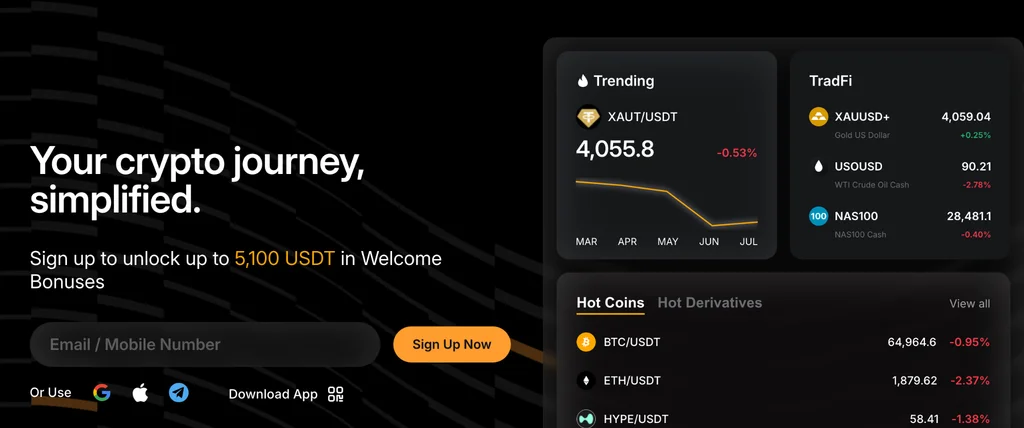
The divide between centralized and decentralized exchanges is fading. In 2026, major CEXs saw a massive increase in traditional asset (TradFi) derivatives trading, reaching $393.15 billion in June 2026, as per CoinGecko Research. That shows a real shift in where people trade.
Traders increasingly rely on CEXs for fiat on- and off-ramps, deep liquidity, and fast execution, while turning to DEXs for self-custody, early-stage token access, and DeFi opportunities.
As security risks, regulation, and user preferences evolve, understanding when to use each platform has become an essential skill for anyone serious about investing in crypto.
Centralized Exchanges (CEX): The Full Picture
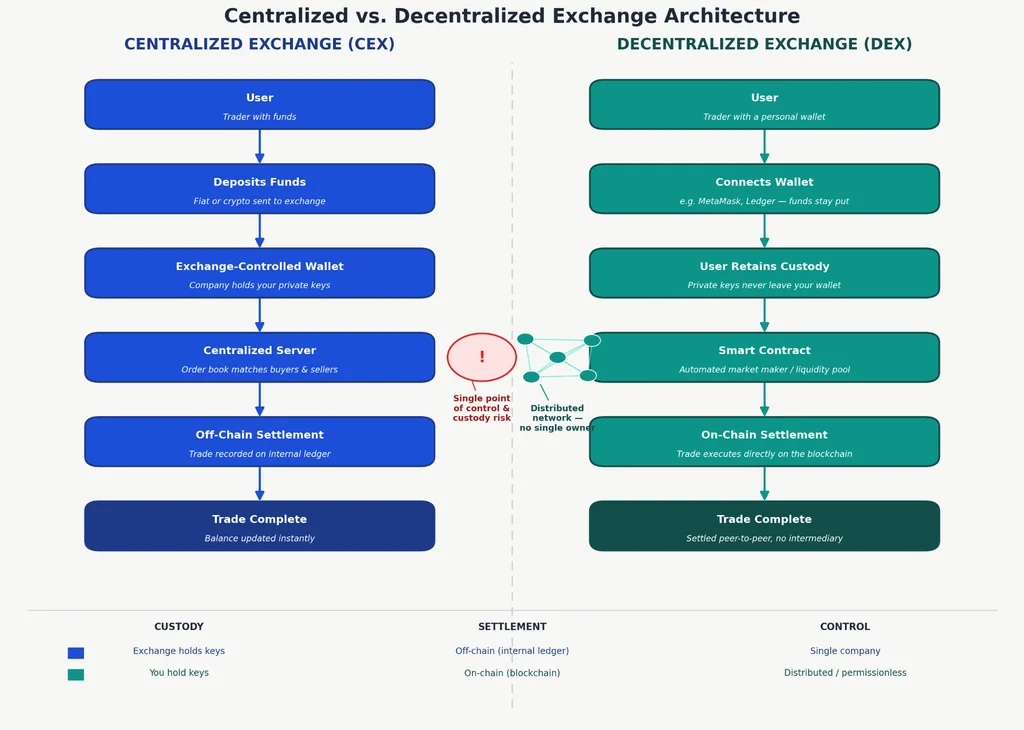
A centralized exchange is a registered business, like Coinbase Global Inc. or Binance Holdings Ltd., that acts as the middleman for every trade. It holds your private keys, runs its own order book, and has to answer to financial regulators.
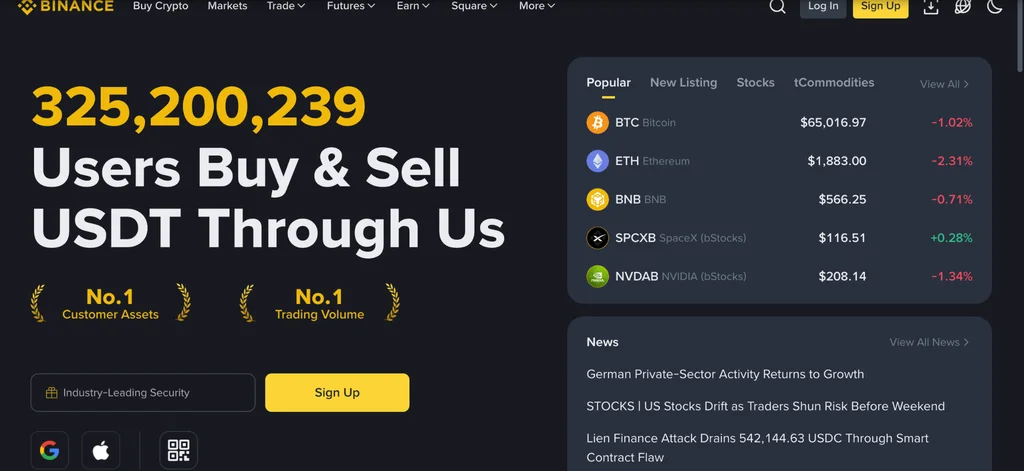
Binance remains the world’s largest cryptocurrency exchange, serving more than 300 million users and supporting a market-leading selection of over 1,000 digital assets and trading pairs.
It continues to dominate spot and derivatives trading while expanding its on-chain ecosystem through Binance Wallet.
However, its regulatory journey remains mixed. Although Binance holds licenses in several jurisdictions, it has faced restrictions in parts of Europe as it restructures its operations to align with the EU’s MiCA framework.
2. Coinbase: Best for Regulation and Beginners
Bron: Pinterest
Coinbase has strengthened its position as one of the industry’s most trusted exchanges.
With support for more than 290 cryptocurrencies, an intuitive interface, and growing institutional services, it remains a top choice for new and experienced investors alike.
The company has also expanded its on-chain presence through the Base network while securing MiCA authorization in Europe, reinforcing its reputation as one of the most regulated crypto exchanges globally.
Bybit remains a leading platform for derivatives trading, consistently expanding its services and improving transparency to sustain investor confidence.
The exchange now serves over 80 million users, supports more than 400 digital assets, and continues expanding into decentralized finance with its integrated Web3 wallet.
Its resilience and improved transparency sustain investor confidence in a competitive market.
4. OKX: Bridging Centralized and Decentralized Finance
Bron: Pinterest
OKX has evolved beyond a traditional exchange into a complete Web3 platform. Supporting more than 350 cryptocurrencies, it combines centralized trading with one of the industry’s most widely used self-custody wallets and DeFi services.
The exchange has also strengthened its regulatory standing by obtaining MiCA authorization in Europe, making it an attractive option for users seeking both compliance and Web3 functionality.
5. Kraken: The Security-First Exchange
Bron: Pinterest
Kraken continues to distinguish itself through its strong focus on security and regulatory compliance. The exchange supports over 430 cryptocurrencies and offers spot trading, staking (where permitted), and institutional services.
Unlike many competitors, Kraken has maintained a strong security record. In June 2025, Kraken secured its own MiCA license through the Central Bank of Ireland, joining Coinbase, OKX, and Bybit among fully authorized platforms in Europe. It remains a preferred choice for investors who prioritize transparency and long-term reliability.
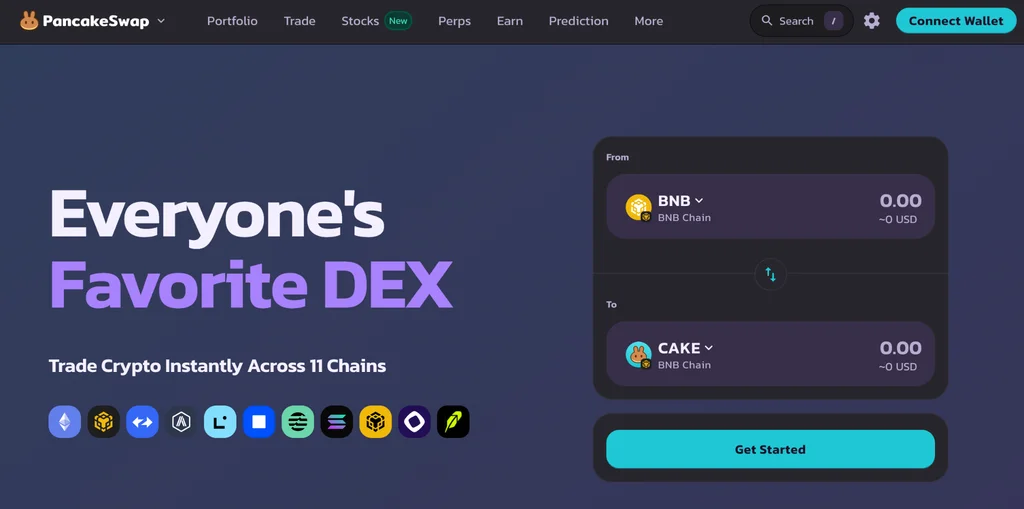
A decentralized exchange runs entirely on smart contracts. Nobody holds your funds for you. You connect a personal portemonnee, like MetaMask or a Ledger hardware device, and trade directly from it.
Instead of a company matching buyers and sellers, automated market makers, essentially pools of tokens supplied by other users, set prices and execute trades on-chain.
The Top 5 DEXs in 2026
Here is the curated top 5 DEXs for 2026
uniswap
Uniswap remains the benchmark for decentralized exchanges, pioneering the automated market maker (AMM) model that powers much of DeFi today.
Its Uniswap v4 upgrade introduced customizable hooks, allowing developers to add advanced features such as dynamic fees and custom trading logic.
Operating across multiple blockchains, the protocol continues to process billions of dollars in trading volume while maintaining its position as Ethereum’s leading DEX.
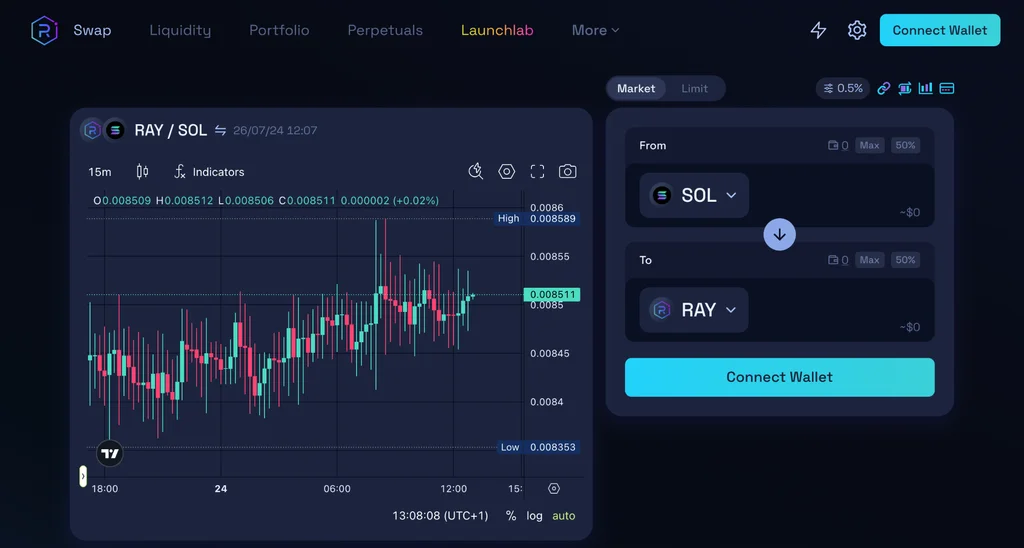
Raydium is Solana’s flagship decentralized exchange, known for its fast execution and low transaction costs. It became a major hub during the memecoin boom, handling trading volumes that at times rivaled Uniswap.
Despite changing market cycles, Raydium remains a key source of liquidity within the Solana ecosystem, supporting token launches, swaps, and yield-generating opportunities.
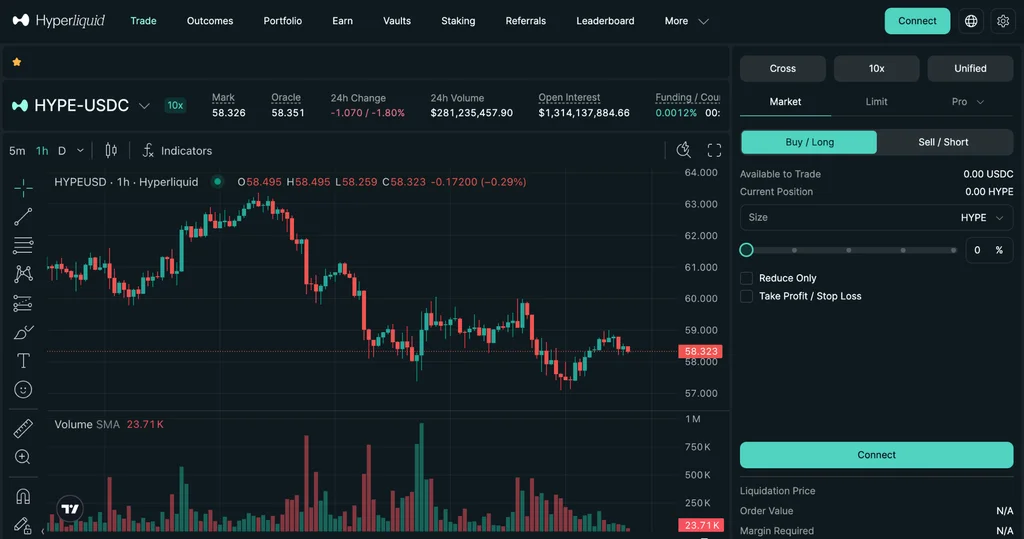
Hyperliquid has emerged as a leader in decentralized perpetual futures trading, proving that on-chain platforms can compete with centralized exchanges in the derivatives market.
Since its late-2024 airdrop, the protocol has experienced rapid adoption, contributing to significant growth in decentralized perpetual trading while attracting active traders with deep liquidity, low fees, and a high-performance trading experience.
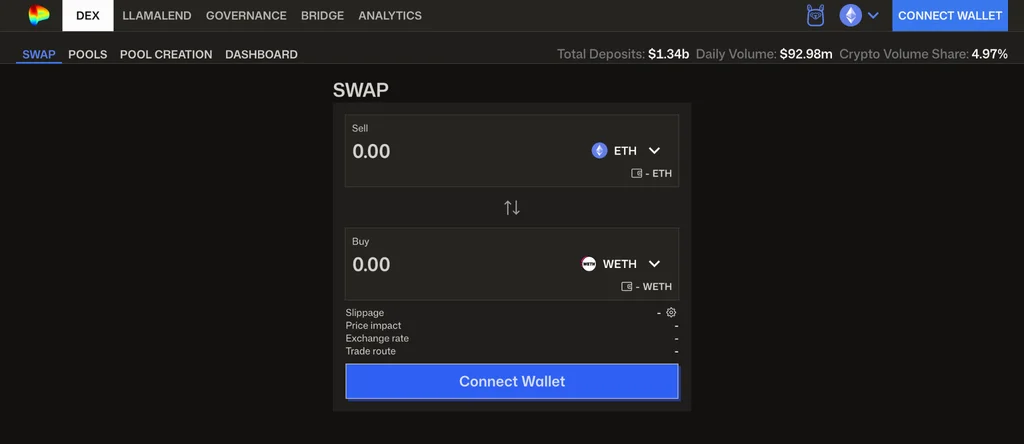
Curve Finance specializes in low-slippage swaps between assets with similar values, particularly stablecoins and liquid staking tokens.
Its efficient AMM design makes it a cornerstone of the DeFi ecosystem, supplying deep liquidity that many lending protocols, yield aggregators, and other decentralized applications rely on for stable and cost-effective asset exchanges.
Permissionless listings for thousands of early-stage assets.
DEX
Snelheid
Millisecond settlement on internal servers.
Subject to network block times and congestion.
CEX
vergoedingen
Flat trading fees can add up on withdrawals.
Network gas fees vary widely by chain.
Hangt
Regulatie
Licensed under legal frameworks with consumer protections.
Operates globally in a regulatory gray area with no recourse.
CEX
Toegang
Restricted by regional laws and country bans.
Open globally to any internet-connected wallet.
DEX
Geavanceerde hulpprogramma's
Professional margin, futures, options, and API access.
Native DeFi tools like yield farming and liquidity pools.
Split
How to Protect Your Crypto
If you use a centralized exchange (CEX):
Enable app-based two-factor authentication (2FA) instead of SMS to reduce the risk of SIM-swap attacks.
Whitelist withdrawal addresses so funds can only be sent to wallets you’ve approved.
Keep only the funds you need for active trading on the exchange; store long-term holdings in self-custody.
Choose exchanges regulated under frameworks such as MiCA where applicable, as these platforms must meet stricter requirements for governance, safeguarding client assets, and consumer protection.
If you use a decentralized exchange (DEX):
Store significant holdings in a hardware wallet rather than a browser-based wallet.
Regularly revoke unused token approvals with tools like Revoke.cash to limit unnecessary permissions.
Verify contract addresses before connecting your wallet or signing transactions.
Use protocols that have undergone independent veiligheid audits by firms such as CertiK or Trail of Bits, but remember that an audit reduces risk; it does not eliminate it.
The best choice depends on your experience, investment goals, and trading habits. For most investors, a combination of both offers the greatest flexibility.
1. Beginners vs. Experienced Traders
If you’re new to crypto, start with a centralized exchange. CEXs provide a familiar interface, customer support, and direct bank deposits, making it easier to learn the basics before managing private wallets or gas fees.
Once you’re comfortable with self-custody, you can gradually explore decentralized exchanges.
2. Portfolio Size and Investment Goals
For smaller portfolios (under roughly $1,000), a CEX is usually more cost-effective since blockchain network fees can significantly impact returns.
Larger portfolios benefit from self-custody using a hardware wallet, with a CEX reserved for high-liquidity trades or fiat conversions.
Long-term investors should consider transferring assets from a CEX to a personal wallet, while active traders often benefit from the speed, liquidity, and advanced tools available on CEXs.
DEXs remain the preferred choice for yield farming, liquidity provision, and accessing new tokens before exchange listings.
3. Privacy, Regulation, and Cash Access
If privacy is a priority, DEXs offer greater control, although transactions remain publicly traceable on the blockchain.
If you regularly deposit or withdraw fiat, keeping a CEX account is essential since DEXs don’t connect directly to banks.
EU investors should prioritize MiCA-licensed exchanges for stronger regulatory protections, while users elsewhere should choose reputable, regulated platforms where available.
Bottom line: Start with a CEX, adopt self-custody as your knowledge grows, and use each platform for what it does best.
Hybrid Strategies: Why Experienced Traders Use Both
The CEX vs DEX debate presents a false choice once you’ve been trading for a while. A large number of experienced crypto users, meaning those with 18 or more months of experience, regularly use both centralized and decentralized platforms, switching based on what a specific trade actually needs.
A few patterns show up again and again among experienced traders:
Fiat gateway approach: keep a CEX account open purely for converting cash to crypto and back, then move funds to a personal wallet for everything else.
Liquidity split: route large trades through a CEX for tighter pricing, and smaller or niche trades through a DEX.
Yield diversification: use simple one-click staking on a CEX for low-effort returns, and reserve more active DeFi strategies, like liquidity provision, for a DEX.
Risicosegmentatie: keep an active trading balance on a CEX and store long-term holdings in a hardware wallet, interacting with DEXs only from that wallet.
Early access strategy: buy new tokens on a DEX at launch, then move to a CEX once a listing happens for better liquidity on the exit.
No matter which approach you choose, follow a few essential security practices: never store all your crypto on a single platform, keep long-term holdings in a hardware wallet, and regularly revoke unused token approvals with tools like Revoke.cash to reduce security risks.
Maintain accurate tax records. While many centralized exchanges provide tax documents, activity on decentralized exchanges often requires manual tracking with platforms such as Koinly or CoinLedger.
Disclaimer : Dit artikel is uitsluitend bedoeld ter informatie en mag niet worden beschouwd als handels- of beleggingsadvies. Niets in dit artikel mag worden opgevat als financieel, juridisch of fiscaal advies. Handelen in of beleggen in cryptovaluta brengt een aanzienlijk risico op financieel verlies met zich mee. Voer altijd gedegen onderzoek uit voordat u handels- of beleggingsbeslissingen neemt.