Stock market books are structured guides written by professional investors, economists, and market analysts that explain how to evaluate securities, build long-term wealth, manage risk, and trade with discipline. Unlike financial news or social media tips, books offer reasoning backed by decades of real market performance. They translate complex theories – value investing, behavioral finance, technical analysis, index strategies – into actionable frameworks any investor can apply. As of Q1 2026, a relatively small set of titles consistently tops recommended reading lists across professional and retail investment communities worldwide.
Why Do Serious Investors Still Read Books in 2026?
Markets change, but human behavior does not. The emotional cycles of greed and panic that drove the 1929 crash, the dot-com collapse, and the 2022 crypto winter follow near-identical patterns. Books written decades ago remain relevant because they document those behavioral patterns with enough rigor to help investors recognize them before it costs money.
According to research aggregated on ResearchGate, approximately 90% of retail traders lose money in equity markets. Most losses trace back not to a lack of information, but to poor decision-making under pressure. The best investment books address this directly – they train investors to think systematically rather than reactively, which is a skill financial apps and short-form content rarely build.
As of 2026, Shortform’s ranked list of 100 all-time investing books shows that titles published between 1949 and 2020 continue to dominate search traffic and recommendation lists, outpacing anything published in the last three years.
Which Classic Books Do Professional Investors Still Recommend?
Is “The Intelligent Investor” Still the Gold Standard?
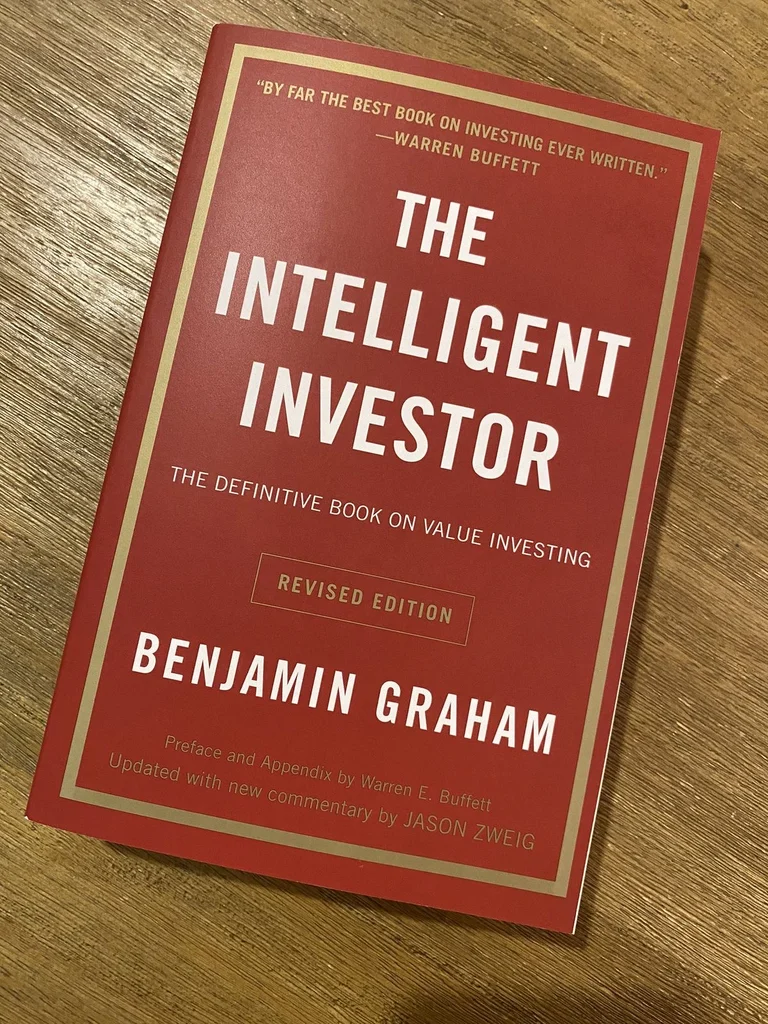
Benjamin Graham’s O Investidor Inteligente (1949, revisado em 1973) remains the most cited investing book among professional fund managers. Graham introduced the concept of “Mr. Market” – a fictional, emotionally volatile business partner – to explain why stock prices often diverge from actual business value. His margin-of-safety principle, which instructs investors to buy only when a stock trades well below its intrinsic worth, is the foundation of value investing as practiced by Warren Buffett.
The book does not predict specific returns. Instead it teaches a process: identify undervalued assets, ignore short-term noise, and hold with patience. That process produced market-beating results for Graham’s own partnerships and, later, for Buffett’s Berkshire Hathaway over 60-plus years.
What Does “A Random Walk Down Wall Street” Argue?
Burton G. Malkiel’s 1973 book, now in its 13th edition, makes the case that stock prices move randomly enough to make consistent market-beating stock-picking essentially impossible for most investors. His prescription: low-cost index funds that capture broad market returns without the fees and tax drag of active management.
The argument has grown stronger over time. S&P Global’s SPIVA reports consistently show that over 15-year periods, roughly 90% of actively managed U.S. large-cap funds underperform their benchmark index. Malkiel’s thesis, once controversial, is now close to mainstream financial consensus.
How Does Peter Lynch’s Approach Differ?
Peter Lynch managed Fidelity’s Magellan Fund from 1977 to 1990, achieving an average annual return of 29.2%. In Um em Wall Street (1989), he argued that individual investors hold an advantage over institutional analysts: they observe real consumer behavior before Wall Street catches on. If a restaurant is always packed, if a retail product keeps selling out – those are investable signals a fund manager in a Manhattan office might miss entirely.
Lynch coined the term “ten-bagger” for stocks that return 10 times their original investment. His method centers on buying what you understand and holding through short-term volatility without panic. As of 2026, Investing.com’s top books list ranks Um em Wall Street among the five most recommended titles for new investors entering the market.
Junte-se à UEEx
Experimente a plataforma líder mundial em gestão de patrimônio digital
What Books Are Best for Understanding Passive Investing?
What Does John Bogle’s Work Teach?
John Bogle founded Vanguard and created the first retail index fund in 1976. O pequeno livro do bom senso de investimento (2007) distills his philosophy into a single thesis: the stock market delivers returns proportional to corporate earnings growth, and every dollar paid in fees and taxes is a dollar subtracted from that return. Over 30 years, a 1% annual fee difference between two funds can cost an investor 25% of their final portfolio value.
Bogle’s work underpins the now-$10-trillion passive investing industry. His message – own the whole market, keep costs low, stay the course – remains among the most empirically supported strategies in financial literature.
Who Is “The Bogleheads’ Guide to Investing” For?
This book, authored by a community of Vanguard-philosophy investors, expands Bogle’s framework into a practical playbook covering asset allocation, tax-advantaged accounts, rebalancing schedules, and retirement planning. It bridges the gap between abstract investing philosophy and the specific decisions a working adult needs to make. For investors who find O Investidor Inteligente too theoretical, the Bogleheads’ guide serves as an accessible starting point.
Which Books Cover Technical Analysis and Chart Reading?
What Makes “Technical Analysis of the Financial Markets” Essential?
John J. Murphy’s Análise Técnica dos Mercados Financeiros (1999) is the most frequently cited reference for traders who rely on chart-based decision-making. It covers candlestick patterns, trend analysis, moving averages, oscillators, volume interpretation, and intermarket relationships in a single, organized volume. As of 2026, it remains the primary textbook used in professional trading training programs at major brokerage firms worldwide.
Murphy’s writing does not assume mathematical sophistication. He explains every concept from first principles, making the book accessible to intermediate investors who want to move beyond buy-and-hold strategies without enrolling in a finance degree program.
How Does “Trading in the Zone” Address Trading Psychology?
Mark Douglas’s Negociação na Zona (2000) is a direct treatment of why technically competent traders still lose money consistently. Douglas argues that markets do not produce certainty, and any trader who needs certainty to act will be paralyzed or, worse, will rationalize bad trades to avoid admitting uncertainty. The book builds a mental framework for accepting probabilistic outcomes – executing a plan without emotional interference, win or lose.
Em 2026, Negociação na Zona appears on recommended reading lists at StockBrokers.com, Warrior Trading, and For Traders, consistently cited as the single most important psychology book for active traders regardless of the strategy they use.
What Is “Market Wizards” and Who Should Read It?
Jack Schwager’s Market Wizards (1989) compiles interviews with top traders – Paul Tudor Jones, Ed Seykota, Michael Marcus, and others – and extracts common principles across wildly different strategies. The book reveals that the traders who survive and grow over decades share traits that have nothing to do with superior information: strict risk management, emotional consistency, and a willingness to accept losses quickly. For beginners, it demystifies what professional trading looks like from the inside.
Which Books Cover Growth Investing and Stock Selection?
What Did Philip Fisher Contribute to Growth Investing?
Philip Fisher’s Ações ordinárias e lucros incomuns (1958) introduced qualitative analysis as a serious investment tool. Where Graham focused on balance sheets, Fisher focused on management quality, research culture, and competitive moat. His “scuttlebutt” method – talking to suppliers, customers, and competitors to understand a business – predated modern due diligence practices by decades.
Warren Buffett has described his own investment philosophy as “85% Graham, 15% Fisher.” Fisher’s influence is most visible in Buffett’s willingness to pay premium prices for high-quality businesses rather than hunting only for statistical bargains.
How Does Joel Greenblatt’s “Magic Formula” Work?
In The Little Book That Still Beats the Market (2005), Joel Greenblatt presented a mechanical stock-screening formula combining two variables: earnings yield (a measure of cheapness) and return on capital (a measure of quality). By ranking thousands of stocks on both metrics and buying the top-ranked names, his back-tested results showed significant outperformance over U.S. market indices across multiple decades. The formula’s value lies in removing emotional judgment from the stock selection process entirely.
What Books Address the Behavioral Side of Investing?
Why Has “The Psychology of Money” Sold Over 10 Million Copies?
Morgan Housel’s A psicologia do dinheiro (2020) has sold over 10 million copies worldwide and been translated into more than 60 languages. Structured as 19 short essays, each examines a different way that emotions, background, and personal history shape financial decisions. Housel argues that financial outcomes depend less on intelligence or technical knowledge than on behavior: the ability to stay invested during downturns, to avoid lifestyle inflation as income rises, and to understand that personal risk tolerance is shaped by lived experience rather than rational calculation.
What Does “The Millionaire Next Door” Reveal About Wealth?
Thomas J. Stanley and William D. Danko’s 1996 study-turned-book surveyed American millionaires and found that the typical high-net-worth individual lived well below their means, drove an ordinary car, and accumulated wealth through decades of disciplined saving rather than high income alone. The book dismantles the cultural assumption that visible affluence signals genuine wealth – and documents in detail why many high earners retire with far less than expected.
What Evidence Does Jeremy Siegel Present in “Stocks for the Long Run”?
Jeremy Siegel’s Ações para o longo prazo (now in its 6th edition, updated in 2022) provides one of the most thorough historical analyses of equity returns ever assembled. His data, covering U.S. markets from 1802 onward, shows that over any 20-year period, stocks have delivered real (inflation-adjusted) returns superior to bonds, gold, and cash – without exception in U.S. history. Siegel does not argue that stocks are risk-free in the short term; over 1-to-5-year windows, they can lose half their value. For investors with long time horizons, however, his data makes a compelling statistical case that avoiding stocks is the higher long-term risk.
How Should a New Investor Choose Which Book to Read First?
RESERVE
Autor
Mais Adequada Para
Estratégia Central
Dificuldade
A psicologia do dinheiro
Morgan Housel
Todos os investidores
Behavioral finance, long-term patience
Iniciante
Um em Wall Street
Peter Lynch
Investidores de varejo
Invest in what you know
Iniciante
O pequeno livro do bom senso de investimento
John C. Bogle
Investidores preocupados com os custos
Fundos de índice de baixo custo
Iniciante
O Investidor Inteligente
Benjamin Graham
Investidores de valor
Margin of safety, undervalued stocks
Nível intermediário
Uma caminhada aleatória por Wall Street
Burton G. Malkiel
Skeptics, index fans
Investimento passivo em índices
Iniciante–Intermediário
Análise Técnica dos Mercados Financeiros
John J. Murphy
Chart-based traders
Technical indicators, chart patterns
Nível intermediário
Negociação na Zona
Mark Douglas
Negociantes ativos
Trading psychology, probabilistic thinking
Nível intermediário
Ações ordinárias e lucros incomuns
Filipe Fisher
Growth investors
Qualitative analysis, management quality
Nível intermediário
Market Wizards
Jack Schwager
Beginners and active traders
Risk management, discipline across strategies
Iniciante
Ações para o longo prazo
Jeremy Siegel
Data-driven investors
Historical equity outperformance
Nível intermediário
Como Ganhar Dinheiro em Ações
William J. O'Neil
Negociantes ativos
CAN SLIM growth screening
Avançado
Investors new to the market are generally best served by starting with either A psicologia do dinheiro or Um em Wall Street. Both are written accessibly, require no prior financial knowledge, and address the emotional and practical dimensions of investing in equal measure. After building that foundation, O Investidor Inteligente or Uma caminhada aleatória por Wall Street provides the theoretical grounding that supports more confident decision-making. Traders who intend to use charts should add Murphy and Douglas to that sequence.
Are These Books Enough to Build a Complete Investment Strategy?
Books provide frameworks, not formulas. O Investidor Inteligente teaches you to think about valuation; it cannot tell you whether a specific stock today is truly cheap or cheap for a reason. The most effective approach combines reading with practice – applying concepts to real portfolio decisions, tracking outcomes, and returning to foundational texts when markets behave irrationally.
As of 2026, MentorCruise’s expert-curated list notes that the investors most consistently recommended by professional mentors share a common habit: they re-read core texts periodically, not just once. Market downturns, in particular, are moments when re-reading Graham or Housel anchors investors who might otherwise make costly reactive decisions.
Frequently Asked Questions About Stock Market Books
What is the single best stock market book for a complete beginner?
Most financial educators point to A psicologia do dinheiro by Morgan Housel or Um em Wall Street by Peter Lynch as the best starting point. Both use plain language, require no economics background, and address the two most important dimensions of investing: managing your own behavior and identifying good businesses. Read either before tackling Graham’s more technical work or Murphy’s chart-based approach.
Do stock market books from the 1970s and 1980s still apply today?
Yes – and for a specific reason. Books like O Investidor Inteligente, Uma caminhada aleatória por Wall Street e Ações ordinárias e lucros incomuns focus on market psychology, business fundamentals, and long-term capital allocation. Those dynamics have not meaningfully changed. What has changed is the speed of information and market structure, but neither eliminates the behavioral patterns the classic books document. As of 2026, they remain on professional reading lists because their core insights have held across multiple market cycles.
Which book is best for learning technical analysis from scratch?
John J. Murphy’s Análise Técnica dos Mercados Financeiros is the standard starting point for traders who want to understand charts, indicators, and price patterns systematically. Jack Schwager’s Getting Started in Technical Analysis is a shorter, more beginner-friendly alternative. After either of those, Mark Douglas’s Negociação na Zona provides the psychological framework to actually apply technical signals without second-guessing every trade. The sequence – Murphy or Schwager first, then Douglas – is recommended by most professional trading training programs.
How long does it take to read and apply these books?
Most titles on this list run between 200 and 400 pages and can be completed in one to three weeks of regular reading. Applying the concepts takes considerably longer – most investors report that ideas from books like O Investidor Inteligente only become operational after working through them against real market conditions. Plan to read, invest a small amount using the principles, and revisit key chapters when specific situations arise. That cycle typically spans six to twelve months before the frameworks become second nature.
Are audiobooks a viable format for investment books?
For narrative-heavy titles like A psicologia do dinheiro, Um em Wall Street, Market Wizards e O milionário ao lado, audiobooks work well. For more analytical texts – particularly O Investidor Inteligente, Análise Técnica dos Mercados Financeiros e Ações para o longo prazo – print or e-book formats are generally more effective because readers benefit from annotating, pausing on data tables, and revisiting dense passages. The format matters less than consistent engagement with the material.
Do these books address cryptocurrency and modern digital assets?
Most titles on this list predate the cryptocurrency era and do not address digital assets directly. However, the behavioral frameworks in A psicologia do dinheiro and the valuation principles in O Investidor Inteligente apply to any speculative asset class. Housel’s chapters on tail risk and wealth preservation are particularly relevant for crypto investors managing high-volatility positions. Murphy’s technical analysis methods translate directly to crypto charting. For dedicated crypto education, supplementary resources specific to blockchain markets are necessary beyond the titles covered here.
Build a Reading Sequence, Not a Reading List
Rather than reading these books in any order, consider a three-phase sequence. Start with A psicologia do dinheiro to understand behavioral biases. Then read either Uma caminhada aleatória por Wall Street or O pequeno livro do bom senso de investimento to build a passive investing baseline. If you plan to trade actively, follow that with Análise Técnica dos Mercados Financeiros e Negociação na Zona. Finally, move to O Investidor Inteligente or Um em Wall Street to develop active evaluation skills. Each phase builds on the previous and prevents the information overload that comes from jumping into technical analysis before the behavioral groundwork is in place.
Escrito pelo UEEx Editorial Team. This article is for informational purposes only and does not constitute financial advice. Always conduct independent research before making investment decisions.
Abeeb é um redator de conteúdo focado em objetivos, com mais de 4 anos de experiência na criação de conteúdo envolvente e perspicaz em diversos gêneros, incluindo tecnologia, notícias, entretenimento e blockchain. Conhecido por construir conexões fortes com clientes e stakeholders, Abeeb se dedica a produzir textos claros, concisos e impactantes que cativam o público.
Aviso : Este artigo tem caráter meramente informativo e não deve ser considerado como aconselhamento de investimento ou negociação. Nada aqui contido deve ser interpretado como aconselhamento financeiro, jurídico ou tributário. Negociar ou investir em criptomoedas acarreta um risco considerável de perda financeira. Sempre realize uma pesquisa completa antes de tomar qualquer decisão de investimento ou negociação.
Negocie com comprovante de reservas.
A UEEx publica auditorias mensais e verificações de terceiros em todos os mercados em que está cotada.
Análises de mercado, estratégias de negociação, insights sobre futuros e alertas de segurança entregues semanalmente. Lido por mais de 10,000 traders de criptomoedas.