
ETF Flows: BTC and ETH Spot ETFs Saw Net Outflows, SOL Spot ETFs Saw Inflows
BTC and ETH bleeding while SOL quietly pulls inflows — that’s interesting. The crypto market just witnessed one of its heaviest ETF outflow events of the year, with Bitcoin and Ethereum funds losing over a billion dollars combined in a single trading session. Yet, in the middle of this broad retreat, Solana once again stood firm, posting positive inflows and reinforcing a trend that continues to surprise even seasoned analysts. A Brutal Day for Bitcoin ETFs U.S. spot bitcoin ETFs recorded $869.9 million in net outflows on Nov. 13, marking their second-largest daily exit on record. Only the mass exodus of Feb. 25, 2025, which saw $1.14 billion pour out, was larger. The bleeding was widespread: Additional outflows hit GBTC, ARKB, Bitwise’s BITB, VanEck, Invesco, Valkyrie, and Franklin Templeton products. Trading was intense, with $6.52 billion moving through bitcoin ETF markets, and total net assets fell to $130.54 billion as redemptions rolled in. Vincent Liu, CIO at Kronos Research, described the day’s flows as “a risk-off reset,” adding that: “Large outflows signal a risk-off reset, reflecting institutions pulling back amid macro noise… These bleed-outs align with oversold conditions, opening doors for long-term opportunists.” Min Jung of Presto Research echoed this, pointing out that the pressure wasn’t isolated to crypto risk: “Investors are pulling capital from higher-beta assets and rotating into safety, reflecting uncertainty around the Fed’s path and deteriorating macro sentiment.” Ethereum Follows the Same Path ETH spot ETFs weren’t spared. They saw $259.72 million in outflows, driven largely by: The segment traded $2.54 billion on the day, with net assets slipping to $20.30 billion. The Market Reaction: Bitcoin Slides Below $97K As the ETF outflows intensified, Bitcoin dropped 6.4% in 24 hours, falling to $96,956 early Friday. Kronos Research’s Liu said the decline wasn’t triggered by a single shock, but by a thinning market structure: “Bitcoin’s drop came from a “liquidity let-down,” where “cascading liquidations met a thinning bid stack.” Buyers are now concentrated around the $92k–$95k region — an area Liu describes as a “cushion zone.” But it may not hold if momentum stays weak. Justin d’Anethan of Arctic Digital noted: “We’re currently sitting at what should be a support zone but, should we go lower, I wouldn’t be surprised to see prices drop to the next key level, in the lower $90Ks.” Many investors who missed the last rally might view that zone as a second chance. Macro data isn’t helping either. Jung of Presto pointed out that recent ADP and NFIB numbers show a softening labor market, pushing the Fed into an “easing with caution” stance heading into December’s FOMC. Rate-cut expectations have shifted as well, with odds of a December cut falling to 52.1% Meanwhile, Solana ETFs Stay Green — Again Amid all the red ink, Solana was the lone bright spot. SOL spot ETFs saw $1.49 million in inflows, mainly driven by: Total trading volume for SOL ETFs hit $52.62 million, and net assets are holding firm at $533.43 million. This isn’t an isolated occurrence. Solana has consistently attracted inflows even during market-wide pullbacks, and Thursday’s action reinforced that narrative. While the inflow amount is small compared to BTC and ETH flows, the signal is notable: capital rotation into Solana continues, even as the broader market retreats. A Market Searching for Direction Thursday’s flows highlight a clear divide: The broader takeaway is that the market remains sensitive to macro shifts, liquidity changes, and ETF-driven flows. This week’s data suggests institutions are trimming exposure, waiting for clearer signals from the Fed and the macro economy. But for long-term investors, analysts like Liu argue that days like these often become opportunities — moments when short-term fear misprices long-term assets. And in the middle of all that noise, Solana’s steady inflows continue to raise eyebrows.
Just In: Michael Saylor Says “There Is No Truth” to Rumors of Strategy Selling Bitcoin

Michael Saylor, the executive chairman of MicroStrategy, moved quickly on Friday morning to shut down growing speculation that MicroStrategy—referred to in several posts as Strategy—had begun selling portions of its massive Bitcoin holdings during the ongoing market slide. The rumor spread rapidly as screenshots of large Bitcoin transfers circulated across X, prompting concern that one of the world’s most prominent corporate BTC accumulators was reducing exposure for the first time in years. Key Takeaways Saylor Rejects Rumors as Market Volatility Intensifies Appearing on CNBC early Friday, Saylor directly addressed the chatter: “We are buying bitcoin,” he said. “We’ll report our next buys on Monday morning.” He added that the company is “accelerating its purchases,” hinting that recent activity on wallets associated with the firm will reflect aggressive accumulation rather than selling. This came as both Bitcoin and MicroStrategy’s stock saw significant declines. Bitcoin dropped to around $95,000–$96,000, while MSTR slid another 4%, falling below $200 and extending its year-to-date decline to nearly 35%. Saylor emphasized that volatility doesn’t change the company’s conviction: “We’ve put in a pretty strong base of support around here,” he noted, suggesting confidence in a potential rebound. How the Rumor Started Online speculation erupted after on-chain data showed sizable BTC movements from wallets linked to MicroStrategy. Without context, many took this as evidence of liquidation. The situation escalated after Arkham’s dashboard briefly displayed what appeared to be a drop in the company’s tracked holdings—from roughly 484,000 BTC to about 437,000 BTC. Influencers quickly amplified the numbers, claiming that over $1 billion worth of Bitcoin had been sold. Market watchers grew more alarmed when Walter Bloomberg shared the updated data, writing that this would be the first recorded decrease in MicroStrategy’s Bitcoin stack since mid-2023. The post went viral within minutes. But Saylor’s response was immediate and unambiguous. Moments after the CNBC interview, he posted on X: “There is no truth to this rumor.” The statement was intended to put the speculation to rest, especially after earlier posts from Saylor—including a “HODL” meme of himself in a lifeboat next to a burning ship—fueled confusion about the firm’s intentions. Wallet Shifts Explained: Not Sales Shortly after Saylor’s post, analysts pointed out that the wallet activity likely reflected internal restructuring rather than actual sales. Ted Pillows, one of the first to push back against the claims, said the Bitcoin had simply been moved to a different address under company control. He cautioned traders to ignore sensational accounts that had not verified their interpretation of the transfers. This kind of internal movement is common, especially for institutions managing hundreds of thousands of Bitcoins, yet the timing—during a steep market dip—made traders more sensitive to the displayed data. Commitment to Accumulation Continues With Bitcoin still showing strong year-over-year performance despite the pullback—and sitting far above its price range of $55,000–$65,000 just a year ago—Saylor encouraged investors to keep perspective: “Zoom out,” he said. Even with the recent drop, Bitcoin at roughly $95,000 remains a strong return compared to its position 12 months prior. His comments suggest MicroStrategy views the current volatility as an opportunity rather than a setback.
Czech Central Bank Buys $1 Million Worth of Bitcoin & Crypto
Czech Central Bank tests the waters as it becomes the first central bank to directly purchase Bitcoin, marking a subtle but historic moment for digital assets within traditional finance. The Czech National Bank (CNB) confirmed on Thursday that it has created a $1 million “test portfolio” made up of Bitcoin, a U.S. dollar–backed stablecoin, and a tokenized bank deposit. The pilot—approved by the Bank Board on October 30, 2025—is designed to help the institution understand the technical, operational, and risk-management processes involved in handling digital assets. According to CNB Governor Aleš Michl, the objective is simple: gain practical experience. “The aim was to test decentralised Bitcoin from the central bank’s perspective and to evaluate its potential role in diversifying our reserves.” The portfolio, acquired outside of the bank’s €140 billion in international reserves, is designed to test every aspect of handling digital assets. According to the bank, officials will use the program to study the processes of “custody and key management to security and AML compliance.” The $1 million allocation is strategically divided. It includes Bitcoin (BTC), which the bank noted represents “decentralized money”; a U.S. dollar-pegged stablecoin for “fiat-backed stability”; and a tokenized bank deposit, seen as “a bridge to regulated finance.” The bank stated that the amount invested will not be actively increased and that it plans to share its findings with the public within the next two to three years. A Cautious Step, A Major Precedent While the sum is symbolic, the action is monumental. The CNB’s direct purchase marks a significant milestone, placing Bitcoin, however small the amount, onto a central bank’s balance sheet for the first time. This move separates the Czech Republic from other nations that have engaged with cryptocurrency. El Salvador, for example, adopted Bitcoin as legal tender in 2021, a sweeping policy decision. The nation of Bhutan has become a large sovereign holder, but primarily through a state-run Bitcoin mining operation. Other countries, like Kazakhstan, have announced plans for sovereign wealth funds involving crypto, while the United States has built a strategic reserve from forfeited and criminally seized assets, not direct purchases. The CNB’s action is a deliberate, operational experiment. It comes during a volatile period for the currency. Bitcoin reached an all-time high of approximately $125,000 just last month, only to pull back about 19% to its current price of around $101,000. This volatility is precisely why the CNB is ring-fencing the project. “Bitcoin’s past performance is impressive, but its volatility remains incomparable to conventional assets. This project is about learning, not investing.” A Compromise Born from Internal Debate This $1 million pilot program is the result of a nearly year-long internal debate within the Czech central bank. Governor Michl first proposed the idea of a small Bitcoin investment in January 2025, a move that was reportedly met with “derision by ECB President Christine Lagarde.” As a member of the European Union, the Czech Republic maintains a “modicum of independence” from the European Central Bank (ECB) by continuing to use its own currency, the koruna. This independence allows it to forge its own path on monetary experiments. Sources suggest Michl’s initial proposal may have been more ambitious, with some discussion of investing up to 5% of the country’s reserves. That plan was ultimately rejected. Cautious board members, such as Jan Kubicek, warned that Bitcoin’s volatility and legal uncertainties made it entirely unsuitable for formal reserve holdings. The $1 million test portfolio is the practical middle ground—a compromise that allows the bank’s technical teams to gain operational experience without altering the bank’s core balance sheet or risk profile. Alongside the test, the CNB has also launched the “CNB Lab,” a new hub focused on financial technologies, including artificial intelligence, instant payments, and tokenized instruments. This initiative also contrasts with the broader European approach. While the ECB continues its multi-year investigation into a potential digital euro, and a group of nine global banks recently announced plans for a G7-backed stablecoin, the CNB has opted for direct, tangible engagement. Governor Michl is looking far beyond this single experiment. He sees it as preparation for an inevitable shift in finance, one where the national currency must adapt. “Let’s be more forward-thinking, more visionary,” Michl said in the statement. “It is realistic to expect that, in the future, it will be easy to use the koruna to buy tokenised Czech bonds and more besides – with one tap an espresso; with another an investment such as a bond or another asset that used to be the preserve of larger investors.” For now, the world’s monetary authorities will be watching. The Czech National Bank has just turned its $1 million educational venture into a real-world case study, and the results, due in two to three years, could provide a blueprint—or a warning—for other central banks. What Happens Next? The CNB emphasized that the $1 million allocation will not increase, and there is no plan to integrate crypto into official reserves. Instead, the bank will monitor the pilot and share its findings with the public within two to three years. For now, the purchase serves as a symbolic entry point into a space that central banks have historically avoided. It also places the CNB in a pioneer position among Western monetary authorities as blockchain-based finance continues to grow. The bank’s stance remains cautious: “Bitcoin’s past performance is impressive, but its volatility remains incomparable to conventional assets. This project is about learning, not investing.” Still, the signal is unmistakable; The Czech Republic is preparing for a financial system where digital assets, tokenization, and blockchain infrastructure will play a much larger role—and it wants to be ready long before those changes become mainstream.
Whales Scooped 45K Btc, the 2nd-Biggest Accumulation of 2025

This is the game right here. 45K BTC getting scooped while the price barely moves… feels like something’s building under the surface. In a powerful display of conviction, Bitcoin whales have initiated their second-largest accumulation spree of 2025, absorbing a massive 45,000 BTC. This aggressive buying occurred as Bitcoin (BTC) clawed its way back from a four-month low of $98,900, briefly touching $107,500 on Tuesday before stalling. Despite the monumental buying pressure from these large-scale investors, the price has been firmly rejected, correcting to around $103,000 by Thursday. The digital asset now finds itself in a high-stakes standoff, pinned below the formidable $106,000 resistance level. The market is currently defined by a stark divergence: while one class of whales is buying the dip with force, another cohort of long-term holders is selling heavily, creating a tense equilibrium that has frustrated any attempt at a decisive recovery. Whales Feast on Retail Fear On-chain data reveals a classic “smart money” maneuver. The entities defined as “whales”—wallets holding 1,000 BTC or more—are not just buying; they are strategically absorbing the supply shed by smaller, panicked investors. This recent 45,000 BTC haul is second only to the accumulation wave seen in March of this year, which also occurred during a sharp price decline. According to market data provider CryptoQuant, these large players are systematically taking advantage of the fear in the market. In a Quicktake analysis on Wednesday, CryptoQuant analyst Caueconomy laid out the situation plainly: “In the last week, whales accumulated more than 45,000 BTC, marking the second-largest weekly accumulation process in these wallets. Large players are once again taking advantage of the capitulation of small investors to absorb coins.” This behavior suggests that the most deep-pocketed investors see significant value at the current levels, viewing the sub-$100K dip as a discount, not a warning. However, this spot-buying volume, while massive, has so far been insufficient to turn the tide on its own. A Wall of Sellers at $106,000 The whales’ accumulation has collided with a formidable wall of overhead supply. The $106,000 mark isn’t just a psychological number; it’s a dense concentration of sellers. Bitcoin’s cost basis distribution heatmap, analyzed by on-chain intelligence firm Glassnode, shows precisely why the rally stopped dead in its tracks. Approximately 417,750 BTC were acquired by investors at an average cost basis between $106,000 and $107,200. These are investors who likely bought during previous support levels or the subsequent breakdown and are now desperate to “exit near breakeven.” This dynamic creates a thick layer of sell pressure. Glassnode’s “Week Onchain” report describes this phenomenon as a “dense supply cluster” that is capping momentum. Glassnode added: “This overhang of latent supply creates a natural resistance zone where rallies may stall, suggesting that sustained recovery will require renewed inflows strong enough to absorb this wave of distribution.” The market simply lacks the broad-based demand to chew through this wall. The whale buying is being met, and so far neutralized, by this wave of breakeven selling. The Other Side: Long-Term Holders Take Profit Complicating the picture further is the opposing action from other large players. While new whales are buying, a significant number of Long-Term Holders (LTHs) are heading for the exits. This isn’t a trickle; it’s a flood. In the last 30 days, LTHs have offloaded a staggering 815,000 BTC. Their daily “spending,” or selling, has ramped up from 12,000 BTC per day in July to over 26,000 BTC per day this week. This cohort includes “OG” whales who are finally taking profits. On-chain trackers highlighted a prominent long-term whale, identified as Owen Gunden, who transferred 2,401 BTC (worth approximately $245 million) to the Kraken exchange on Thursday, presumably to sell. However, analysts suggest this isn’t necessarily a bearish signal for the long-term, but rather a strategic, end-of-year rotation. With spot Bitcoin ETFs now a mature and regulated product, many LTHs are reportedly selling their on-chain BTC to re-buy inside an ETF wrapper. This allows them to realize profits or losses for tax purposes before the year’s end while maintaining their exposure to the asset in a more tax-efficient or “in-the-system” structure. The Path Forward: What to Watch The market is currently “Stuck in Limbo,” as Glassnode aptly titled its recent report. The Fear and Greed Index has plunged back into “Extreme Fear,” and social media is rife with a “wave of FUD,” especially after Bitcoin dipped below $100,000 for the second time this month. This battle between whale accumulation and LTH/breakeven distribution has trapped the price. For the bulls to regain control, two things need to happen. First, the market needs backup. The current whale buying isn’t enough. As Glassnode stated, there is a clear need for… “…renewed conviction and stronger demand from new market entrants” and other investors, such as day traders and retail investors, to push the price to above $106,000. Second, traders are watching the chart for a decisive technical break. The key is not just to touch the resistance but to flip it into support. Analyst Daan Crypro Trades noted the immediate technical posture in a recent post on X (formerly Twitter): “BTC is trending up on the lower time frame. But it needs to break that $107K area. If it can do so, it would turn this into a decent deviation and retake back into the range.” If Bitcoin can decisively break and hold above $107,000, analysts see a path to the next major liquidity cluster, which sits around $112,000. A failure to do so, however, leaves the door open for a retest of the critical $100,000 psychological level and the $97,500 support zone. The battle lines are drawn. On one side, 45,000 BTC of fresh whale demand. On the other, 417,750 BTC of breakeven sellers and 815,000 BTC of LTH distribution. The first side to blink will likely determine Bitcoin’s direction for the remainder of 2025.
Today: The First Us $XRP ETF Canary Capital’s XRPC Is Now Live

It’s happening — the first U.S. spot XRP ETF is officially live, marking a milestone that many in the crypto industry have waited more than a decade to witness. Canary Capital Group LLC has launched the Canary XRP ETF (NASDAQ: XRPC), giving U.S. investors regulated access to spot XRP without the complications of exchanges or self-custody. The debut immediately sent ripples across financial and crypto markets, not just for what it means today, but for what it signals about XRP’s maturing role in global finance. A Landmark Moment for XRP Steven McClurg, the CEO of Canary Capital, framed the launch as a critical enabler for the next phase of digital asset adoption. He said: “XRP is one of the most established and widely used digital assets in the world,” said McClurg. “Accessibility to XRP through an ETF will enable the next wave of adoption and growth in a critical blockchain system.” The sentiment was echoed by Ripple CEO Brad Garlinghouse, who celebrated the historic moment with a simple but powerful message on X (formerly Twitter) just moments after trading began: “It’s (finally!) happening.” XRP’s utility has always been its strongest argument. Built for fast, low-cost global settlement, the XRP Ledger (XRPL) processes transactions in seconds, at minimal fees, and has been running smoothly since 2012. Its design isn’t centered on speculation: it’s meant to move value efficiently, support asset tokenization, and serve institutions looking for scalable settlement solutions. The ETF’s launch brings that utility into the U.S. investment mainstream. Record-Breaking Market Debut: $26M in 30 Minutes XRPC exploded out of the gate. Within the first 30 minutes, the fund recorded roughly $26 million in volume, closing its debut day above $36 million — one of the strongest early performances for a crypto ETF. Analyst Dom Kwok, who predicted earlier this year that XRP would become one of the most in-demand ETF products, says the early data is already confirming that view. Kwok also suggested that BlackRock could soon enter the XRP ETF race, a development that would accelerate institutional exposure dramatically — similar to how BlackRock’s Bitcoin ETF reshaped the market in 2024. More Than Just a Token: Why XRP? The excitement surrounding XRPC is about more than just a new ticker. As the digital asset market evolves beyond Bitcoin, investors are increasingly looking for tokens with tangible, real-world use cases and established institutional adoption. XRP is positioned squarely at that intersection. XRP is not designed primarily as a speculative store of value. Its purpose is practical: to power the XRP Ledger (XRPL), a global payment and settlement network designed to move value quickly, efficiently, and at a massive scale. The core concept behind the XRPL was to make transferring money “as easy as sending an email.” With growing institutional adoption and renewed regulatory clarity, XRP is increasingly recognized as one of the most established and scalable digital assets in the market. Canary Capital’s ETF gives investors exposure to this utility without the complexities of self-custody or managing exchange accounts. “We believe XRP will play a key role in the evolution of our global financial system,” McClurg added. “It’s a bridge between traditional finance and the blockchain economy, built for scale, and real enterprise utility. XRPC allows investors to participate in the prospects of that evolution.” Price Action: A Classic ‘Sell the News’ Event? While the ETF’s volume was explosive, the price of XRP itself told a different, more nuanced story—one familiar to veteran traders. At the time of launch, XRP’s price sat around $2.29, having traded in a narrow range between $2.32 and $2.52 over the past 24 hours. Analysts note the token faces a significant resistance zone between $2.69 and $2.84, and a breakout above that level is needed to trigger a stronger upward move. So, why did XRP pull back slightly despite the overwhelmingly positive news? Market analysis points to a classic, short-term “buy the rumor, sell the news” reaction. This post-ETF dip is not seen as a bearish reversal but as a predictable catalyst reaction driven by several factors, which are: What’s Next XRP just made history. This launch is a major turning point, providing regulated U.S. market access and unlocking a door that was closed for a decade. Analysts are already comparing this moment to Bitcoin’s 2024 ETF ignition, a catalyst that reshaped its market structure. Based on that model, some forecasts predict $1B+ in potential inflows over the coming months if trends hold. The immediate volatility is just noise. The real story will be told by the flow data. As one market summary put it: “Tomorrow’s inflow numbers for XRPC will reveal everything.” Strong inflows will confirm institutional validation and fuel momentum. Weak inflows could lead to a period of consolidation. Either way, a new era for XRP has begun.
UPDATE: Circle Enters FX With StableFX on ARC1
The introduction of StableFX for onchain settlements is an exciting development for the crypto market, enhancing efficiency and reducing risks in currency pair transactions. Circle, the issuer of USDC, is officially pushing into one of the world’s biggest financial arenas — the foreign exchange (FX) market — with the launch of StableFX, an institutional-grade trading engine built on the company’s upcoming Arc1 blockchain. Alongside this, Circle has introduced the Circle Partner Stablecoins program, aimed at supporting regulated regional stablecoins and expanding global stablecoin adoption. Together, these initiatives position Circle to reshape how institutions interact with FX markets, using blockchain infrastructure to deliver faster, more transparent, and more secure currency settlements. What StableFX Brings to the FX Market StableFX is designed specifically for institutions that require fast, compliant, and risk-reduced currency trading. Built on Arc1, Circle’s new layer-1 blockchain, the platform supports 24/7 stablecoin pair trading with instant onchain settlement, enabling simultaneous payment and delivery. This approach removes the need for traditional intermediaries and drastically reduces counterparty exposure — a critical pain point in traditional FX settlements. Circle’s chief product and technology officer, Nikhil Chandhok, highlighted this vision clearly, saying: “With StableFX and Circle Partner Stablecoins, we’re connecting the world’s currencies on Arc.” This reflects Circle’s long-term strategy to transform FX into a digitally native market where transactions can occur at any time, not just during banking hours. Why Circle Is Targeting FX Now The FX market is the largest financial market on earth, and it is growing at an impressive rate. According to the Bank for International Settlements (BIS), FX trading volume reached $9.6 trillion per day in April 2025, representing a 28% jump from 2022. For context, this daily volume: This enormous scale offers stablecoin issuers like Circle a clear opportunity. By providing stablecoin rails for FX settlements, Circle is aiming to: And with stablecoin usage surging globally, Circle’s timing aligns well with broader adoption trends. Circle Partner Stablecoins: Expanding the Ecosystem Alongside StableFX, Circle announced the Circle Partner Stablecoins program. This initiative allows regulated regional stablecoin issuers to integrate with the Arc network and benefit from unified global standards. Eight regional stablecoin issuers have already been onboarded into Circle’s Payments Network. By extending their reach beyond domestic markets, these partners can tap into broader FX activity and improve liquidity options for their users. This framework also supports jurisdictions exploring their own digital currency infrastructures, offering a regulatory-friendly path to stablecoin interoperability. Institutional Compliance at the Core Circle has reinforced that StableFX is built for institutions, not retail users. To access the platform: are mandatory. This ensures a compliance-centric trading environment, aligning with the expectations of banks, payment providers, asset managers, and other large financial participants who require stringent oversight. Arc Blockchain: Built for Institutional Finance The Arc1 blockchain, which will host StableFX, is designed to act as a foundational settlement layer for financial institutions. The public testnet launched recently with participation from over 100 major organizations, including: This early industry involvement signals strong confidence in Arc’s potential as an institutional-grade chain. Circle plans to roll out the StableFX alpha version alongside the Arc mainnet launch in 2026, giving developers and institutions a full preview on the Arc Testnet in the meantime. The Bigger Picture: Crypto Firms Targeting TradFi Revenue Circle’s expansion mirrors a broader industry movement. Major crypto companies are now actively pursuing traditional finance opportunities, not just crypto-native ones. Circle’s revenue reached $740 million in Q3, a 66% year-over-year increase, showing strong demand for stablecoin infrastructure. Meanwhile, Coinbase is developing its “Everything Exchange” vision, exploring tokenized stocks, prediction markets, and deeper stablecoin integrations. With StableFX, Circle positions itself as a central player in digitizing global FX — an industry historically resistant to modernization. What Comes Next? With StableFX now live on the Arc Testnet and the mainnet scheduled for 2026, institutions have a new pathway to explore onchain FX settlement. If the platform delivers on its promise — faster settlement, reduced risk, and 24/7 access — Circle may establish itself as a primary driver of the next phase of institutional blockchain adoption. The FX market is massive, complex, and ripe for modernization. And Circle’s move signals that stablecoins may soon become a standard tool for global currency settlement, not just crypto trading.
ALERT: Crypto Is in Extreme Fear, Lowest Since March. $Btc Hangs Near $100K
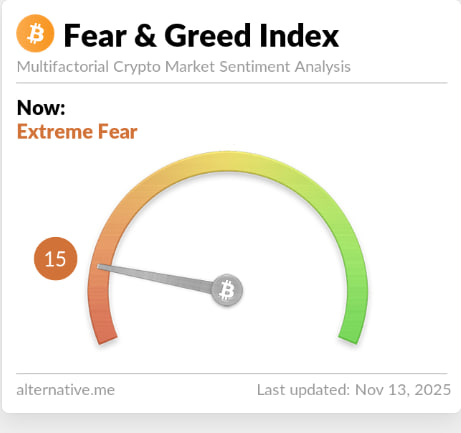
BTC near 100k while fear spikes? That’s not panic — that’s the calm before the next leg up. The so-called Crypto Fear & Greed Index, which tracks sentiment among cryptocurrency investors, has tumbled to its lowest level since March 2025. TradingView reports the index has dropped to a reading of 15/100, placing it squarely in the “extreme fear” zone. This extreme anxiety is likely tied to the stagnation of Bitcoin near the $100,000 mark, amid a broader thirst for safer assets. The market’s mood is dark, and the fear gauge says we’re past tense and maybe on the verge of something different. Bitcoin Limping Near $100K Bitcoin is hovering right around the six-figure threshold. It has recently dipped below $100,000, trading near $97,000 at one point. On November 13, the drop beneath $100K marked the third time in the month that BTC cleared below that level. Bloomberg data shows that this slide has taken place while Bitcoin is down more than 20 % from its 2025 high. This means that the psychological support belt at $100K is being tested, while underlying momentum has clearly waned. Why the Pull-Back? Several forces are converging: The Safe-Haven Shuffle: Metals Shine as Bitcoin Stalls This internal crypto-conflict is not happening in a vacuum. The fear is amplified by a “broader uncertainty in the macroeconomic environment.” The recent, narrowly-avoided government shutdown scare has left a bad taste in the mouths of institutional investors. Talk of fiscal instability has pushed capital toward traditional, “safe” assets. This brings us to the market’s current, fascinating divergence: In contrast, traditional safe-haven assets are enjoying a rally. Gold and silver prices have surged following the resolution of a major government shutdown scare. These gains reflect renewed interest in historically stable assets amid mounting global uncertainties. For the past year, Bitcoin has been championed as “digital gold,” the 21st-century hedge against inflation and government instability. Yet, at this critical juncture, old-fashioned, physical gold and silver are the ones rallying. This isn’t a failure of Bitcoin’s narrative. It’s a temporary rotation based on risk. When a major “shutdown scare” hits, it triggers a “risk-off” cascade. Large funds are forced to de-risk their portfolios immediately. In this environment, an asset like Bitcoin—still perceived as volatile despite its $100K price tag—gets sold off or paused, while stable, low-volatility assets like precious metals are bought up. This divergence between digital and traditional assets suggests a temporary shift in investor preference, as they weigh risk and reward in an uncertain economic climate. Bitcoin’s momentum is clashing with a powerful macro-economic headwind. The “extreme fear” in crypto isn’t just about the $100K wall; it’s about the fear that in a true global crisis, traditional money still prefers traditional havens. What to watch next With sentiment at extreme lows, the scenario split looks something like this: Bullish Case Bearish Case
SEC Chair, Paul Atkins Unveils ‘Token Taxonomy’ Plan To Modernize Crypto Regulation
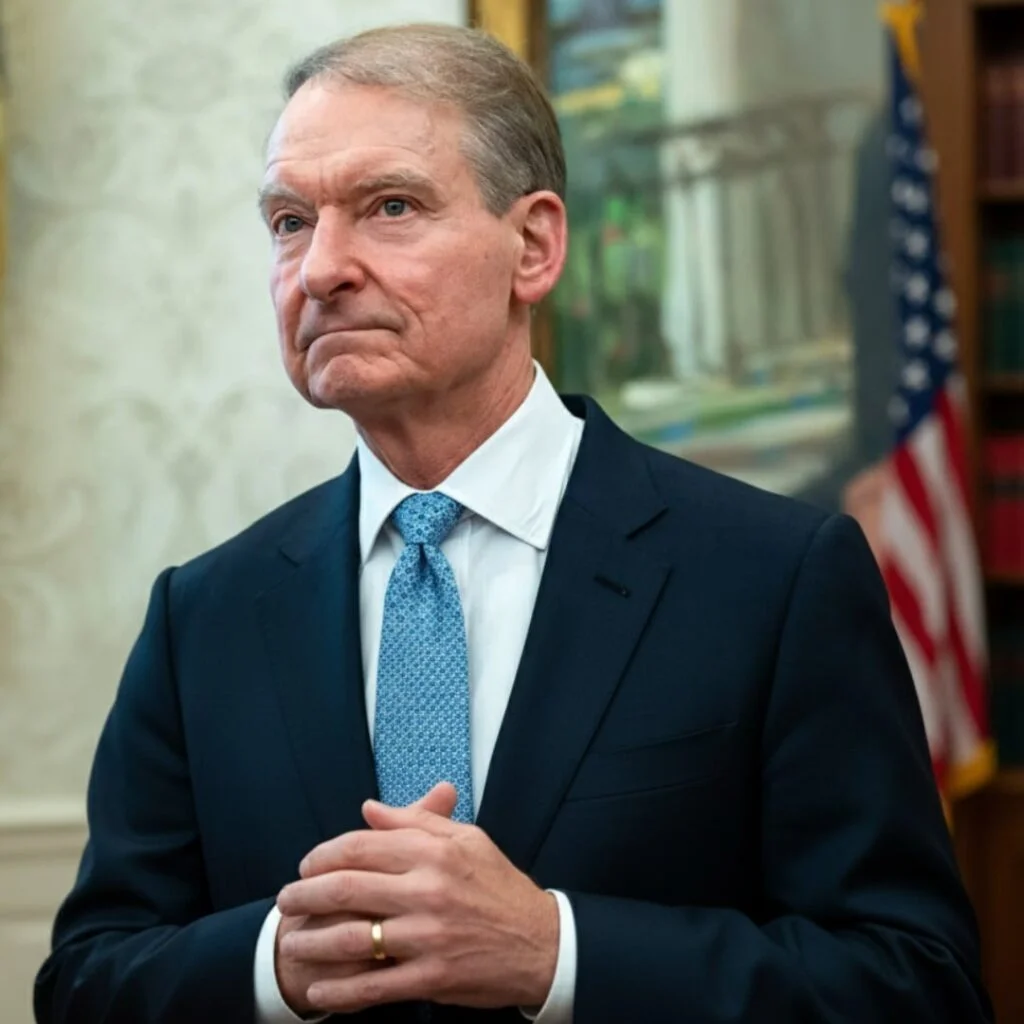
The U.S. might finally be saying ‘Let’s regulate smartly, not strangle innovation.’ This could end years of crypto confusion and pave the way for mainstream adoption – if done right. The U.S. Securities and Exchange Commission (SEC) under Paul S. Atkins has announced a major shift in how crypto‑assets will be regulated. Speaking at the Federal Reserve Bank of Philadelphia’s Fintech Conference, Atkins described a new initiative dubbed “Project Crypto” and outlined plans to introduce a formal token taxonomy. This new framework seeks to finally draw clearer lines for which digital assets qualify as securities under U.S. law, a question that has left projects, investors, and exchanges in a state of costly regulatory limbo. Atkins stated: “In the coming months, I anticipate that the Commission will consider establishing a token taxonomy that is anchored in the longstanding Howey investment contract securities analysis.” He also noted: “Once the investment contract can be understood to have run its course, the token may continue to trade, but those trades are no longer ‘securities transactions.’” Key Takeaways A New Chapter Rooted in a 70-Year-Old Test For years, the crypto market has been hampered by uncertainty: when is a token a security, and when isn’t it? Atkins acknowledged this directly: “If you are tired of hearing the question ‘Are crypto assets securities?’, I very much sympathise.” The centerpiece of Atkins’ plan is not to reinvent the wheel, but to modernize its application. He confirmed that the new token taxonomy will be firmly “grounded in the Howey test,” the 1946 Supreme Court decision that has long been the SEC’s tool for defining an “investment contract.” The critical difference, however, lies in a new, dynamic interpretation. Atkins’ SEC appears ready to formally acknowledge what many in the crypto space have argued for years: the classification of a digital asset is not necessarily permanent. The critical difference, however, lies in a new, dynamic interpretation. Atkins’ SEC appears ready to formally acknowledge what many in the crypto space have argued for years: the classification of a digital asset is not necessarily permanent. Atkins’ remarks align closely with the long-standing position of Commissioner Hester Peirce, who has championed the idea of a “safe harbor” for crypto projects. Atkins highlighted this, stating: “Commissioner Hester Peirce has rightly observed that while a project’s token launch might initially involve an investment contract, those promises may not remain forever.” Here’s how the taxonomy is expected to work: He outlined four broad categories of crypto tokens which include: Why It Matters This announcement carries significance for several reasons: Clarity for Industry and Investors For years, crypto innovators and investors complained about regulatory ambiguity — a token might be sold in a way that looks like a security, yet traded like a commodity. Atkins’s statement signals that the SEC wants to draw clearer lines. A More Flexible Regime The “sunset” concept — wherein a token’s security status can end once the investment contract is fulfilled and decentralisation achieved — is a meaningful departure from treating every token sale as permanently a security. Continued Enforcement Importantly, Atkins emphasised: “This is not a promise of lax enforcement at the SEC,” Atkins stated during his speech. “Fraud is fraud. While the SEC protects investors from securities fraud, the federal government has a host of other regulatory bodies well equipped to police and protect against illicit conduct.” Regulators will still act against wrongdoing, even with new frameworks. Signals to Congress and Broader Regulation Atkins stressed that this taxonomy is to complement — not replace — legislation currently before the U.S. Congress. He further noted coordinated efforts with the Commodity Futures Trading Commission (CFTC), banking regulators and state authorities. A New Era of Collaboration with Congress This entire strategy marks a stark departure from the “regulation by enforcement” posture of former Chair Gary Gensler, which often put the agency at odds with lawmakers. Atkins, by contrast, framed his plan as one that works in tandem with Congress. He confirmed the SEC is actively working alongside lawmakers to complement, not replace, legislative action. This includes a market structure bill currently under consideration in the U.S. Senate. “In the coming months, as contemplated in legislation currently before Congress, I hope that the Commission will also consider a package of exemptions to create a tailored offering regime for crypto assets that are part of or subject to an investment contract,” Atkins stated. This collaborative stance is proceeding even in the face of political headwinds. Despite a U.S. government shutdown, the Senate remained in session, with some senators reportedly working on the market structure bill. For an industry that has been desperate for regulatory clarity, Atkins’ speech is a watershed moment. It signals a move away from adversarial ambiguity and toward a functional, collaborative framework that recognizes the unique, evolving nature of digital assets. While enforcement will continue, the goal appears to have shifted from prosecution to clear-eyed regulation.
Just In: Nasdaq Releases Official Listing Notice for Spot XRP ETF
The OGs have dreamed of days like this. At the beginning it seemed so far-fetched that cryptocurrency would be adopted by institutions. But, here we are. Canary Capital Group LLC has just moved the first U.S. spot XRP exchange-traded fund (ETF) closer to launch. According to recent filings, the issuer filed a Form 8-A with the U.S. Securities and Exchange Commission (SEC) on November 10, 2025, which registers the shares under the Securities Exchange Act of 1934 and signals the fund’s listing on the Nasdaq Stock Market under the ticker “XRPC”. The filing marks the final regulatory step before trading: following the S-1 registration (filed October 24) and once Nasdaq publishes its daily “ready” list, trading could begin in just one to three sessions. Key Takeaways What the Filing Says The Form 8-A was signed by Steven McClurg, CEO of Canary Capital, on November 10. He said on the PaulBarron channel: “An XRP ETF would probably double what Solana did.” He cites XRP’s liquidity, global utility, and clearer regulatory path expecting major institutional inflows ahead. The filing further says: Why This Matters What To Watch With the listing approval now in hand, XRPC is poised to begin trading — potentially this week. For the XRP community and broader crypto space, this represents a major step toward mainstream institutional adoption. Whether the inflows match the upbeat projections remains to be seen, but the foundation is now set. For investors, the window is narrowing: this is a “get-in early” moment, but also one that demands awareness of risks and mechanics.
Coinbase CEO Revives Token Sales: But This Time They’re Built for Real Users Not Flippers

When Coinbase Global, Inc. announced that it is relaunching a public token-sales platform in the U.S., the crypto world took notice. Under the direction of its chief executive officer Brian Armstrong, Coinbase is attempting to bring back the excitement of early-stage token launches, but this time with investor protections and a clear bias toward community participation rather than quick flips. A U.S. Retail Comeback For U.S. retail investors, this move marks the first broadly accessible token-sale platform since 2018. Projects will now be able to offer tokens directly to verified users via Coinbase, paying in the stablecoin USD Coin (USDC). The first offering will come from MON, the native token of the layer-1 blockchain Monad Foundation, with a sale window running from November 17–22, 2025. Built-in Fairness from the Ground Up What makes this launch different is how Coinbase has structured the sale to favour broader participation and to discourage rapid resale (“flipping”). The key features include: Why This Matters In recent years, token launches have earned a reputation for being unfair, opaque and dominated by large investors. By creating a structured platform with defined guardrails, Coinbase is attempting to restore trust and re-position token sales as viable for regular investors, rather than exclusively for venture-backed insiders. The involvement of a major regulated U.S. exchange also sends a signal that token fundraising might be entering a more mature phase. For token issuers, the benefits appear clear: access to a large retail base, built-in mechanisms for fairer distribution, and clear listing prospects on Coinbase. For retail investors, the promise is early access to projects under more transparent, regulated conditions — albeit not without risk. What’s Next Coinbase plans to host approximately one token sale per month on this new platform. Monitoring the following will be key:
Breaking: Circle Is Exploring Launching It’s Own Native Token on Arc Network
Circle Internet Group, the issuer of the dollar-backed stablecoin USDC, announced in its third-quarter earnings report that it is exploring the launch of a native token for its layer-1 blockchain, Arc Network, signalling a major shift in its ecosystem strategy. Key Details What’s happening Circle reported a surge in its financials for Q3 2025: USDC in circulation reached US $73.7 billion, up 108 % year-over-year. Total revenue and reserve income hit US $740 million (a 66 % increase), and net income rose 202 % to US $214 million. In parallel, the Arc Network, which launched its public testnet on October 28, has garnered participation from more than 100 firms spanning banks, asset-managers, fintech platforms, and insurers. Within its earnings release, Circle said the potential native token “could foster network participation to drive adoption, further align the interests of Arc stakeholders and support the long-term growth and success of the Arc network.” Why it matters Until now, Arc has used USDC (and potentially other stablecoins) as the gas token for transaction fees. Introducing a new native token would shift the network’s economic model, offering a dedicated utility token for governance, incentives and fees. For Circle, this move is more than technical: it reflects an ambition to go beyond issuing stablecoins and become a broader infrastructure provider, combining stablecoin issuance, settlement rails via its Circle Payments Network (CPN) and a programmable blockchain. It also introduces new competitive dynamics: token issuance brings regulatory, market-and-distribution questions that differ from stablecoin business models. Some analysts view the native-token possibility as one reason for market concern despite Circle’s strong earnings. With this development, Circle is navigating the next stage of its roadmap, from stablecoin issuance to full-stack digital money network. If executed well, the native token could strengthen Arc’s appeal, but it also introduces new layers of complexity and risk. We’ll continue to track updates and bring you further details as they develop.