
Introduction
Overview
Is crypto truly independent of the government? While the market is often lauded for its decentralized nature, our 2012-2015 analysis reveals that political events, regulatory decisions, and geopolitical crises truly affect market direction and investor sentiment.
Donald Trump’s re-election, combined with a pro-crypto stance, led to a major market rally. Bitcoin rose from $76,000 post-election to $109,000 by Inauguration Day in January 2025.
After years of delays, the U.S. SEC approved Spot Bitcoin ETFs. This caused short-term volatility but marked a major step toward institutional adoption.
China’s crackdown began with an ICO ban in 2017 and ended with a full ban on crypto transactions and mining in 2021. These decisions led to global sell-offs and price declines.
After the invasion, sanctions pushed many Russians to use Bitcoin. This led to a spike in BTC trading volume against the ruble.
Central banks, especially the U.S. Federal Reserve, launched major stimulus programs. The resulting liquidity boost helped push Bitcoin above $60,000 and fueled a broader bull market.
El Salvador became the first country to make Bitcoin legal tender. The announcement helped push market optimism during the 2021 bull run.
| Date | Title | $BTC Price Then | $BTC Price (30D After) | Links |
|---|---|---|---|---|
| 4/7/2025 | U.S. Department of Justice disbands crypto enforcement team | $78,430 | $96,834 | View |
| 3/6/2025 | Trump Establishes U.S. Strategic Bitcoin Reserve to Lead Global Crypto Policy | $90,606 | $83,537 | View |
| 3/6/2025 | Trump Creates Strategic Bitcoin Reserve and Digital Asset Stockpile to Lead in Crypto Policy | $90,606 | $83,537 | View |
| 2/19/2025 | Hong Kong’s Fast-Track Licensing for Crypto Exchanges: A Game-Changer for Market Growth | $95,671 | $87,088 | View |
| 1/20/2025 | Bitcoin hits new ATH over $109k on Trump inauguration day | $101,331 | $96,644 | View |
| 12/30/2024 | EU’s MiCA Regulation Takes Effect in 2024: Bitcoin and Ethereum Prices Climb | $93,738 | $103,733 | View |
| 11/22/2024 | U.S. SEC intensifies enforcement actions against crypto firms | $98,317 | $95,186 | View |
| 11/21/2024 | Gensler’s SEC Departure Ignites Crypto Optimism: Bitcoin Eyes $100,000 | $94,286 | $97,291 | View |
| 11/6/2024 | Bitcoin reaches new ATH of $76,243.98 after Trump wins presidential race | $69,372 | $99,740 | View |
| 7/23/2024 | SEC’s 2024 Spot Ether ETF Approval: Bitcoin Soars, Ethereum Gains | $67,532 | $62,834 | View |
| 1/10/2024 | SEC’s 2024 Spot Bitcoin ETF Approval News | $63,327 | $72,344 | View |
| 10/2/2024 | Middle East Tensions in 2024: Bitcoin Faces Greater Volatility Than Traditional Markets | $60,804 | $69,496 | View |
| 6/6/2023 | SEC sues Coinbase for operating as an unregistered exchange | $71,108 | $58,203 | View |
| 6/5/2023 | SEC’s 2023 Charges Against Binance | $70,537 | $55,857 | View |
| 3/14/2023 | U.S. Government sells seized Bitcoin for $215M | $24,112 | $30,373 | View |
| 3/8/2023 | Silvergate Bank’s 2023 Collapse and 2024 Settlements | $22,198 | $27,906 | View |
| 11/11/2022 | FTX Bankruptcy Filing in 2022 | $19,164 | $17,085 | View |
| 3/16/2022 | Federal Reserve’s 2022 Rate Hike | $39,280 | $40,551 | View |
| 3/9/2022 | Biden’s 2022 Crypto Executive Order Announced In The U.S | $38,730 | $42,252 | View |
| 2/28/2022 | Rouble-Tether Trading Surge in 2022: Crypto’s Role Amid Russian Sanctions | $37,699 | $47,067 | View |
| 2/24/2022 | Crypto Crash After Russia’s 2022 Ukraine Invasion | $37,250 | $44,511 | View |
| 11/3/2021 | Federal Reserve’s 2021 Tapering Plan: Bitcoin and Ethereum’s Mixed Response | $63,220 | $53,601 | View |
| 10/19/2021 | U.S. First Bitcoin Futures ETF Launches in 2021 | $62,005 | $56,891 | View |
| 9/24/2021 | China’s 2021 Crypto Transaction Ban | $44,865 | $60,852 | View |
| 6/9/2021 | El Salvador’s 2021 Bitcoin Legal Tender Move | $33,380 | $33,185 | View |
| 5/18/2021 | China’s 2021 Crypto Ban Expansion | $43,538 | $38,092 | View |
| 5/12/2021 | Tesla’s 2021 Bitcoin Payment Suspension | $56,670 | $37,331 | View |
| 2/8/2021 | Tesla’s $1.5 Billion Bitcoin Investment | $38,795 | $55,851 | View |
| 3/15/2020 | Federal Reserve’s 2020 Emergency Rate Cut and QE | $5,172 | $6,868 | View |
| 3/12/2020 | The 2020 COVID-19 Crypto Crash: Why Bitcoin and Ethereum Tanked | $7,934 | $6,876 | View |
| 3/4/2020 | India’s 2020 Crypto Banking Ban Lift | $8,760 | $6,734 | View |
| 10/30/2019 | New York’s BitLicense Tightens Crypto’s Leash, Stirs Industry Backlash | $9,407 | $7,739 | View |
| 10/28/2019 | China’s 2019 Blockchain Endorsement | $9,528 | $7,508 | View |
| 7/11/2019 | President Trump’s 2019 Crypto Criticism | $10,174 | $10,050 | View |
| 4/26/2019 | Bitfinex and Tether’s $850M Fraud Allegations | $5,220 | $8,614 | View |
| 8/22/2018 | SEC denies Winklevoss Bitcoin ETF application | $6,479 | $6,759 | View |
| 8/7/2018 | SEC’s 2018 Bitcoin ETF Delays | $6,935 | $6,516 | View |
| 3/7/2018 | SEC’s 2018 Crypto Exchange Crackdown | $10,716 | $6,601 | View |
| 2/5/2018 | Mt Gox Trustee’s $400 Million Bitcoin Sale | $8,179 | $9,910 | View |
| 1/11/2018 | South Korea’s 2018 Crypto Ban Threat: How It Crashed Bitcoin and Ethereum Prices | $14,940 | $8,533 | View |
| 12/28/2017 | South Korea’s 2017 Crypto Crackdown Threat | $15,459 | $11,491 | View |
| 12/27/2017 | Bangladesh Bank Slams Door on Bitcoin, Citing Crime Risks and Legal Void | $15,709 | $11,089 | View |
| 10/31/2017 | CME Group's 2017 Bitcoin Futures Launch | $6,120 | $9,838 | View |
| 9/15/2017 | China's Cryptocurrency Crackdown: The 2017 and 2021 Exchange Bans | $3,740 | $5,693 | View |
| 9/4/2017 | China's 2017 ICO Ban: How It Crashed Bitcoin and Ethereum Prices | $4,626 | $4,214 | View |
| 11/30/2016 | US IRS sends John Doe summons to Coinbase | $732 | $960 | View |
| 11/9/2016 | Trump’s Shock Win Ignites Bitcoin Surge as Investors Flee to Digital Gold | $711 | $773 | View |
| 10/22/2015 | EU Court Backs Bitcoin’s VAT-Free Future, Defying Swedish Tax Hawks | $268 | $327 | View |
| 9/18/2015 | US CFTC declares Bitcoin a commoditCFTC Brands Bitcoin a Commodity, Cracking Whip on Crypto Derivativesy | $233 | $265 | View |
| 1/1/2015 | Ecuador Launches World’s First Government-Backed Digital Currency in January 2015 | $322 | $215 | View |
| 10/3/2014 | Serbia and Portugal’s Central Banks Sound Alarm on Bitcoin, Spook Crypto Traders | $371 | $323 | View |
| 3/25/2014 | US IRS Slaps Bitcoin with Property Status, Shaking Crypto’s Currency Dreams | $584 | $503 | View |
| 3/4/2014 | Vietnam’s Central Bank Shuns Bitcoin, Casting Shadow on Crypto’s Asian Ambitions | $680 | $448 | View |
| 12/5/2013 | China’s Bitcoin Crackdown Sends Prices Crashing, Rattles Global Crypto Dreams | $1,230 | $839 | View |
| 10/1/2013 | FBI Shuts Down Silk Road: Inside the Fall of Bitcoin’s Most Notorious Darknet Market | $143 | $208 | View |
| 8/16/2013 | Germany Recognizes Bitcoin as Financial Instrument, Opening Path for Crypto Taxation and Legitimacy | $109 | $138 | View |
| 5/16/2013 | Mt. Gox Seizure: How U.S. Authorities Exposed Regulatory Gaps in Crypto’s Early Days | $114 | $99 | View |
| 3/18/2013 | FinCEN's Evolving Role in Virtual Currency Oversight: From 2011 to 2021 | $47 | $93 | View |
While different political events can affect the cryptocurrency market, some trends strongly affect crypto valuations and investor sentiment.
Shifts in political power, especially in major economies like the United States, often affect the crypto market. Election outcomes can lead to strong market reactions based on the perceived crypto stance of the winners.
For example, President Trump’s win after the U.S. Presidential election in November 2024 caused notable optimism in the crypto sector. Market participants reacted to the pro-crypto signals from the incoming Trump administration. This pushed Bitcoin to $76,000 immediately after the election, eventually hitting $103,000 by the end of the year.
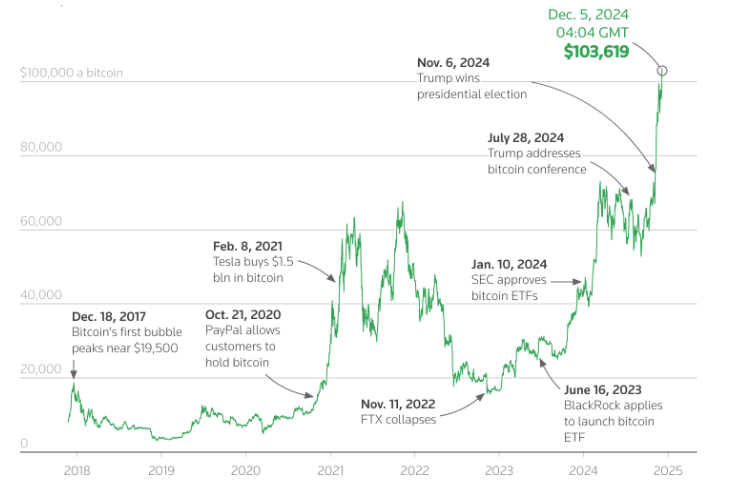
The surge continued till around the inauguration day in January 2025, when it peaked at $109,000.
Again, statements pledging to foster crypto innovation or reports regarding initiatives like a Strategic Bitcoin Reserve signaled policy direction and further shaped market expectations during this period.
Likewise, key regulatory personnel changes also draw significant market attention. For example, the departure of SEC chairman Gary Gensler from office triggered a market rush as traders anticipated a new regulatory approach.
International conflicts and subsequent economic sanctions have heavily shaped cryptocurrency's narrative as an alternative funding means Russia's invasion of Ukraine in February 2022 provides a stark example.
Western financial sanctions restricting Russia's access to global payment systems made individuals turn to crypto. Data confirmed a spike in Bitcoin trading volume against the Russian Ruble on various exchanges immediately following the invasion.
Similarly, heightened geopolitical tensions in other areas, such as the Middle East, often correlate with increased volatility in crypto markets.
Decisions made by major central banks, particularly the U.S. Federal Reserve on interest rates and money supply are now dominant drivers of crypto volatility. These policies dictate the broader macroeconomic environment and influence investor appetite for risk assets like crypto.
From 2020 to 2021, the Federal Reserve slashed interest rates to near zero and implemented large-scale quantitative easing (QE) in response to the COVID-19 pandemic. This injected liquidity into the financial system and led to a major crypto bull run.
Alt text: Data showing how the crypto index increased during QE and decreased during QT
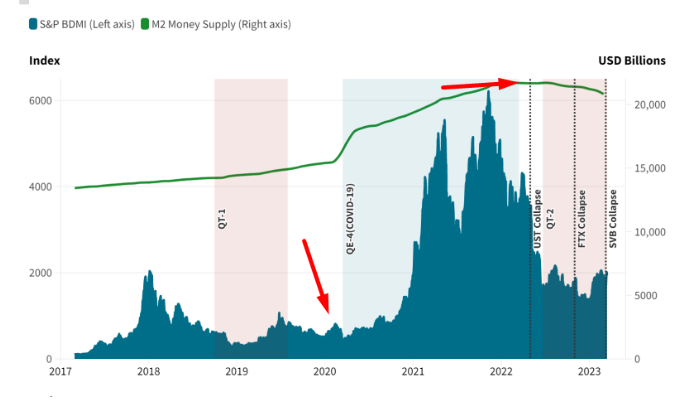
Conversely, from 2022, the Fed embarked on aggressive interest rate hikes and quantitative tightening (QT) to combat inflation. Less liquidity and increased borrowing costs made lower-risk assets like bonds more attractive. Inevitably, the crypto market began experiencing a downturn.
Aside from the United States, policies from other major central banks also shape the overall liquidity conditions that impact crypto asset valuations.
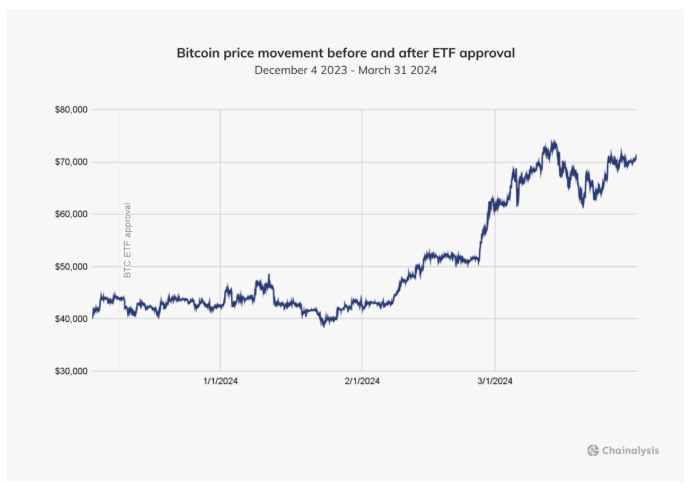
Another trend that became very popular in recent years was the the back and forth that the SEC had with the approval of Spot Bitcoin ETFs especially until January 2024. While the approval was anticipated, it initially led to significant volatility.
Bitcoin’s price spiked shortly after approval before revisiting lows of around $38,500. The upward movement continued shortly after, signalling growing mainstream acceptance and increased institutional investment.
movements before and after ETF approvals
Direct regulatory enforcement actions against major players in the crypto industry can also influence the market. When powerful agencies like the U.S. SEC announce lawsuits against prominent exchanges or projects, it increases fear and uncertainty in the market.
A key example is the SEC's lawsuits against Binance and Coinbase in June 2023. The SEC alleged that these exchanges were operating as unregistered securities exchanges and offering unregistered securities in the form of certain crypto tokens.
The announcements of these high-profile lawsuits caused panic and triggered a sharp price correction across the crypto market. Investors showed concerns about exchange viability, token listings, and the future classification of digital assets.
Direct regulatory enforcement actions against major players in the crypto industry can also influence the market. When powerful agencies like the U.S. SEC announce lawsuits against prominent exchanges or projects, it increases fear and uncertainty in the market.
A key example is the SEC's lawsuits against Binance and Coinbase in June 2023. The SEC alleged that these exchanges were operating as unregistered securities exchanges and offering unregistered securities in the form of certain crypto tokens.
The announcements of these high-profile lawsuits caused panic and triggered a sharp price correction across the crypto market. Investors showed concerns about exchange viability, token listings, and the future classification of digital assets.
Quite unlike many other trends that crypto has been affected by, we could easily say China has been a major bane on the neck. China alone has banned cryptocurrencies and their affiliated sectors at least five times since the industry went mainstream, causing immediate shocks in its wake.
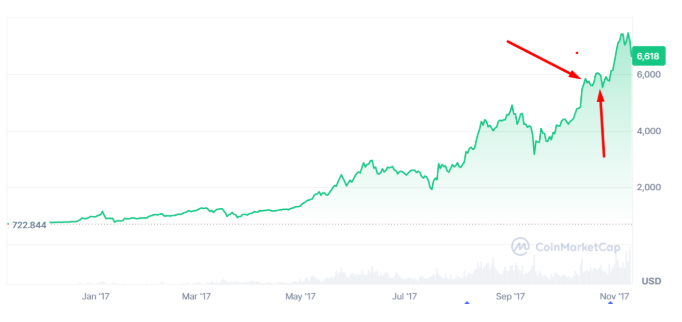
China's 2017 bans on Initial Coin Offerings (ICOs) and exchanges and the blanket ban on all crypto transactions and mining in 2021 are prime examples. These actions historically triggered immediate and sharp sell-offs across global crypto markets as access was restricted in a major economy.
The global political impact on crypto is most evident in the unique but conflicting approaches that countries take towards regulating or adopting digital assets. While some countries foster innovation hubs, others impose strict controls. This creates a complex meshwork that impacts crypto development, adoption, and market flows.
For instance, Asia has countries like India and Vietnam with particularly high crypto adoption rates globally. Yet, it also has nations with severe restrictions.
Consider the following countries, their stance, and the political impact on crypto.
China's relationship with cryptocurrency is perhaps the worst globally. Over the years, the nation has increased its clampdown on crypto assets, repeatedly affecting the global crypto market. A rough timeline of China’s crypto policy is outlined below;
As of early 2025, China’s official stance bans crypto in the nation. However, there are unconfirmed reports of underground crypto activity and occasional speculation about potential future policy shifts.
While there is growing institutional acceptance of crypto in the United States, the United States has maintained ambiguity in terms of crypto regulations. At best, the country has practiced “regulation by enforcement," with agencies like the SEC bringing lawsuits against crypto firms like Binance based on existing securities laws.
However, recent developments suggest a gradual shift.
In September 2021, El Salvador became the first nation to adopt Bitcoin as legal tender alongside the U.S. dollar.
The announcement generated significant international buzz and was initially correlated with positive Bitcoin price movement. The government's publicized purchases of Bitcoin further fueled market discussion during the bull run of that period.
While the initial mandate requiring all businesses to accept Bitcoin aroused public criticism, a subsequent IMF loan negotiation reportedly led the government to make its acceptance voluntary.
However, Bitcoin remains a legal tender in El Salvador. Also, the government has indicated it continues to accumulate Bitcoin for its reserves
India has one of the world's largest crypto user bases, despite its complex regulatory history. Back in 2018, the Reserve Bank of India prohibited banks from providing services to crypto exchanges. That decision was overturned in March 2020 when India's Supreme Court struck down the directive.
Following the lifting of the banking ban, India witnessed explosive growth in crypto users and trading volumes. This was driven largely by a large, young, tech-savvy population seeking investment alternatives.
Later in 2022, the government implemented a strict tax regime (including a 30% tax on gains and 1% TDS on transactions) on crypto holders. There are also ongoing discussions about a comprehensive bill to further regulate the country’s crypto sector.
Nigeria consistently ranks among the top countries globally for cryptocurrency adoption, particularly driven by its youth. Key drivers of crypto adoption include high inflation rates, currency controls, the need for cheaper remittances, and a digitally native population.
Nigeria’s crypto regulation journey mirrors that of India, with the country also initially directing banks to restrict services to crypto entities. Since then, Nigerian regulators have shifted towards developing a formal framework.
In 2022, the SEC issued rules for digital asset platforms. In late 2023, the Central Bank lifted the banking restriction. Finally, in 2025, the government unveiled new legislation formally recognizing crypto assets (potentially as securities), but with potentially high compliance costs for licensed entities.
Brazil stands out in Latin America for its relatively pragmatic and progressive approach to crypto regulation.
Brazil’s legislation recognizes cryptocurrencies as legal payment methods and investment assets. The country also licenses Virtual Asset Service Providers (VASPs) under the oversight of the Central Bank of Brazil (BCB).
Meanwhile, the BCB is actively developing its Central Bank Digital Currency, Drex, which will integrate with tokenized assets on a distributed ledger platform. This, combined with the success of its instant payment system Pix, signals an intent to incorporate digital asset technology within the existing regulated financial system.
The UAE, particularly the emirate of Dubai, has strategically positioned itself as a global hub for cryptocurrency and blockchain innovation. Authorities have established dedicated regulatory bodies, such as Dubai's Virtual Assets Regulatory Authority (VARA), specifically to oversee the sector.
Beyond regulatory bodies, the UAE has clear licensing frameworks. It also operates crypto-friendly economic free zones (like the DMCC in Dubai and ADGM in Abu Dhabi), designed to attract international crypto businesses by providing regulatory certainty.
This proactive approach aims to foster innovation while adhering to international compliance standards.
Conclusion
Data from 2012 to 2025 demonstrates that the cryptocurrency market is profoundly influenced by the currents of global politics, despite its technological underpinnings and decentralized ideals.
From regulatory decisions to macroeconomic policies orchestrated by central banks, geopolitical events, and national strategies, these political decisions continue to shape digital asset adoption and innovation in many places.
Clearly, understanding the ongoing political impact on crypto is no longer optional for market enthusiasts and investors. Rather, everyone must learn to manage the risks, recognize the opportunities, and comprehend the political forces that can shape the future of crypto to secure their crypto investments.
SEC.gov, Justice.gov , Reuters , Coindesk , BeInCrypto , Dechert Law , SEC , CTFC , Forbes