
Bitcoin News: An Independent Audit of Bitcoin Core Found No Major Vulnerabilities
Bitcoin Core, the reference software that powers the world’s largest decentralized financial network, has completed its first-ever public third-party security audit in its 16-year history — and the results reinforce its reputation for exceptional resilience. The review, conducted by cybersecurity firm Quarkslab and commissioned by the Open Source Technology Improvement Fund (OSTIF) with funding from Brink, found no major or critical vulnerabilities across the components that secure trillions of dollars in network value. Key Takeaways A Landmark Audit for Bitcoin’s Most Important Software Despite being one of the most scrutinized open-source projects in the world, Bitcoin Core had never undergone a formal, independent security assessment. Community-led code review has traditionally carried the weight of maintaining its security. This new audit marks a major milestone in bringing outside expertise into Bitcoin’s development process. The assessment, which spanned roughly 100 to 104 days between May and September, focused on areas attackers are most likely to target: Quarkslab’s engineers — Robin David, Nicolas Surbayrole, and Mihail Kirov — worked alongside Bitcoin Core contributors Niklas Gögge (Brink) and Antoine Poinsot (Chaincode Labs). Their methods included manual code inspection, dynamic testing, static analysis, and advanced fuzzing techniques. Their conclusion: “No significant security issues were identified. Most recommendations focus on refining existing fuzzing harnesses to further improve their effectiveness and coverage.” Only Minor Findings, but Major Improvements to Testing The audit uncovered just two low-severity issues and 13 non-classified vulnerabilities. Importantly, none of these findings affected consensus, denial-of-service resilience, transaction validation, or any of the areas that could threaten network security or stability. Beyond identifying potential issues, Quarkslab strengthened the project’s testing infrastructure. They produced: Brink emphasized that this work is already being incorporated into the Bitcoin Core codebase, noting: “This audit demonstrates that Bitcoin Core’s dedication to security has produced real results.” Independent Verification Boosts Confidence Amid Industry Scrutiny Blockchain security remains under heightened scrutiny, especially as institutional adoption grows. With more enterprises relying on Bitcoin infrastructure, the need for robust, externally verified security practices has never been greater. Quarkslab praised the development culture behind Bitcoin Core, describing the process as: “Both a bless by the code maturity, security culture — and a curse by the challenge it represents.” Their findings noted that Bitcoin Core’s massive codebase — over 200,000 lines of C++ and more than 1,200 tests — is among the most mature and well-tested they have evaluated. The audit confirmed the effectiveness of protections in the P2P networking layer, which handles block and transaction relay across roughly 125 peer connections per node. Reviewers found no scenario where malicious data could bypass validation or ban mechanisms. Context: The Bitcoin Core vs. Knots Debate The audit also comes amid ongoing debate between supporters of Bitcoin Core and Bitcoin Knots, sparked by the Bitcoin Core v30 update and concerns about non-financial data entering the blockchain. While Knots advocates call for filtering such data to prevent abuse, Core developers argue that restricting data types would undermine Bitcoin’s neutrality and potentially fragment the ecosystem. Despite the noise, institutional investors appear largely indifferent. According to Galaxy Digital researcher Alex Thorn: The timing of the audit’s completion adds weight to Bitcoin Core’s stance by demonstrating that its existing security model remains strong. Market Reaction: Price Swings, but Underlying Confidence The audit was released as Bitcoin traded near $91,616, down 12% over the past week and temporarily pushing the average spot ETF investor into negative territory for 2025. Yet leading industry voices argue the price drop does not reflect a shift in fundamentals. Bitwise CIO Matt Hougan told clients the pullback is “short-term noise,” adding that Bitcoin’s value, like that of major tech companies, ultimately depends on user demand. Michael Saylor echoed that sentiment, explaining that institutional adoption has actually reduced volatility, not increased it. While his firm first bought Bitcoin during a period of roughly 80% annualized volatility, he estimates it has since fallen to about 50%. “Bitcoin is stronger than ever… the company is engineered to take an 80 to 90% drawdown and keep on ticking,” Saylor said. Meanwhile, Cameron Winklevoss suggested that Bitcoin below $90,000 may be a final opportunity for investors before the next upward cycle. Analysts remain divided on whether current price movements represent a broader correction or temporary macro-driven pressure, but the audit adds an important layer of reassurance about Bitcoin’s long-term security. A New Standard for Security in Open-Source Blockchains For Bitcoin Core, the audit represents a turning point. While the project has always been rigorously reviewed by its community, formal external verification sets a stronger precedent for transparency and accountability. As the Bitcoin ecosystem grows and regulatory expectations increase, such audits may become a standard requirement rather than an exception. For now, the Quarkslab assessment reinforces a core message: Bitcoin’s foundational software remains robust, mature, and ready for the demands of its expanding global role.
A New Singapore Survey Shows Crypto Investors Now Prioritize Trust Over Low Fees When Choosing Exchanges

Singapore’s crypto market is undergoing a noticeable shift as investors place greater importance on trust and platform reliability rather than simply choosing the cheapest option. This change, highlighted in new survey data released by MoneyHero and Coinbase, signals a maturing market where users are becoming more discerning about where they store and trade digital assets. A parallel study from Independent Reserve reinforces this trend, painting a detailed picture of how Singaporeans now view crypto, what motivates their decisions, and why security has become a defining factor for the majority of users. Trust Takes Center Stage For years, low trading fees were the main selling point for exchanges targeting retail users. That narrative is rapidly changing. According to the new findings, two-thirds of users now rank trust and security above fees, and investors—particularly experienced ones—are showing stronger preference for platforms that offer transparency, regulatory compliance, and reliable safeguards. The MoneyHero–Coinbase survey, which polled 3,513 retail investors and crypto-curious adults, revealed that 61% of “finance-savvy” Singaporeans now hold crypto, one of the strongest adoption rates observed in the country. This group is not only familiar with digital assets but also more cautious, with security concerns shaping their platform choices far more than fee structures. The shift reflects a market that has weathered global exchange failures, asset freezes, and regulatory crackdowns. As one finding phrased it, investors are increasingly drawn to “more reputable platform(s)”—a clear sign of evolving expectations. Ownership Declines but Confidence Holds Firm Independent Reserve’s Singapore Crypto Market Survey, published by the licensed exchange, shows that although 94% of respondents are familiar with at least one cryptocurrency, active ownership dipped to 29%, down from 40% the previous year. The decline suggests that some retail users reduced exposure following volatility in 2024–2025. Yet the same data reveals strong long-term interest: Bitcoin remains the backbone of Singapore’s crypto economy. 68% of crypto holders own Bitcoin, and 86% view it as a currency, a store of value, or a viable long-term investment. Optimism remains strong—77% expect Bitcoin to surpass $100,000 by 2030. Despite the growth of ETFs and structured products globally, Singaporean investors still prefer direct custody of assets. 61% hold crypto directly, rather than through intermediaries such as exchange-traded funds. Younger and Middle-Aged Investors Dominate Activity Demographics in the survey reveal that 71% of Singapore’s crypto investors are between 25 and 54, up from 61% in 2024. This same age group accounts for 76% of those who trade weekly, underscoring the dominance of tech-aware, digitally active users. Trading behavior is also becoming more strategic. 67% of respondents sold part or all of their holdings over the past year to capture price swings—a sign of increased arbitrage and short-term trading activity among more informed investors. Independent Reserve Singapore President Lasanka Perera underscored Bitcoin’s persistent appeal, noting that: “The decentralized design, scarcity and transparency are the reasons why many investors continue to trust it.” These findings suggest that while day-to-day participation may have softened, long-term confidence in digital assets remains intact. Regulation Continues to Shape Market Behavior Singapore’s regulatory clarity is repeatedly cited as a key reason the city-state remains one of Asia’s most active blockchain hubs. Market participants appear to value the Monetary Authority of Singapore’s (MAS) strict but supportive approach. In 2024, the MAS issued 13 new crypto licenses, more than double the number granted the previous year, extending approvals to platforms such as OKX, Upbit, and Anchorage. Regulatory enforcement has continued into 2025. Mid-year, Bitget and Bybit began scaling down services after receiving final warnings to stop serving overseas clients without authorization. The decisions highlight Singapore’s insistence on compliance, even as interest in digital assets grows domestically. This stance appears to reinforce investor trust rather than deter participation, aligning with survey results showing platform credibility is now a top priority. Beyond Trading: Singapore Builds a Digital Asset Economy Crypto activity in Singapore no longer revolves solely around buying and selling tokens. Institutional experimentation and cross-border collaboration are expanding the country’s role as a financial innovation hub. Key developments include: Stablecoin usage is accelerating as well. Circle reported that the Asia-Pacific region handled $2.4 trillion in on-chain stablecoin flows between June 2024 and June 2025, placing Singapore among the top three stablecoin hubs worldwide. Meanwhile, corporate infrastructure continues to grow. Coinbase recently launched Coinbase Business, offering tools for instant USDC payments and global transfers as part of MAS’s BLOOM Initiative for compliant cross-border transactions. Looking Ahead: Trust as a Defining Metric As more Singaporeans adopt digital assets, trust appears to be the defining factor shaping participation. Even with overall ownership down to 29% among the broader population, finance-savvy users remain active and committed—choosing reputable exchanges, increasing their holdings, and anticipating higher valuations in the future. The new survey results point to a turning point in investor behavior: Singapore’s retail crypto market is no longer driven by cost alone. Reliability, compliance, and transparent operations now matter more than ever. For platforms hoping to compete in the region, the message is clear—trust is no longer optional; it’s the deciding factor for the majority of users.
Bitmine Is Sitting on a $3.7B Unrealized Loss From Its Massive $ETH Position
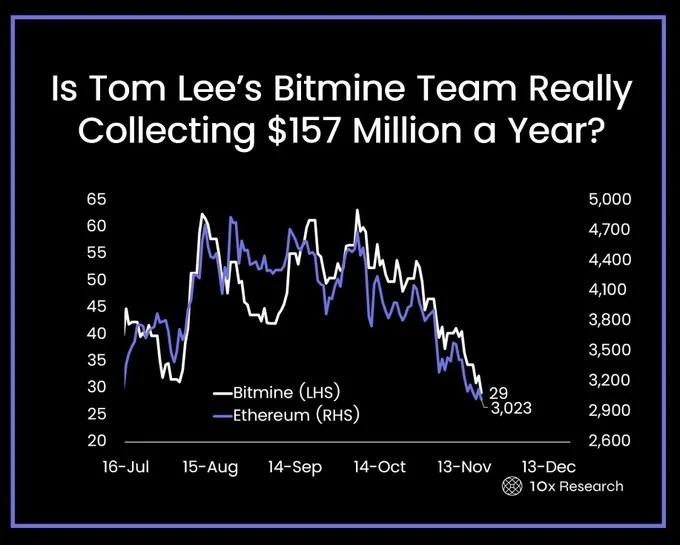
BitMine Immersion Technologies is facing one of the most troubling financial moments in the history of corporate crypto treasuries. The company, which has built its business model around holding and managing large digital-asset reserves, is now sitting on an estimated $3.7 billion unrealized loss from its Ethereum position — and the timing could not be worse. A Treasury Model Under Pressure According to analysis from 10x Research, BitMine holds 3.56 million ETH, representing roughly 2.94% of all Ethereum in circulation. The firm accumulated this position at an average purchase price of $4,051 per ETH. With Ethereum currently trading nearly $1,000 below that cost basis, BitMine is deeply underwater. These massive losses aren’t merely a paper problem. BitMine’s financial metrics suggest its business model is strained. The company’s mNAV ratio sits at 0.77 basic and 0.92 diluted, signaling that its enterprise value has fallen below the value of its crypto assets. For a DAT (Digital Asset Treasury) firm, this is a critical red flag. An mNAV below 1 means the company cannot effectively issue new shares to raise fresh capital or scale its holdings — a core part of how DATs generate value. Markus Thielen, founder of 10x Research, issued a stark warning about the broader risks faced by DAT investors. He described the current environment as a “Hotel California scenario”, where “investors find themselves trapped in the structure, unable to get out without significant damage.” He emphasized that DATs typically operate with opaque, hedge-fund-style fee models that slowly eat into returns, unlike the transparent cost structures of regulated ETFs. BlackRock’s Move Raises the Stakes BitMine’s troubles are unfolding just as BlackRock, the world’s largest asset manager, steps deeper into Ethereum-based investment products. BlackRock recently registered the iShares Staked Ethereum Trust in Delaware — an early-stage filing signaling intent to introduce a staking-enabled ETH ETF. Even though it is not yet listed or formally operational, the registration has already shifted sentiment across the digital-asset investment space. The contrast between a regulated, low-cost staking ETF and the structure of DATs is stark. BlackRock’s proposed fund carries a 0.25% management fee, compared to the often complex and significantly higher embedded costs seen in DAT-style treasuries. With other firms such as REX-Osprey and Grayscale already offering staked ETH ETF products, BlackRock’s arrival intensifies competition. Investors now have more liquid, regulated, and yield-generating alternatives — and this shift threatens to marginalize DATs that cannot match the transparency or income potential of staking ETFs. Why BitMine’s Losses Matter BitMine’s current position highlights a series of challenges facing corporate crypto treasuries: For BitMine, the unrealized losses would be concerning even in a stable environment. But in a moment when institutional options are expanding, and traditional asset managers are moving into Ethereum staking, the pressure is compounded. A Market at a Crossroads DATs were initially seen as a novel way to gain broad exposure to digital assets through equity markets. But BitMine’s situation shows that the model depends heavily on trading premiums, strong market conditions, and investor confidence. When those elements fade, the structure struggles to sustain itself. Investor sentiment may continue to shift as more regulated, cost-efficient staking products enter the market. If these trends accelerate, DATs could lose their relevance unless they meaningfully adapt. BitMine’s $3.7 billion unrealized loss stands as more than a number — it’s a signal. The digital-treasury business model is being tested, and the firms that cannot evolve may find themselves outpaced by the very institutions that once lagged behind them in embracing digital assets.