
Bank of America Says Its Wealth Clients Could Allocate up to 4% of Their Portfolios to Crypto
In a major shift for traditional finance, Bank of America is now recommending that its wealth‑management clients allocate between 1% and 4% of their investment portfolios to cryptocurrencies. The guidance — which applies to clients using its Merrill, Bank of America Private Bank, and Merrill Edge platforms — marks a clear endorsement of digital assets as a legitimate part of a diversified portfolio. “For investors with a strong interest in thematic innovation and comfort with elevated volatility, a modest allocation of 1% to 4% in digital assets could be appropriate,” said Chris Hyzy, chief investment officer at Bank of America Private Bank. Key Takeaways Why This Matters This change represents a major step for one of the United States’ largest banks. Until now, BofA allowed clients to buy crypto — but only if they requested it and their portfolio managers agreed. The new policy flips that script: more than 15,000 wealth advisers affiliated with BofA can now proactively recommend institutional‑grade cryptocurrency exposure. The bank will begin covering four major spot Bitcoin exchange‑traded funds (ETFs) starting January 5, 2026. These are: By choosing regulated ETFs rather than direct crypto holdings, BofA is effectively encouraging a structured, compliant, and professionally managed form of cryptocurrency exposure. The Strategy Behind 1–4% The 1–4% range is deliberately modest. According to Hyzy’s statement, the allocation is targeted at investors who are comfortable with volatility and seek exposure to “thematic innovation.” For conservative clients with lower risk tolerance, the lower end of the range likely makes sense — offering minimal but meaningful exposure to a high‑growth asset class. For more aggressive investors — those who are open to higher risk in exchange for potential long-term gains — the 3–4% allocation could serve as a small but significant growth driver. Importantly, this isn’t a blanket recommendation for all clients. The decision hinges on individual risk profiles and willingness to accept crypto’s characteristic volatility. What This Signals for the Wider Financial Industry The move by Bank of America reflects a broader trend among major financial institutions increasingly embracing digital assets. The inclusion of Bitcoin ETFs from major asset managers — such as BlackRock, Fidelity, Bitwise, and Grayscale Investments — gives clients regulated, transparent and professionally managed exposure. The fact that BofA is now comfortable recommending crypto suggests growing institutional confidence in digital‑asset infrastructure and regulatory clarity. For clients who were previously hesitant or unable to access crypto through their banks, this change opens up new opportunities — under the oversight of experienced advisors, not just self‑directed investing platforms. What Investors Should Know While this development is encouraging for crypto adoption, there are important caveats: Final Thoughts Bank of America’s decision to recommend cryptocurrency exposure to its wealth clients is an important milestone in traditional finance’s acceptance of digital assets. By endorsing a modest 1–4% allocation through regulated Bitcoin ETFs, the bank is signaling a new level of institutional legitimacy for crypto — and potentially paving the way for broader adoption across the sector. For investors who are informed, comfortable with volatility, and looking for diversification beyond stocks and bonds, this might be the moment to consider whether a small crypto allocation makes sense.
Trustwallet Launches Native Predictions, Powered by Myriadmarkets

Trust Wallet — the self‑custodial crypto wallet backed by Changpeng Zhao (CZ) — has introduced a new built‑in feature called “Predictions”, enabling users to trade YES/NO‑style markets on real‑world events (sports, politics, crypto developments and more) directly inside their wallet. What’s New in Trust Wallet With “Predictions,” users no longer need to register, deposit tokens, or switch between multiple apps to take part in event‑driven markets. The new tab appears within the existing “Swaps” page. From there, users can browse a variety of markets, take positions, and track outcomes — all while maintaining full self‑custody of their funds. At launch, the markets are powered by Myriad Markets on the BNB Chain. According to Myriad, the protocol has recently passed $100 million in cumulative trading volume, marking a ten‑fold growth over the past few months. In the coming weeks, the wallet will also integrate two other leading platforms — Polymarket and Kalshi — widening the selection of available events and increasing geographic and market coverage. Why It Matters Prediction markets have seen explosive growth lately. In October 2025 alone, Polymarket and Kalshi — the two largest platforms in the space — together processed roughly US$7.4 billion in trades, the highest monthly volume on record. By embedding predictions natively, Trust Wallet is lowering the barrier for participation — eliminating the need for separate accounts or third‑party apps. This makes event‑based speculation more accessible to its global base of some 220 million users. The shift also signals a broader trend: crypto wallets evolving beyond storage and swaps, towards being all‑in‑one platforms that combine asset custody, trading, and now real‑world event speculation. What Users Should Know Final Thought With “Predictions,” Trust Wallet is staking a claim in a rapidly expanding segment of crypto: event‑driven, narrative trading. By combining token custody, market access, and a streamlined interface, the wallet could become a major gateway for both seasoned crypto users and newcomers eager to bet on the next big event — whether a sports final, a political result, or a major crypto milestone.
Brazilian Federal Court Sentenced 14 People for Using Bitcoin To Launder Over $95M From Drug Trafficking and Kidnappings

Brazilian authorities have handed down major convictions in one of the country’s largest crypto-related money laundering cases to date, sentencing 14 individuals for using Bitcoin and other cryptocurrencies to wash over $95 million in profits from drug trafficking, extortion, and kidnapping. Criminal Network Operated for Five Years The convictions came after a lengthy investigation tied to Operation Fertile Land (Terra Fértil), which uncovered a vast criminal laundering infrastructure active from April 2019 to July 2024 in the states of Minas Gerais and Paraná. According to the Brazilian Public Prosecutor’s Office, the group’s central purpose was: “to hide the nature, origin, movement, and ownership of assets obtained through cross-border drug trafficking and violent crimes.” One of the violent crimes included laundering ransom payments from the kidnapping of a victim in Rio de Janeiro. Two unnamed ringleaders were sentenced to 21 years and 1 month, while the remaining members received prison terms ranging from 8 to 17 years, depending on their roles in the operation. Among the ringleaders was an insider — a prison security officer — who helped facilitate the network’s operations. Shell Companies, Fake Records, and Crypto Channels Investigators revealed that the organization functioned much like a corporate enterprise, with structured roles and technical financial operations. The group created an “accounting department” that managed: Many of these companies appeared to operate in legitimate industries such as: But despite modest-looking corporate profiles, they were moving millions — far beyond realistic earnings for businesses of their type. Several known shell entities used to support the laundering network included: Kaupan, DG Cerealista, AG Intermediações, MSS Rental, Truck Foz, and RBS Agropecuária, among others. How Bitcoin Was Used to Obscure the Trail The group relied heavily on Bitcoin and other digital assets to fragment and disguise the source of criminal funds. The laundering process involved: Authorities found that after digital layering, the assets were reintroduced into the legal financial system through the acquisition of high-value lifestyle goods — including: One of the aircraft seized was registered to a swimsuit-shop shell company run by one of the defendants. Financial Seizures and Legal Restitutions In addition to the prison sentences, the court ordered that the convicted parties provide financial reparations totalling: R$ 508,646,344.08 — approximately US$95.3 million Investigators also seized: All shell companies were liquidated under court order. While appeals are still possible, the judgment marks one of Brazil’s strongest anti-crypto crime rulings to date. A Message to Crypto-Enabled Crime Brazilian law enforcement agencies — including the Federal Police and the Special Action Group to Combat Organized Crime — coordinated efforts across multiple states and industries to dismantle the laundering network. Prosecutors emphasized that forensic evidence, electronic communications, and accounting discrepancies conclusively demonstrated the criminal activity. This case is emblematic of a broader trend: while cryptocurrencies provide anonymity and decentralization, they leave digital forensic trails that investigators are becoming increasingly effective at tracking. The sentencing sends a direct signal — both inside Brazil and internationally — that authorities are escalating efforts to uncover and dismantle criminal networks using cryptocurrency to mask dirty money.
LATEST: New Rankings Show the Top 10 Privacy Coin Projects by Development
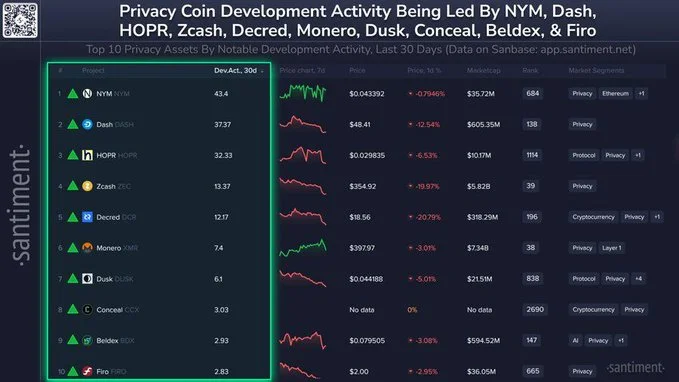
A new ranking published this week reveals which privacy-focused cryptocurrencies are seeing the most active development right now. According to the data, the leading projects are: “NYM, Dash, HOPR, Zcash, Decred, Monero, Dusk, Conceal, Beldex and Firo” Here is how the top 10 stack up: Rank Project (Ticker) 1 NYM (NYM) 2 Dash (DASH) 3 HOPR (HOPR) 4 Zcash (ZEC) 5 Decred (DCR) 6 Monero (XMR) 7 Dusk (DUSK) 8 Conceal (CCX) 9 Beldex (BDX) 10 Firo (FIRO) Why This Matters Developer activity — often measured by code commits, repository updates, and other open-source contributions — is widely regarded as a key indicator of a project’s long-term health. Active development signals ongoing innovation, maintenance efforts, and potentially upcoming improvements or upgrades. In this latest snapshot, NYM emerged as the frontrunner, followed by Dash and HOPR. It’s worth noting that some legacy favorites, such as Monero and Zcash, remain in the top tier — Monero at #6 and Zcash at #4 — though they no longer dominate the very top. What It Suggests for the Privacy Coin Sector Keep in Mind Being high on a development-activity ranking does not guarantee rising prices, adoption, or regulatory acceptance. As highlighted by recent market analyses, coins such as Zcash and Monero — while still under active development — have recently declined in value, with some analysts noting that their “safe-haven” appeal has weakened. Still, for anyone tracking privacy-focused cryptocurrencies — whether investor, developer, or user — this ranking provides a useful snapshot of where technical work is happening right now. For those following privacy coins closely, this update is a strong reason to revisit some of the lesser-known names and reassess their potential.
Circle and Tether Have Issued $18.5B in New Stablecoins Since the Major Market Crash on October 10

Since the sharp crypto market crash on October 10, two of the biggest stablecoin issuers — Circle Internet Group and Tether Limited — have flooded the market with a combined $18.5 billion in new stablecoins. Among that total, Circle alone recently minted $750 million in new USD Coin (USDC), underscoring how demand for stable, dollar-pegged crypto remains elevated amid ongoing volatility. Surge in Stablecoin Issuance Reflects Demand for Safety and Liquidity The issuance spree comes after a turbulent October 10 market crash that roiled major cryptocurrencies and triggered a flight to stable assets. Analysts say the rush by Circle and Tether to mint large amounts of stablecoins signals investors are prioritizing liquidity and stability over speculative bets — often using USDC or Tether USD (USDT) as a temporary refuge or for tactical flexibility. On-chain data suggest that much of this minting may serve as “dry powder”: capital waiting on the sidelines to be redeployed once market conditions stabilise. What It Means for the Crypto Market A Snapshot of Recent Moves What to Watch Next As more USDC and USDT enter circulation, key questions emerge: will this supply sit idle as capital waiting on the sidelines, or redeploy into risk assets — potentially powering the next rally? Also relevant: how regulators and institutions will react to the growing size and influence of stablecoins, particularly as liquidity roles expand across trading, borrowing, and payment rails. In short, the $18.5 billion issuance by Circle and Tether is a clear signal: for now, many in crypto are choosing safety over speculation. What happens next depends on whether that dry powder is fired, or left waiting.