
Solana’s Stablecoin Transfer Volume Hit $11.7T in 2025

Solana’s stablecoin transfer volume soared to a staggering $11.7 trillion in 2025, underscoring a major shift in how digital dollars are moving on-chain and what adoption actually looks like. In a year marked by impressive network milestones, Solana’s blockchain has firmly positioned itself as a leading stablecoin settlement hub, a feat reflected in the eye-popping transfer volume reported across the ecosystem. According to official on-chain data, users transferred $11.7 trillion worth of stablecoins on Solana throughout 2025 — a sevenfold increase over the past two years and a clear indicator of widespread utility beyond mere speculation. A Turning Point for On-Chain Payments For years, stablecoins — digital tokens pegged to traditional currencies like the U.S. dollar — have been heralded as crypto’s bridge to real-world payments. This surge on Solana highlights that promise coming into sharper focus. As transaction costs remained ultra-low and throughput stayed high, Solana became a preferred conduit for large-scale value movement. Compared with other networks, Solana’s growth has been especially dramatic. The blockchain processed billions of daily transactions and significantly expanded its user base in 2025, drawing both retail and institutional participants who are increasingly comfortable sending stable value on-chain. This dynamic contrasts with earlier eras when stablecoins were predominantly traded on centralized exchanges or used for speculative purposes. The new volume suggests a maturing use case where stablecoins are used as genuine settlement tools — for cross-border transfers, business-to-business payments, and decentralized finance operations that require reliable, fast, and cost-efficient rails. Implications for the Crypto Market Solana’s stablecoin surge doesn’t just reflect internal growth; it signals broader industry shifts. With competition heating up among major blockchains for transaction volume and liquidity, networks that can handle high stablecoin throughput are gaining strategic importance. Solana’s performance in 2025 cements its claim as one of those networks. As the crypto landscape continues to evolve, stablecoin transfer figures like these offer one of the clearest measures of meaningful adoption — not just bouts of speculative trading, but real value moving through next-generation financial rails.
Bitcoin Depot Agrees to a $1.9m Settlement With Maine Over Crypto Kiosk Scam Losses From 2022–2025
Bitcoin Depot, one of the largest cryptocurrency ATM operators in North America, has agreed to pay $1.9 million to settle allegations tied to crypto kiosk scams that affected Maine residents between 2022 and 2025. The settlement follows a lengthy investigation by the Maine Bureau of Consumer Credit Protection, conducted in collaboration with the Office of the Maine Attorney General, and was formally signed in December before being announced publicly this week. Under the agreement, Maine residents who lost money after being deceived into using Bitcoin Depot kiosks can seek compensation, provided they submit claims by April 1, 2026. Refunds are expected to begin in May 2026, although the exact amount each victim will receive will depend on the number of approved claims. “We will not know how much each refund will be until we have received and reviewed all of the claims,” the bureau said in a notice published on its website. Key Takeaways How the Kiosk Scams Worked The investigation found that scammers exploited Bitcoin Depot kiosks by directing victims to convert cash into cryptocurrency and send it to digital wallets controlled by fraudsters. In most cases, the victims were instructed to deposit funds into unhosted wallets, which are wallets controlled entirely by the user and not by regulated exchanges or financial institutions. This structure made it easier for scammers to move funds quickly and harder for victims to recover their money once the transaction was completed. According to state investigators, many victims were pressured through impersonation scams, including tech support fraud and other urgent payment schemes. One case cited by investigators involved a Maine senior who, in 2024, was coerced by a fake tech support agent into sending funds through a Bitcoin Depot kiosk in Old Orchard Beach. Bitcoin Depot’s Presence in Maine Bitcoin Depot is headquartered in Atlanta and operates more than 25,000 crypto kiosks globally, including locations across the United States, Canada, Australia, Mexico, and Hong Kong. During the period under investigation, the company operated roughly 80 kiosks in Maine, primarily in York, Cumberland, Kennebec, and Penobscot counties. Those kiosks are no longer operating in the state. “They’ve been gone since last summer,” said Linda Conti, superintendent of the Maine Bureau of Consumer Credit Protection. The kiosks were removed after Maine passed emergency legislation in June aimed at tightening oversight of virtual currency ATMs. While Bitcoin Depot no longer runs kiosks in the state, it remains licensed to transmit funds in Maine through online transactions. Licensing Disputes and Regulatory Action The settlement also addresses regulatory concerns about Bitcoin Depot’s compliance with Maine’s money transmission laws. In March 2023, bureau investigators determined that the company’s kiosks were performing money transmission activities and invited Bitcoin Depot to apply for a state license. Although the company submitted an application that same month, regulators deemed it incomplete until February 2025. The application was ultimately denied in April 2025, a decision Bitcoin Depot appealed the following month. In July 2025, the bureau provided the company with a list of consumer transactions where Maine residents may have suffered losses linked to third-party fraud. The $1.9 million settlement was reached soon after, without an admission of wrongdoing. As part of the agreement, Bitcoin Depot must send the settlement funds to the Maine Attorney General’s office by February 2 and comply fully with the state’s consumer protection and money transmission laws. Who Is Eligible for Compensation To qualify for a share of the settlement, claimants must meet several conditions. They must have been Maine residents between 2022 and 2025, used a Bitcoin Depot kiosk located in Maine during that period, and deposited cryptocurrency into an unhosted wallet provided by a scammer or third-party fraudster. Claims must be submitted online through the Bureau of Consumer Credit Protection. Officials emphasized that eligibility does not guarantee a full refund, as payouts will be distributed proportionally based on the total number of valid claims. Broader Crackdown on Crypto ATMs The Bitcoin Depot settlement comes amid heightened scrutiny of cryptocurrency kiosks across Maine. While Bitcoin Depot has exited the state, nearly 100 other crypto ATMs remain in operation, including machines run by CoinFlip, CoinStar, and Coinme. “The kiosks are where the trouble happens,” Conti said, adding that investigations into other operators are ongoing. Maine has taken several legislative steps to address these risks. In 2024, Governor Janet Mills signed the Maine Money Transmission Modernization Act, which expanded oversight of digital payment providers. This was followed by emergency legislation in June 2025 that specifically targeted virtual currency kiosks. The newer rules limit daily transaction amounts, cap fees and exchange rates, and establish clearer pathways for consumer redress when fraud occurs. They also introduced an unhosted wallet provision, requiring money transmitters to adopt safeguards that ensure consumers retain genuine ownership and control of their wallets. State Leaders Respond Governor Janet Mills praised regulators for securing the settlement and highlighted its importance for affected residents. “This will put money back into the pockets of Maine people who were defrauded by predatory third-party scammers,” Mills said. She also urged residents to remain vigilant. “I urge all Maine people to talk with their loved ones about the threats of scammers and precautions to take to avoid these cruel and often sophisticated schemes,” the governor added. Conti echoed that sentiment, noting that regulatory tools were essential to reaching the agreement. “Maine’s new consumer protection laws have allowed us to reach this consent agreement,” she said. “Whenever you have new technologies, you’re going to have people who are vulnerable and need to be protected.” Rising crypto fraud nationwide The case reflects a broader rise in crypto-related fraud across the United States. FBI data shows that Americans lost more than $333 million to cryptocurrency ATM scams between January and November 2025, a sharp increase from the $250 million reported for all of 2024. Law enforcement agencies continue to warn that legitimate businesses and government bodies do not demand payment through cryptocurrency, gift cards, or kiosks. Authorities are encouraging victims and concerned residents to report suspicious activity
A Bitcoin OG Is Back in Profit on His Long Positions, Posting Nearly $12M in Gains Over the Past 24 Hours
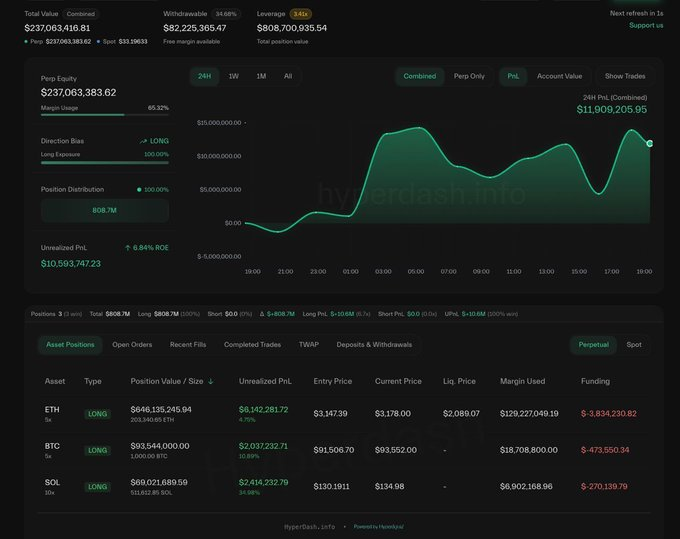
A long-dormant Bitcoin whale has returned to profitability, racking up nearly $12 million in gains within the last 24 hours as the market continues to reward conviction on the long side. The trader, widely regarded as a Bitcoin OG due to his early positioning and large exposure, is now firmly back in profit after months of drawdowns that tested even seasoned market participants. On-chain watchers note that while the position faced heavy funding pressure over time, the total funding cost stood at approximately $4.7 million—a price the whale was clearly willing to pay to stay in the trade. The sharp turnaround highlights a recurring theme in Bitcoin cycles: deep-pocketed traders often endure extended periods of unrealized losses before markets swing decisively in their favor. In this case, the rebound came swiftly, with price movement over a single day enough to erase months of pressure and push the position back into strong profit. Whales Move Early, Markets Follow Large Bitcoin holders tend to operate on longer timeframes, absorbing volatility that would force smaller traders out. Their activity is closely tracked because it often precedes major trend shifts. While retail sentiment has remained mixed, whale positioning suggests confidence in higher prices ahead. The willingness to sustain millions of dollars in funding costs implies strong conviction that the broader market structure is turning favorable. Looking Ahead to 2026 Beyond the short-term profit, the trade has reignited discussion around Bitcoin’s next major cycle. With macro conditions shifting and supply dynamics tightening, many believe the groundwork is being laid for a much larger move over the coming years. For now, the whale’s return to profit serves as a reminder that Bitcoin rewards patience, capital strength, and emotional discipline. While most traders focus on daily candles, the biggest players are often betting on where the market will be—not tomorrow, but years from now. As Bitcoin continues to test key levels, all eyes remain on whale activity, searching for clues about what comes next.
BULLISH: Bitcoin Briefly Touches $94,000

Bitcoin began the week with renewed strength, briefly pushing to the $94,000 mark and setting a new high for 2026. The move marks Bitcoin’s strongest rally in nearly four weeks and signals a notable shift in market sentiment after weeks of range-bound trading and muted volatility. The rally unfolded against a backdrop of rising appetite for risk across global markets. U.S. equities closed higher, led by technology stocks, while traditional safe havens such as gold and silver also posted gains. Despite heightened geopolitical tension following the detention of Venezuelan President Nicolás Maduro by U.S. special forces and his subsequent transfer to the United States, investors appeared unfazed, continuing to rotate into risk assets rather than retreating from them. Bitcoin climbed more than 3% on the day, holding just below $94,000 at the time of writing. Ethereum followed the broader market higher but recorded more modest gains, underperforming Bitcoin during the session. Key Takeaways Technical Breakout Restores Confidence One of the most closely watched developments during the rally was Bitcoin’s move above its 50-day moving average for the first time since the sharp correction that began in early October. This technical level had capped upside attempts for weeks, and its breach is being interpreted by many traders as a sign that the market may have found firmer ground. Year-to-date, Bitcoin is now up roughly 6%, a recovery that contrasts with its performance late last year. The asset fell 24% during the fourth quarter, diverging sharply from gold and silver and underperforming broader financial markets. It also ended 2025 down about 6.5%, despite optimism surrounding a more favorable regulatory tone toward crypto under the Donald Trump administration in the United States. Market participants say the current upswing is being driven less by speculative frenzy and more by structural factors. Buying activity from crypto-focused companies has increased, while selling pressure from miners and large institutional holders has remained relatively subdued. “Recent price strength has been supported by steady spot demand, combined with limited selling from miners and long-term holders,” said Sean McNulty, Head of Derivatives for APAC at FalconX. This combination has helped Bitcoin break out of the tight range it had been stuck in for much of the holiday period, during which it lagged the rally in equities. ETFs Signal Shift in Sentiment Another key catalyst underpinning the move is renewed interest in U.S.-listed spot Bitcoin exchange-traded funds. On January 2 alone, the 12 spot Bitcoin ETFs traded in the U.S. recorded a combined net inflow of approximately $471 million, a figure that stands out after weeks of more subdued flows. ETF demand is often viewed as a proxy for institutional and long-term investor sentiment. The return of strong inflows suggests that investors who had been on the sidelines are beginning to re-engage, particularly as Bitcoin shows signs of technical stabilization. At the same time, on-chain and market indicators point to improving demand from U.S.-based investors. The Coinbase Bitcoin Premium, which measures price differences between Coinbase and offshore exchanges, turned positive, indicating stronger buying interest from American traders. Rally Defies Weak U.S. Manufacturing Data Bitcoin’s rise came despite fresh signs of economic weakness in the United States. Data from the Institute for Supply Management (ISM) showed that manufacturing activity remained in contraction territory for a tenth consecutive month. “The ISM Manufacturing PMI printed at 47.9, below the 48.3 forecast, extending the contraction in U.S. manufacturing activity.” Ordinarily, such data might dampen risk appetite. Instead, markets appeared to interpret the figures as reinforcing expectations that monetary conditions could eventually ease if economic weakness persists. This backdrop has supported both equities and alternative assets, including cryptocurrencies. Bitcoin’s ability to rally alongside stocks, while also keeping pace with gains in gold and silver, once again highlights its shifting role in global markets. At times, it trades like a high-beta risk asset; at others, it attracts flows typically reserved for hedges against macro uncertainty. Liquidations and Key Levels Ahead Volatility returned to the crypto market as prices surged, triggering a wave of liquidations. Over the past 24 hours, roughly $297 million worth of positions were wiped out, with short positions accounting for the majority. This suggests that bearish bets were caught off guard by the speed and strength of the move higher, adding fuel to the rally as positions were forcibly closed. Looking ahead, analysts are closely monitoring whether Bitcoin can sustain a break above the $94,000 level. A clean move higher could open the door to further upside and reinforce the view that the recent consolidation phase has ended. On the downside, the $88,000 area is emerging as a critical support zone. A drop below that level could weaken the bullish narrative and pull Bitcoin back into its previous trading range. For now, momentum is firmly on the side of the bulls. Bitcoin’s push to a new 2026 high, driven by improving demand, strong ETF inflows, and a broader rally in risk assets, suggests that confidence is returning to the market—at least in the short term. Whether that confidence can carry prices decisively beyond $94,000 remains the key question in the days ahead.
UPDATE: Polygon Hits a New High With 1.4b+ Transactions Processed in 2025, Showcasing Adoption at Scale

Polygon’s transaction activity in 2025 is forcing a rethink of how blockchain adoption is measured. This is no longer a debate about theoretical throughput or benchmark-driven TPS claims. The numbers now point clearly to sustained, real-world usage happening quietly in the background. The network has crossed a major milestone this year, processing more than 1.4 billion transactions in 2025 alone, marking its strongest annual performance to date. More importantly, this surge pushes Polygon’s lifetime transaction count beyond 4.2 billion as of March 2025, underscoring years of compounding growth rather than a short-lived spike. A Shift From Capacity to Consumption For much of crypto’s history, scaling discussions focused on what networks could handle under ideal conditions. Polygon’s recent performance flips that narrative. The transaction volume recorded this year reflects consistent demand from applications already in use, not stress tests or isolated campaigns. In the first half of 2025, Polygon processed 12.3 billion transactions, a figure that places it well ahead of Ethereum’s transaction volume over the same period. This comparison is notable not because it signals competition at the base layer, but because it highlights how Layer-2 and scaling-focused ecosystems are becoming the primary execution environments for users. Behind these numbers are everyday actions: NFT mints that cost cents instead of dollars, gaming interactions executed in seconds, DeFi strategies running continuously, and enterprise integrations that require predictable fees. Many of these interactions never feel “crypto-native” to the end user, and that may be the clearest signal of maturity. Invisible Adoption Is Still Adoption One of the more striking implications of Polygon’s growth is how little attention it attracts outside technical circles. Users interact with games, marketplaces, loyalty programs, and payment rails without needing to know which chain is settling the transaction. Polygon’s infrastructure increasingly serves as a backend rather than a headline feature. This raises a question that now matters more than raw transaction counts: how many users are already relying on Polygon without realizing it? As blockchain technology fades into the background, networks that prioritize low friction, stable performance, and predictable costs stand to gain the most. Polygon’s ability to sustain high volumes without major congestion or fee shocks strengthens its position as a default choice for developers who care more about user retention than protocol branding. What This Means Going Forward Processing over a billion transactions in a single year is not a marketing milestone; it is an operational one. It suggests that Polygon has crossed into a phase where its success is increasingly tied to application demand rather than ecosystem incentives. If this trajectory holds, future growth may not come from louder announcements or speculative narratives, but from continued integration into products that users already trust. The more invisible the infrastructure becomes, the harder it is to displace. Polygon’s 2025 transaction record sends a clear message: adoption at scale is no longer theoretical. It is happening quietly, transaction by transaction, often without the user ever needing to ask which blockchain made it possible.