
21SHARES Launches a Bitcoin & Gold ETP on the London Stock Exchange
21Shares has expanded its footprint in the U.K. market with the launch of its Bitcoin and Gold Exchange-Traded Product (ETP), known as BOLD, on the London Stock Exchange (LSE). The product began trading on January 13, marking a significant milestone for regulated crypto investment products available to U.K. retail investors. The listing follows the removal of long-standing U.K. restrictions on crypto-backed exchange-traded products in October 2025, a regulatory shift that has opened the door for broader participation in digital asset markets. With BOLD, 21Shares becomes the first issuer to offer U.K. investors exposure to both Bitcoin and physical gold within a single exchange-traded instrument. A Dual Store-of-Value Strategy BOLD is designed to combine Bitcoin’s long-term growth profile with gold’s historical role as a hedge against inflation and monetary instability. Rather than allocating capital equally between the two assets, the ETP uses a risk-weighted approach. Portfolio weights are determined by the inverse historical volatility of Bitcoin and gold, meaning the more stable asset receives a higher allocation at any given time. This structure aims to balance risk more effectively, reducing the sharp swings often associated with holding Bitcoin alone while preserving upside potential. The portfolio is rebalanced monthly to maintain roughly equal risk contribution from both assets, automatically trimming exposure to the stronger performer and increasing exposure to the weaker one. The ETP is developed in partnership with ByteTree Asset Management and is fully physically backed. Both the Bitcoin and gold are held with institutional-grade custodians, with digital assets stored in cold storage, offering an added layer of security compared to many retail custody options. Performance and Market Context Since its initial launch in Switzerland in April 2022, BOLD has delivered a total return of 122.5% in sterling terms through the end of 2025. Over the same period, it outperformed holding Bitcoin or gold individually, highlighting the impact of its risk-managed allocation strategy. The product currently carries a three-year Sharpe ratio of 1.79, reflecting strong risk-adjusted returns, and has assets under management of approximately $40.1 million as of January 12, 2026. The launch comes at a time when Bitcoin and gold have moved in sharply different directions. Over the past year, Bitcoin finished 2025 largely flat and remains nearly 30% below its all-time high, while gold surged more than 65%, recently trading around a record $4,600 per ounce. Despite these contrasting price trends, institutional interest in both assets has continued to grow amid global monetary uncertainty. Product Details and Fees The 21Shares Bitcoin Gold ETP trades on the LSE under the ticker BOLD and is denominated in British pounds. It carries a total expense ratio of 0.65% per year. The product has received approval from the Financial Conduct Authority, making it the fifth 21Shares crypto product cleared for U.K. retail investors, following its Bitcoin and Ethereum offerings. Commenting on the launch, 21Shares CEO Russell Barlow said the product is intended to offer investors a potential hedge against inflation while providing exposure to Bitcoin’s growth potential alongside the relative stability of gold. With regulated crypto ETPs now accessible in the U.K., BOLD positions itself as a diversification tool for investors seeking exposure to alternative assets without taking on single-asset volatility. As trading begins in London, BOLD represents a notable step in the integration of digital assets into traditional financial markets, offering a blended approach to two of the world’s most widely recognized stores of value.
Crypto Fear & Greed Index Drops to 26 From 44 Last Week

Wake up; the crypto fear & greed index is flashing a clear warning signal as market sentiment continues to deteriorate. Global cryptocurrency markets opened the new week under visible pressure, with the widely followed Crypto Fear & Greed Index falling to 26, down sharply from 44 just a week ago. The reading places the market firmly in the “Fear” zone, highlighting growing caution among investors as volatility persists. The index reading, recorded on March 24, 2025, reflects a steady erosion of confidence rather than a sudden panic. While prices across major digital assets have struggled to regain momentum, sentiment has weakened even faster, suggesting traders are increasingly hesitant to take risk despite periodic relief rallies. “The Crypto Fear & Greed Index measures market sentiment on a scale from 0 to 100, where lower values signal fear and higher values indicate greed.” This drop from neutral territory into deeper fear territory underscores how quickly psychology can shift in crypto markets, especially when uncertainty outweighs positive catalysts. Key Takeaways What’s Driving the Sudden Shift in Sentiment The Crypto Fear & Greed Index, developed by Alternative.me, aggregates multiple data points into a single score designed to capture investor mood beyond price action. A reading of 26 reflects broad-based caution across several fronts rather than weakness from one isolated metric. Volatility and trading volume, which together account for half of the index’s weighting, remain elevated. Sharp intraday swings and uneven liquidity often signal nervous positioning, as traders react quickly to headlines instead of committing to longer-term trades. Declining spot volume across several major exchanges has further reinforced the perception that buyers are stepping back. Social sentiment has also cooled notably. Activity across platforms such as X and Reddit shows fewer bullish calls and an increase in defensive narratives centered on capital preservation. Market surveys embedded in the index reveal a similar trend, with respondents increasingly expecting sideways or lower price action in the near term. “A rising Bitcoin dominance typically reflects a flight to perceived safety within the crypto market.” Bitcoin’s dominance has edged higher during this period, another classic signal of fear. When investors rotate out of altcoins and into Bitcoin, it often reflects a desire to reduce exposure rather than chase returns. Meanwhile, search interest related to crypto price declines has picked up, reinforcing the risk-off tone captured by the index. How Today’s Reading Compares Historically A score of 26 does not represent full-blown panic, but it is far from comfortable. Historically, the index has dipped into single digits during moments of systemic stress, such as the March 2020 COVID-19 crash or the aftermath of the FTX collapse in 2022. Those periods were marked by forced selling and widespread capitulation. By contrast, mid-20s readings usually signal prolonged uncertainty. Markets in this zone tend to react strongly to negative news while largely ignoring positive developments. Price action often becomes choppy, with rallies fading quickly and support levels tested multiple times. “Extreme fear has historically aligned with market bottoms, while extreme greed has often preceded major corrections.” While the current reading remains above the “Extreme Fear” threshold, the rapid fall from 44 in just one week suggests sentiment is deteriorating faster than price alone would imply. That divergence often appears during consolidation phases, when confidence erodes quietly before the next decisive move. A Contrarian Signal for Long-Term Watchers? For experienced market participants, fear-based readings are not always bearish signals. Historically, prolonged fear has tended to coincide with accumulation by long-term investors rather than aggressive selling. Institutions and high-conviction holders often view these periods as opportunities to build positions gradually, particularly when liquidity thins and competition eases. That said, fear alone is not a timing tool. Without a shift in macro conditions or a clear catalyst, markets can remain cautious for extended periods. In 2025, sentiment continues to be shaped by several external forces, including expectations around interest rate policy, regulatory clarity in major economies, and spillover volatility from traditional financial markets. Regulatory headlines, especially from the U.S. and European Union, remain a double-edged sword. Progress toward clearer frameworks can stabilize sentiment, while enforcement actions or restrictive proposals tend to deepen fear quickly. At the same time, correlations between crypto and equities remain elevated, meaning turbulence in stock or bond markets often drags crypto sentiment lower. How Traders Are Responding A fear-heavy environment changes behavior across the market. Retail traders typically reduce position sizes or sit on the sidelines, waiting for confirmation that downside risk has eased. Stablecoin dominance often rises during these phases, reflecting capital parked rather than deployed. Institutional players, on the other hand, tend to operate quietly. Reduced hype and thinner order books allow for accumulation without attracting attention. Bitcoin and Ethereum usually absorb the bulk of this activity, reinforcing their role as relative safe havens within the asset class. Interestingly, development activity across major blockchain ecosystems often remains steady during fear-driven markets. Builders continue shipping upgrades and infrastructure improvements regardless of sentiment, creating a disconnect between short-term psychology and long-term fundamentals. What to Watch Next The fall to 26 sends a clear message: confidence is fragile. Whether fear deepens into extreme levels or begins to stabilize will depend on how markets respond to upcoming macro data, regulatory signals, and price structure across major assets. For now, the Crypto Fear & Greed Index remains a critical lens into market psychology. While it does not predict price movements on its own, it provides context that price charts alone cannot. As history has shown, fear is uncomfortable—but it is also a recurring feature of crypto market cycles, often setting the stage for the next meaningful shift in direction.
Nigeria Requires Crypto Transactions To Be Linked To Tax IDs and National IDs

Nigeria has embarked on a decisive shift in how it oversees the country’s booming cryptocurrency sector by tying digital asset transactions directly to Tax Identification Numbers (TINs) and National Identification Numbers (NINs). This move, now mandated under the Nigeria Tax Administration Act (NTAA) 2025 and effective January 1, 2026, aims to finally bring the often opaque world of crypto trading into clearer view for tax and regulatory authorities. Once often outside the formal tax net, crypto transactions in Nigeria—which accounted for an estimated $92.1 billion in value between mid‑2024 and mid‑2025—will now be visible to tax officials without direct blockchain surveillance. Key Takeaways Identity Reporting Replaces Blockchain Monitoring Under the new regulations, Virtual Asset Service Providers (VASPs), such as exchanges and custodial platforms, must now collect comprehensive identity information from all customers. Monthly reports submitted to the Federal Inland Revenue Service (FIRS) must include: This requirement marks a departure from earlier policy approaches that struggled to link digital asset activity with individual taxpayers. By anchoring crypto transactions to identity records, authorities can now match crypto‑related earnings with declared income and tax filings without relying on costly on‑chain analytics. A Broader Framework for Compliance and Enforcement The NTAA 2025 also aligns Nigeria’s domestic policy with the Organization for Economic Co‑operation and Development’s (OECD) Crypto‑Asset Reporting Framework (CARF), which came into effect globally on January 1, 2026. CARF standardizes the reporting of crypto transactions internationally, bolstering cross‑border transparency and helping curb tax evasion. Beyond identity reporting, the law extends anti‑money laundering (AML) requirements: These measures integrate crypto oversight into existing financial crime prevention frameworks, significantly broadening the reach of regulatory enforcement. Filling Enforcement Gaps Nigeria’s earlier attempt to tax crypto activity under the Finance Act 2022—which imposed a flat 10% tax on crypto profits—saw patchy compliance because authorities lacked a reliable way to identify taxpayers behind wallet addresses. The new TIN/NIN linkage is designed to close that enforcement gap. The law’s enforcement comes with tangible penalties for non‑compliance. VASPs that fail to meet reporting obligations can face fines—commonly starting at ₦10 million (about $7,000) for the first month of default and ₦1 million for subsequent months—and risk suspension or revocation of their operating license under the Securities and Exchange Commission (SEC). Impact on the Crypto Ecosystem For crypto users in Nigeria, these developments will reshape how they interact with digital assets. Exchanges and other service providers will demand verified identity credentials before onboarding users, effectively ending anonymous crypto trading within the regulated sector. Experts believe this could significantly increase Nigeria’s tax revenues by tapping into a previously elusive source of income. At the same time, industry stakeholders warn that stricter compliance requirements and reporting burdens might raise operational costs for crypto platforms and reduce service availability. Regional and Global Context Nigeria’s policy mirrors trends in other major jurisdictions. In the United Kingdom, for instance, crypto asset providers already collect details such as names, dates of birth, and tax references for residents and TINs for non‑residents—advancing a similar goal of identity‑based reporting without blockchain monitoring. By integrating with the OECD’s reporting standards, Nigeria signals its intent to participate in a global network of crypto tax transparency. This alignment is expected to foster greater accountability for cross‑border crypto flows, while helping the country benefit from a share of revenues tied to its large crypto market. Looking Ahead As enforcement of the NTAA 2025 and related frameworks unfolds through 2026, Nigeria’s crypto sector will enter a new phase of formalization. What was once a loosely regulated frontier now sits squarely within the ambit of national tax and identity systems—a development that could serve as a template for other emerging markets wrestling with similar challenges of crypto taxation and oversight.
Bitmine Expands Its Ethereum Treasury, Adding 24,266 ETH Last Week and Holding Over 4.16m ETH Total

Bitmine is once again making waves in the crypto market after revealing a fresh addition of 24,266 ETH to its balance sheet over the past week, pushing its total Ethereum holdings beyond 4.16 million tokens. The disclosure, made in a January 12 update, places the value of its ETH treasury at roughly $12.9 billion based on prevailing market prices and further underscores the firm’s aggressive, long-term bet on Ethereum. The latest purchase reinforces Bitmine Immersion Technologies’ position as the largest single source of what it describes as “fresh money” flowing into ETH. Unlike passive custodial holders or legacy allocations, Bitmine’s strategy has centered on consistent, large-scale accumulation within a relatively short timeframe. In just about six months, the company has built a stake that now represents approximately 3.45% of Ethereum’s circulating supply. “With the latest purchases, Bitmine Immersion Technologies now controls about 3.45% of Ethereum’s circulating supply.” This level of concentration is rare among publicly visible entities and places Bitmine among the most influential ETH holders globally. Internally, management has labeled its long-term ambition the “Alchemy of 5%,” a target that would see the firm command one-twentieth of Ethereum’s total supply if achieved. Treasury Growth Without Draining Cash What has drawn particular attention from market observers is Bitmine’s claim that its ETH accumulation has not come at the expense of liquidity. The company reported combined crypto assets, cash, and strategic “moonshot” investments of around $14 billion, including close to $1 billion held in cash. Executives argue this demonstrates disciplined capital management, even as the firm continues to buy ETH at scale. That balance-sheet narrative will be front and center at Bitmine’s annual shareholder meeting in Las Vegas on January 15. Management is seeking approval to expand the number of authorized shares, a move Chairman Tom Lee says is necessary to maintain the current pace of Ethereum purchases. “The measure is not about dilution but about flexibility,” Lee told shareholders, warning that existing authorization limits could soon force the company to slow its ETH strategy. The request comes as Bitmine’s stock has seen intense trading activity, averaging roughly $1.3 billion in daily dollar volume over the past week. Institutional names such as ARK, Founders Fund, Pantera, Galaxy Digital, and DCG are listed among its backers, adding weight to its capital-market appeal. Staking Becomes a Core Pillar Beyond simple accumulation, Bitmine is steadily increasing the productive use of its ETH holdings. The company disclosed that more than 1.25 million ETH is now staked, a sharp week-on-week increase. At current network yields, management estimates that staking its full Ethereum position could generate revenue in excess of $1 million per day. “More than 1,256,000 ETH is now staked, up sharply from the prior week.” For now, Bitmine is relying on a mix of third-party staking providers. However, the firm plans to internalize much of that activity with the launch of its Made in America Validator Network (MAVAN), scheduled for the first quarter of 2026. According to executives, MAVAN is designed to meet institutional operational standards while offering clearer regulatory alignment, a factor that could appeal to large investors wary of opaque staking setups. A Signal to the Wider Market With ETH trading near $3,090 and volumes picking up in early 2026, Bitmine’s continued accumulation sends a strong signal about institutional sentiment toward Ethereum. The firm’s approach reads less like a short-term trade and more like a deliberate balance-sheet strategy built around ownership, yield generation, and long-term network influence. While questions remain about concentration risk and governance optics as a single entity amasses such a large share of supply, Bitmine has shown no sign of slowing. For now, its growing treasury highlights a broader shift: Ethereum is increasingly being treated not just as a speculative asset, but as a core reserve and income-generating instrument for institutional players willing to commit at scale.
Leading Telegram Trading Bot Trojan Has Launched Its Onchain Trading Terminal
Leading Telegram-based trading bot Trojan has rolled out its own onchain trading terminal on Solana, marking a significant expansion beyond its long-standing Telegram interface and signaling deeper ambitions within the Solana ecosystem. The new product, known as Trojan Terminal or the Trojan on Solana Bot, officially went live on January 12, 2026. It introduces a dedicated trading interface built directly on Solana and integrates MetaMask as a native wallet option, a move aimed at onboarding a wider cross-chain audience into Solana’s fast-paced trading environment. Key Takeaways From Telegram Bot to Full Trading Terminal Trojan has already built a strong reputation among Solana traders as one of the most widely used Telegram trading bots, particularly in the memecoin segment. According to figures shared by the project, the bot has processed over $25 billion in cumulative trading volume and serves more than 2.5 million users. With the launch of Trojan Terminal, the team is pushing beyond chat-based trading toward a more advanced onchain interface. The terminal offers near-instant trade execution through custom routing, alongside automation features such as copy trading and auto-selling. These tools are designed to cater both to highly active traders and to users who want exposure to volatile markets without constant manual monitoring. Unlike custodial platforms, Trojan Terminal is fully non-custodial. Users retain direct control over their funds while accessing real-time charts, market data, and execution tools in one place. The project positions the terminal as a hybrid experience that combines elements commonly associated with centralized exchanges, decentralized exchanges, and market analytics platforms. MetaMask Becomes a Native Wallet Option A key part of the launch is MetaMask’s integration as a native wallet within the terminal. The collaboration was announced publicly by MetaMask on X shortly after the terminal went live, drawing immediate attention from both Solana and Ethereum-focused communities. “We are teaming up with Trojan. @TrojanOnSolana has launched a new, state-of-the-art Solana trading terminal, and MetaMask is now a native wallet option,” MetaMask stated in its announcement. MetaMask’s support for Ethereum, Solana, and Bitcoin allows Trojan Terminal to appeal to traders who are already active across multiple blockchains. By reducing the need for additional wallets or manual bridging, the integration lowers the entry barrier for users who may be new to Solana but familiar with MetaMask from other ecosystems. Focus on Early-Stage Tokens and Incentives Trojan Terminal places a strong emphasis on speed and early access. In Solana’s memecoin-driven market, where new tokens can gain liquidity within minutes, the terminal claims to allow trading from the earliest stages of a token’s lifecycle, without waiting for listings on major exchanges. To encourage adoption, the platform also introduces an incentive layer. Basic access to the terminal is free, while users can earn rewards through an “Arena” system that includes daily bonuses, trade cashback, and referral commissions. Trojan says cashback can reach up to 40%, with referral rewards approaching 50%, depending on activity. Riding Solana’s Momentum The launch comes as Solana continues to strengthen its position as a high-throughput blockchain known for low fees and fast settlement. The network has attracted sustained trading activity over the past year, particularly in speculative markets, and has reportedly surpassed Ethereum in onchain revenue during that period. By pairing Solana’s infrastructure with a popular trading bot and one of the most widely used non-custodial wallets in crypto, Trojan is positioning its terminal as a serious contender in Solana’s increasingly competitive trading landscape. With Trojan Terminal now live, the project is clearly signaling its intent to move beyond Telegram and establish itself as a broader onchain trading platform tailored to the speed, volatility, and culture of the Solana ecosystem.
Santiment Ranks Metamask, Filecoin, and Starknet as the Top Crypto Projects by Development Activity Over the Past 30 Days
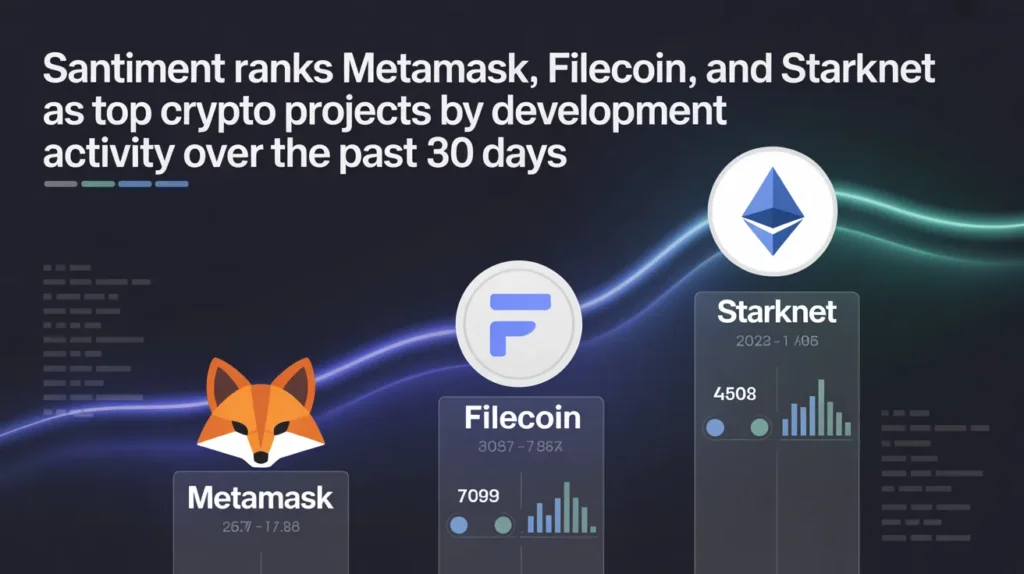
Santiment has released fresh data highlighting where crypto developers have concentrated their efforts over the past 30 days, offering a clear snapshot of which blockchain projects are seeing the most sustained technical work. The rankings, based on meaningful GitHub development activity, place MetaMask USD (mUSD), Filecoin (FIL), and Starknet (STRK) firmly at the top, underscoring their strong momentum behind the scenes. MetaMask USD Leads Developer Focus According to Santiment’s latest figures, MetaMask USD emerged as the most actively developed crypto project in the last month by a wide margin. The stablecoin recorded the highest developer activity score, signaling intense ongoing work around its codebase, tooling, and infrastructure. This level of attention suggests that contributors are prioritizing reliability, upgrades, and long-term usability rather than short-term market moves. “According to Santiment’s data, which examines significant development activity on GitHub, MetaMask USD (mUSD) topped the list.” Filecoin followed in second place, continuing its consistent performance among developer-focused projects. As a decentralized storage network, Filecoin’s strong showing reflects ongoing improvements to its storage economy, network efficiency, and developer tools. Starknet claimed third place, maintaining its position as one of the most actively built Layer-2 solutions, driven by work on scalability and zero-knowledge technology. Shifts Among Established Networks Beyond the top three, Hedera (HBAR) ranked fourth, benefiting from steady development tied to enterprise-grade applications and network upgrades. Chainlink (LINK), however, stood out for a different reason. After spending months near the top of Santiment’s rankings, it slipped to fifth place this time, indicating a relative slowdown in visible GitHub activity compared to peers. “Chainlink (LINK), which remained at the top of the list for months, has recently fallen to lower positions, which is noteworthy.” Other projects rounding out the top ten include Safe (SAFE), Internet Computer (ICP), DeFiChain (DFI), Cardano (ADA), and Avalanche (AVAX). While some of these networks moved up the rankings, others saw modest declines, reflecting shifting development priorities rather than a lack of progress. Top Crypto Projects by Developer Activity (Last 30 Days) Santiment’s full ranking for the past month places the leading projects as follows: Directional indicators shared by Santiment also show how each project’s position changed compared to the previous month, with Filecoin, Starknet, Hedera, Safe, and DeFiChain recording upward moves, while Chainlink, Internet Computer, Cardano, and Avalanche experienced slight drops. Why Developer Activity Matters High developer activity is widely viewed as a strong signal of long-term commitment. It points to active problem-solving, feature development, and network maintenance, all of which are critical for sustainability. While prices may fluctuate daily, consistent technical progress often lays the groundwork for future adoption and growth. Santiment’s latest report reinforces that, even in volatile market conditions, developer focus remains a key metric for tracking which crypto projects are building steadily for the future.