
Strategy Completes Its 100th Bitcoin Buy With Another 592 $BTC, Celebrating the Orange Century

In a milestone moment for corporate cryptocurrency adoption, Strategy (NASDAQ: MSTR) has completed its 100th Bitcoin acquisition since embracing BTC as its principal reserve asset in 2020. The company added 592 Bitcoin (worth about $39.8 million) between February 17 and 22, marking another step in its relentless accumulation strategy. Funded entirely through the sale of 297,940 shares of its Class A common stock under its at-the-market offering program, the latest purchase injected fresh capital directly into Bitcoin, emphasizing the firm’s commitment to increasing its crypto holdings instead of reducing them. Key Takeaways A Century of Bitcoin Buying Since August 2020, when the company first pivoted toward Bitcoin as a treasury reserve, Strategy has steadily accumulated BTC through regular purchases, often weekly. With this latest transaction, its total holdings now stand at 717,722 Bitcoin—acquired for a cumulative $54.56 billion at an average cost around $76,020 per coin. Executive Chairman Michael Saylor, a longtime Bitcoin advocate, hinted at the purchase in the days leading up to the announcement with a post on X showing Strategy’s Bitcoin tracker alongside the caption: This phrase has been used by Saylor to emphasize Bitcoin’s long‑term potential and the company’s belief that the asset will play a defining role in the financial landscape of the next hundred years. Market Reaction and Price Context The purchase comes amid a softening Bitcoin market, with the cryptocurrency trading around $64,700–$65,000 at press time. The recent dip below Strategy’s average acquisition price has placed its massive BTC position temporarily underwater on a cost basis, resulting in an estimated unrealized loss measured in the billions. That dynamic has also weighed on Strategy’s own share price, which traded lower following the announcement—underscoring the strong correlation between MicroStrategy’s stock performance and Bitcoin’s price action. Funding Strategy and Capital Markets Moves The company’s approach to expanding its Bitcoin stash continues to rely heavily on equity issuance. In this latest round, proceeds from common stock sales under the at‑the‑market program were the sole source of funds for the BTC buy. Strategy still has substantial capacity under its offering programs, including billions of dollars in preferred and other stock lines available for future funding. This blend of capital markets activity and Bitcoin purchases has drawn attention from institutional investors. Recent brokerage filings suggest growing interest in gaining BTC exposure via Strategy shares rather than direct crypto purchases, with some investors increasing their positions significantly. A Long View on BTC Despite short‑term price swings and paper losses, Strategy’s leadership has repeatedly stressed its commitment to buying Bitcoin regardless of market conditions. Saylor has reiterated that the company has no plans to sell, asserting that its reserves are positioned to support dividends and debt obligations for years without liquidation. As Strategy closes in on a new era of Bitcoin accumulation, the company remains the largest corporate holder of Bitcoin in the world—a fact that continues to shape sentiment around institutional participation in the cryptocurrency market.
Bitdeer Exits Its $BTC Position, Offloading 1,132.9 Bitcoin in Total and Reducing Holdings to Zero
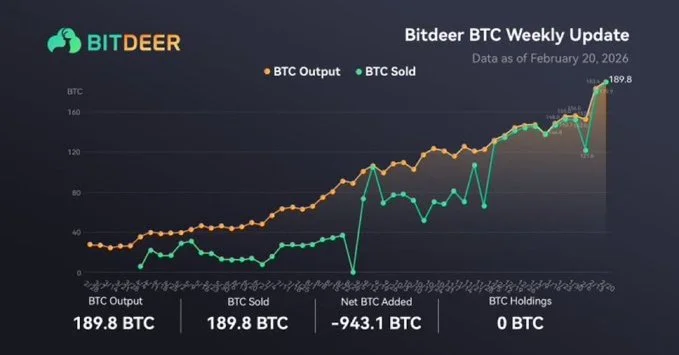
Bitcoin mining giant Bitdeer Technologies Group (BTDR) has completed a dramatic shift in its balance sheet strategy, fully liquidating its corporate Bitcoin holdings as of February 20, 2026. According to the company’s latest operational report, Bitdeer sold a total of 1,132.9 BTC, including its entire reserve and recent production, leaving its treasury at zero BTC—a rare stance among publicly traded miners. In the week leading up to Feb. 20, the Singapore‑based miner reported 189.8 BTC mined, all of which was immediately sold rather than being added to reserves. Alongside this week’s output, Bitdeer liquidated 943.1 BTC previously held, marking a net outflow of 943.1 BTC and the complete exit from its proprietary Bitcoin balance. Key Takeaways A Break From Traditional Miner Treasury Strategy Historically, many Bitcoin miners have retained a portion of mined coins as a hedge against future price appreciation, contributing to both earnings flexibility and investor confidence. Bitdeer’s move breaks sharply with this approach: as of Feb. 20, 2026, no Bitcoin remains on its corporate books, excluding customer deposits. This full liquidation caps an eight‑week reduction from the roughly 2,000 BTC the company held at the end of 2025. By comparison, peers like Marathon Digital and Riot Platforms continue to hold substantial Bitcoin treasuries, with tens of thousands of coins on their balance sheets. Why the Sudden Exit? Bitdeer management has framed the decision not as a loss of confidence in Bitcoin’s long‑term prospects but as a liquidity‑focused move, intended to support operational and strategic objectives. The sale coincided with a major financing effort: the company priced $325 million in convertible notes due 2032, alongside a $43.5 million registered direct offering of shares, to strengthen its balance sheet and fund future growth. Proceeds from these financings are slated for data center expansion, ASIC hardware development, high‑performance computing (HPC) and AI cloud initiatives, and general corporate purposes. This suggests Bitdeer is prioritizing capital for infrastructure buildouts over maintaining Bitcoin exposure amid tightening mining economics. Operating Pressure and Market Context Bitdeer’s decision comes during a period of compressed mining margins. Recent network conditions have seen Bitcoin mining difficulty rise by significant margins, and hash price—a key measure of miner revenue per unit of computational power—has fallen below $30 per PH/s/day, squeezing profitability. For many miners, selling a portion of activity to cover costs like electricity and rig maintenance is routine. But liquidating all reserves and weekly output—as Bitdeer did—underscores how difficult the current environment has become for some operators. Investor Reaction and Industry Implications The market response was immediate: Bitdeer’s stock price experienced downward pressure following the announcements, reflecting investor concerns over dilution and the abandonment of a traditional “HODL” reserve strategy. While selling more than 1,100 BTC represents a small slice of the cryptocurrency’s total supply, corporate exits like this can influence sentiment—especially when executed by miners with high public visibility. However, analysts note that the broader Bitcoin market’s depth can absorb such sales without significant sustained price disruption. What Comes Next for Bitdeer? With a zero‑Bitcoin treasury, Bitdeer now stands apart from peers that continue to balance mining operations with long‑term asset accumulation. The company’s strategy appears focused on deploying capital into high-growth infrastructure segments like AI and data center services—areas where sustained revenue could help offset cyclical weaknesses in Bitcoin mining income. Whether this shift will pay off depends on execution: expanding data centers, scaling AI cloud services, and managing debt responsibly will be critical as Bitdeer transitions from a pure mining play to a broader technology operator—all while Bitcoin continues trading under pressure near multi-month lows. In a sector marked by thin margins and volatile price action, Bitdeer’s full departure from Bitcoin holdings signals a bold, if unconventional, gamble on liquidity and diversification as the next chapter of its corporate roadmap.
Michael Saylor Says Quantum Computing Is Not an Immediate Threat to Bitcoin and May Be at Least a Decade Away

Michael Saylor, the executive chairman of Strategy (formerly MicroStrategy), has added a calm voice to one of the most speculative debates in crypto: whether quantum computing poses a real and immediate threat to Bitcoin’s security. According to Saylor’s recent statements, the answer is a clear not yet—and industry timelines support the idea that any quantum risk is still well over the horizon. Key Takeaways Quantum Computing: Not a Present Danger In a statement that’s quickly circulating across crypto media, Saylor emphasized that quantum computing does not currently threaten Bitcoin’s cryptographic foundations and is unlikely to do so within the near future. He pointed out that the technology is still far from being capable of compromising Bitcoin’s core cryptographic protocols and suggested it may take at least a decade before quantum advancements become materially relevant. That perspective resonates with broader analysis from technology commentators and blockchain security researchers, who generally project that quantum machines powerful enough to crack Bitcoin’s elliptic‑curve cryptography (ECDSA) are unlikely before the 2030s. The consensus among several industry reports is that practical quantum threats remain distant, giving Bitcoin developers and the wider ecosystem time to prepare. Why Experts Say Bitcoin Isn’t Under Immediate Threat Quantum computing certainly captures headlines with promises of revolutionizing computation—but revolution and threat are not the same. Today’s quantum systems, even the most advanced prototypes from leading research labs, contain only a few hundred qubits and are highly error-prone. They lack the large numbers of logical qubits—hundreds of thousands or more—required to run Shor’s algorithm effectively against real‑world cryptographic systems like Bitcoin’s. Multiple assessments from independent analysts indicate that: The Broader Industry View Saylor’s position aligns with a spectrum of expert analysis. Some voices in the cryptography community suggest caution in treating quantum risk as a remote certainty—and note that standards bodies like the U.S. National Institute of Standards and Technology (NIST) are already working on quantum‑resistant cryptographic algorithms that Bitcoin and other blockchains could adopt as needed. Meanwhile, analysts from the crypto sector generally regard quantum concerns as a longer‑term planning issue rather than a reason for panic today. Over the next several years, developers can and likely will incorporate post‑quantum cryptographic techniques into Bitcoin wallets and protocol upgrades, maintaining security well ahead of any plausible “quantum threat date.” What This Means for Bitcoin Holders For investors and users, Saylor’s comments should provide two clear takeaways: In short, while the theoretical risk of quantum computing breaking blockchain encryption is real in principle, it is not a pressing threat today—nor is it likely to be for many years. Saylor’s remarks, backed by current scientific and industry discourse, suggest that Bitcoin’s security assumptions are intact for now, giving the market and developers time to prepare before any serious quantum challenge arrives.