
Crypto Fear & Greed Index Remains in Extreme Fear at 10 Today, Down From 20 Last Month as Market Sentiment Continues to Deteriorate
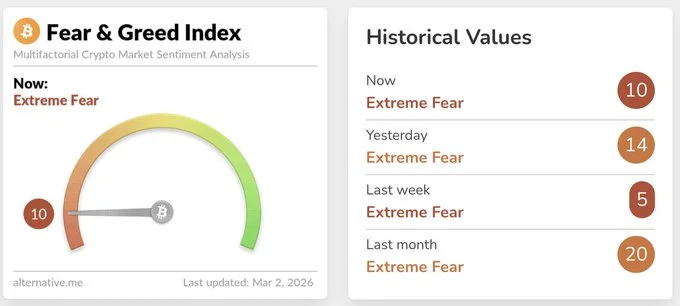
The Crypto Fear & Greed Index has dropped to 10 today, firmly placing the digital asset market in what is classified as “Extreme Fear.” Just one month ago, the index stood at 20. The sharp decline underscores how quickly sentiment has weakened amid renewed volatility and mounting macroeconomic pressure. A reading of 10 is among the lowest levels the index can register. It signals that investors are overwhelmingly risk-averse, with panic-driven selling dominating trading activity across major cryptocurrencies. Key Takeaways What’s Behind the Sharp Decline? Several forces are converging to push sentiment lower. First, volatility has intensified. Sudden price swings in large-cap cryptocurrencies have unsettled traders, eroding confidence in short-term stability. Rapid sell-offs tend to amplify uncertainty, especially in a market where leverage and derivatives trading can accelerate downward momentum. Second, macroeconomic conditions remain restrictive. Elevated global interest rates and tighter liquidity have reduced appetite for speculative assets. When borrowing costs are high and capital is less accessible, risk assets like cryptocurrencies often face sustained pressure. Investors are increasingly cautious, preferring safer instruments over highly volatile digital tokens. Third, sentiment itself has become a driver of further weakness. Negative headlines and social media reactions spread quickly, influencing retail traders in real time. As fear escalates, selling begets more selling. This feedback loop can deepen downturns beyond what fundamentals alone might justify. Why Extreme Fear Deserves Attention Historically, extreme fear readings have often appeared near market bottoms. When the majority of participants are liquidating positions in panic, much of the immediate selling pressure may already be exhausted. At that point, long-term investors sometimes begin accumulating positions quietly. Past market cycles show that single-digit or near-single-digit readings on the Crypto Fear & Greed Index have coincided with periods of significant stress—including broad crypto downturns and macro-driven corrections. In several instances, these episodes were followed by stabilization and eventual recovery. That said, extreme fear does not guarantee an immediate rebound. Markets can remain depressed for extended periods, particularly if macro headwinds persist. Timing a bottom in real time is notoriously difficult. Still, professional investors monitor sentiment indicators closely. When fear is pervasive, valuations may begin to reflect worst-case scenarios. For disciplined buyers with long-term conviction, such phases can present strategic entry opportunities. Liquidity and Macro Risks Still Loom Despite the contrarian signal that extreme fear can represent, risks remain substantial. Liquidity conditions are central. If global financial conditions tighten further, cryptocurrencies could experience additional downside. Reduced inflows into digital asset funds and declining trading volumes would compound weakness. Moreover, confidence is fragile. Sentiment-driven markets require clarity and stability to rebuild momentum. Uncertainty around monetary policy, regulatory developments, or broader economic data can prolong caution among participants. It is also worth noting that prolonged fear can dampen new capital formation in the sector. Venture funding, token launches, and speculative retail flows often slow during extended downturns, limiting near-term catalysts for recovery. A Critical Inflection Point With the index at 10, the market sits at a sensitive juncture. Short-term sentiment is deeply negative, but long-term structural interest in digital assets remains intact among institutional players and committed retail investors. If macro conditions stabilize and volatility cools, confidence could gradually return. A recovery in prices would likely lift the index out of extreme fear territory, signaling improving risk appetite. Until then, caution dominates. The current reading reflects both danger and potential. Panic has historically preceded periods of rebuilding in crypto markets, but recovery depends heavily on external economic forces and renewed investor trust. For now, the data is clear: sentiment has deteriorated sharply over the past month, and the market remains under pressure. Whether this phase marks capitulation or the start of a deeper correction will depend on how global conditions and investor psychology unfold in the weeks ahead.
U.S. Chartered Bank SoFi Has Enabled Solana Network Deposits for Its 13.7 Million Customers Directly Through Its Banking App
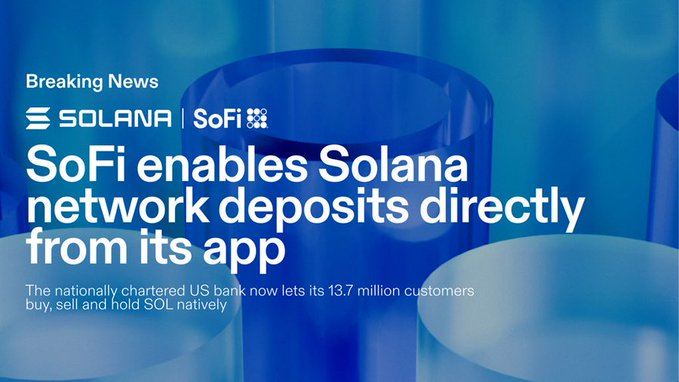
SoFi has rolled out support for direct deposits on the Solana network, allowing its 13.7 million customers to transfer SOL from external wallets straight into their SoFi crypto accounts. The update, announced on X, confirms that users can now buy, sell, hold, and receive SOL within the bank’s mobile app. This development positions SoFi among a small group of nationally chartered U.S. banks offering direct interaction with a public blockchain network inside a regulated banking framework. Key Takeaways Direct On-Chain Access Inside a National Bank With this integration, SoFi customers are no longer limited to brokerage-style crypto exposure. Instead of only gaining price exposure through custodial or off-chain products, users can deposit SOL directly from self-custody wallets into their SoFi accounts. In practical terms, the feature bridges traditional banking and on-chain activity. Customers can manage SOL balances alongside checking and savings accounts within the same interface. For a U.S. national bank operating under a federal charter, enabling live blockchain deposits represents a meaningful shift. Most large U.S. banks have so far restricted crypto access to ETFs, custody partnerships, or trading services without allowing direct blockchain transfers. SoFi’s move stands out because it connects a regulated bank charter to a public layer-1 network in a way that remains uncommon in American banking. A Growing Digital Bank With National Reach Founded in 2011 as a student loan refinancing platform, SoFi later secured a U.S. national bank charter and has since expanded into a full-service financial institution. Today, it manages more than $50 billion in assets and holds tens of billions in customer deposits. While it does not rival Wall Street’s largest banks in size, SoFi ranks among the most prominent digital-first banks in the country. Its customer base of 13.7 million users gives the Solana integration immediate scale. The bank’s brand recognition extends well beyond financial services. SoFi holds naming rights to SoFi Stadium in California, a venue that hosted Super Bowl LVI and WrestleMania 39. The stadium is also scheduled to stage multiple matches during the 2026 FIFA World Cup and will play a central role in the 2028 Summer Olympics. That visibility underscores how a mainstream U.S. bank with national branding is now directly integrating a public blockchain into its product suite. What This Means for Solana and U.S. Banking For Solana, the integration offers access to millions of U.S. retail banking customers under a regulated umbrella. Customers can move SOL on-chain while remaining within the compliance and oversight structure of a federally chartered bank. This is not merely another trading pair listing. Direct deposits imply real blockchain connectivity rather than synthetic or derivative exposure. Users who already hold SOL in external wallets can transfer their assets into SoFi without converting to fiat first. The announcement also reflects a broader trend: crypto infrastructure is gradually being embedded into traditional financial platforms rather than operating entirely outside them. While major banks have been cautious, mid-sized and digital-native institutions appear more willing to test direct blockchain integrations. A Step Toward Deeper Integration SoFi’s update suggests that regulated financial institutions are becoming more comfortable enabling controlled on-chain access for customers. By supporting Solana network deposits, the bank has moved beyond offering simple buy-and-sell functionality and into active blockchain connectivity. For its 13.7 million users, the change simplifies access to SOL within a familiar banking app. For the wider industry, it signals that public blockchain networks are beginning to find structured entry points into U.S. banking infrastructure. As regulatory clarity continues to develop, similar integrations from other nationally chartered banks could follow. For now, SoFi’s move marks a notable moment: a federally chartered U.S. bank directly linking its customers to one of the largest public blockchain networks through its core banking platform.
Arthur Hayes Argues That a Prolonged US-Iran Conflict Could Push the Fed to Print Money, Ultimately Sending Bitcoin Higher

Arthur Hayes, co-founder of BitMEX, has reignited debate in crypto markets by arguing that escalating U.S.-Iran tensions could ultimately force the Federal Reserve into renewed money printing—a shift he believes would send Bitcoin sharply higher over time. In a series of recent remarks and essays, Hayes drew parallels between current geopolitical strains and previous U.S. military engagements in the Middle East, suggesting that war spending has historically coincided with looser monetary policy. Key Takeaways A Pattern From Past Conflicts Hayes points to historical precedents. During the 1990 Gulf War, Federal Open Market Committee (FOMC) discussions noted that instability in the Middle East complicated monetary policymaking. Later that year, the Fed cut interest rates as uncertainty weighed on the economic outlook. Following the September 11, 2001 attacks, then-Fed Chair Alan Greenspan announced an emergency 50-basis-point rate cut, citing a “heightened degree of fear and uncertainty” affecting markets and asset prices. For Hayes, these episodes illustrate a consistent playbook: geopolitical shock leads to economic strain, which ultimately invites easier financial conditions. His thesis rests on the assumption that prolonged military engagement would expand fiscal deficits, pressure growth, and increase the probability of rate cuts or quantitative easing (QE). In such an environment, he argues, scarce assets like Bitcoin benefit as the dollar weakens and liquidity floods back into markets. Market Reaction: Volatility First, Direction Later? Crypto markets have already shown sensitivity to the unfolding geopolitical headlines. When initial reports of strikes surfaced on February 28, Bitcoin dropped sharply from around $66,000 to roughly $63,600 within minutes. The sell-off proved brief. By later that evening, BTC had rebounded to approximately $67,000 amid shifting headlines. As of March 2, 2026, Bitcoin is trading near $66,800—down less than 1% on the day, up roughly 2.8% over the past week, but still more than 20% lower over the past month. The quick reversal reinforced a familiar pattern: crypto remains highly reactive to macro shocks but equally responsive to liquidity expectations. Market commentary account The Kobeissi Letter urged restraint during the volatility, posting: The episode highlights a critical distinction. While geopolitical fear can trigger immediate risk-off moves, expectations of monetary easing often stabilize and eventually lift risk assets. The Liquidity Thesis Hayes’ broader argument extends beyond war alone. He has repeatedly stated that Bitcoin’s long-term trajectory is driven less by halving cycles and more by global liquidity conditions. In late 2025, he projected Bitcoin could reach $200,000 by March 2026, citing what he described as hidden liquidity injections through the Fed’s Reserve Management Purchases program. That target has not been met, and Hayes has acknowledged that his timing has sometimes been premature. Still, he maintains that structural pressures are building. He warns that a combination of deficit-financed military spending and potential economic disruption—including AI-driven labor displacement—could eventually force policymakers into aggressive easing. “The longer Trump engages in the extremely costly activity of Iranian nation-building, the higher the likelihood that the Fed lowers the price and increases the quantity of money,” Hayes wrote. Under a renewed QE regime, Hayes has floated longer-term Bitcoin price targets ranging from $500,000 to $750,000, with even higher projections by 2028 under sustained monetary expansion. Bitcoin: Digital Gold or Risk Asset? Despite the “digital gold” narrative, Bitcoin’s historical performance during geopolitical stress has often resembled equities more than precious metals. In early 2026, for example, gold rallied to fresh highs during political instability abroad while BTC weakened alongside broader risk markets. That mixed record raises questions about Bitcoin’s immediate safe-haven credentials. However, Hayes’ argument is less about crisis hedging and more about the secondary effect: central bank response. If oil price spikes, supply chain disruptions, or economic slowdown from Middle East escalation were to weigh on growth, the Federal Reserve could face renewed pressure to cut rates or inject liquidity. In that scenario, Bitcoin’s sensitivity to money supply expansion becomes the focal point. Caution Before the Pivot Despite his bullish long-term outlook, Hayes is not calling for blind leverage. He has advised investors to wait for confirmation of policy shifts—specifically an actual rate cut or explicit return to large-scale QE — before aggressively positioning. Markets, he argues, may experience additional volatility before policymakers act. For now, Bitcoin remains near key technical levels amid global uncertainty. Whether geopolitical escalation translates into sustained monetary easing remains uncertain. But if history offers any guidance, Hayes believes the real catalyst for crypto will not be the conflict itself — it will be how the Federal Reserve chooses to finance its aftermath.