
The Ethereum ETF Has Now Seen 8 Straight Days of Net Outflows
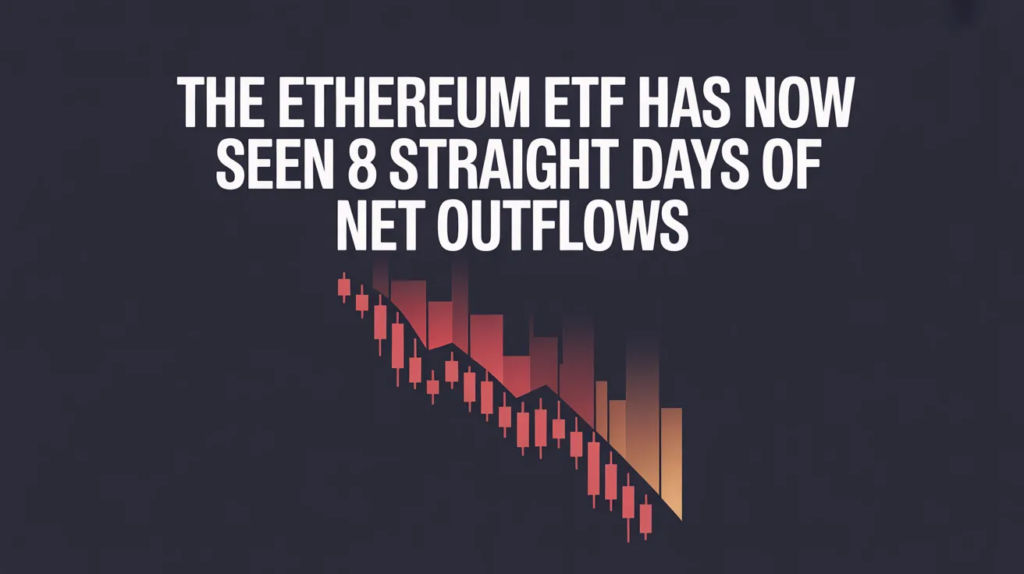
Ethereum exchange-traded funds (ETFs) are facing sustained selling pressure, marking a notable shift in institutional sentiment toward the second-largest cryptocurrency. After months of mixed flows, the latest data shows a persistent streak of capital exits, raising concerns about liquidity conditions and near-term price direction. According to SoSoValue data, spot Ethereum ETFs recorded another day of net outflows on March 26, extending the current streak to eight consecutive sessions. The withdrawals reflect a broader risk-off environment driven by macroeconomic uncertainty and geopolitical tensions. While not all funds moved in the same direction, the overall trend remains decisively negative. BlackRock’s ETHA product has been at the center of the outflows, even as its newer staking-focused counterpart, ETHB, has attracted fresh capital. Key Takeaways A Prolonged Shift in Institutional Positioning The current streak stands out not just for its duration but for its consistency. Unlike earlier volatility driven by one-off redemptions, particularly from legacy products, this phase reflects a broader repositioning across institutional investors. This marks a reversal from the previous trend, where ETFs experienced a six-day inflow run totaling over $386 million. Since then, sentiment has clearly shifted, with approximately $391.65 million exiting Ethereum ETFs over the past week alone. On a monthly scale, the trend is even more pronounced. Ethereum ETFs are now on track to log their fifth consecutive month of net outflows, with nearly $2.85 billion withdrawn since November. This sustained drawdown suggests that the current movement is more than short-term profit-taking. Rotation, Not Just Exit Despite the headline outflows, some of the capital is not leaving the Ethereum ecosystem entirely. Instead, there are signs of internal rotation—particularly toward products offering additional yield. This shift highlights a growing preference for yield-generating crypto exposure, especially in an environment where traditional interest rates remain elevated. ETHB’s structure allows investors to capture staking rewards, making it more attractive compared to passive spot exposure. Still, these inflows have not been sufficient to offset the broader selling pressure. Macro Pressures Driving the Sell-Off Alt text: Data showing Total Ethereum Spot ETF New Inflow The ETF outflows are closely tied to developments beyond the crypto market. Rising geopolitical tensions, particularly between the United States and Iran, have contributed to a flight toward safer assets. Investors are increasingly reallocating capital into gold and other traditional hedges as oil prices remain elevated, fueling inflation concerns. At the same time, expectations of interest rate cuts by the Federal Reserve have weakened, reinforcing a more cautious market stance. Such conditions tend to disproportionately affect assets like Ethereum, which are often viewed as higher-risk compared to Bitcoin or traditional investments. Price Impact and Liquidity Concerns The direct relationship between ETF flows and price action is becoming more evident. As capital exits these funds, the underlying Ethereum holdings must be sold to meet redemptions, adding continuous pressure on the market. Ethereum’s price has already reflected this dynamic. The asset has dropped more than 45% from its year-to-date high, falling to around $1,815 in late February before recovering slightly above $2,000. The impact extends beyond price declines. Reduced liquidity can lead to wider bid-ask spreads and increased volatility, making trading conditions more challenging for both institutional and retail participants. Institutional Footprint Still Matters Despite the recent outflows, Ethereum ETFs still hold significant assets under management—currently around $12.33 billion. This large capital base means that even moderate daily outflows can have an outsized impact on market dynamics. One key metric to watch is the cumulative inflow position of major funds like ETHA. If this foundational capital begins to erode meaningfully, it could signal a deeper reassessment of Ethereum’s role in institutional portfolios. Signs of Accumulation Beneath the Surface Interestingly, not all indicators point to weakness. On-chain data suggests that Ethereum balances on exchanges have dropped to historic lows, typically a sign of accumulation. This divergence—ETF outflows alongside declining exchange reserves—indicates that while institutional players may be reducing exposure, other market participants could be stepping in. Market analysts have also begun to identify potential bottoming signals. Tom Lee of Fundstrat has suggested that Ethereum may be nearing a cyclical low, aligning with ongoing accumulation strategies by large entities aiming to increase their share of the circulating supply. What Comes Next The current outflow streak has become the dominant narrative for Ethereum’s short-term outlook. Whether this trend continues will likely depend on macroeconomic developments, particularly Federal Reserve policy and geopolitical stability. For now, ETF flows remain a critical barometer of institutional sentiment. If the outflows persist, they could continue to weigh on price and liquidity. Conversely, a reversal back to sustained inflows would signal renewed confidence and potentially mark the beginning of a recovery phase. Until then, the market appears firmly in a cautious stance, with Ethereum caught between institutional selling pressure and emerging signs of long-term accumulation.
Nearly 90% of All Stablecoin Volume Comes From Tether and Circle’s USDC
The global stablecoin market is increasingly dominated by a narrow group of issuers, with recent data showing that nearly 90% of all trading volume flows through Tether’s USDT and Circle’s USDC. The figures, widely circulated online and highlighted in a recent social media post by Cointelegraph, reinforce just how central these two assets have become to the broader cryptocurrency economy. This concentration is not just a reflection of popularity—it signals where liquidity resides, where traders feel confident parking capital, and how digital markets function on a day-to-day basis. Key Takeaways Two Issuers, One Dominant Market Stablecoins are designed to maintain a steady value, typically pegged to fiat currencies like the U.S. dollar. While dozens of such tokens exist, only a handful command meaningful usage. Among them, USDT and USDC stand far ahead of the rest. Their combined dominance stems from a mix of early adoption, deep exchange integration, and strong network effects. Traders gravitate toward assets that offer tight spreads, high liquidity, and widespread acceptance—and both USDT and USDC deliver on those fronts. Once liquidity concentrates at this level, it becomes self-reinforcing. Exchanges list the most active pairs, market makers focus on the deepest pools, and users naturally follow the path of least friction. Why Stablecoins Matter So Much Stablecoins are more than just a convenience—they are the backbone of crypto trading infrastructure. They allow users to move capital quickly without relying on traditional banking rails, which can be slow or restricted depending on jurisdiction. For active traders, stablecoins provide a way to exit volatile positions without fully leaving the crypto ecosystem. Instead of converting to fiat, they can hold value in a dollar-pegged asset and re-enter the market at any time. This function becomes even more important during periods of market stress, when speed and liquidity are critical. In such moments, the dominance of a few stablecoins can actually improve efficiency—provided confidence holds. Tether’s Longstanding Lead Tether remains the largest stablecoin issuer by a wide margin, and USDT continues to dominate trading activity across global exchanges. Its early entry into the market and aggressive expansion strategy helped it secure deep liquidity pools, particularly in offshore and emerging markets. USDT is especially prevalent on high-volume trading platforms and in regions where access to traditional dollar banking is limited. Its utility in cross-border transactions and arbitrage trading has cemented its position as the go-to stablecoin for many users. Despite periodic scrutiny over its reserves and transparency, Tether has maintained market confidence—largely because of its unmatched liquidity and utility. USDC’s Institutional Appeal While Tether leads in volume, USDC has carved out a strong position by appealing to institutions and compliance-focused users. Issued by Circle, USDC emphasizes transparency, regulatory alignment, and regular attestations of its reserves. This positioning has made USDC particularly attractive to fintech firms, payment platforms, and institutional investors entering the crypto space. It is often the preferred choice for decentralized finance (DeFi) protocols that prioritize risk management and auditability. As institutional participation in crypto continues to grow, USDC’s role could expand further, potentially narrowing the gap with USDT in certain segments of the market. The Trade-Off: Efficiency vs. Concentration The dominance of two stablecoins brings clear benefits. Liquidity is deep, transactions are efficient, and price stability is easier to maintain when most activity flows through a few widely accepted assets. However, this concentration also introduces systemic risks. If either issuer were to face regulatory action, operational issues, or a loss of market confidence, the impact could ripple across the entire crypto ecosystem. Exchanges, DeFi protocols, and traders would all feel the effects. This dynamic has led to ongoing discussions about diversification and the need for alternative stablecoin models. Beyond Crypto: Real-World Impact Stablecoins are no longer confined to trading desks. Their use cases are expanding into real-world financial applications, including remittances, cross-border payments, and digital commerce. In regions with unstable currencies or limited banking access, stablecoins offer a practical way to store and transfer value. This growing adoption is drawing attention from policymakers and regulators worldwide. Regulatory Pressure Is Building As stablecoins become more integrated into global finance, regulatory scrutiny is intensifying. Authorities are focusing on issues such as reserve backing, transparency, and the potential for systemic risk. The dominance of USDT and USDC may accelerate regulatory efforts, as policymakers look to ensure that key players operate within clearly defined frameworks. Future regulations could shape how stablecoins are issued, audited, and integrated into financial systems—potentially altering the competitive landscape. Competition Isn’t Standing Still Despite the current dominance of Tether and USDC, new entrants continue to emerge. These include algorithmic stablecoins, asset-backed tokens, and region-specific alternatives designed to meet local regulatory requirements. While none have yet come close to matching the scale of USDT or USDC, competition could increase as the market matures and demand for specialized solutions grows. Risks That Can’t Be Ignored Stablecoins rely heavily on trust. Users must believe that each token is fully backed and redeemable at its stated value. Any doubts about reserves, governance, or operational integrity can quickly lead to instability. Maintaining transparency and robust infrastructure will be essential for both leading issuers and new entrants alike. What Comes Next The stablecoin market is set to expand alongside broader crypto adoption. Trading volumes are likely to grow, and new use cases will continue to emerge. Tether and USDC are expected to remain dominant in the near term, but the balance could shift as regulation tightens and competition increases. For now, their combined control of nearly 90% of trading volume underscores a simple reality: the crypto market runs on stablecoins—and two issuers are carrying most of that weight. As the industry moves forward, the challenge will be finding the right balance between efficiency, competition, and resilience.