
Stablecoin Yield Framework Remains Unresolved as Coinbase, Along with Other Crypto Firms Push Back

Legislative efforts in Washington to establish a stablecoin yield framework—a key part of broader digital‑asset regulation—have hit another major roadblock as Coinbase reasserts its opposition to the latest Senate proposal. What advocates hoped would break months of deadlock in Congress is now once again stalled, underscoring deep and persistent divides between the crypto industry, traditional banks, and lawmakers. The Senatorial Compromise — And Why It’s Faltering In recent weeks, Senators Thom Tillis (R‑NC) and Angela Alsobrooks (D‑MD) have led a bipartisan push to negotiate a compromise on how—or whether—stablecoins can pay yields or rewards to users. This language was crafted to quiet concerns from bank lobbyists, who argue that high yields on stablecoins could pull deposits away from insured banks and threaten financial stability. But despite these efforts, Coinbase officials informed Senate aides that the exchange cannot support the updated stablecoin reward framework in the current draft. The company says the language would unduly restrict how crypto platforms offer financial incentives tied to stablecoin holdings. The standoff reflects tensions that go beyond yield mechanics. Coinbase and other crypto firms see stablecoin rewards as not just a product feature but as critical to expanding digital financial services and competing with traditional banking products. Restrictive language, they argue, would undercut innovation and limit the competitiveness of U.S. platforms in a global market. Why Yield Rules Matter Yield-bearing stablecoins—digital tokens pegged to the dollar that can pay interest or rewards—have become one of the most contentious issues in the U.S. crypto policy debate. For exchanges, yield products have become a meaningful revenue generator. But for banks and some regulators, unrestricted yield poses risks by creating instruments that resemble deposit accounts without the same safety nets. Under current law in the United States, the GENIUS Act of 2025 already prohibits stablecoin issuers from paying yield directly into holders’ wallets — a provision meant to prevent stablecoin balances from functioning like bank deposits. That gap in the regulatory regime has been central to the dispute in Congress. Senators trying to bridge the divide have floated language that might allow activity-based rewards—such as bonuses tied to transactions or platform usage—while curbing passive, interest-like payments. But Coinbase says the latest proposal still goes too far, and its refusal to back it signals that legislative consensus remains distant. Impact on the Legislative Clock The broader bill in question—frequently referred to in press coverage as the Digital Asset Market CLARITY Act—has already passed the House but stalled multiple times in the Senate. Lawmakers had hoped that revisions on stablecoin yield provisions would finally unlock movement, but persistent objections from the crypto sector have kept the bill from a floor vote. Proponents of the legislation, including members from both parties and officials from the White House, have stressed the urgency of finalizing clear rules before the midterm election cycle reshapes Congress. Without progress now, the bill risks further delays or outright failure. Industry and Market Ripples The ongoing uncertainty has reverberated beyond Capitol Hill. Market sentiment has reflected anxiety over regulatory risk, with crypto‑adjacent stocks reacting sharply to news surrounding the bill’s provisions. Both Coinbase and Circle—issuer of the USDC stablecoin—saw share prices weaken on recent revisions that would restrict yield‑paying products. Analysts point out that ambiguity in stablecoin rules not only affects the growth prospects of yield products but also dampens broader confidence for institutional participation in digital assets. Without a clear framework, firms face difficulty planning products that hinge on predictable regulatory outcomes. Regulatory Horizon: Still Unclear Attempts by regulators and industry stakeholders to find common ground have included multiple White House‑hosted discussions, but so far no definitive agreement has been announced. Banking groups have lobbied vigorously for guardrails to protect deposit stability, while crypto advocates warn that overly restrictive legislation could push innovation offshore and diminish U.S. leadership in digital finance. Critics of the current approach argue that failing to address the stablecoin yield question comprehensively could leave the market in limbo, with firms reluctant to roll out new products and users facing confusion over legal rights and protections. Sound regulatory design, they say, is necessary not just for industry growth but for consumer protection and systemic resilience. What’s Next With Coinbase publicly distancing itself from the latest proposal, the ball is back in lawmakers’ court. Negotiators must now weigh how to balance the competing priorities of innovation, consumer protection, financial stability and bank‑industry concerns. Whether a revised compromise can attract crypto industry backing — and avoid alienating the banking sector — will likely determine the future of stablecoin regulation in the U.S. For now, the framework remains unresolved, its fate hanging in the balance as discussions continue behind closed doors.
Revolut Transaction Volume Onchain Has Crossed $1.2B on Polygon

European digital banking giant Revolut has quietly reached a major milestone in blockchain payments, moving over $1.2 billion in stablecoin transfers on the Polygon network — a figure that reflects actual user transfers, not trial activity or internal testing. This development not only highlights the rapid uptake of blockchain rails for real‑money transfers but also underscores a subtle shift in how financial institutions view and use decentralized infrastructure for cross‑border payments. Key Takeaways Onchain Transfers: Real Volume, Real Users Revolut’s integration with Polygon saw users send and receive stablecoins like USDC and USDT through Polygon’s settlement layer. These transfers are executed in seconds and, critically, at a tiny fraction of a cent in transaction costs. According to the latest data: For context, legacy banking systems such as SWIFT still involve multiple intermediaries, slow settlement windows (often days), and fees that can range into double digits, whereas Polygon’s blockchain settlements occur rapidly and at a tiny cost. Economics Driving Institutional Choice Cost and speed are central to why Revolut and other institutions are choosing Polygon as their payment backbone. According to on‑chain data, Polygon’s transaction fees are, on average, 426 × lower than Ethereum’s and approximately 4 × lower than Solana’s for equivalent transfers. At the scale Revolut is operating — hundreds of millions moving steadily through the system — this cost differential matters. Lower fees translate directly into savings for end users and businesses alike, especially in scenarios like remittances where every basis point counts. Beyond a Milestone: Momentum Across Payments Revolut isn’t alone in putting real volume through Polygon’s payment stack. Other big players, such as Paxos, have reported similarly large stablecoin volumes on Polygon, reinforcing the network’s attractiveness for settlement services. Inside the Revolut app, users benefit from: These features make blockchain usage feel like regular finance to most end users — a crucial factor in accelerating mainstream adoption. Regulatory Progress and Future Prospects The timing of the $1.2 billion milestone coincides with Revolut’s regulatory progress. The company has filed for a U.S. national bank charter, which, if approved, would allow it to operate across the U.S. with FDIC‑insured deposits and access to core payment systems like Fedwire and ACH. Revolut is also testing a pound‑pegged stablecoin within the UK Financial Conduct Authority’s regulatory sandbox — a signal that blockchain‑native money movement could integrate directly with regulated fiat frameworks. These moves suggest that Revolut’s blockchain strategy isn’t experimental—it’s preparing for regulated, global scale. What This Means for Blockchain Adoption Revolut’s on‑chain volume milestone is significant not just for its size but for its implications: This growing footprint of stablecoin settlement and blockchain rails in everyday financial activity marks a structural shift in how value moves globally. What was once the domain of niche crypto communities is now live, real‑money infrastructure powering real transfers for millions of users.
Crypto Advocacy Group Stand With Crypto Targets 2026 Us Midterms With Voter Mobilization Strategy Across Key Swing States

Stand With Crypto — a grassroots political advocacy organization supported by Coinbase — has launched an ambitious campaign to mobilize pro‑crypto voters ahead of the 2026 US midterm elections, marking a significant escalation in the cryptocurrency industry’s political engagement. The initiative centers on a new online voter hub, a first wave of candidate endorsements, and a strategic focus on competitive districts where digital‑asset policy could influence election outcomes. The effort reflects a growing belief among industry advocates that digital‑asset policy has become a meaningful electoral issue, not just a niche concern. With more than 2.7 million advocates nationwide plugged into its network, Stand With Crypto is now pushing to convert that base into a decisive voting bloc in November’s races. Key Takeaways New Voter Hub Aims to Inform and Activate At the heart of Stand With Crypto’s strategy is a comprehensive voter hub, designed to give voters detailed insights into where candidates stand on cryptocurrency regulation and innovation. The platform aggregates public statements, legislative records, and responses to Stand With Crypto’s own questionnaire, then assigns favorability ratings that users can review before casting their ballots. This voter hub serves two purposes. First, it gives the crypto community a transparent comparison tool to assess candidates’ positions. Second, it doubles as an organizing platform, helping to coordinate outreach and encourage voter participation across a range of competitive congressional contests. Endorsements and Battleground Priorities In its initial slate of endorsements, Stand With Crypto has backed six incumbent lawmakers from both major parties whose records align with clearer, more pragmatic digital‑asset policy frameworks. That group includes: Stand With Crypto has also identified eight highly competitive House districts where crypto voters are thought to make up a significant share of the electorate. In some, such as Ohio’s 9th District and Pennsylvania’s 10th District, the group is specifically prioritizing contests against incumbents with records it deems unfavorable on crypto policies. The bipartisan nature of the endorsements—spanning Republicans and Democrats—underscored Stand With Crypto’s broader messaging that support for clear digital asset rules transcends party lines and that the issue could sway persuadable voters in tight races. Polling Shows Crypto Voters Highly Motivated Stand With Crypto also released new polling data this month indicating that crypto owners are more enthusiastic about voting than the average American and could be a pivotal voting bloc in several key states. According to the survey of 1,000 crypto owners and Stand With Crypto advocates: The poll results also suggest that many crypto voters do not consistently align with one party, making them potentially influential in close contests — particularly in swing states such as Nevada, Pennsylvania, Ohio, and North Carolina. Multi‑Channel Outreach and On‑the‑Ground Organizing To translate enthusiasm into turnout, Stand With Crypto is deploying a multi‑channel outreach effort ahead of November. This includes: The goal is not just to inform crypto voters about candidates’ stances, but to turn them into a mobilized force at the ballot box—something the group believes could be decisive in shaping the composition and legislative priorities of the 120th Congress. Crypto Policy as an Electoral Factor This midterm engagement builds on broader industry trends where crypto‑backed political action committees (PACs) and advocacy groups have poured significant resources into supporting sympathetic candidates and opposing critics. In the 2024 cycle, crypto PACs were among the largest corporate donors, and their influence is only expanding in 2026 with war chests now estimated in the hundreds of millions. Lawmakers in Congress remain deeply divided over how to regulate digital assets, with legislation around topics like market structure and stablecoin frameworks still unresolved. Stand With Crypto’s campaign signals that policy clarity—or lack thereof—could become a voting issue, particularly for voters whose economic interests are tied to the growth of the digital asset sector. What Comes Next Stand With Crypto has indicated that this is just the first phase of its midterm engagement. Additional candidate endorsements and battleground race updates are expected in the coming weeks, as the group continues refining its strategy and outreach. With the midterm elections still months away, Stand With Crypto’s efforts mark a clear escalation in crypto’s involvement in U.S. electoral politics, raising the stakes for how digital‑asset policy might shape legislative priorities in the years ahead.
Peter Schiff Warns That Using Bitcoin as a Mortgage Down Payment Puts Lenders at Serious Risk, as a BTC Crash Could Wipe Out the Collateral Entirely

Prominent gold advocate and long-time Bitcoin critic Peter Schiff has issued a fresh warning about the growing trend of using Bitcoin as collateral in mortgage financing, arguing that the practice exposes lenders to severe downside risk in the event of a sharp market correction. His concerns come as crypto-backed lending gains traction among fintech firms and select financial institutions experimenting with alternative credit models. While proponents argue that digital assets can unlock liquidity without forcing investors to sell their holdings, critics say the volatility of Bitcoin makes it an unreliable foundation for long-term loans like mortgages. A steep decline in Bitcoin’s price can rapidly erode the value of pledged collateral, putting pressure on lenders. As collateral weakens, the probability of loan default increases, forcing lenders to tighten borrowing conditions or demand additional security. Recent market behavior supports these concerns. Bitcoin has historically experienced sharp drawdowns—sometimes exceeding 50% within months—raising questions about its suitability for securing large, multi-year obligations such as home loans. In such scenarios, lenders could find themselves undercollateralized almost overnight. Key Takeaways Volatility Remains the Core Challenge Unlike traditional assets used in mortgage underwriting, Bitcoin lacks price stability and is heavily influenced by macroeconomic sentiment, regulatory developments, and market speculation. This creates a mismatch between the long-term nature of mortgages and the short-term price swings of crypto assets. For lenders, risk management becomes significantly more complex. A sudden drop in BTC value could trigger margin calls or forced liquidations, but in a fast-moving market, executing those safeguards may not fully cover losses. Rising volatility continues to test confidence in crypto-backed lending, even as adoption grows among retail and institutional participants. Adoption vs. Risk Appetite Despite these risks, some firms continue to push forward with Bitcoin-backed mortgage products, betting on increasing adoption and long-term price appreciation. However, traditional financial institutions remain cautious, largely due to regulatory uncertainty and the unpredictable nature of digital assets. Schiff’s warning underscores a broader divide in the financial world: whether innovation in crypto lending can outpace the structural risks tied to volatility. For now, many lenders appear unwilling to fully embrace Bitcoin as a stable form of collateral for housing finance. As crypto markets mature, the debate is unlikely to fade. The key question remains whether Bitcoin can transition from a speculative asset to a dependable financial instrument—or whether its volatility will continue to limit its role in critical sectors like mortgage lending.
Bitcoin Has Outperformed the S&P 500, Gold, and Oil in Nearly Every Major Geopolitical Crisis Over the Past 6 Years
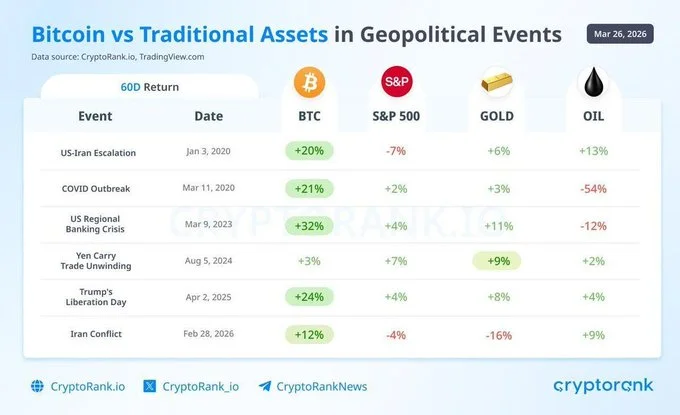
Bitcoin is once again at the center of a high-stakes macro test, and early data suggests it is holding up better than many expected. Fresh figures from CryptoRank indicate that across nearly every major geopolitical crisis in the past six years, Bitcoin’s 60-day returns have consistently outpaced traditional assets like equities, gold, and oil. The latest conflict, which escalated on February 28 under what has been referred to as Operation Epic Fury, is following a similar pattern—though the underlying dynamics are more complex than the headline suggests. Since the conflict began, Bitcoin has gained roughly 7%, while the S&P 500 has slipped, gold has declined by about 5%, and the MSCI World Index has dropped around 4%. On the surface, this appears to reinforce the long-debated “digital safe haven” narrative. But a closer look reveals that timing—not just resilience—is playing a crucial role. Key Takeaways A Different Starting Point Bitcoin did not enter this crisis on equal footing with traditional markets. In fact, much of its correction had already taken place. That pre-war decline effectively reset the market. Excess leverage was unwound, weaker participants exited, and valuations normalized. By the time geopolitical tensions escalated, Bitcoin had already absorbed a significant portion of downside pressure. Contrast that with the S&P 500 and gold. Both were trading near record highs before the conflict began, leaving them more exposed to sudden repricing. As a result, their recent declines may reflect delayed adjustment rather than outright weakness. Resilience Under Pressure Even after accounting for its earlier drawdown, Bitcoin’s behavior during the conflict has been notable. The asset briefly dipped to around $63,000 in the immediate aftermath of the escalation but rebounded within 48 hours. Despite over $1 billion in crypto liquidations triggered by political developments in late March, Bitcoin has managed to hold above its pre-war lows. This rapid recovery contrasts sharply with equity markets, where the S&P 500 continues to trend lower, forming a pattern of lower highs. While Bitcoin still shows strong correlation with equities during sharp sell-offs—reaching as high as 89% during peak panic on March 19—its rebound profile suggests a different kind of market participation. There are two possible explanations. One is simple exhaustion: sellers have already acted, leaving limited downside pressure. The other is more structural—new buyers entering the market with a longer-term view, potentially driven by concerns around monetary policy and currency debasement. Traditional Safe Havens Underperform Gold’s performance has been particularly surprising. Historically viewed as the go-to hedge during geopolitical instability, it has struggled in this environment. Rising real yields appear to be diverting capital away from gold, weakening its appeal despite heightened global uncertainty. This shift highlights a broader change in how investors are positioning during crises, with some capital potentially rotating into alternative stores of value—including Bitcoin. Meanwhile, the S&P 500 has entered a more technically fragile position. Key resistance levels have formed in the 6,731 to 6,782 range, with major financial institutions projecting further downside in the event of sustained energy shocks. JPMorgan has flagged 6,000 as a near-term risk, while more severe scenarios could push the index significantly lower. Oil: The Critical Variable At the center of the current macro landscape is oil. Brent crude has surged from around $70 to above $112, driven largely by disruptions linked to the Strait of Hormuz. The waterway remains a crucial chokepoint for global energy supply, and its status is shaping expectations across all major asset classes. The implications are straightforward. If supply constraints ease and oil prices retreat toward the $80–$85 range, risk assets could stabilize. In that scenario, the S&P 500 may attempt a recovery toward its previous resistance zone, Bitcoin could push above $75,000, and gold may regain momentum. However, a prolonged disruption would reinforce stagflation concerns—slower growth combined with persistent inflation. That environment would likely pressure equities further and complicate the outlook for Bitcoin, particularly if expectations for interest rate cuts begin to fade. A Question of Timing, Not Just Strength Bitcoin’s outperformance in the current crisis is real, but it is not purely a story of strength. This distinction matters. Bitcoin had already undergone a significant correction, while traditional markets were still priced for stability. As a result, the same geopolitical shock produced very different outcomes across asset classes. For traders and investors, this shifts the focus away from simple directional bets. Instead, the emphasis is increasingly on sequencing—understanding which markets have already priced in risk and which are still adjusting. Divergence Creates Opportunity The divergence between Bitcoin, equities, and commodities is becoming one of the defining features of the current market environment. Bitcoin’s earlier repricing has positioned it differently from equities, which are now undergoing their own adjustment phase. At the same time, oil continues to act as the primary transmission mechanism, influencing inflation expectations, monetary policy outlooks, and overall risk sentiment. This interconnected structure is creating opportunities that go beyond single-asset trades. Movements in oil feed directly into equities and indirectly into Bitcoin through liquidity conditions and policy expectations. In that context, Bitcoin’s recent performance is not just a headline about outperformance—it is a signal about how market cycles, timing, and macro forces are interacting in real time. The coming weeks will test whether this relative strength can hold. But one thing is already clear: Bitcoin is no longer behaving like a fringe asset during global crises. It is moving alongside, and sometimes ahead of, the world’s most established markets.
Trump Says US Will Be the Undisputed Bitcoin and Crypto Superpower of the World at Future Investment Initiative

U.S. President Donald Trump has laid out one of his clearest positions yet on cryptocurrency, declaring that the United States is on track to become the global leader in Bitcoin and digital assets. Speaking on March 27 at the Future Investment Initiative Summit in Miami, Trump framed crypto not as a fringe innovation but as a strategic pillar of national economic policy. Addressing a room filled with investors, policymakers, and technology leaders, Trump emphasized the urgency of leadership in the sector, warning that global competitors are already positioning themselves to dominate the space. His remarks signal a more aggressive posture toward crypto adoption, one that aligns regulatory clarity, institutional participation, and technological investment under a broader economic agenda. Key Takeaways A Strategic Shift Toward Crypto Leadership Trump’s comments reflect a notable shift in how digital assets are being positioned within U.S. policy circles. Rather than treating cryptocurrencies as speculative instruments, the administration is framing them as critical infrastructure for future financial systems. During the address, Trump pointed to rising real-world usage as evidence of momentum. This framing suggests that crypto is no longer confined to trading platforms and investment portfolios. Instead, it is being recognized as a viable medium of exchange and a growing component of global commerce. At the same time, Trump underscored the geopolitical dimension of the industry, highlighting competition with other major economies. That comparison reinforces the idea that crypto leadership is not just about innovation, but also about maintaining financial influence on the global stage. Regulatory Clarity Takes Center Stage A key element of Trump’s message focused on regulation—or more precisely, the need to simplify it. His administration has moved toward a framework that aims to reduce uncertainty while encouraging growth. Recent joint guidance issued on March 17, 2026, by U.S. regulators marked a significant step in that direction. The Securities and Exchange Commission (SEC) and the Commodity Futures Trading Commission (CFTC) categorized several major digital assets, including bitcoin, ether, and XRP, as digital commodities. This distinction shifts oversight toward a more structured regulatory environment and away from enforcement-heavy approaches that previously dominated the space. Trump also highlighted legislative progress tied to stablecoins, pointing to the GENIUS Act as a cornerstone of this effort. The law establishes guidelines for issuance and compliance, aiming to strengthen trust in dollar-backed digital currencies while keeping innovation within U.S. jurisdiction. In framing his regulatory philosophy, Trump made it clear that the administration intends to avoid overreach. This approach is designed to attract businesses and developers who have previously been deterred by unclear or restrictive policies. Market Impact and Institutional Interest Statements from political leaders often influence market sentiment, and Trump’s remarks have already drawn attention from institutional players. A more supportive regulatory environment could accelerate capital inflows into the U.S. crypto sector, particularly as firms seek stable jurisdictions for operations. Institutional adoption has been one of the defining trends in crypto over the past few years. With clearer rules and government backing, the U.S. could strengthen its position as a hub for exchanges, blockchain startups, and financial products tied to digital assets. However, analysts note that long-term impact will depend on execution. Policy announcements can drive short-term optimism, but sustained growth requires consistent implementation and coordination across agencies. Beyond Crypto: A Broader Tech Investment Push Trump’s speech also placed cryptocurrency within a larger framework of technological investment. Alongside digital assets, he highlighted artificial intelligence and advanced manufacturing as priority sectors. The administration is targeting more than $2.7 trillion in technology investment, aiming to reinforce the country’s leadership in innovation-driven industries. In this context, crypto is being treated as one piece of a wider economic strategy rather than a standalone initiative. This integration could create synergies between sectors. For example, blockchain applications in supply chains, digital identity systems, and financial infrastructure could benefit from parallel advancements in AI and data systems. Political Dynamics and Bipartisan Interest Interestingly, Trump acknowledged that support for crypto is not limited to one side of the political spectrum. This observation points to a growing bipartisan recognition of crypto’s economic potential. While disagreements remain over regulatory details, there appears to be broader consensus on the importance of maintaining U.S. competitiveness in the sector. Such alignment could play a crucial role in passing future legislation and ensuring regulatory consistency over time. Challenges Still Ahead Despite the optimistic tone, several challenges remain. Crypto markets are still subject to volatility, and concerns around security, fraud, and consumer protection continue to shape regulatory debates. Balancing innovation with oversight will be critical. Too much regulation could stifle growth, while too little could undermine confidence in the system. There is also the question of global coordination. As more countries develop their own frameworks, differences in regulation could create friction for companies operating across borders. Looking Forward Trump’s declaration marks a significant moment in the U.S. approach to cryptocurrency. By positioning the country as a future “Bitcoin superpower,” the administration is signaling that digital assets will play a central role in economic strategy moving forward. Whether that vision becomes reality will depend on how policies are implemented and how effectively the U.S. can attract talent, capital, and innovation. For now, the message is clear: the race for crypto leadership is intensifying, and the United States intends to be at the front.