
Cryptocurrency in Supply Chain Management: How Blockchain Is Reshaping Global Trade

Cryptocurrency in supply chain management refers to the use of digital assets and the blockchain networks that power them to record, verify, and automate transactions across every stage of a product’s journey, from raw material sourcing to final delivery. The technology enables real-time traceability, tamper-proof records, and programmable payments without relying on traditional banking intermediaries. Key Takeaways Global supply chains move roughly $19 trillion in goods each year, yet they still rely on processes built for a pre-digital era: paper bills of lading, multi-day bank settlements, and manual quality checks that create weeks of lag between a problem occurring and anyone finding out about it. Counterfeiting costs the global economy an estimated $4.5 trillion annually. A single contaminated food shipment can take a week to trace back to its source. Supplier payments routed through correspondent banks can take three to five business days and lose 2 to 3 percent to fees along the way. Cryptocurrency and the blockchain infrastructure beneath it offer credible, deployable solutions to all three problems. This guide explains how the technology works in a supply chain context, which companies are already deploying it at scale, which digital assets are best suited to the job, and what barriers still stand in the way of mainstream adoption. What Is Blockchain’s Role in Supply Chain, and Why Does It Matter Now? A blockchain is a distributed ledger, a database replicated simultaneously across hundreds or thousands of computers. No single party controls it, and every entry is cryptographically linked to the one before it, making records practically impossible to alter retroactively. These characteristics solve a problem that has plagued supply chains for decades: no single participant has complete, reliable visibility into what everyone else is doing. In a traditional supply chain, a manufacturer, a freight forwarder, a customs broker, a retailer, and a bank each hold their own siloed records of the same transaction. Reconciling those records is slow, expensive, and prone to error. On a shared blockchain, every authorised party sees the same information in real time, and no party can quietly alter it after the fact. Market Snapshot (2025): The global blockchain in supply chain market was valued at approximately $1.45 billion in 2024 and is projected to grow to $20.5 billion by 2032, at a compound annual growth rate of 39.2% (Market Research Future, 2025). North America holds roughly 39% of current market share, while Asia-Pacific is expanding fastest, projected to grow at a 50.3% CAGR through 2031. The acceleration of adoption in 2025 reflects several converging forces: post-pandemic pressure to build supply chain resilience, maturing enterprise blockchain platforms, growing regulatory clarity in the US and EU, and the increasingly practical integration of blockchain with IoT sensors and AI-powered analytics. Supply chain tokenization has also emerged as a major growth area, converting physical goods and trade documents into on-chain digital assets that can be tracked and transferred in real time. How Does Cryptocurrency Specifically Improve Supply Chain Payments? Blockchain provides the record-keeping layer. Cryptocurrency provides the payment layer. The two are designed to work together: a smart contract can verify a condition such as confirmed delivery or a passed inspection and automatically release a crypto payment as part of a single automated sequence, on the same network, without human intervention or bank approval. Cross-border settlements without correspondent banks Traditional cross-border payments travel through a chain of correspondent banks, each charging a fee and adding days of settlement time. For a manufacturer in Vietnam paying a component supplier in Germany, this can mean two to five business days and a loss of 2 to 3 percent to fees and currency conversion. Ripple’s XRP Ledger settles the equivalent transaction in 3 to 5 seconds at a cost of roughly $0.0002. Stellar (XLM) processes over 7 million cross-border transactions daily at under $0.01 each. Our crypto comparison guide provides a detailed breakdown of how these assets stack up against each other. Stablecoins for price-stable trade finance One of the first objections supply chain practitioners raise about crypto payments is price volatility. A supplier who accepts Bitcoin on Monday could find its value has moved 10 percent by Friday. Crypto volatility is a genuine consideration for operational treasury management. Stablecoins solve this directly: digital assets pegged to fiat currencies give buyers and sellers the settlement speed and programmability of crypto with the price predictability of dollars. USDC and USDT are the most widely used in trade contexts. Ripple’s RLUSD, a regulated dollar-pegged stablecoin issued under a New York Trust Charter, is gaining ground specifically in institutional supply chain and payments use cases. Smart contracts as self-executing purchase orders A smart contract is a program stored on a blockchain that executes automatically when predetermined conditions are met. In supply chain terms, a buyer and supplier encode their agreement into a smart contract specifying quantity, price, delivery conditions, and payment terms. When IoT sensors or third-party data oracles confirm delivery, the contract releases payment without any invoice, accounts payable team, or payment delay. Renault’s XCEED compliance network uses exactly this approach, eliminating roughly 40 percent of manual reconciliations across its European supplier base. Crypto Asset Primary Supply Chain Use Settlement Speed Avg. Transaction Fee (2025) XRP (Ripple) Institutional cross-border payments 3 to 5 seconds ~$0.0002 XLM (Stellar) SME remittances, financial inclusion 3 to 5 seconds Under $0.01 USDC / USDT Stable trade finance, supplier payments Seconds (varies by chain) $0.01 to $0.50 ETH / ERC-20 tokens Smart contracts, DeFi trade finance 12 to 15 seconds $0.05 to $2.00 BTC Large treasury settlements Approx. 10 minutes $1 to $10 Which Real Companies Are Already Using Blockchain in Their Supply Chains? Blockchain supply chain initiatives have moved well beyond pilot programs. The following are operational deployments with measurable, publicly reported outcomes. Case Study: Food Safety Walmart and IBM Food Trust: Walmart deployed IBM’s Food Trust platform, built on Hyperledger Fabric, across its produce supply chain. The system tracks over 15 million food units monthly, capturing temperature, location, and handling data at every checkpoint. When
Bitcoin’s Whitepaper Is on Wall Street
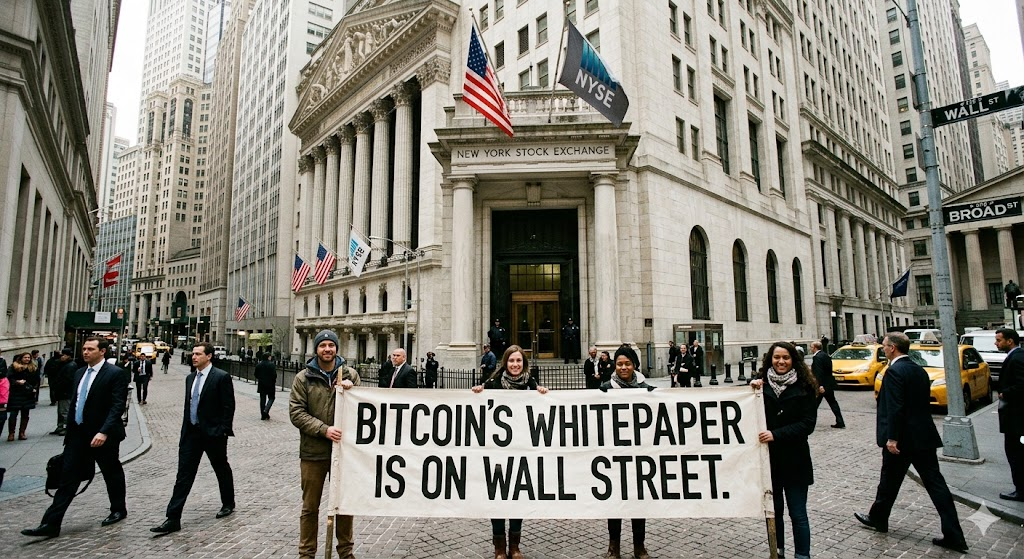
One of the world’s most recognizable financial institutions has now spotted a document that once circulated quietly among cryptography enthusiasts. The original whitepaper behind Bitcoin has reportedly appeared inside the New York Stock Exchange (NYSE), marking another moment in the gradual crossover between digital assets and traditional finance. According to a February 21, 2026 report from Bitcoin Magazine, the document authored by Satoshi Nakamoto was seen on display within the exchange. While there has been no official confirmation from the NYSE or affiliated parties, the sighting adds to a growing list of Bitcoin-related symbols appearing inside legacy financial institutions. Key Takeaways From Cypherpunk Roots to Wall Street Visibility The Bitcoin whitepaper, released in 2008, introduced a peer-to-peer payment system designed to operate without banks or intermediaries. Its core idea challenged the very structure that institutions like Wall Street were built upon. That contrast is what makes this moment notable. Seeing the document displayed inside the NYSE creates a striking juxtaposition. The same financial system that Bitcoin was designed to bypass is now hosting its foundational blueprint. For supporters of decentralized finance, the symbolism is difficult to ignore. This is not the first time Bitcoin has made its presence felt within the exchange. In December 2025, a statue of Satoshi Nakamoto was installed inside the NYSE. The installation was tied to Twenty One Capital, which listed on the exchange under the ticker XXI on December 9, 2025. The statue was described as part of a broader initiative involving multiple installations, reinforcing the idea that Bitcoin is no longer operating entirely outside institutional visibility. Symbolism vs Market Reality Despite these symbolic milestones, market sentiment tells a more cautious story. At the time of reporting, Bitcoin was trading at approximately $73,323, posting a modest 24-hour gain of around 0.57%. Its market capitalization stood near $1.47 trillion, with daily trading volume hovering above $24 billion. However, sentiment indicators present a contrasting perspective. The Fear & Greed Index registered a score of 15— firmly in “Extreme Fear” territory. This disconnect highlights a recurring pattern in crypto markets. Institutional recognition and headline-driven developments often build long-term narratives, but they do not always translate into immediate price momentum. Traders appear more focused on macro uncertainty, regulatory developments, and liquidity conditions than on symbolic gestures inside financial institutions. Institutional Bridges Continue to Form The presence of Bitcoin-related artifacts at the NYSE reflects a broader trend: the gradual integration of crypto-native companies into traditional financial systems. Twenty One Capital’s listing is one example of this shift. The firm positioned itself as a Bitcoin-focused public company, completing a business combination ahead of its debut. Its presence on Wall Street signals growing interest in offering Bitcoin exposure through regulated, publicly traded vehicles. At the same time, regulatory uncertainty remains a central issue. Developments such as the Commodity Futures Trading Commission (CFTC) exploring a larger role in crypto oversight, alongside government-linked Bitcoin transfers to institutional platforms like Coinbase Prime, show that the market is still navigating complex policy terrain. Even companies aligned with Bitcoin acknowledge these risks. Filings associated with Twenty One Capital point to ongoing legal and regulatory challenges that could affect the asset’s trajectory. A Narrative That Extends Beyond Price The appearance of the Bitcoin whitepaper at the NYSE may not move markets in the short term, but it carries narrative weight. It signals that Bitcoin is no longer viewed solely as an outsider asset. Instead, it is increasingly being acknowledged — and in some cases embraced — by the very institutions it once sought to replace. For long-term observers, moments like this contribute to a broader shift in perception. Bitcoin is gradually becoming part of the financial conversation at the highest levels, even if its original philosophy remains in tension with centralized systems. The Bigger Picture Bitcoin’s journey from a nine-page PDF shared on a mailing list to a document displayed on Wall Street reflects how far the asset has come. However, the future remains unpredictable. Market sentiment remains fragile. Regulatory frameworks are still being defined. And the balance between decentralization and institutional adoption continues to raise questions. The whitepaper’s presence at the NYSE does not resolve those tensions — it highlights them. For now, it stands as a symbol. Not of victory or full acceptance, but of a financial system in transition, where old structures and new ideas are beginning to occupy the same space.
Paying Iran in Crypto Could Trigger Serious Sanctions Violations for Shipping Firms

Shipping companies considering the use of cryptocurrency to settle potential transit fees linked to Iran may be stepping into a legal minefield, according to blockchain intelligence experts. As tensions in key maritime corridors draw global attention, the intersection of sanctions policy and digital assets is becoming increasingly difficult for operators to ignore. Kaitlin Martin, a senior intelligence analyst at Chainalysis, has warned that any such payments—whether made in fiat or cryptocurrency—could expose firms to severe penalties under existing sanctions regimes. Her comments come amid unconfirmed reports that Iran could explore collecting transit-related fees in digital currencies. Key Takeaways Crypto Payments Still Count as “Material Support” Under current U.S. and international sanctions frameworks, the method of payment does not change the legal interpretation of the transaction. If funds—crypto or otherwise—reach sanctioned entities or support state-controlled infrastructure, they may be classified as “material support.” For shipping firms navigating sensitive routes, this creates a compliance dilemma. Even indirect exposure—such as paying intermediaries who later transfer funds to sanctioned groups—can trigger enforcement actions. The concern is particularly acute given the role of Iran’s Islamic Revolutionary Guard Corps (IRGC), which has been designated by multiple jurisdictions as a sanctioned organization. Any financial flow linked to entities under its control raises immediate red flags for regulators. Speculation Over Crypto-Based Transit Fees The warnings follow growing speculation that Iran may seek alternative mechanisms to monetize its strategic position along critical shipping lanes. While no official policy has been announced, the possibility of crypto-denominated transit fees has drawn scrutiny from policymakers and analysts alike. Former U.S. President Donald Trump has already signaled strong opposition to any such move, stating he would not accept attempts by Tehran to impose tolls on maritime traffic through vital waterways. Even without formal confirmation, the mere prospect has forced shipping operators and insurers to reassess risk exposure in the region. Iran’s Expanding Use of Digital Assets Iran’s interest in cryptocurrency is not new. Over the past few years, the country has increasingly turned to digital assets—particularly stablecoins—to facilitate international trade in sectors such as oil, weapons, and raw materials. These efforts are largely driven by the need to bypass restrictions imposed on its banking system. With limited access to global financial networks, crypto offers an alternative channel for cross-border settlements. However, Martin emphasized that digital currencies are far from a perfect workaround. Blockchain transactions are recorded on public ledgers, allowing investigators to track the movement of funds with increasing precision. While users can obscure identities through certain techniques, cash-out points—such as exchanges—often provide enforcement agencies with opportunities to freeze or seize assets. Lessons From Other Sanctioned States Iran is not alone in exploring crypto as a sanctions workaround. Russia, for example, has experimented with digital tokens to facilitate cross-border trade following the sweeping restrictions imposed after its 2022 invasion of Ukraine. These efforts highlight a broader trend: sanctioned states are actively testing blockchain-based systems to maintain economic activity outside traditional financial rails. Yet the effectiveness of these strategies remains limited. Regulatory scrutiny has intensified globally, and blockchain analytics firms have become increasingly adept at identifying suspicious flows. For businesses operating internationally, this means that engaging with such systems—knowingly or unknowingly—can carry significant legal and reputational consequences. Bitcoin Mining in Iran Takes a Hit Recent data also points to a decline in Iran’s domestic crypto activity, particularly in Bitcoin mining. The country’s hashrate has reportedly dropped sharply over the past quarter, falling by around 7 exahashes per second to approximately 2 EH/s. This decline comes amid heightened geopolitical tensions involving the United States and Israel, which may have disrupted energy supplies or operational stability for mining facilities. Despite the drop, the broader Bitcoin network has remained resilient. Global hashrate continues to hover near 1,000 EH/s, indicating that the impact has been largely contained within Iran. Neighboring countries, including the United Arab Emirates and Oman, have not experienced similar disruptions, underscoring the localized nature of the issue. Compliance Pressures Mount for Shipping Firms For shipping companies, the situation underscores the importance of robust compliance frameworks. The use of cryptocurrency does not shield firms from regulatory oversight—in many cases, it may increase exposure due to the transparency of blockchain transactions. Operators must now consider not only the legal status of their counterparties but also the potential downstream implications of any payments made in high-risk jurisdictions. Insurance providers and financial partners are also likely to take a cautious approach, potentially limiting coverage or services for firms operating in areas where sanctions risks are elevated. A High-Stakes Environment As geopolitical tensions intersect with emerging financial technologies, the risks for global shipping firms are becoming more complex. The possibility of crypto-based transit fees, even if speculative, highlights how quickly the landscape can shift. For now, the message from analysts is clear: using cryptocurrency does not provide a safe harbor from sanctions compliance. If anything, it introduces new layers of traceability that regulators are increasingly equipped to exploit. In an environment where a single transaction can trigger significant penalties, caution is no longer optional—it is essential.
SpaceX Still Holds $594M in BTC Despite Reporting a $5B Loss in 2025

SpaceX is facing renewed scrutiny after reports revealed the company posted a nearly $5 billion loss in 2025—yet its Bitcoin holdings remain untouched, signaling continued conviction in the digital asset despite mounting financial pressure. According to a Reuters report published on April 9, 2026, the aerospace firm generated more than $18.5 billion in revenue last year but still ended deeply in the red. The reported loss figure includes financials from xAI, the artificial intelligence company SpaceX acquired in February 2026. While the figures have not been independently verified and the company declined to comment, the scale of the loss has sparked conversations across both traditional finance and crypto circles. The key point of interest: despite the downturn, SpaceX has not sold any of its Bitcoin. Key Takeaways Bitcoin Holdings Remain Intact Alt text: data showing SpaceX BTC holdings Blockchain data suggests that SpaceX continues to hold a substantial Bitcoin position, reinforcing its long-term stance on the asset. On-chain analytics firm Arkham Intelligence reported on March 31, 2026, that SpaceX is the second-largest private holder of Bitcoin globally. The company’s holdings are estimated at around 8,300 BTC, placing it behind only Tether among private firms. A separate analysis from early March indicated a similar figure—8,285 BTC—distributed across dozens of institutional-grade custody addresses. At the time of that earlier snapshot, the holdings were valued at approximately $544.8 million. Since then, Bitcoin’s price has climbed, pushing the value of SpaceX’s reserves higher. BTC Value Climbs Toward $600 Million With Bitcoin trading at around $71,742, the estimated value of SpaceX’s BTC stash now stands close to $594 million. This represents a notable rebound in valuation within just a few weeks, driven largely by broader market momentum. Despite short-term fluctuations—including a modest 1.4% dip in the last 24 hours at the time of reporting—the asset has maintained a strong upward trajectory in 2026. For SpaceX, this price movement has helped offset part of the perceived financial strain, at least on paper. Strategic Hold or Missed Liquidity Opportunity? The decision to retain Bitcoin during a year of heavy losses raises an important question: is SpaceX demonstrating strategic discipline or missing an opportunity to improve liquidity? Many corporate Bitcoin holders view the asset as a long-term store of value rather than a short-term hedge. This perspective aligns with the broader trend among tech-forward companies that see Bitcoin as a treasury reserve asset rather than a trading instrument. Selling during a downturn could provide immediate cash relief, but it also risks forfeiting future upside—especially in a market that has historically rewarded patience. In SpaceX’s case, the decision to hold may reflect confidence in Bitcoin’s long-term trajectory, even as other parts of the business absorb significant financial pressure. The xAI Factor in the $5B Loss A major contributor to the reported loss is the integration of xAI into SpaceX’s financials. The AI company, acquired earlier this year, likely brought substantial operational and development costs. While details remain limited, AI ventures typically require heavy upfront investment in infrastructure, talent, and research. These costs can weigh heavily on financial statements before any meaningful revenue is realized. This context is critical when interpreting the $5 billion loss figure. Without a breakdown of SpaceX’s core aerospace operations versus its newer ventures, it’s difficult to assess the underlying health of the business. Market Reaction and Transparency Questions Reuters noted that it could not independently verify the financial report, and SpaceX has not issued a public response. This lack of confirmation has left room for speculation, particularly given the company’s private status. Unlike publicly traded firms, SpaceX is not required to disclose detailed financials, making third-party reports one of the few windows into its performance. For investors and analysts, this creates a level of uncertainty that can influence sentiment. Still, the blockchain does not lie. The transparency of Bitcoin holdings provides a rare, verifiable data point in an otherwise opaque financial picture. What This Means for Corporate Crypto Adoption SpaceX’s decision to hold onto nearly $600 million in Bitcoin during a challenging financial year reinforces a broader narrative: corporate conviction in Bitcoin remains strong. Even in the face of significant losses, the company has chosen not to liquidate its digital assets. This sends a signal to the market that Bitcoin is being treated as a strategic reserve rather than a disposable asset. It also highlights the growing role of on-chain data in financial analysis. While traditional financial reports can be delayed, incomplete, or unverified, blockchain data offers real-time insight into asset movements and holdings. Final Thoughts SpaceX’s financial situation in 2025 presents a complex picture—massive revenue, significant losses, and a sizable Bitcoin position that continues to grow in value. Whether this approach proves wise will depend on both Bitcoin’s future performance and SpaceX’s ability to stabilize its broader operations. For now, one thing is clear: despite the $5 billion loss, the company is not backing down from its crypto bet.
Crypto Is Not Secure: Crypto Misconceptions

Cryptocurrency security refers to the combination of blockchain cryptography, consensus mechanisms, and user practices that protect digital assets from theft, fraud, and unauthorized access. The blockchain itself has never been successfully hacked at the protocol level for major networks like Bitcoin or Ethereum. Security failures in crypto overwhelmingly originate from user error, exchange vulnerabilities, social engineering, and smart contract exploits rather than the underlying technology. Despite its rising popularity, a common misconception persists that crypto is not secure. This view often stems from headlines about high-profile exchange hacks and a general misunderstanding of how blockchain technology actually works. The reality is nuanced: the underlying technology is extraordinarily robust, but the ecosystem surrounding it introduces real and evolving risks that every investor needs to understand. This article addresses the misconception directly, examines the real security landscape with current 2024 and 2025 data, and provides actionable guidance for protecting your holdings. Key Takeaways Is Crypto Actually Secure? Yes, it is secure at the protocol level, particularly compared to many traditional financial systems. Cryptocurrencies leverage blockchain technology, a decentralized ledger that records all transactions across a network of computers. This technology ensures that each transaction is encrypted and linked to the previous one, making alterations extremely difficult to execute unnoticed. The decentralized nature of blockchain removes the single point of failure that is regularly exploited in traditional banking systems. The security protocols for cryptocurrency involve advanced cryptographic techniques designed to ensure the integrity and confidentiality of data. Unlike traditional banking systems that rely on physical security measures and often aging digital protocols, crypto wallets and exchanges use rigorous authentication processes to minimize unauthorized access. However, the security of the blockchain technology does not mean the broader ecosystem is invulnerable. The main risks come from user errors, such as losing private keys or falling for phishing scams, exchange vulnerabilities, smart contract flaws, and increasingly sophisticated organized criminal operations. In comparison, traditional financial systems also face fraud and theft, but offer established regulatory frameworks and deposit insurance that provide recourse and protection largely absent in crypto. What Does the Current Crypto Threat Landscape Look Like? Understanding the real scale and nature of crypto security threats is essential for separating genuine risk from misconception. Here is what the 2024 and 2025 data shows: Metric Figure Context Total crypto stolen in 2024 $2.2 billion Up 21% from 2023 across 303 incidents. Majority tied to compromised private keys at centralized services. Total crypto stolen in 2025 ~$2.935 billion Across approximately 200 incidents. Incidents fell by half versus 2024, but total losses rose significantly as attacks targeted larger, higher-value platforms. Largest single hack ever (Bybit, Feb 2025) $1.46 billion North Korea’s Lazarus Group stole ETH from Bybit. Accounted for approximately 50% of all 2025 losses. Bybit absorbed the loss, demonstrating institutional resilience. Average loss per incident (2025) ~$15 million More than double the 2024 average of roughly $5 million. Attackers are abandoning low-value targets to focus on deep-liquidity centralized chokepoints. Share of all crypto transactions that are illicit 0.14% (2024) Down from 0.61% in 2023. In absolute dollar terms losses are rising, but as a proportion of total activity, the ecosystem is becoming cleaner. Phishing losses in 2025 ~$84 million An 83% drop from 2024. Phishing drainer losses fell sharply while exchange-level hacks grew, reflecting a shift in attacker strategy toward institutional targets. The most important trend in 2025 is not that crypto became less secure, but that attackers became more sophisticated and selective. The “lone wolf” hacker has largely been replaced by organized crime syndicates and nation-state actors, most notably groups linked to North Korea, which stole an estimated $1.5 billion in 2025 alone. This concentration of risk at institutional chokepoints actually represents a different kind of security challenge than retail investors typically face. What Are the Most Common Security Risks in Cryptocurrency? Phishing Attacks Phishing scams remain a constant threat. Attackers craft fake websites and emails designed to mimic legitimate cryptocurrency exchanges or wallet providers to trick users into surrendering login credentials, seed phrases, or private keys. In 2025, phishing evolved beyond simple malicious links into multi-stage operations using AI-generated content and deepfake voice calls to impersonate support agents, making them significantly harder to identify. Despite this sophistication, total phishing losses fell 83 percent in 2025 to approximately $84 million, suggesting improving user awareness at the retail level. Exchange Hacks and Private Key Compromise Centralized cryptocurrency exchanges store large pools of user funds, making them high-value targets. Wallet compromise, where an attacker gains access to private keys, was the costliest attack vector in 2025, accounting for $1.7 billion in losses across 34 incidents in the first half of the year alone. The Bybit hack in February 2025 represented $1.46 billion of this total. The FTX collapse in 2022, while not a hack, demonstrated the equally significant risk of exchange insolvency and mismanagement of custodied funds. Smart Contract Vulnerabilities Smart contracts are self-executing programs stored on a blockchain that automate agreements. Bugs or logical flaws in their code can be exploited to drain funds. Unverified smart contracts caused over $630 million in DeFi losses in 2025, driven largely by unchecked bugs and copy-pasted code. The lack of formal audits remains a critical gap: 52 percent of DeFi protocols go more than six months without a formal code review. In 2025, smart contract exploits and account compromises were essentially tied at 56 and 50 incidents respectively, showing that human-layer attacks are now as common as code-layer attacks. Also Read: 5 Best Crypto Screeners in 2026 Social Engineering and AI-Enhanced Attacks In 2025, artificial intelligence enabled a significant escalation in social engineering sophistication. Deepfake calls and voice clones rendered traditional voice verification habits obsolete. Attackers impersonated customer support agents, project founders, recruiters, and journalists with high fidelity synthetic audio and video. Supply chain attacks became another major vector, with malicious code inserted into software libraries, development tools, and browser extensions that then compromised thousands of downstream users simultaneously. These human-layer attacks are now as dangerous as technical exploits. Malware