
Robinhood Crypto COO Steps Down as Trading Revenue Slumps

Robinhood is facing renewed pressure in its crypto business after the departure of Robinhood Crypto Chief Operating Officer Tatyana Denisova, whose exit comes during a sharp slowdown in digital asset trading activity. The leadership change follows a steep decline in the company’s crypto revenue and highlights the broader challenges facing retail-focused crypto platforms in a weaker trading environment. Key Takeaways Revenue Decline Pressures Crypto Division Robinhood reported that crypto-related revenue dropped to $134 million in the first quarter of 2026, down significantly from $252 million during the same period last year. The decline reportedly contributed to the company missing analyst expectations, with reduced digital asset trading activity cited as a major factor behind the weaker performance. The slowdown reflects broader conditions across the crypto industry, where trading volumes have cooled after years of heightened retail participation during previous bull market cycles. Denisova Oversaw Robinhood’s Crypto Expansion During her time at Robinhood, Denisova helped oversee several major developments in the company’s crypto operations. The platform expanded from basic commission-free crypto trading into additional services such as digital wallets, staking features, and broader international access. Robinhood also increased support for major cryptocurrencies including Bitcoin, Ethereum, Solana, and Dogecoin. Neither Denisova nor Robinhood publicly disclosed specific reasons for the departure, and no replacement has been officially announced. Robinhood Shifts Toward Diversification The executive change comes as Robinhood continues efforts to diversify its business away from heavy dependence on crypto market cycles. The company has increasingly focused on products such as exchange-traded funds (ETFs), options trading, and wealth management services that can generate more predictable revenue streams. While Robinhood has not indicated plans to exit the crypto market, the company appears to be repositioning its digital asset business within a broader financial services strategy. Industry Faces Broader Slowdown Robinhood’s challenges mirror trends across the wider crypto industry. Major trading platforms including Coinbase and Binance have also experienced periods of declining trading activity amid regulatory uncertainty, lower investor participation, and changing market sentiment. Analysts say the decline in retail trading has been particularly difficult for platforms like Robinhood that built much of their crypto growth around casual and first-time traders. What It Means for Users For most Robinhood customers, the leadership transition is unlikely to create immediate changes to trading functionality or account access. However, the company’s restructuring efforts could eventually lead to adjustments in crypto incentives, platform features, or fee structures as Robinhood seeks more sustainable long-term growth. Final Thoughts Tatyana Denisova’s departure marks a significant moment for Robinhood Crypto as the company adapts to a more challenging market environment. With crypto trading revenue falling sharply, Robinhood is increasingly balancing its digital asset ambitions with a broader push into traditional financial services. How successfully the company manages that transition could shape its position in the evolving crypto brokerage industry over the next several years.
Congress Launches Insider Trading Probe Into Polymarket and Kalshi

US lawmakers have opened a major investigation into prediction market platforms Polymarket and Kalshi following allegations that users may have profited from confidential government information tied to geopolitical and political events. The probe is being led by the House Oversight Committee, chaired by James Comer, who is demanding internal records from both companies within two weeks. Key Takeaways Lawmakers Demand Internal Records According to reports, Comer sent formal letters to Kalshi CEO Tarek Mansour and Polymarket CEO Shayne Coplan requesting documents related to insider trading prevention and user verification procedures. The investigation focuses on whether traders may have used nonpublic government or military information to gain an unfair advantage in prediction markets tied to wars, elections, and international political events. Comer reportedly warned that government insiders could potentially be making “huge profits” through access to confidential information. Probe Linked to Maduro and Iran Cases The investigation follows several high-profile incidents that raised concerns about suspicious trading activity on prediction market platforms. Federal prosecutors in April charged US Army Special Forces soldier Gannon Ken Van Dyke with allegedly using classified government information to place bets related to the capture of former Venezuelan leader Nicolás Maduro. Authorities claim the trades generated more than $400,000 in profits. Meanwhile, a recent investigation highlighted by CBS News and “60 Minutes” reportedly found that several Polymarket accounts earned millions of dollars by accurately predicting major developments tied to the Iran conflict. Prediction Markets Face Regulatory Scrutiny Prediction markets allow users to speculate on the outcomes of future events, ranging from elections and sports to geopolitical developments. The platforms have rapidly grown in popularity, but regulators and lawmakers are increasingly questioning whether existing rules are sufficient to prevent insider trading and market manipulation. The Commodity Futures Trading Commission currently oversees parts of the prediction market industry and formally prohibits insider trading. However, lawmakers argue that regulations may not fully address the risks posed by decentralized and crypto-linked trading systems. Platforms Respond With New Safeguards Both Polymarket and Kalshi say they already maintain market integrity systems designed to detect and prevent improper trading behavior. Kalshi recently banned members of Congress from creating accounts after an internal investigation found several congressional candidates had traded on their own election outcomes. The company also suspended those accounts for five years. Polymarket introduced a similar rule earlier this year prohibiting users from betting on events if they hold positions of authority or influence that could directly impact the outcome. Read More: Using News and Events in Technical Strategies Final Thoughts The congressional investigation marks one of the most serious political and regulatory challenges yet for the fast-growing prediction market sector. As platforms like Polymarket and Kalshi expand into politically sensitive and geopolitical betting markets, lawmakers are increasingly focused on whether insider information and government access could undermine market fairness and public trust. The outcome of the probe could shape future legislation and determine how prediction markets operate in the United States moving forward.
Michael Saylor Says Strategy Will “Probably Buy All the Bitcoin Mined Between Now and 2140.”

Michael Saylor has once again pushed the boundaries of Bitcoin market expectations after stating that Strategy could eventually acquire nearly all Bitcoin mined between now and 2140, the year the final BTC is expected to enter circulation. The comment, made during a recent interview discussing institutional demand and digital credit markets, immediately sparked debate across both crypto and traditional finance circles. Investors and analysts interpreted the statement as another sign that Strategy remains firmly committed to its aggressive Bitcoin accumulation strategy despite growing scrutiny surrounding its balance sheet and financing model. Saylor’s remarks arrive as Strategy continues expanding its already massive Bitcoin reserves. The company recently disclosed holdings of more than 843,000 BTC, valued at roughly $65 billion based on current market prices. That makes Strategy the world’s largest corporate holder of Bitcoin by a wide margin. The company added nearly 25,000 BTC in a single week earlier this month, spending over $2 billion on additional purchases as institutional demand for Bitcoin products continues rising. Key Takeaway Institutional demand reshapes Bitcoin supply Saylor argued that institutional accumulation is now absorbing most of Bitcoin’s newly mined supply. According to him, corporate treasuries, exchange traded funds, and digital credit products are rapidly tightening available market liquidity. His comments reflect a broader market trend that has accelerated since the approval and expansion of spot Bitcoin ETFs in the United States. Large asset managers, public companies, and wealth platforms have steadily increased exposure to Bitcoin, contributing to a shift in market structure away from retail driven speculation. Strategy itself has become one of the most influential participants in that shift. Since adopting Bitcoin as its treasury reserve strategy in 2020, the company has consistently raised capital through stock offerings, convertible notes, and preferred shares to fund additional BTC purchases. Recent filings showed the company sold millions of shares tied to its STRC preferred stock program alongside portions of common equity to finance another major Bitcoin acquisition. A change in tone around selling Bitcoin While Saylor remains one of Bitcoin’s strongest advocates, investors recently reacted sharply after he acknowledged that Strategy could eventually sell some Bitcoin under specific circumstances. During the company’s first-quarter earnings call, Saylor suggested the firm may at some point dispose of a portion of its holdings to fund shareholder dividends or strengthen market confidence. The statement marked a noticeable shift from Saylor’s long standing “never sell” messaging that has defined Strategy’s Bitcoin narrative for years. Although the comments were framed hypothetically, they triggered immediate reactions across the market. Prediction markets quickly raised the probability that Strategy could sell Bitcoin before the end of the year, while traders reassessed the company’s role as a one way source of BTC demand. Still, Strategy has continued buying aggressively despite those concerns. Last week alone, the company purchased another $2 billion worth of Bitcoin, pushing its average acquisition price to roughly $75,700 per coin. Bitcoin scarcity remains central to Strategy’s thesis Saylor’s long term conviction continues to revolve around Bitcoin’s fixed supply model. Only 21 million BTC will ever exist, with mining rewards gradually declining through programmed halving cycles until issuance eventually stops around 2140. That scarcity mechanism has become the foundation of Strategy’s corporate strategy. Saylor believes rising institutional adoption combined with slowing issuance will continue placing upward pressure on Bitcoin prices over the long term. During the same interview, he reiterated an extremely bullish outlook for the asset’s future valuation. While supporters view Strategy’s positioning as visionary, critics argue the company’s financing structure exposes shareholders to significant downside risk during volatile market conditions. Strategy reported a $12.5 billion net loss during the first quarter after Bitcoin prices declined sharply earlier in the year, leading to a massive unrealized impairment charge. Although Bitcoin has since recovered above $80,000, concerns remain over the sustainability of continuously funding purchases through debt and equity issuance. Some analysts have also questioned whether Strategy’s growing dominance in corporate Bitcoin ownership could eventually create broader market risks if the company were ever forced to unwind positions. Market influence continues expanding Despite criticism, Strategy’s buying activity remains one of the largest institutional demand drivers in the Bitcoin market. Analysts estimate the company has absorbed more BTC this year than miners have produced over the same period. That accumulation has elevated Strategy into a unique position within the crypto economy, where its treasury decisions are now closely watched alongside ETF flows and exchange reserves. Saylor also linked Bitcoin accumulation to a larger transformation happening across financial markets. He argued that tokenization and digital credit systems could reshape how capital markets operate by creating more competitive and efficient forms of financing. For now, Strategy appears committed to continuing its Bitcoin first approach regardless of short term volatility. The company’s expanding reserves, combined with Saylor’s latest remarks, reinforce one message clearly: Strategy still sees Bitcoin not as a trade, but as the foundation of its long-term corporate identity.
Minnesota Governor Signs Bill Allowing Banks To Offer Bitcoin Custody
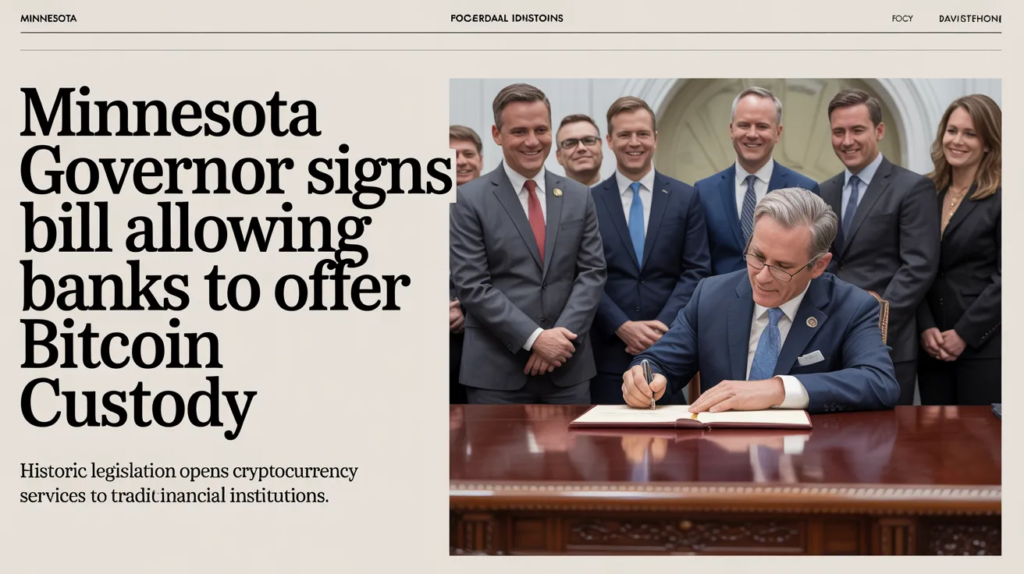
Minnesota Governor Tim Walz has signed a new law allowing state chartered banks and credit unions to provide Bitcoin and digital asset custody services, adding another U.S. state to the growing list of jurisdictions opening the door for regulated crypto banking services. The legislation, House File 3709, takes effect on Aug. 1, 2026, and gives financial institutions legal authority to hold cryptocurrencies and private cryptographic keys on behalf of customers. The move is designed to provide a regulated framework for digital asset storage while giving traditional financial institutions a clearer path into the crypto sector. Under the law, banks and credit unions can safeguard virtual currencies, manage private keys, and work with third party custodians if customer assets remain legally separated from the institution’s own holdings. Institutions must also notify the Minnesota Commissioner of Commerce at least 60 days before launching custody services. Minnesota joins states such as Wyoming, New York, Nebraska, and Virginia in establishing legal frameworks for crypto custody through regulated financial institutions. Key Takeaway Why the Nonfiduciary Structure Matters One of the most closely watched parts of the legislation is its nonfiduciary structure. The law allows banks and credit unions to provide custody services without assuming full fiduciary responsibility over customer assets. That distinction could significantly limit institutional liability in cases involving hacks, lost keys, frozen funds, or operational failures. Supporters of the bill argue that reduced liability exposure makes it easier for banks to enter the crypto custody market without taking on risks that many institutions still consider difficult to manage. Critics, however, say the structure could leave customers with fewer protections compared to traditional fiduciary arrangements. While the law requires institutions to maintain written policies and compliance programs, some industry observers argue that operational safeguards are not the same as direct legal accountability. Rep. Bernie Perryman, one of the bill’s lead sponsors, said the legislation is intended to prevent Minnesotans from relying on offshore or unregulated crypto platforms for custody services. Banks Must Meet Compliance and Cybersecurity Standards Financial institutions offering custody services will still face a range of compliance obligations under the new law. The legislation requires written policies covering cybersecurity, risk management, internal controls, emergency response procedures, and regulatory compliance before custody products can launch. Customer assets must also remain operationally and legally segregated from institutional funds. Banks and credit unions cannot treat customer crypto holdings as their own property. The rules are designed to address one of the biggest concerns in crypto custody: private key security. Private keys act as ownership credentials for digital assets, and losing them can permanently lock users out of their funds. St. Cloud Financial Credit Union had already begun offering digital asset custody before the law officially passed. The institution launched its CU-Digital Asset Vault earlier this year and said members currently custody approximately 13.5 BTC through the platform. The custody infrastructure operates through a collaborative safekeeping model in which no single party independently controls customer assets. Traditional Finance Pushes Deeper Into Crypto Custody Minnesota’s legislation arrives as banks, asset managers, and crypto firms continue expanding into digital asset custody and settlement services. At the federal level, crypto companies including Kraken parent company Payward have sought national trust charters from the Office of the Comptroller of the Currency to provide institutional custody services. The Office of the Comptroller of the Currency has also reaffirmed that crypto custody is a permissible activity for national banks, helping reduce uncertainty around institutional participation in the sector. The broader custody market has become increasingly important following the rapid growth of spot Bitcoin ETFs and rising institutional demand for secure storage solutions. Traditional financial institutions are now competing with crypto-native firms for custody market share, particularly among institutional investors seeking regulated service providers. Minnesota’s approach differs from states such as Wyoming, which created specialized crypto banking charters. Instead, the new framework focuses on allowing existing banks and credit unions to expand their services under state oversight. The law could also strengthen competition among regional financial institutions looking to retain customers interested in digital assets without forcing them toward external crypto exchanges. The Real Test Begins After August 1 While the legislation creates a legal pathway for crypto custody, it does not require banks or credit unions to launch services. The next phase will depend on whether institutions believe there is enough customer demand to justify the operational, cybersecurity, and compliance costs tied to digital asset custody. Industry participants will be watching closely to see which institutions file notice with state regulators first and what types of custody products emerge after the law takes effect in August. If adoption gains traction, Minnesota could become another example of how state-level legislation is shaping the integration of Bitcoin and digital assets into the traditional banking system.
ABTC Says Its Bitcoin Reserve Has Tripled Since Launch, Surpasses 7,500 BTC

American Bitcoin Corp. (ABTC) says its Bitcoin reserves have grown more than threefold since the company debuted on Nasdaq, with total holdings now surpassing 7,500 BTC as competition among corporate treasury firms intensifies. The update places ABTC among the larger public Bitcoin holders globally and reinforces the growing trend of companies using Bitcoin as a long term treasury reserve asset rather than treating it purely as a speculative investment. The company said the reserve continues to expand through a combination of self mining operations and direct market purchases. At current Bitcoin prices, holdings above 7,500 BTC represent a treasury worth hundreds of millions of dollars. ABTC’s latest disclosure comes as institutional appetite for Bitcoin exposure continues rising through exchange traded funds, corporate treasury allocations, and regulated custody platforms.ABTC’s Bitcoin reserves have grown over 3x since its Nasdaq debut, now exceeding 7,500 BTC. Key Takeaway Bitcoin Accumulation Becomes the Core Strategy ABTC has increasingly positioned itself as a Bitcoin accumulation company built around two main business lines: industrial scale mining and long term treasury growth. Management previously disclosed that roughly one third of its reserves came from mining operations, while the remaining balance was acquired through open market purchases. The strategy mirrors a broader shift across the crypto industry, where mining firms are moving away from immediately selling mined Bitcoin and instead retaining a larger percentage on their balance sheets. The company entered 2026 holding around 5,400 BTC before crossing 6,000 BTC earlier this year. The latest milestone above 7,500 BTC signals that accumulation has continued aggressively despite broader market volatility. ABTC has described the treasury model as a long term bet on Bitcoin’s future role in the global financial system. Mining Expansion Supports Treasury Growth The reserve growth has been supported by a major expansion in mining infrastructure. ABTC recently added more than 11,000 ASIC mining machines as part of a broader effort to scale its mining fleet toward roughly 89,000 rigs and approximately 28 EH/s in hashrate capacity. The company said the goal is to increase internal Bitcoin production while lowering acquisition costs compared with buying entirely from the open market. Mining margins have reportedly remained above 50%, allowing the company to continue expanding reserves even during periods of price weakness across the crypto market. Hut 8, which holds a majority stake in ABTC, has also expanded financing support tied to the company’s operations. Additional liquidity facilities from institutional lenders have strengthened ABTC’s ability to continue accumulating Bitcoin while scaling mining capacity. The treasury first strategy separates ABTC from some crypto mining competitors that have shifted focus toward AI infrastructure and high performance computing businesses. Treasury Growth Has Not Prevented Share Price Pressure Despite the rapid growth in Bitcoin reserves, ABTC’s stock performance has remained under pressure since its public debut. Shares have fallen sharply from post listing highs, with analysts pointing to several factors including broader Bitcoin volatility, dilution from equity offerings, and accounting losses linked to fair value reporting rules. The company previously reported a large non cash mark-to-market loss after Bitcoin prices corrected from 2025 highs. Because firms holding Bitcoin on their balance sheet must adjust valuations based on market prices, treasury heavy companies can experience significant earnings swings even without selling any assets. That volatility has become one of the biggest debates surrounding corporate Bitcoin treasury models. Supporters argue that companies accumulating Bitcoin today are positioning themselves ahead of long term institutional adoption. Critics, however, warn that heavy concentration in a volatile asset can expose shareholders to major downside risk during market corrections. The disconnect between ABTC’s growing Bitcoin reserves and weaker equity performance reflects the challenge many crypto linked public companies face in balancing long-term accumulation strategies with short-term investor expectations. Corporate Bitcoin Treasuries Continue Expanding ABTC’s latest milestone reflects a broader movement among corporations adopting Bitcoin treasury strategies. Companies including Strategy helped popularize the model by aggressively accumulating Bitcoin as a reserve asset. Since then, a growing number of mining firms, fintech companies, and public corporations have followed similar approaches. The trend has accelerated alongside institutional demand for spot Bitcoin ETFs, regulated custody solutions, and blockchain-based financial products. Large scale corporate buying also has implications for Bitcoin’s circulating supply. When companies move large quantities of Bitcoin into long term reserves, fewer coins remain actively available on the open market. Market participants increasingly view corporate treasury activity as a major driver of long term demand dynamics. The Next Phase for ABTC The company’s next challenge will be maintaining reserve growth while improving investor confidence around profitability and operational sustainability. Expanding mining infrastructure requires substantial capital, and continued Bitcoin accumulation leaves treasury-focused firms highly exposed to market swings. Still, ABTC’s latest announcement signals that management remains firmly committed to Bitcoin accumulation despite the volatility surrounding crypto linked equities. With reserves now exceeding 7,500 BTC, the company is strengthening its position among the largest public corporate Bitcoin holders as institutional adoption of digital assets continues expanding.
Bank of England Eyes Near-24/7 Settlement System To Support Tokenized Finance

The Bank of England and the Financial Conduct Authority have launched a coordinated push to prepare the UK financial system for tokenized finance, proposing extended operating hours for the country’s core settlement infrastructure as digital assets continue moving deeper into wholesale markets. Under the proposal, the Bank of England plans to expand the operating schedule of its Real Time Gross Settlement (RTGS) system and the Clearing House Automated Payment System (CHAPS) toward near 24/7 availability. The move would introduce longer weekday hours alongside potential weekend settlement windows, allowing financial institutions to process transactions beyond the traditional banking timetable. The consultation reflects growing pressure on central banks and regulators to modernize financial infrastructure as tokenized assets, stablecoins, and blockchain based settlement models gain traction among institutional participants. Key Takeaway UK Regulators Push for Tokenized Market Infrastructure The Bank of England said broader settlement availability could improve cross-border payments and support new transaction models linked to tokenization. Officials argue that wholesale financial markets are beginning to shift toward digital representations of traditional assets such as bonds, funds, and deposits. Existing settlement systems were designed for conventional market hours, creating friction for markets increasingly capable of operating continuously. In a joint communication, the BoE and FCA stated that the consultation aims to examine how settlement systems should adapt as tokenization technologies mature across the financial sector. The proposal also aligns with the UK government’s wider ambition to position Britain as a global hub for digital finance and blockchain based capital markets. Public feedback on the consultation remains open until July 3, with regulators expected to publish a summary of responses later this summer. Why RTGS and CHAPS Matter RTGS serves as the backbone of high value payments in the UK financial system, enabling the transfer of central bank money between institutions in real time. CHAPS processes large value sterling payments used across banking, corporate finance, and capital markets. Extending those systems toward near continuous operations would mark one of the biggest structural changes to UK payment infrastructure in years. The Bank of England is reportedly considering a phased approach. Earlier opening hours for RTGS are already planned from 2027, while additional settlement windows on Sundays and selected holidays could follow later in the decade. Regulators believe expanded settlement access could help financial institutions manage liquidity more efficiently while reducing delays tied to time zone differences in international transactions. FCA Expands Broader Crypto Framework The settlement consultation arrives alongside a broader regulatory effort by the FCA focused on digital assets and tokenized finance. In April, the FCA opened consultations covering stablecoins, crypto custody, trading platforms, and staking services as part of its long term crypto regulatory framework scheduled for rollout around 2027. The regulator has also increased its focus on tokenized securities and distributed ledger technology within wholesale finance. A separate joint “Call for Input” issued by the FCA and Bank of England asks market participants how tokenized assets should interact with existing legal and settlement systems, particularly regarding collateral treatment and post-trade infrastructure. The UK’s Digital Securities Sandbox already includes multiple firms testing tokenized bond issuance and blockchain based settlement systems under regulatory supervision. PRA Signals Equal Treatment for Tokenized Assets The Prudential Regulation Authority has also stepped into the discussion, issuing updated guidance suggesting tokenized financial instruments should generally receive the same regulatory treatment as traditional assets when legal rights and economic risks remain comparable. The PRA described the guidance as an interim step ahead of a broader prudential framework expected no earlier than 2028. That longer term framework will likely incorporate findings from the Basel Committee on Banking Supervision’s ongoing review of crypto asset exposure standards. The Basel Committee launched its review in late 2025 to examine how banks should handle tokenized instruments, stablecoins, and blockchain based financial infrastructure from a risk management perspective. Industry Sees Opportunity in UK Tokenization Push The proposal has drawn support from parts of the crypto and fintech sector that view the UK as increasingly open to institutional blockchain adoption. Katie Harries, head of policy for Europe at Coinbase, welcomed the initiative in comments shared with Cointelegraph. She added: Supporters of tokenization argue that blockchain based settlement systems could reduce costs, speed up settlement times, and improve market accessibility. At the same time, regulators remain cautious about operational resilience, cyber risks, liquidity management, and legal clarity surrounding tokenized assets. Competition Over Financial Infrastructure Is Intensifying The UK’s latest move comes as multiple jurisdictions accelerate efforts to modernize financial infrastructure around digital assets. The European Union continues advancing Markets in Crypto Assets (MiCA) implementation, while Singapore, Hong Kong, and the United States are all expanding frameworks tied to tokenized finance and stablecoin oversight. For the Bank of England, maintaining the relevance of central bank settlement infrastructure appears increasingly important as private stablecoin networks and blockchain-based payment systems operate around the clock. Near continuous settlement could reduce one of crypto’s long standing advantages over traditional finance: the ability to transact outside standard banking hours. Still, regulators are moving carefully. The BoE emphasized that any transition toward extended settlement operations would require detailed industry coordination, operational testing, and risk assessment before implementation. The consultation marks another sign that tokenized finance is no longer being treated as a niche experiment inside global financial markets. Instead, central banks and regulators are beginning to redesign core infrastructure around the possibility that digital assets could become a permanent part of institutional finance.
Myanmar Imposes Tough Crypto Scam Penalties As Australia Tightens Crypto Taxes

Myanmar’s military backed government has introduced one of the toughest anti crypto fraud proposals seen anywhere in the world, including life imprisonment and potential death sentences for individuals connected to violent online scam operations. The move comes as Australia pushes in the opposite direction, advancing what could become one of the heaviest tax regimes for cryptocurrency investors and traders globally. The contrasting approaches highlight how governments across the Asia Pacific region are responding differently to the rapid rise of digital assets, online fraud, and cross-border crypto activity.Myanmar proposed harsh anti-crypto scam laws, including life sentences and possible death penalties for violent fraud operators.Key Takeaway Myanmar Targets Crypto Fraud Rings With Extreme New Penalties Myanmar’s proposed Anti-Online Scam Bill, unveiled on May 14, targets operators involved in large-scale online fraud, including schemes linked to cryptocurrency investments and digital payment scams. Under the draft legislation, individuals convicted of digital currency fraud could face prison terms ranging from 10 years to life imprisonment. The harshest penalties apply to scam operators accused of using violence, torture, unlawful detention, or coercion to force people into fraudulent activities. In cases where victims die as a result of those operations, the bill allows for the death penalty. The proposed law is expected to be discussed during Myanmar’s next parliamentary session in June. Myanmar Targets Scam Compounds Linked to Crypto Fraud Authorities say the crackdown is aimed at dismantling industrial scale scam compounds that expanded rapidly following the country’s 2021 military coup. Many of these operations have been tied to crypto investment fraud, romance scams, fake trading platforms, and money laundering schemes targeting victims across Asia, Europe, and the United States. International agencies have repeatedly warned about the scale of the problem. The United Nations previously estimated that around 120,000 people may have been trapped inside scam compounds operating in Myanmar, with many allegedly forced into conducting online fraud under violent conditions. The draft legislation specifically targets operators accused of running these compounds through intimidation and abuse. According to the proposal, individuals responsible for “violence, torture, unlawful arrest and detention, or cruel treatment” linked to online scam activity could face capital punishment. Myanmar’s move follows broader enforcement efforts across Southeast Asia. China has intensified operations against fraud networks connected to Myanmar based scam centers, reportedly sentencing multiple members of criminal organizations to death earlier this year after convictions tied to large scale financial fraud and trafficking cases. Cambodia and Singapore have also introduced stricter anti-scam measures in recent months, reflecting growing concern across the region over cybercrime and crypto enabled fraud. Australia Moves Toward Aggressive Crypto Tax Rules While Myanmar focuses on criminal enforcement, Australia is tightening oversight through taxation. Australian regulators and policymakers are advancing proposals that would increase tax obligations tied to cryptocurrency trading, capital gains, and digital asset income. Industry analysts say the framework could become one of the most demanding crypto tax systems globally if implemented in full. The proposed approach would affect both retail investors and institutional market participants, with closer scrutiny on trading profits, staking rewards, and other crypto related income streams. The policy direction reflects Australia’s broader effort to bring digital assets further into the formal financial system while improving tax compliance. Unlike Myanmar’s enforcement heavy model, Australia’s strategy relies more on regulatory reporting and taxation mechanisms rather than criminal penalties. Still, critics argue that excessive taxation could push some traders toward offshore platforms or lower-tax jurisdictions. Governments Increase Pressure on Crypto Crime The developments come as authorities worldwide face mounting pressure to address rising losses tied to online fraud and crypto scams. According to FBI data cited in multiple international enforcement reports, Americans lost more than $20 billion to online scams last year, with crypto related fraud accounting for a growing share of total losses. Global law enforcement agencies have stepped up cooperation in response. Earlier this year, U.S. authorities worked alongside Asian enforcement agencies to dismantle multiple scam centers connected to crypto investment fraud operations. Interpol has also identified cryptocurrency scams as a major component of transnational organized cybercrime, warning that criminal groups are increasingly using advanced technologies and cross-border infrastructure to conceal operations. Crypto Regulation Is Becoming Increasingly Fragmented The widening policy gap between Myanmar and Australia reflects a broader divide in global crypto regulation. Some governments are prioritizing strict enforcement and criminal penalties, especially in regions heavily affected by scam compounds and trafficking linked fraud networks. While others are focusing on taxation, licensing frameworks, and financial oversight designed to integrate digital assets into existing economic systems. At the same time, several jurisdictions continue competing to attract blockchain startups and crypto investment through lighter regulatory environments. The lack of global consistency remains one of the biggest challenges facing the industry. Investors, exchanges, and crypto companies are increasingly navigating a patchwork of laws that vary sharply from one country to another. Despite growing regulatory pressure, crypto adoption across the Asia Pacific region continues to expand. Bitcoin, Ethereum, and stablecoins remain heavily traded throughout both developed and emerging markets, even in countries with restrictive policies. For now, Myanmar and Australia represent two very different visions for the future of crypto oversight. One is centered on harsh punishment and deterrence. The other is focused on taxation and regulatory integration. Both approaches signal the same reality: governments are no longer treating digital assets as a fringe sector outside the reach of state control.