Polygon’s co-founder Sandeep Nailwal has ignited a major discussion in the crypto community after publicly floating the idea of bringing back the original MATIC ticker—just months after the ecosystem transitioned its token identity to POL under the Polygon 2.0 upgrade.
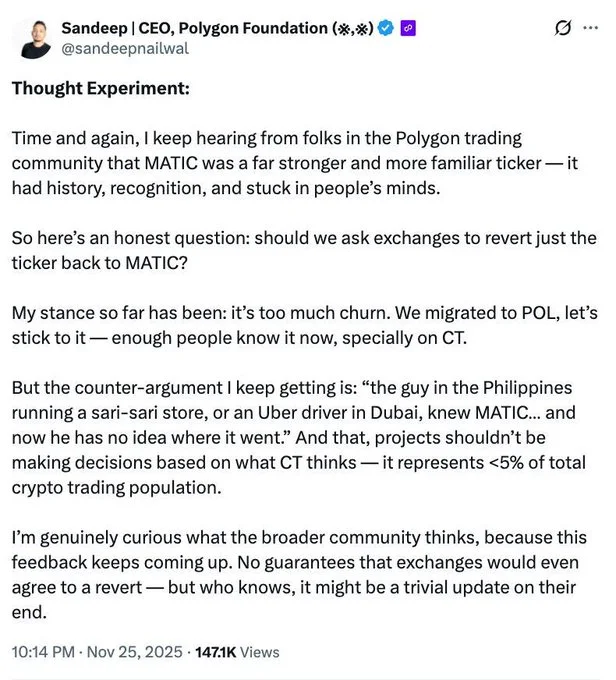
Nailwal said he has consistently heard that the MATIC name remains stronger, more recognizable, and more deeply rooted in user memory compared to POL. In a candid post on X, he wrote:
“Time and again, I keep hearing from folks in the Polygon trading community that MATIC was a far stronger and more familiar ticker — it had history, recognition, and stuck in people’s minds,”
calling the idea a “thought experiment.”
Initially, Nailwal said he opposed the idea of another change due to the disruption it could cause:
“My stance so far has been: it’s too much churn. We migrated to POL, let’s stick to it—enough people know it now, especially on CT.”
However, mounting feedback from traders, token holders, and ecosystem participants has compelled him to re-examine the issue.
Key Takeaways
- Sandeep Nailwal is exploring whether exchanges should revert the POL ticker back to MATIC due to community preference and familiarity.
- The transition to POL under Polygon 2.0 expanded token utility, but the new ticker has struggled to achieve market recognition.
- Many traders still instinctively search for MATIC, creating practical confusion in wallets and exchanges.
- Some industry voices support the return to MATIC while others warn that another ticker shift could signal instability.
MATIC’s Brand Memory vs. POL’s Intended Utility
When Polygon switched from MATIC to POL in September 2024, the move was framed as a modernization step aligned with its shift toward zero-knowledge infrastructure and cross-chain liquidity via Polygon 2.0. POL was designed to expand utility, allowing holders to participate in staking, sequencing, and data availability roles.
While the technical upgrade succeeded—and POL now functions as Polygon’s native gas and staking token—the branding transition has faced resistance.
Users have repeatedly reported confusion when trying to locate POL on exchanges or inside their wallets. Many still instinctively search for “MATIC,” leading to mismatches, misidentification, and weaker market visibility.
Even experienced traders claim the rename weakened the psychological brand strength MATIC had built for years. The older ticker was widely referenced not just within crypto circles, but among payment processors, merchants, and newer retail traders.
This contrast has led to a unique situation: the network grew more advanced, but its token became less recognizable.
Market Sentiment and Token Performance
The frustration around the POL branding has been amplified by poor token performance. POL currently trades nearly 89% below its all-time high, further fueling dissatisfaction and criticism of the rebrand.
Some traders argue the weaker name recognition contributed to poor traction among new entrants, while others believe the drop is simply market-wide pressure unrelated to branding. Still, in an ecosystem where ticker association often influences search behavior, app listings, and social visibility, naming matters—perhaps more than most projects want to admit.
Polygon Community Divided Over a Possible Reversal
The idea of reverting to MATIC has been met with varied reactions:
The Pro-MATIC camp claims that:
- Brand familiarity increases adoption
- MATIC still “feels like Polygon”
- Reversing the name would reaffirm identity rather than erase progress
This sentiment is reinforced by network supporters who argue the Polygon brand is inherently tied to MATIC’s history.
The Stick-With-POL group argues the opposite:
- Changing back would appear indecisive
- It would cause confusion for a second time
- POL reflects Polygon’s upgraded technological era
A smaller group has suggested a third route entirely: introducing a completely new ticker such as PGON—representing a fresh direction without reverting to the past.
Perspectives From Industry Figures
Several industry participants weighed in on the debate:
- Abhinav Mehta (Mansa Finance) argued that the revert is unnecessary and that change requires time. He warned against reactionary decisions due to noise from a subset of users.
- Mo Ezeldin (Open Campus) said early adopters still identify with MATIC and noted that fresh retail interest in POL has been slow. He suggested that returning to MATIC might actually strengthen the network’s position.
- Abdul Rafay Gadit (ZIG Chain) acknowledged that MATIC “had a different vibe,” but cautioned that rebranding alone won’t fix core issues, especially price performance.
- Peter Kim (Coinbase) encouraged Polygon to strengthen POL’s visibility through marketing, including updating official Polygon accounts and seeking wider exchange relistings — citing Robinhood as one example that could significantly improve recognition.
What Happens Next?
Polygon has not announced any formal mechanism for deciding the ticker’s future. There’s no vote planned and no official community governance process initiated. This means the idea remains speculative, though publicly entertained by the network’s leadership.
Nailwal also warned that even if Polygon wants to revert, exchanges might not comply or may do so slowly and inconsistently, leading to further fragmentation.
He also highlighted that Crypto Twitter—despite being extremely loud—represents less than 5% of actual crypto traders, implying that real sentiment could be broader than what shows up in social media engagement.
The Bigger Picture
At its core, this debate is about more than letters on a screen. It’s about:
- Brand identity
- Market trust
- Network narrative
- User accessibility
- Long-term ecosystem cohesion
MATIC built Polygon’s reputation. POL aims to position it for its future. The question is whether the network must choose one or can find a compromise without damaging momentum.
For now, the conversation is ongoing, and the final outcome remains uncertain. What is clear is that Polygon is listening—publicly and openly—to what its community thinks.
Whether the future token powering Polygon’s ecosystem reads as POL, MATIC, or something new entirely, the discussion represents a rare example of a major blockchain project transparently wrestling with its identity in real time.