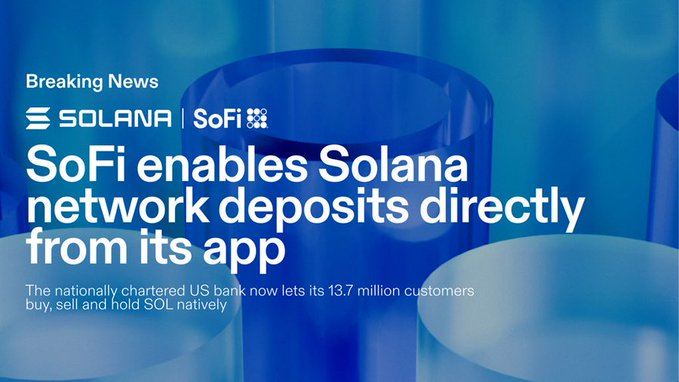
SoFi has rolled out support for direct deposits on the Solana network, allowing its 13.7 million customers to transfer SOL from external wallets straight into their SoFi crypto accounts. The update, announced on X, confirms that users can now buy, sell, hold, and receive SOL within the bank’s mobile app.
This development positions SoFi among a small group of nationally chartered U.S. banks offering direct interaction with a public blockchain network inside a regulated banking framework.
Key Takeaways
SoFi now allows its 13.7 million customers to deposit SOL directly from external wallets into their crypto accounts within the banking app.
The integration connects a federally chartered U.S. bank to the Solana network through live on-chain transfers rather than simple brokerage exposure.
Customers can manage SOL alongside traditional products like checking and savings accounts in a single regulated interface.
The move places SoFi among a small group of nationally chartered U.S. banks offering direct public blockchain deposit functionality.
The update strengthens mainstream access to Solana by embedding blockchain activity within a regulated U.S. banking framework.
Direct On-Chain Access Inside a National Bank
With this integration, SoFi customers are no longer limited to brokerage-style crypto exposure. Instead of only gaining price exposure through custodial or off-chain products, users can deposit SOL directly from self-custody wallets into their SoFi accounts.
In practical terms, the feature bridges traditional banking and on-chain activity. Customers can manage SOL balances alongside checking and savings accounts within the same interface. For a U.S. national bank operating under a federal charter, enabling live blockchain deposits represents a meaningful shift.
Most large U.S. banks have so far restricted crypto access to ETFs, custody partnerships, or trading services without allowing direct blockchain transfers. SoFi’s move stands out because it connects a regulated bank charter to a public layer-1 network in a way that remains uncommon in American banking.
A Growing Digital Bank With National Reach
Founded in 2011 as a student loan refinancing platform, SoFi later secured a U.S. national bank charter and has since expanded into a full-service financial institution. Today, it manages more than $50 billion in assets and holds tens of billions in customer deposits.
While it does not rival Wall Street’s largest banks in size, SoFi ranks among the most prominent digital-first banks in the country. Its customer base of 13.7 million users gives the Solana integration immediate scale.
The bank’s brand recognition extends well beyond financial services. SoFi holds naming rights to SoFi Stadium in California, a venue that hosted Super Bowl LVI and WrestleMania 39. The stadium is also scheduled to stage multiple matches during the 2026 FIFA World Cup and will play a central role in the 2028 Summer Olympics.
That visibility underscores how a mainstream U.S. bank with national branding is now directly integrating a public blockchain into its product suite.
What This Means for Solana and U.S. Banking
For Solana, the integration offers access to millions of U.S. retail banking customers under a regulated umbrella. Customers can move SOL on-chain while remaining within the compliance and oversight structure of a federally chartered bank.
This is not merely another trading pair listing. Direct deposits imply real blockchain connectivity rather than synthetic or derivative exposure. Users who already hold SOL in external wallets can transfer their assets into SoFi without converting to fiat first.
The announcement also reflects a broader trend: crypto infrastructure is gradually being embedded into traditional financial platforms rather than operating entirely outside them. While major banks have been cautious, mid-sized and digital-native institutions appear more willing to test direct blockchain integrations.
A Step Toward Deeper Integration
SoFi’s update suggests that regulated financial institutions are becoming more comfortable enabling controlled on-chain access for customers. By supporting Solana network deposits, the bank has moved beyond offering simple buy-and-sell functionality and into active blockchain connectivity.
For its 13.7 million users, the change simplifies access to SOL within a familiar banking app. For the wider industry, it signals that public blockchain networks are beginning to find structured entry points into U.S. banking infrastructure.
As regulatory clarity continues to develop, similar integrations from other nationally chartered banks could follow. For now, SoFi’s move marks a notable moment: a federally chartered U.S. bank directly linking its customers to one of the largest public blockchain networks through its core banking platform.
Akindele T. Francis is a versatile content writer with extensive experience spanning various sectors. Specializing in blog posts, website content, service pages, compelling sales copy, etc., Akindele has collaborated with numerous agencies to deliver engaging and effective written material. With a keen eye for detail and a passion for crafting impactful narratives, Akindele consistently exceeds client expectations, driving results and enhancing brand messaging across diverse platforms.
Disclaimer: This article is intended solely for informational purposes and should not be considered trading or investment advice. Nothing herein should be construed as financial, legal, or tax advice. Trading or investing in cryptocurrencies carries a considerable risk of financial loss. Always conduct due diligence before making any trading or investment decisions.
Trade with proof of Reserves
UEEx publish monthly audits and third party verification on every listed market.