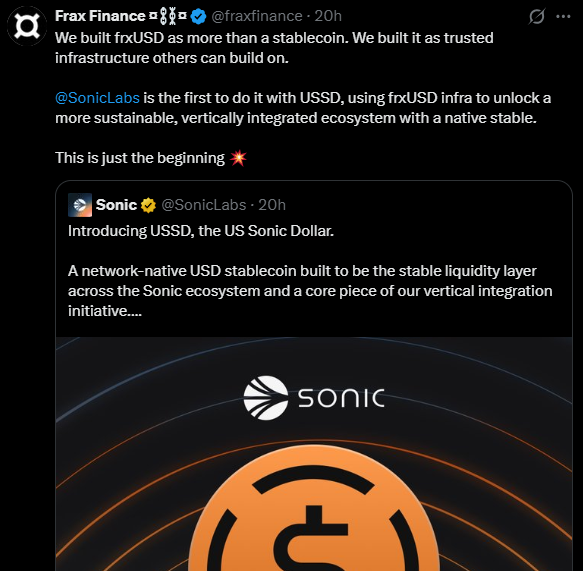
Sonic Labs has unveiled USSD, a new dollar-pegged stablecoin designed to serve as the primary liquidity asset within its high-performance Layer-1 blockchain ecosystem.
The launch, announced on March 9, 2026, positions the token as a network-native digital dollar intended for trading, lending, payments, and settlement across decentralized finance (DeFi) applications built on Sonic.
Unlike many traditional stablecoins that rely on bank deposits or opaque reserve structures, USSD is backed one-to-one by tokenized U.S. Treasury products issued by major asset managers, including BlackRock, Superstate, and WisdomTree. The model introduces institutional-grade backing while keeping reserves transparent and verifiable on-chain.
“USSD is fully backed 1:1 by high-quality U.S. Treasury products held with regulated custodians, providing stability and transparency across the Sonic network.”
The launch marks a strategic step for Sonic Labs as it attempts to strengthen liquidity within its blockchain ecosystem while attracting both DeFi users and institutional participants.
Key Takeaways
Sonic Labs launched USSD, a dollar-pegged stablecoin designed to serve as the primary liquidity asset within its blockchain ecosystem.
The stablecoin is fully backed 1:1 by tokenized U.S. Treasury products from major asset managers, including BlackRock, Superstate, and WisdomTree.
Users can mint USSD through non-custodial smart contracts by depositing supported assets such as USDC or USDT at a one-to-one ratio with no minting fees.
Cross-chain functionality powered by LayerZero allows participants from more than ten blockchains, including Ethereum and Arbitrum, to mint USSD directly on the Sonic network.
Yield generated from the Treasury-backed reserves may support developer incentives, ecosystem growth, and liquidity across Sonic’s DeFi applications.
Institutional Treasury Assets Power the Stablecoin
USSD’s reserve structure centers on short-duration U.S. Treasury instruments tokenized for blockchain markets. These assets include products such as BlackRock’s BUIDL fund, Superstate’s USTB, and treasury-linked offerings from WisdomTree.
Tokenized Treasuries have become increasingly popular across crypto markets because they combine the stability of government bonds with blockchain accessibility. By backing USSD with these instruments, Sonic Labs aims to create a stable asset that maintains the reliability of traditional finance while remaining fully usable in decentralized environments.
“The stablecoin is fully backed one-to-one with regulated U.S. Treasury products from financial institutions including BlackRock, WisdomTree, and Superstate.”
This reserve structure also introduces yield into the ecosystem. Treasury assets generate returns, and Sonic Labs plans to route part of that revenue back into the network to support development incentives and user rewards.
The framework follows a model similar to that used by Frax Finance, which emphasizes clear redemption mechanisms and verifiable backing for stablecoins.
Built on Frax Infrastructure
The technical foundation of USSD relies on infrastructure developed by Frax Finance, specifically its modular frxUSD system. This architecture allows Sonic Labs to deploy a stablecoin with tested smart-contract security while maintaining flexibility for cross-chain integration.
Users can mint USSD directly through non-custodial smart contracts by depositing supported dollar-based assets. Deposits occur at a 1:1 ratio, meaning every unit of collateral produces one USSD token.
Importantly, Sonic Labs has removed the usual minting charges often associated with stablecoin issuance.
“Users can mint USSD through non-custodial smart contracts on the Sonic network, depositing supported assets at a one-to-one ratio with zero minting fees.”
Supported collateral includes well-known stablecoins such as USDC and USDT, along with tokenized treasury products.
The fee-free minting model is intended to encourage liquidity providers and DeFi participants to move capital into Sonic’s ecosystem without additional entry costs.
Cross-Chain Liquidity From Day One
A defining feature of USSD is its native cross-chain functionality. Sonic Labs integrated LayerZero technology, enabling users on other blockchain networks to deposit assets and mint USSD directly on Sonic.
At launch, this capability supports more than ten blockchain ecosystems, including major networks like Ethereum, Arbitrum, and Base.
“USSD launches with cross-chain minting support from more than ten blockchain networks, allowing users to deposit assets on another chain and receive USSD directly on Sonic.”
The system significantly reduces the complexity typically associated with bridging assets across networks. Instead of moving tokens manually through multiple bridging steps, users can mint USSD directly on Sonic while depositing assets from their original chain.
Compatibility with USDC further strengthens the design. Users can convert USSD back into USDC using cross-chain infrastructure such as Chainlink’s Cross-Chain Transfer Protocol, ensuring familiar entry and exit points for dollar-based liquidity.
Strengthening Sonic’s DeFi Strategy
Stablecoins play a central role in decentralized finance by acting as the base currency for trading pairs, lending markets, and derivatives settlement. Without a stable asset, liquidity often fragments across multiple tokens and platforms.
Sonic Labs believes USSD will help prevent that issue within its ecosystem.
“A native stablecoin helps keep liquidity within the Sonic ecosystem and gives applications a consistent dollar reference.”
The network itself is designed for high throughput, supporting around 10,000 transactions per second with sub-second confirmation times. By pairing that performance with a built-in stable asset, Sonic hopes to attract developers building trading platforms, lending protocols, and other DeFi services.
USSD is also tied to Sonic’s broader incentive structure. The yield generated from treasury reserves may fund developer rewards, liquidity incentives, and ecosystem grants. This allows value produced by the stablecoin’s backing assets to circulate within the network rather than flowing to external issuers.
Competing in the Liquidity Race
The introduction of USSD reflects a growing trend among blockchain networks to launch native stablecoins as part of their financial infrastructure. Instead of relying entirely on external stablecoins, ecosystems increasingly want direct control over their primary source of dollar liquidity.
For Sonic Labs, the strategy is also tied to the long-term value of its native S token. A stable liquidity layer encourages activity on the chain, which could drive transaction volume and network adoption.
Some analysts view the approach as a way to capture the yield from treasury-backed reserves while reinvesting it into the network.
“By creating its own stablecoin backed by Treasury assets, Sonic can keep the revenue generated from those instruments inside the ecosystem.”
If adoption grows, the resulting liquidity could strengthen DeFi markets built on Sonic and help the network compete with other high-performance chains.
Outlook
The success of USSD will depend largely on whether users and developers trust the system enough to move capital into the Sonic ecosystem. The combination of institutional treasury backing, cross-chain minting, and zero-fee issuance gives the stablecoin several advantages as it enters the market.
For DeFi participants, the token offers a familiar dollar reference backed by government securities while remaining fully programmable on-chain.
If adoption gains traction, USSD could become the financial backbone of Sonic’s ecosystem—anchoring liquidity, powering decentralized markets, and channeling real-world asset yield into blockchain applications.
Akindele T. Francis is a versatile content writer with extensive experience spanning various sectors. Specializing in blog posts, website content, service pages, compelling sales copy, etc., Akindele has collaborated with numerous agencies to deliver engaging and effective written material. With a keen eye for detail and a passion for crafting impactful narratives, Akindele consistently exceeds client expectations, driving results and enhancing brand messaging across diverse platforms.
Disclaimer: This article is intended solely for informational purposes and should not be considered trading or investment advice. Nothing herein should be construed as financial, legal, or tax advice. Trading or investing in cryptocurrencies carries a considerable risk of financial loss. Always conduct due diligence before making any trading or investment decisions.
Trade with proof of Reserves
UEEx publish monthly audits and third party verification on every listed market.