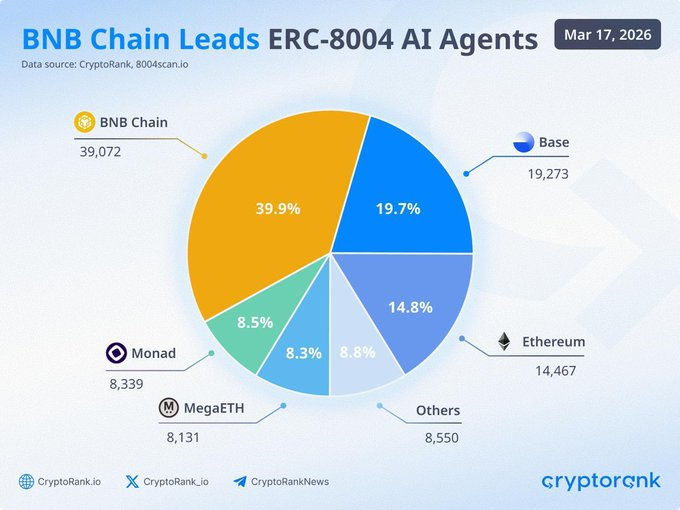
BNB Chain has moved ahead of Ethereum and Base in the rapidly expanding market for on-chain AI agents, marking a significant shift in blockchain adoption trends tied to artificial intelligence.
Recent data shows that BNB Chain now hosts more than 34,000 AI agents built using the ERC-8004 standard—comfortably ahead of Base and Ethereum, which trail with roughly 16,500 and 14,000 agents, respectively. Out of about 89,000 registered agents across chains, BNB Chain alone accounts for the largest share.
At the same time, the broader ecosystem is experiencing explosive growth. The total number of ERC-8004 agents has surged from just a few hundred at the start of the year to nearly 130,000, representing one of the fastest expansions in on-chain activity seen in recent months.
Key Takeaways
- BNB Chain now leads all networks in hosting ERC-8004 AI agents, surpassing both Ethereum and Base.
- The number of ERC-8004 AI agents has surged from a few hundred to nearly 130,000 within months, reflecting extremely rapid adoption.
- On-chain activity is accelerating alongside growth, with hundreds of thousands of daily transactions and millions in trading volume driven by AI agents.
- Lower fees, faster transactions, and added identity and reputation infrastructure are key reasons developers are choosing BNB Chain.
- Security challenges and unclear economic value remain major concerns as the AI agent ecosystem continues to expand.
A Rapid Shift in Leadership
Only weeks ago, Ethereum held a commanding lead in the AI agent category. Early March data showed Ethereum with tens of thousands of agents, while BNB Chain lagged far behind with a few thousand.
That gap has now reversed dramatically.
BNB Chain’s rise appears to have been driven by a combination of infrastructure advantages and increasing developer adoption. The network’s ability to handle high-frequency, low-cost interactions has made it particularly attractive for autonomous systems that operate continuously and at scale.
What ERC-8004 Actually Enables
The ERC-8004 standard, introduced earlier this year, defines how AI agents function on-chain. It allows agents to establish persistent identities, manage wallets, and interact directly with smart contracts without human intervention.
In practice, this means AI systems can operate like independent users—executing trades, running tasks, and interacting across decentralized applications.
Unlike traditional blockchain users, these agents can perform thousands of actions per day, which places significant demands on network performance and cost efficiency.
Activity Levels Surge Alongside Adoption
The growth in agent numbers is being matched by a sharp increase in on-chain activity.
On March 10, BNB Chain recorded nearly 523,000 daily transactions linked to AI agents. Just a day later, decentralized exchange activity driven by these agents surpassed $18 million in daily trading volume.
These figures indicate that AI agents are actively participating in blockchain economies, not just deploying themselves.
Much of this activity appears to center on automated trading, data retrieval, and developer-focused services such as browser automation and API-based tools.
Why BNB Chain Is Pulling Ahead
According to BNB Chain leadership, the network’s architecture plays a key role in its growing dominance.
Low transaction fees and quick settlement times make frequent, small-value transactions viable—something essential for AI-driven systems.
But beyond performance, BNB Chain has introduced an additional layer that differentiates it from competitors. A complementary framework tied to NFT-based identity allows agents to build verifiable reputations on-chain.
This combination of cost efficiency and identity infrastructure appears to be attracting developers looking to deploy scalable, autonomous systems.
The Bigger Picture: How Real Is the “Agent Economy”?
Despite the surge in activity, there is still debate about the actual economic impact of AI agents on-chain.
Estimates of transaction value vary widely depending on methodology. Some reports suggest tens of millions of dollars in agent-driven payments over a 30-day period, while more conservative analyses—after filtering out wash trading—place the figure significantly lower.
What is clear, however, is where most of the activity is concentrated.
Current usage leans heavily toward developer tools—services like web scraping, automated browsing, and content generation—often billed per request without requiring user accounts.
This suggests the ecosystem is still in its early, utility-driven phase rather than a fully developed consumer market.
Big Tech and Crypto Are Converging
The rise of on-chain agents is also drawing attention from major technology players.
Recent collaborations involving dozens of companies—including crypto infrastructure providers and large tech firms—have focused on standardizing how AI agents make payments across blockchains.
These efforts point toward a future where autonomous systems can transact seamlessly across platforms, further expanding the role of blockchain in machine-driven economies.
Security Remains a Key Concern
While growth is accelerating, security challenges remain unresolved.
Autonomous agents often require access to wallets or credentials, creating potential vulnerabilities. In many current implementations, sensitive data like private keys can be exposed or improperly stored.
BNB Chain acknowledges these risks and is working with developers to improve safeguards.
New approaches are already being tested. Some platforms are introducing tools that allow AI agents to execute transactions without directly accessing private keys, reducing the risk of compromise.
Still, as adoption grows, ensuring secure interaction between AI systems and blockchain infrastructure will be critical.
A Market Still in Its Early Days
The rapid rise of ERC-8004 agents signals a shift in how blockchain networks are being used—not just by people, but by machines.
BNB Chain’s sudden lead highlights how quickly the competitive landscape can change when new technologies emerge.
With total agent numbers approaching 100,000 and activity climbing sharply, the next phase will likely focus on refining use cases, improving security, and determining whether these systems can sustain meaningful economic value.
For now, one thing is clear: AI agents are no longer a niche experiment on-chain—they are becoming a major force shaping the direction of blockchain ecosystems.