Definition
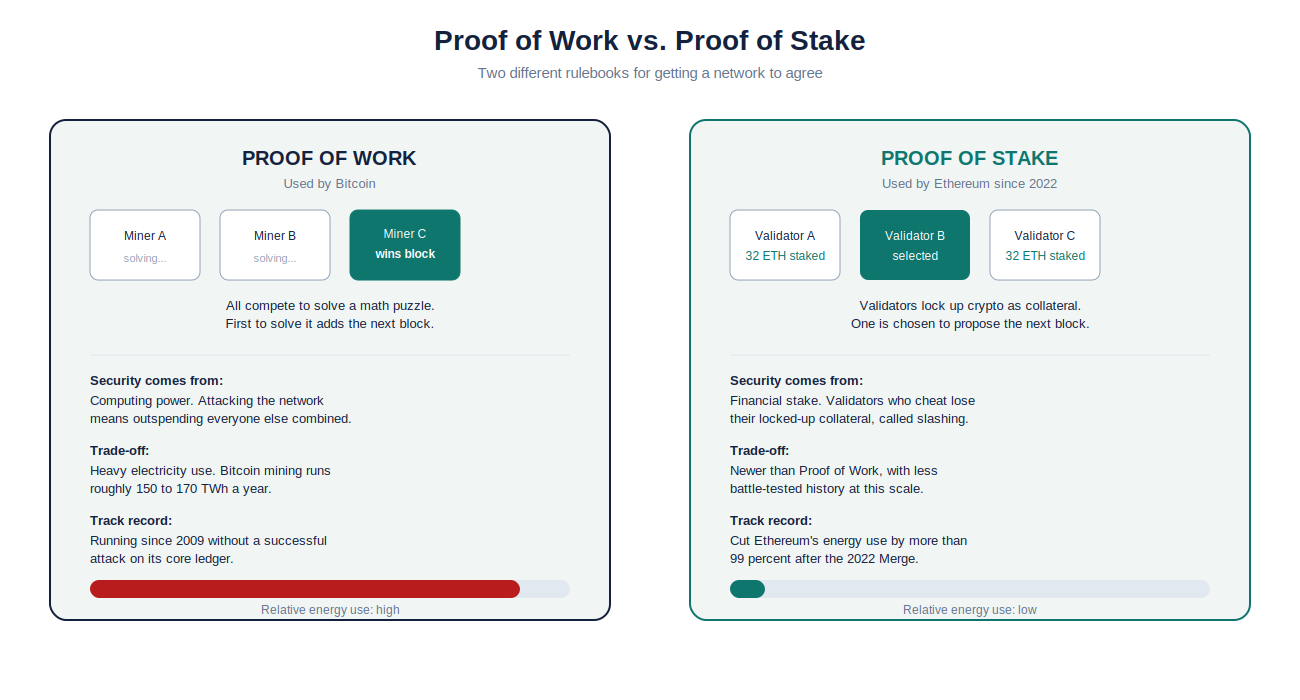
Staking is the process of locking cryptocurrency tokens in a blockchain protocol to participate in the network’s consensus mechanism, validate transactions, and secure the chain — in exchange for periodic rewards denominated in the network’s native token. In Proof-of-Stake (PoS) and its variants (Delegated Proof-of-Stake, Nominated Proof-of-Stake, Liquid Proof-of-Stake), staking replaces the energy-intensive mining process used in Proof-of-Work (PoW) systems like pre-Merge Bitcoin and Ethereum. Validators who stake tokens are economically incentivized to act honestly because their locked capital (the “stake”) can be partially or fully destroyed (“slashed”) if they behave maliciously or fail to maintain uptime.
At its core, staking aligns economic incentives with network security. A validator who has locked 32 ETH on Ethereum, for example, has a direct financial interest in correctly attesting to blocks, proposing valid blocks when selected, and maintaining consistent uptime. The greater the total value staked on a network, the more expensive it becomes for an attacker to acquire enough stake to compromise consensus — this is the economic security model that underpins all Proof-of-Stake systems.
Staking has evolved well beyond simple validator operation. The modern staking ecosystem encompasses several distinct categories: solo staking (running your own validator node), delegated staking (assigning your tokens to a professional validator while retaining ownership), pooled staking (combining tokens with other users to meet minimum thresholds via services like Lido or Rocket Pool), liquid staking (receiving a tradeable derivative token such as stETH that represents your staked position), and restaking (using staked assets as security for additional protocols, as pioneered by EigenLayer). As of early 2026, over $120 billion in crypto assets are staked across all PoS networks, making staking one of the most significant activities in the entire digital asset ecosystem.
Staking also plays a central role in governance. Many PoS protocols grant voting rights proportional to staked tokens, meaning stakers directly influence protocol upgrades, parameter changes, fee structures, and treasury allocations. This intertwining of economic security and governance makes staking a foundational primitive not just for blockchain consensus, but for decentralized autonomous organizations (DAOs) and on-chain governance systems.
Origin & History
2012: Peercoin (PPC), created by Sunny King and Scott Nadal, became the first cryptocurrency to implement a Proof-of-Stake consensus mechanism. Peercoin used a hybrid PoW/PoS system where coin age (how long tokens had been held) determined staking eligibility and block production rights. This was the first practical demonstration that blockchain consensus could be achieved through economic stake rather than computational work alone.
2014: Daniel Larimer introduced Delegated Proof-of-Stake (DPoS) in BitShares, a system where token holders vote to elect a fixed number of block producers (delegates) who validate transactions on the network’s behalf. DPoS traded some decentralization for dramatically higher transaction throughput and laid the groundwork for EOS, which launched in 2018 with 21 elected block producers.
2017: The Cosmos Network (Atom) whitepaper by Jae Kwon and Ethan Buchman introduced the Tendermint BFT consensus engine, which formalized bonded Proof-of-Stake with explicit slashing conditions and a 21-day unbonding period. Cosmos popularized the concept of validator delegation where users could stake tokens through validators without running infrastructure themselves.
2019: Tezos launched its “Liquid Proof-of-Stake” system with on-chain governance, allowing token holders (“bakers”) to either stake directly or delegate to other bakers while retaining the ability to withdraw at any time. This introduced the concept of flexible, governance-integrated staking.
2020: Ethereum’s Beacon Chain launched on December 1, 2020, initiating the transition from Proof-of-Work to Proof-of-Stake. The genesis event required 524,288 ETH staked across 16,384 validators, each depositing the minimum 32 ETH threshold. The deposit contract reached its target on November 24, 2020, just days before launch.
2020-2021: Lido Finance launched in December 2020 as the first major liquid staking protocol for Ethereum, issuing stETH tokens that represented staked ETH positions. This solved the illiquidity problem of early Beacon Chain staking (where withdrawals were not yet enabled) and catalyzed the liquid staking category. By 2021, Lido had become the largest staking provider on Ethereum.
September 2022: Ethereum completed “The Merge,” transitioning from Proof-of-Work to Proof-of-Stake on mainnet. This was the most significant staking milestone in crypto history, instantly making Ethereum the largest PoS network by market capitalization and reducing its energy consumption by approximately 99.95%.
April 2023: Ethereum’s Shanghai/Capella upgrade enabled staking withdrawals for the first time, completing the PoS transition. Validators could finally exit and withdraw their staked ETH, removing the largest risk factor that had discouraged participation. Contrary to fears of mass unstaking, net staking inflows increased after withdrawals were enabled.
2023-2024: EigenLayer pioneered “restaking,” allowing staked ETH to simultaneously secure multiple protocols (Actively Validated Services, or AVSs). This created a new model where staking economics could compound across multiple layers. By mid-2024, EigenLayer had attracted over $15 billion in restaked assets.
2026-2026: The staking market matured with institutional adoption accelerating. Regulated staking products from entities like Coinbase (cbETH), BlackRock-affiliated custodians, and traditional financial institutions brought billions in new capital. Ethereum’s staking ratio exceeded 28% of total supply. Solana’s staking ratio exceeded 65%. Cross-chain restaking and modular staking architectures continued to evolve.
“Proof-of-Stake is the idea that a blockchain can be secured by people who have economic stake in the network itself. Instead of burning electricity to prove commitment, validators put their money where their mouth is.” — Vitalik Buterin, Ethereum co-founder
In Simple Terms
- Think of staking like putting a security deposit on an apartment. You lock up money to show you are a trustworthy tenant (validator). As long as you follow the rules and maintain the property (validate blocks correctly), you get your deposit back plus a share of the building’s profits (staking rewards). If you trash the apartment (act maliciously), the landlord keeps part of your deposit (slashing).
- Imagine a neighborhood watch program where volunteers must post a cash bond to participate. The bond ensures they take the job seriously — if a volunteer falls asleep on duty or gives false reports, they lose their bond. Volunteers who consistently do good work receive a monthly stipend from the community. Staking works the same way: your locked tokens are the bond, and staking rewards are the stipend.
- Staking is like buying shares in a cooperative that pays dividends. By locking your crypto in the network, you become a co-owner who helps keep the system running. In return, the network pays you a portion of transaction fees and newly minted tokens — similar to how shareholders receive dividends from a profitable company.
- Picture a group of friends pooling money to open a restaurant. Each person’s contribution determines their voting power on menu decisions and their share of the profits. If someone tries to steal from the register, their contribution is forfeited. In blockchain staking, your tokens are your investment in the “restaurant” (network), your rewards are your profit share, and slashing is the penalty for dishonesty.
- Consider a bank certificate of deposit (CD). You lock money for a set period and earn interest. Staking is the crypto equivalent — you lock tokens to support the network and earn yields. Unlike a CD, however, your staked tokens can lose value if the underlying cryptocurrency’s price drops, and you face slashing risk if your validator misbehaves.
Important: Staking is not risk-free passive income. Your staked tokens remain exposed to market price volatility, and you may be unable to sell quickly during a downturn if there is an unbonding period. Validator slashing can destroy a portion of your stake due to downtime, double-signing, or other protocol violations. Liquid staking derivatives (like stETH) can de-peg from the underlying asset during market stress. Additionally, staking rewards are considered taxable income in most jurisdictions. Always understand the specific slashing conditions, unbonding periods, and risks of any staking protocol before committing capital.
Key Technical Features
Consensus Participation and Block Production
- Validators are selected to propose blocks based on their stake weight, protocol-specific randomness (e.g., RANDAO on Ethereum), and sometimes additional factors like validator age or reputation scores
- On Ethereum, one validator is randomly selected per slot (12 seconds) to propose a block, while committees of validators attest to the block’s validity
- Attestation duties require validators to vote on the head of the chain, the justified checkpoint, and the finalized checkpoint in each epoch (32 slots)
- Block proposers earn higher rewards than attesters because they bear the responsibility of constructing and broadcasting the block
Slashing and Penalties
- Slashing is the punitive mechanism that destroys a portion of a validator’s staked tokens for provably malicious behavior
- On Ethereum, slashing is triggered by two offenses: double-voting (attesting to two conflicting blocks in the same slot) and surround-voting (making an attestation that surrounds or is surrounded by a previous attestation)
- Correlation penalties amplify slashing: if many validators are slashed in the same timeframe, each validator’s penalty increases proportionally — this discourages coordinated attacks and single-point-of-failure infrastructure
- Inactivity leak: if Ethereum fails to finalize for more than 4 epochs, inactive validators gradually lose stake until finality resumes
How Staking Works on Ethereum (Step by Step)
- The staker acquires at least 32 ETH and generates a validator key pair (signing key and withdrawal key) using the official staking deposit CLI or a key management tool
- The staker sends 32 ETH to the Ethereum deposit contract (0x00000000219ab540356cBB839Cbe05303d7705Fa) along with the validator public key, withdrawal credentials, and a deposit data signature
- The deposit enters a processing queue on the Beacon Chain; the validator enters the activation queue once the deposit is recognized (typically 16-24 hours)
- After waiting in the activation queue (which can take days to weeks depending on validator demand), the validator is activated and begins receiving attestation duties
- The validator client software (e.g., Prysm, Lighthouse, Teku, Nimbus, Lodestar) connects to an execution client (e.g., Geth, Nethermind, Besu) and begins performing attestations and, when selected, proposing blocks
- Rewards accumulate on the Beacon Chain for correct attestations, sync committee participation, and block proposals; penalties accrue for missed duties or inactivity
- To exit, the validator signs a voluntary exit message; after processing, the validator enters an exit queue followed by a withdrawal delay before the 32 ETH plus accumulated rewards are returned to the withdrawal address
Liquid Staking Mechanics
- Liquid staking protocols (Lido, Rocket Pool, Coinbase, Frax) accept user deposits, distribute them across a set of professional node operators, and issue a receipt token (stETH, rETH, cbETH, sfrxETH) representing the staked position
- The receipt token accrues staking rewards through a rebasing mechanism (stETH balance increases daily) or an exchange-rate mechanism (rETH appreciates against ETH over time)
- Users can trade, lend, or use the liquid staking token in DeFi while their underlying ETH remains staked — this is sometimes called “DeFi composability” or “staking leverage”
- Liquid staking tokens carry smart contract risk, oracle risk, and potential de-pegging risk in addition to standard staking risks
Restaking and Shared Security
- EigenLayer introduced restaking, where already-staked ETH (or liquid staking tokens) can be “restaked” to provide security for additional protocols called Actively Validated Services (AVSs)
- Restakers opt into additional slashing conditions imposed by AVSs in exchange for additional reward streams
- This creates a layered security model where the base layer (Ethereum) security is extended to middleware protocols (bridges, oracles, data availability layers) without each needing to bootstrap its own validator set
- Restaking compounds both rewards and risks — a slashing event on an AVS could reduce the restaker’s base ETH position
Advantages & Disadvantages
| Aspect | Details |
| Energy Efficiency | Proof-of-Stake consumes approximately 99.95% less energy than Proof-of-Work. Ethereum’s post-Merge energy consumption is comparable to a few thousand households, versus millions under PoW. |
| Passive Income | Stakers earn yields typically ranging from 3% to 15% APY depending on the network, providing a sustainable income stream on held assets. Ethereum staking yields approximately 3.5-4.5% APY as of early 2026. |
| Network Security | Higher total staked value increases the economic cost of attacking the network. Ethereum has over $60 billion staked, making a 51% attack prohibitively expensive for any attacker. |
| Governance Rights | Many PoS networks grant governance voting power proportional to staked tokens, giving stakers direct influence over protocol upgrades and treasury management. |
| Low Barrier to Entry (Delegated) | Delegated and liquid staking allow participation with any amount of tokens, unlike solo staking which requires 32 ETH (~$100,000+) or running infrastructure. |
| Market Risk | Staked tokens remain fully exposed to price volatility. A 50% decline in token price can wipe out years of staking rewards in dollar terms. |
| Slashing Risk | Validator misbehavior or operational failures can result in permanent loss of staked capital through slashing penalties, potentially destroying 1 ETH to the entire 32 ETH stake. |
| Illiquidity and Lock-Up | Unbonding periods (21 days on Cosmos, variable queue on Ethereum) prevent immediate access to staked funds, creating risk during market downturns or emergency liquidity needs. |
| Centralization Concerns | Liquid staking providers like Lido control over 28% of all staked ETH, raising concerns about validator centralization and single points of failure. |
| Regulatory Uncertainty | The SEC and other regulators have questioned whether staking services constitute securities offerings. Kraken paid a $30 million settlement in 2023 over its staking-as-a-service program. |
Risk Management
Validator Operational Risk: Solo stakers must maintain near-perfect uptime (ideally above 99%) to avoid inactivity penalties. This requires redundant internet connections, uninterruptible power supplies, and monitoring systems. Using a minority client (not the most popular validator software) reduces correlated slashing risk — if a bug causes the majority client to double-attest, using a minority client protects your stake from amplified correlation penalties.
Diversification Across Validators: Delegators should spread their stake across multiple validators with different infrastructure providers, geographic locations, and client software. If one validator is slashed or suffers extended downtime, the impact on total returns is minimized. Services like Rated Network and StakingRewards provide validator performance metrics to aid selection.
Liquid Staking De-Peg Risk: During the stETH depeg event in June 2022 (triggered by the Three Arrows Capital and Celsius collapses), stETH traded at a 6% discount to ETH on secondary markets. Stakers who needed immediate liquidity had to sell at a loss. Risk mitigation includes maintaining a cash buffer outside of staked positions and using time-weighted entry strategies.
Smart Contract Risk: All staking beyond solo operation involves smart contract interaction. Bugs in liquid staking protocols, restaking platforms, or DeFi strategies using staked tokens can result in loss of funds. Only use audited, battle-tested protocols with significant total value locked and long track records. Review audit reports from firms like Trail of Bits, OpenZeppelin, Spearbit, and Sigma Prime.
Tax and Regulatory Risk: Staking rewards are taxable income in most jurisdictions (including the US, UK, Germany, and Australia) at the time of receipt. The tax basis is typically the fair market value at the moment rewards are received. Failure to track and report staking income accurately can result in penalties. Use crypto tax software (Koinly, CoinTracker, TokenTax) that supports staking reward tracking.
Key Management: Validator signing keys must be kept secure but accessible to the validator client. Withdrawal keys should be stored on hardware wallets or cold storage and never exposed to internet-connected systems. Key compromise can result in unauthorized validator exits or, in worst cases, slashing through double-signing.
Cultural Relevance
Staking has fundamentally transformed crypto culture from the “miners versus holders” dynamic of the PoW era to a more inclusive model where virtually any token holder can actively participate in network security and governance. The Ethereum Merge in September 2022 was a watershed moment — the largest decentralized network abandoning mining entirely validated the PoS thesis and reframed the crypto industry’s relationship with energy consumption, directly addressing one of the most persistent criticisms from environmental advocates and mainstream media.
The rise of liquid staking created entirely new social dynamics in DeFi. “Staking yield” became the risk-free rate benchmark for crypto — the minimum return that any DeFi strategy must exceed to be considered worthwhile. This mirrored the role of Treasury yields in traditional finance and signaled the maturation of crypto into a more structured financial ecosystem. The term “real yield” emerged in 2022-2023 to distinguish protocol revenue (denominated in ETH or stablecoins) from inflationary token emissions, with staking yield at the center of this debate.
Governance staking has made token holders into active participants in protocol evolution. Major governance decisions — Uniswap’s $20 million grant program, Aave’s deployment on new chains, Compound’s parameter adjustments — are voted on by stakers and delegators. This has created a new class of “governance participants” and professional delegates who analyze proposals and vote on behalf of delegating communities. The concept of “stake-weighted voting” has become the dominant governance model in DAOs.
The centralization of staking through platforms like Lido (which at one point controlled over 32% of staked ETH) sparked intense community debate about the acceptable concentration of validator power. Ethereum researchers proposed self-limiting rules, and Lido adopted a dual-governance model in response. This tension between capital efficiency and decentralization remains one of the defining cultural conversations in crypto.
Restaking through EigenLayer introduced the concept of “shared security” as a community narrative, with proponents arguing it extends Ethereum’s trust model to the entire middleware stack and critics warning about compounding systemic risk. The “restaking wars” of 2024-2026 — where protocols competed for restaked capital through points programs and airdrop speculation — became a defining cultural moment for the speculative dynamics of crypto markets.
Real-World Examples
Scenario 1: Ethereum Solo Staking for Long-Term Holders
Scenario: A long-term ETH holder with 64 ETH decides to run two solo validators instead of leaving funds idle in a wallet. They want to earn staking rewards while contributing to Ethereum’s decentralization. Implementation: The staker sets up a dedicated mini-PC (Intel NUC) running Ubuntu Server with Lighthouse (consensus client) and Geth (execution client). They generate validator keys using the Ethereum staking-deposit-cli tool, deposit 32 ETH per validator to the official deposit contract, and configure monitoring with Grafana dashboards and Prometheus alerts. They store withdrawal keys on a Ledger hardware wallet in a bank safe deposit box. Outcome: Over 18 months, the two validators earn a combined 4.8 ETH in rewards (approximately 3.8% APY) through attestation duties, sync committee participation, and two block proposals. The staker contributes to network decentralization by running minority clients in a geographic location (Southeast Asia) that is underrepresented in Ethereum’s validator set. Total infrastructure cost is approximately $600/year for hardware, electricity, and internet.
Scenario 2: Liquid Staking via Lido for DeFi Composability
Scenario: A DeFi-active user wants to earn staking yield on their 10 ETH while simultaneously using that capital as collateral in lending protocols. They do not want to run validator infrastructure or lock their ETH in unbonding queues. Implementation: The user deposits 10 ETH into Lido Finance and receives 10 stETH (rebasing liquid staking token). They deposit the stETH into Aave V3 as collateral and borrow 5,000 USDC at a variable rate of 4.2% to provide liquidity on Uniswap V3. The stETH collateral earns approximately 3.6% staking APY from Lido while the Aave borrowing position costs 4.2% APY, partially offset by Aave supply incentives. Outcome: The user earns staking yield on the full 10 ETH position, Uniswap trading fees on the borrowed capital, and maintains exposure to ETH price appreciation. Net yield after borrowing costs is approximately 8-12% APY depending on Uniswap fee revenue. The strategy carries smart contract risk across three protocols (Lido, Aave, Uniswap) and liquidation risk if ETH price drops sharply.
Scenario 3: Institutional Staking Through Coinbase Prime
Scenario: A digital asset fund managing $50 million in ETH needs to earn staking yield for its investors while meeting regulatory requirements for custody, reporting, and compliance. They cannot run their own validators due to operational complexity and fiduciary constraints. Implementation: The fund uses Coinbase Prime’s institutional staking service, which provides regulated custody, SOC 2 Type II compliance, insurance coverage, and automated tax reporting. Coinbase operates the validators on the fund’s behalf, charges a 25% commission on staking rewards, and provides cbETH liquid staking tokens for reporting purposes. Outcome: The fund earns approximately 2.8% net APY (after Coinbase commission) on its $50 million ETH position, generating approximately $1.4 million in annual staking income for investors. Regulatory-compliant reporting satisfies the fund’s auditors and limited partners. The trade-off is lower yield compared to solo staking and dependency on a centralized custodian.
Scenario 4: Restaking via EigenLayer for Enhanced Yield
Scenario: An experienced DeFi user with 100 stETH wants to maximize yield by restaking through EigenLayer to earn additional rewards from Actively Validated Services (AVSs) beyond base Ethereum staking yield. Implementation: The user deposits 100 stETH into EigenLayer’s strategy contracts, opting into three AVSs: a cross-chain bridge validation service, a decentralized oracle network, and a data availability layer. Each AVS imposes additional slashing conditions but pays additional rewards in its native token. The user delegates to a professional operator with a strong track record and diversified AVS portfolio. Outcome: The user earns base Ethereum staking yield (3.6% via Lido) plus additional AVS rewards estimated at 2-5% combined, bringing total yield to approximately 6-8% APY. However, the user is exposed to additional slashing conditions from three AVSs, smart contract risk across EigenLayer and each AVS, and the complexity of managing multiple reward token streams.
Comparison Table
| Feature | Staking (PoS) | Mining (PoW) | Yield Farming (DeFi) |
| Capital Requirement | 32 ETH for solo; any amount for delegated/liquid | $5,000-$500,000+ for competitive ASIC hardware | Variable; no minimum in most protocols |
| Energy Consumption | Minimal (standard computer or cloud server) | Extremely high (megawatts for mining farms) | Minimal (blockchain transactions only) |
| Risk of Capital Loss | Slashing (1-32 ETH); market risk on staked tokens | Hardware depreciation; electricity costs if unprofitable | Impermanent loss; smart contract exploits; rug pulls |
| Typical Annual Yield | 3-15% APY depending on network | Variable; depends on hashrate, difficulty, energy costs | 5-50%+ APY but often unsustainable or subsidized by token emissions |
| Technical Complexity | Moderate for solo; low for delegated/liquid | High (hardware setup, cooling, power management) | Moderate to high (DeFi protocol knowledge, transaction management) |
| Governance Rights | Yes — voting power proportional to stake in most PoS chains | No direct governance rights from mining | Sometimes — some protocols grant governance tokens |
| Environmental Impact | Negligible carbon footprint | Significant carbon footprint (Bitcoin mining uses ~150 TWh/year) | Negligible carbon footprint |
FAQ
Q: How much can I earn from staking?
Staking yields vary significantly by network. As of early 2026, Ethereum staking yields approximately 3.5-4.5% APY, Solana yields 6-8% APY, Cosmos yields 15-20% APY (with higher inflation), and Polkadot yields 12-15% APY. These returns are denominated in the native token — so your dollar-denominated return also depends on the token’s price movement. A 4% staking yield on an asset that drops 40% in price results in a net loss in dollar terms. Yields tend to decrease as more tokens are staked because rewards are distributed across a larger pool of validators.
Q: What is the difference between staking and lending?
Staking involves locking tokens to participate in blockchain consensus and earn protocol-level rewards from block production. Lending involves depositing tokens into a DeFi protocol (like Aave or Compound) where they are borrowed by other users who pay interest. Staking rewards come from the protocol itself (newly minted tokens and transaction fees), while lending yields come from borrower interest payments. Staking carries slashing risk but no counterparty default risk (the protocol guarantees rewards); lending carries borrower default risk (though typically mitigated by over-collateralization) but no slashing risk.
Q: Can I lose money staking?
Yes, there are several ways to lose money staking. First, the underlying token’s price can decline, erasing rewards in dollar terms. Second, validator slashing can destroy part of your stake — on Ethereum, slashing penalties range from 1/32 of a validator’s balance to the entire 32 ETH, depending on the correlation penalty. Third, liquid staking tokens can trade below their theoretical value during market stress. Fourth, smart contract bugs in staking protocols can result in permanent loss of funds. Fifth, extended validator downtime results in inactivity penalties that slowly drain your balance.
Q: Do I need 32 ETH to stake on Ethereum?
No. While solo validation requires exactly 32 ETH, liquid staking protocols like Lido, Rocket Pool, and Coinbase allow staking with any amount of ETH. On Lido, you can stake as little as 0.01 ETH and receive stETH in return. Rocket Pool allows mini-pool operators to stake with 8 ETH (the remaining 24 ETH comes from the pool). Centralized exchanges like Coinbase, Kraken, and Binance also offer staking with no minimum. However, each method involves different trust assumptions, fee structures, and risk profiles.
Q: Is staking income taxable?
In most jurisdictions, yes. The IRS (United States), HMRC (United Kingdom), and most tax authorities treat staking rewards as ordinary income at the time of receipt. The taxable amount is the fair market value of the tokens when they are received (or become accessible). When you later sell the rewarded tokens, you pay capital gains tax on any appreciation from the income basis. Some jurisdictions (like Germany) offer exemptions if tokens are held for more than one year. Tax treatment is still evolving — consult a crypto-specialized tax professional for guidance specific to your jurisdiction.
Q: What happens if my validator goes offline?
If your Ethereum validator goes offline, it incurs inactivity penalties that are roughly equal to the rewards it would have earned during the same period. Under normal network conditions, the financial impact of short downtime (hours to a few days) is relatively minor — approximately 0.001 ETH per day of offline penalties versus approximately 0.001 ETH per day of missed rewards. However, during an inactivity leak (when the network fails to finalize), penalties increase quadratically, and extended offline periods can result in significant stake erosion. On other networks like Cosmos, prolonged downtime (e.g., missing more than 95% of blocks in a window) can trigger jailing, which prevents the validator from participating until manually unjailed.
Q: What is the difference between liquid staking and restaking?
Liquid staking gives you a tradeable token representing your staked position (e.g., stETH for staked ETH), solving the illiquidity problem of traditional staking while earning base staking rewards. Restaking takes this further by allowing your staked (or liquid-staked) tokens to simultaneously provide security for additional protocols (AVSs) beyond the base layer. Liquid staking earns one layer of yield (Ethereum consensus rewards); restaking earns additional yield from AVSs but introduces additional slashing conditions. You can combine both: stake ETH via Lido to get stETH (liquid staking), then deposit stETH into EigenLayer (restaking) to earn layered yields.
Sources
- Ethereum.org – Staking Documentation — Official Ethereum Foundation guide covering solo staking, staking as a service, pooled staking, and centralized exchange staking options. .
- Ethereum Proof-of-Stake Consensus Specification — The formal technical specification for Ethereum’s Beacon Chain consensus, including validator lifecycle, reward calculations, and slashing conditions. .
- Lido Finance Documentation — Technical documentation for the largest liquid staking protocol on Ethereum, covering stETH mechanics, oracle system, and node operator management. .
- Rocket Pool Documentation — Technical documentation for Rocket Pool’s decentralized staking protocol, including mini-pool mechanics and RPL tokenomics. .
- Vitalik Buterin – Proof of Stake FAQ — Vitalik’s detailed frequently asked questions document addressing common concerns and design decisions around Proof-of-Stake consensus. .