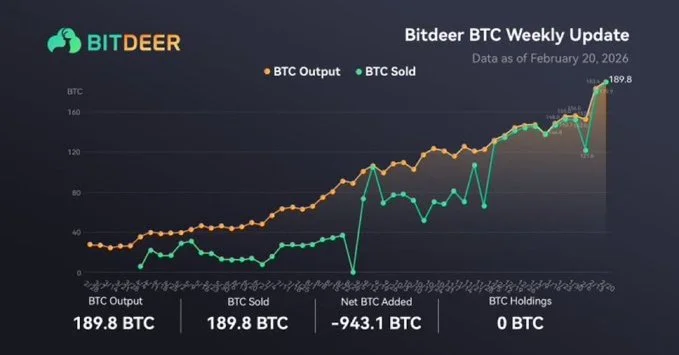
Bitcoin mining giant Bitdeer Technologies Group (BTDR) has completed a dramatic shift in its balance sheet strategy, fully liquidating its corporate Bitcoin holdings as of February 20, 2026.
According to the company’s latest operational report, Bitdeer sold a total of 1,132.9 BTC, including its entire reserve and recent production, leaving its treasury at zero BTC—a rare stance among publicly traded miners.
In the week leading up to Feb. 20, the Singapore‑based miner reported 189.8 BTC mined, all of which was immediately sold rather than being added to reserves. Alongside this week’s output, Bitdeer liquidated 943.1 BTC previously held, marking a net outflow of 943.1 BTC and the complete exit from its proprietary Bitcoin balance.
Key Takeaways
- Bitdeer Technologies fully liquidated its Bitcoin holdings, selling a total of 1,132.9 BTC and leaving its treasury at zero.
- The company sold all 189.8 BTC mined in the latest week along with 943.1 BTC from reserves, marking a net outflow of 943.1 BTC.
- The liquidation was framed as a liquidity measure to fund infrastructure expansion, AI cloud services, and data center development.
- Mining profitability pressures, including rising network difficulty and falling hashprice, likely influenced the decision to exit BTC holdings.
- Bitdeer’s move departs from the traditional miner strategy of holding Bitcoin as a treasury asset, signaling a focus on operational stability and strategic diversification.
A Break From Traditional Miner Treasury Strategy
Historically, many Bitcoin miners have retained a portion of mined coins as a hedge against future price appreciation, contributing to both earnings flexibility and investor confidence. Bitdeer’s move breaks sharply with this approach: as of Feb. 20, 2026, no Bitcoin remains on its corporate books, excluding customer deposits.
This full liquidation caps an eight‑week reduction from the roughly 2,000 BTC the company held at the end of 2025. By comparison, peers like Marathon Digital and Riot Platforms continue to hold substantial Bitcoin treasuries, with tens of thousands of coins on their balance sheets.
Why the Sudden Exit?
Bitdeer management has framed the decision not as a loss of confidence in Bitcoin’s long‑term prospects but as a liquidity‑focused move, intended to support operational and strategic objectives.
The sale coincided with a major financing effort: the company priced $325 million in convertible notes due 2032, alongside a $43.5 million registered direct offering of shares, to strengthen its balance sheet and fund future growth.
Proceeds from these financings are slated for data center expansion, ASIC hardware development, high‑performance computing (HPC) and AI cloud initiatives, and general corporate purposes. This suggests Bitdeer is prioritizing capital for infrastructure buildouts over maintaining Bitcoin exposure amid tightening mining economics.
Operating Pressure and Market Context
Bitdeer’s decision comes during a period of compressed mining margins. Recent network conditions have seen Bitcoin mining difficulty rise by significant margins, and hash price—a key measure of miner revenue per unit of computational power—has fallen below $30 per PH/s/day, squeezing profitability.
For many miners, selling a portion of activity to cover costs like electricity and rig maintenance is routine. But liquidating all reserves and weekly output—as Bitdeer did—underscores how difficult the current environment has become for some operators.
Investor Reaction and Industry Implications
The market response was immediate: Bitdeer’s stock price experienced downward pressure following the announcements, reflecting investor concerns over dilution and the abandonment of a traditional “HODL” reserve strategy.
While selling more than 1,100 BTC represents a small slice of the cryptocurrency’s total supply, corporate exits like this can influence sentiment—especially when executed by miners with high public visibility. However, analysts note that the broader Bitcoin market’s depth can absorb such sales without significant sustained price disruption.
What Comes Next for Bitdeer?
With a zero‑Bitcoin treasury, Bitdeer now stands apart from peers that continue to balance mining operations with long‑term asset accumulation. The company’s strategy appears focused on deploying capital into high-growth infrastructure segments like AI and data center services—areas where sustained revenue could help offset cyclical weaknesses in Bitcoin mining income.
Whether this shift will pay off depends on execution: expanding data centers, scaling AI cloud services, and managing debt responsibly will be critical as Bitdeer transitions from a pure mining play to a broader technology operator—all while Bitcoin continues trading under pressure near multi-month lows.
In a sector marked by thin margins and volatile price action, Bitdeer’s full departure from Bitcoin holdings signals a bold, if unconventional, gamble on liquidity and diversification as the next chapter of its corporate roadmap.
Related posts:
- CoinShares Records $785 Million in Digital Asset Inflows, 2024 YTD Surpasses $7.5 Billion
- Metaplanet Launches $5.4 Billion Bitcoin-Linked Equity Offering in Japan
- Ripple, Absa Partner to Launch Digital Asset Custody in South Africa
- Bitmine Expands Its Ethereum Treasury, Adding 24,266 ETH Last Week and Holding Over 4.16m ETH Total
- TON Foundation Has Partnered With Banxa to Expand Stablecoin Payment Processing for Asia-Pacific Merchants