BitMine Immersion Technologies is facing one of the most troubling financial moments in the history of corporate crypto treasuries. The company, which has built its business model around holding and managing large digital-asset reserves, is now sitting on an estimated $3.7 billion unrealized loss from its Ethereum position — and the timing could not be worse.
A Treasury Model Under Pressure
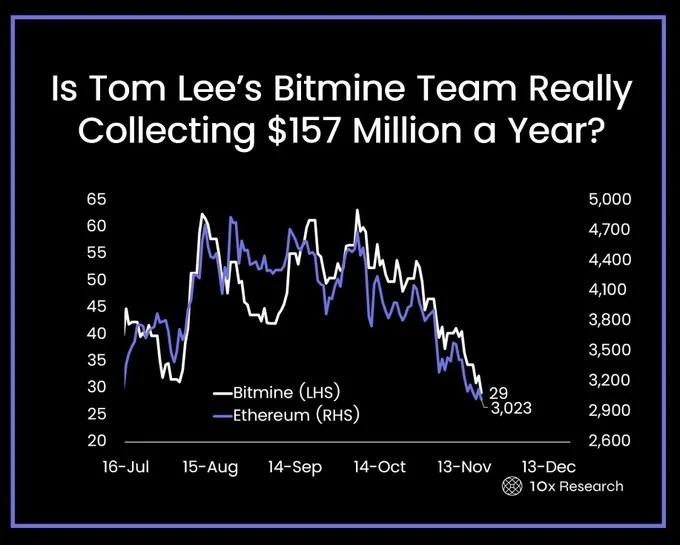
According to analysis from 10x Research, BitMine holds 3.56 million ETH, representing roughly 2.94% of all Ethereum in circulation. The firm accumulated this position at an average purchase price of $4,051 per ETH. With Ethereum currently trading nearly $1,000 below that cost basis, BitMine is deeply underwater.

These massive losses aren’t merely a paper problem. BitMine’s financial metrics suggest its business model is strained. The company’s mNAV ratio sits at 0.77 basic and 0.92 diluted, signaling that its enterprise value has fallen below the value of its crypto assets.
For a DAT (Digital Asset Treasury) firm, this is a critical red flag. An mNAV below 1 means the company cannot effectively issue new shares to raise fresh capital or scale its holdings — a core part of how DATs generate value.
Markus Thielen, founder of 10x Research, issued a stark warning about the broader risks faced by DAT investors. He described the current environment as a “Hotel California scenario”, where “investors find themselves trapped in the structure, unable to get out without significant damage.”
He emphasized that DATs typically operate with opaque, hedge-fund-style fee models that slowly eat into returns, unlike the transparent cost structures of regulated ETFs.
BlackRock’s Move Raises the Stakes
BitMine’s troubles are unfolding just as BlackRock, the world’s largest asset manager, steps deeper into Ethereum-based investment products. BlackRock recently registered the iShares Staked Ethereum Trust in Delaware — an early-stage filing signaling intent to introduce a staking-enabled ETH ETF.
Even though it is not yet listed or formally operational, the registration has already shifted sentiment across the digital-asset investment space. The contrast between a regulated, low-cost staking ETF and the structure of DATs is stark. BlackRock’s proposed fund carries a 0.25% management fee, compared to the often complex and significantly higher embedded costs seen in DAT-style treasuries.
With other firms such as REX-Osprey and Grayscale already offering staked ETH ETF products, BlackRock’s arrival intensifies competition. Investors now have more liquid, regulated, and yield-generating alternatives — and this shift threatens to marginalize DATs that cannot match the transparency or income potential of staking ETFs.
Why BitMine’s Losses Matter
BitMine’s current position highlights a series of challenges facing corporate crypto treasuries:
- No yield generation: Unlike staking ETFs, most DATs do not provide investors with staking rewards.
- High and opaque fees: DATs often include hidden or layered fee structures that reduce returns over time.
- Liquidity constraints: As premiums shrink and mNAV drops, firms lose the ability to issue new shares or expand holdings.
- Increased competition: Regulated ETF products offer lower costs, better liquidity, and built-in yield, making DATs less appealing.
For BitMine, the unrealized losses would be concerning even in a stable environment. But in a moment when institutional options are expanding, and traditional asset managers are moving into Ethereum staking, the pressure is compounded.
A Market at a Crossroads
DATs were initially seen as a novel way to gain broad exposure to digital assets through equity markets. But BitMine’s situation shows that the model depends heavily on trading premiums, strong market conditions, and investor confidence. When those elements fade, the structure struggles to sustain itself.
Investor sentiment may continue to shift as more regulated, cost-efficient staking products enter the market. If these trends accelerate, DATs could lose their relevance unless they meaningfully adapt.
BitMine’s $3.7 billion unrealized loss stands as more than a number — it’s a signal. The digital-treasury business model is being tested, and the firms that cannot evolve may find themselves outpaced by the very institutions that once lagged behind them in embracing digital assets.