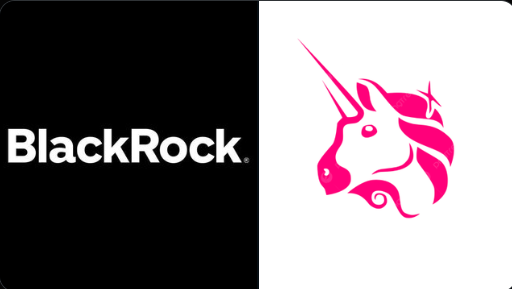
BlackRock is taking a decisive step into decentralized finance. The world’s largest asset manager is integrating its tokenized U.S. Treasury fund, BUIDL, with Uniswap through UniswapX, a marketplace protocol designed to source the best execution from professional market makers.
As part of the arrangement, BlackRock is also acquiring an undisclosed amount of Uniswap’s governance token, UNI—marking the first time the firm is holding a DeFi-native token on its balance sheet.
The announcement sent UNI sharply higher. The token climbed more than 13% on Wednesday to trade around $3.80, according to CoinGecko data, though it remains down roughly 29% over the past month amid broader market weakness.
Key Takeaways
- BlackRock is integrating its $1.8–$2.1 billion tokenized Treasury fund, BUIDL, with Uniswap through the UniswapX trading protocol.
- The asset manager is purchasing an undisclosed amount of UNI, marking its first direct exposure to a DeFi-native governance token.
- BUIDL trades as a yield-bearing, dollar-pegged token backed by cash and U.S. Treasuries, distinguishing it from most traditional stablecoins.
- Access to BUIDL on Uniswap will initially be restricted to qualified institutional investors and whitelisted market makers under Securitize’s compliance framework.
- The partnership signals accelerating convergence between traditional finance and decentralized trading infrastructure built on Ethereum.
A Treasury Fund Meets DeFi Infrastructure
BUIDL, BlackRock’s tokenized money market fund backed by cash and short-term U.S. Treasuries, currently has a market value of roughly $1.8–$2.1 billion, making it one of the largest tokenized real-world assets on-chain, according to RWA.xyz data referenced in coverage of the deal.
Unlike most stablecoins, which simply track the U.S. dollar, BUIDL pays yield to eligible holders. Trading of BUIDL on Uniswap will be conducted via UniswapX, where market makers compete through a request-for-quote (RFQ) system to provide best pricing.
The tokenization firm Securitize, which manages the BUIDL fund on-chain, will continue to facilitate issuance and compliance, including maintaining a whitelist of eligible institutional participants and approved liquidity providers such as Wintermute and Flowdesk.
That structure means access will remain limited to qualified purchasers—typically investors with at least $5 million in assets—at least for now. While that narrows participation, the framework is designed to test how regulated financial products can function within decentralized trading rails.
Uniswap Labs described the move as a step toward “bridging the gap between traditional finance and DeFi.”
Securitize CEO Carlos Domingo framed it more bluntly:
“This is the unlock we’ve been working toward: bringing the trust and regulatory standards of traditional finance to the speed and openness for which DeFi is known.”
He added that the same model could be extended to other tokenized real-world assets.
A Strategic Bet on DeFi
BlackRock’s involvement goes beyond listing BUIDL on a decentralized venue. The firm confirmed it has made a strategic investment within the Uniswap ecosystem and plans to purchase UNI tokens. While details of the allocation were not disclosed, reports indicate the firm noted that any existing investment “may be discontinued at any time.”
For Uniswap founder Hayden Adams, the collaboration is the result of roughly 18 months of discussions between the two firms. The pairing is notable: BlackRock, the $9 trillion Wall Street heavyweight, and Uniswap, one of the most recognizable decentralized exchanges built on Ethereum and long associated with crypto-native traders.
Adams has argued that tokenization will eventually shift a broad range of asset trading onto blockchain infrastructure, citing faster settlement and more efficient capital usage as key benefits.
BlackRock executives have expressed similar convictions. In a December column for The Economist, CEO Larry Fink and COO Rob Goldstein wrote that tokenization would represent “the next major evolution in market infrastructure,” pointing to instant settlement and broader access to investable assets.
In its 2026 thematic outlook, BlackRock identified Ethereum—the network underpinning most stablecoins and a large share of tokenized assets—as central to this transformation. Uniswap launched on Ethereum in 2018 and recently introduced its own layer-2 network, Unichain.
Robert Mitchnick, BlackRock’s global head of digital assets, said the integration is about interoperability:
“This collaboration with Uniswap Labs alongside Securitize is a notable step in the convergence of tokenized assets with decentralized finance. The integration of BUIDL into UniswapX marks a major leap forward in the interoperability of tokenized USD yield funds with stablecoins.”
A Controlled Experiment—For Now
Despite the headline significance, the immediate trading impact may be modest. Participation will be restricted to a relatively small pool of institutions and approved liquidity providers. Still, the technical architecture is designed to scale beyond this initial cohort.
Securitize’s Domingo acknowledged that large asset managers prefer to proceed cautiously, starting with qualified purchasers before expanding access. The infrastructure, however, is intended to support broader participation over time.
There is already around $100 billion locked across DeFi platforms, according to industry estimates cited in reporting on the deal. The addition of a regulated, Treasury-backed yield product from BlackRock introduces a new category of on-chain asset—one that blends traditional fixed-income exposure with decentralized trading mechanics.
For Uniswap and the wider DeFi sector, the significance lies less in immediate trading volume and more in validation. A firm of BlackRock’s scale committing capital and product to decentralized infrastructure signals that tokenization is moving beyond pilot programs into operational integration.
Wall Street and DeFi have often operated at opposite ends of the financial spectrum. With BUIDL’s arrival on Uniswap, that divide is narrowing.
Related posts:
- Bitwise Predicts $200K Bitcoin, $7K Ethereum, and $750 Solana by 2025
- Tron Founder Proposes Radical Changes for Ethereum, Aims for $10,000 ETH
- Bitwise Launches Bitcoin Standard ETF, Tracking Corporate BTC Holdings
- Strategy Acquires $1.42 Billion in Bitcoin Amid Market Shifts
- Strategy to Release Bitcoin Finance Model for Corporations