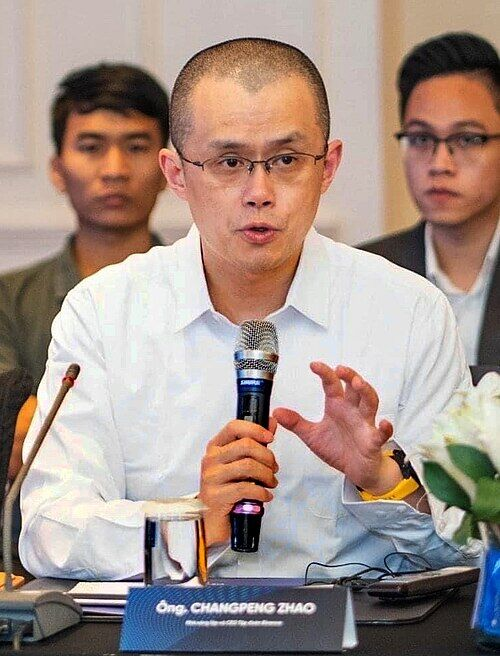
Changpeng Zhao, founder and former CEO of Binance, has sparked fresh debate across the tech and finance world with a blunt message: artificial intelligence is coming for jobs, and cryptocurrency may be one of the few realistic paths to financial independence in that future.
Speaking during an industry discussion toward the end of 2024, Zhao drew a sharp contrast between two forces reshaping the global economy. On one side is AI, rapidly automating tasks that once required human labor.
On the other is crypto, which he believes offers a rare opportunity for individuals to step outside the traditional work-for-wages model entirely.
“AI will make many people jobless,” Zhao said during the discussion, adding that crypto could allow some people to reach a point where they no longer need a job.
The statement, while provocative, reflects a growing anxiety among workers and policymakers as automation accelerates—and a parallel optimism among crypto proponents who see digital assets as a long-term hedge against that disruption.
Key Takeaways
- Changpeng Zhao believes artificial intelligence will significantly reduce traditional job opportunities, increasing pressure on existing employment structures.
- Cryptocurrency, according to Zhao, offers a potential route to financial independence that could reduce reliance on long-term employment.
- Long-term crypto holders have historically benefited the most, though outcomes depend heavily on timing, discipline, and market cycles.
- High volatility, regulatory uncertainty, and survivor bias remain major risks for anyone viewing crypto as a retirement strategy.
- Growing institutional adoption and clearer regulations are gradually integrating crypto into mainstream financial systems.
Why Zhao Thinks Crypto Changes the Retirement Equation

Zhao’s argument is not built around quick wins or short-term speculation. Instead, he points to the historical performance of major cryptocurrencies and the behavior of long-term holders.
Bitcoin, since its launch in 2009, has gone through multiple boom-and-bust cycles, yet its long-term trajectory has remained upward. Ethereum and a handful of other digital assets have followed similar, though more volatile, paths.
According to Zhao, individuals who accumulated crypto early and held through market cycles have already achieved financial independence—sometimes decades earlier than traditional retirement timelines would allow.
He suggested that people who position themselves early in crypto markets could “retire within a few years,” rather than spending decades contributing to pension schemes or retirement funds.
This philosophy mirrors the widely known “HODL” mindset in crypto communities, where investors prioritize long-term conviction over short-term price movements. Bull markets in 2017 and 2021 offered clear examples: some investors who stayed invested through downturns later saw returns that were difficult to replicate in traditional markets.
AI, Automation, and the Job Market Reality
Zhao’s comments land at a time when concerns about technological unemployment are no longer theoretical. Research bodies such as the World Economic Forum have repeatedly warned that AI will reshape the labor market. Its 2023 Future of Jobs Report found that while automation will create new roles, it will also displace millions of existing ones.
Routine tasks—both physical and cognitive—are especially vulnerable. Customer support, data entry, basic analysis, and even some creative roles are already being augmented or replaced by AI systems developed by firms like OpenAI, Google DeepMind, and Anthropic.
Zhao does not argue that work will disappear entirely. Instead, his point is more uncomfortable: the stability once promised by long-term employment may no longer be guaranteed. In that environment, alternative ways to build and preserve wealth become more attractive.
Crypto as an Economic Alternative, Not Just an Asset
Beyond price speculation, Zhao frames crypto as part of a broader economic shift. Blockchain networks have given rise to entire sectors that did not exist a decade ago—decentralized finance, tokenized assets, NFTs, and Web3 infrastructure among them. These systems allow users to earn, lend, trade, and build without relying on traditional banks or employers.
This matters especially in regions where access to financial services is limited. Research published in 2024 by blockchain economist Dr. Jane Thomason highlights how digital assets can improve financial inclusion in emerging markets, offering savings and payment tools outside fragile banking systems.
At the same time, some researchers see crypto and AI as complementary rather than competing technologies. AI researcher Ben Goertzel has argued that blockchain-based systems could help govern advanced AI models transparently, reducing centralized control and abuse.
The Risks Behind the Crypto Retirement Narrative
Despite the appeal of Zhao’s vision, financial professionals urge caution. Crypto markets remain highly volatile. Historical data shows that even major assets like Bitcoin and Ethereum can swing more than 30% in short periods. For anyone considering crypto as a retirement strategy, that volatility cannot be ignored.
Diversification remains a core principle. Holding crypto as part of a broader portfolio is fundamentally different from betting everything on digital assets. Time horizon also plays a crucial role. Zhao’s suggestion of retiring within “a few years” assumes patience, discipline, and the ability to withstand deep drawdowns.
Regulation adds another layer of complexity. While frameworks like the European Union’s Markets in Crypto-Assets (MiCA) regulation aim to protect investors and stabilize markets, global rules remain uneven. Policy changes can still impact prices and access with little warning.
There is also the issue of survivor bias. Stories of early Bitcoin holders becoming financially free are real—but they represent a small fraction of participants. Many others entered markets near peaks and suffered heavy losses.
Growing Institutional Interest Changes the Picture
One factor strengthening Zhao’s argument is the steady advance of institutional adoption. Major asset managers such as BlackRock and Fidelity now offer regulated crypto investment products. In early 2024, U.S. regulators approved spot Bitcoin exchange-traded funds, opening the door for broader institutional participation.
In some jurisdictions, retirement accounts can now gain crypto exposure through approved instruments. While this does not eliminate risk, it signals a shift toward mainstream acceptance and improved market infrastructure.
A Future Defined by Choice—and Risk
Zhao’s remarks are best understood not as a guarantee, but as a challenge to conventional thinking. As AI reshapes employment and productivity, the idea of spending 40 years in stable work before retirement looks less certain.
Crypto, with all its volatility and promise, offers an alternative path—one that rewards early understanding, long-term conviction, and risk tolerance.
Whether that path leads to early retirement or painful losses depends on strategy, education, and timing. What Zhao has done is force a difficult question into the open: in a world where machines increasingly do the work, how do humans secure financial freedom?
Crypto may not be the answer for everyone—but for some, it could redefine what “retirement” even means.