Definition
Delegated Proof of Stake (DPoS) is a consensus mechanism in which cryptocurrency token holders exercise their voting power to elect a limited set of delegates – commonly referred to as block producers, witnesses, or validators – who are entrusted with the responsibility of validating transactions, producing new blocks, and maintaining the integrity of the blockchain. Unlike traditional Proof of Stake (PoS), where any staker can potentially be chosen to validate blocks in proportion to their holdings, DPoS concentrates block production among a small, elected group while distributing governance power across the entire token-holding community through a continuous democratic voting process.
In a DPoS system, every token holder can cast votes weighted by the number of tokens they hold or have staked. The top candidates receiving the most votes are elected as active block producers for a given round or epoch. These elected delegates take turns producing blocks in a deterministic, round-robin order, which eliminates the competitive resource expenditure seen in Proof of Work (PoW) and reduces the randomness-related latency of conventional PoS. If a delegate fails to produce a block within its allotted time slot, misses rounds, or acts maliciously, the community can vote them out and replace them with a standby delegate, creating a system of continuous accountability.
DPoS was designed to solve three persistent problems in blockchain consensus: the energy waste of PoW mining, the low transaction throughput of early blockchain architectures, and the lack of direct community governance in network operations. By limiting the active validator set to a small number of high-performance nodes – typically between 21 and 101 – DPoS achieves block times as low as 0.5 seconds and throughput exceeding several thousand transactions per second, making it one of the fastest consensus mechanisms deployed in production blockchains.
Origin & History
2014: Dan Larimer invented Delegated Proof of Stake and first implemented it in BitShares, a decentralized exchange platform. Larimer recognized that traditional PoW consensus wasted enormous computational resources and that even early PoS designs suffered from low throughput. His insight was that a representative democracy model – where token holders elect trusted delegates rather than all participants competing to validate – could achieve both high performance and democratic governance.
2014–2015: BitShares launched as the first DPoS blockchain, using 101 elected witnesses to produce blocks every 10 seconds. The system demonstrated that DPoS could handle thousands of transactions per second, far exceeding Bitcoin’s 7 TPS. BitShares also introduced the concept of committee members and worker proposals, extending the DPoS governance model beyond mere block production.
2016: Dan Larimer applied DPoS to Steem, a decentralized social media platform. Steem reduced the active witness count to 21 and introduced 3-second block times, proving that DPoS could power content-heavy applications requiring rapid transaction processing. Steem’s success demonstrated DPoS viability beyond financial applications.
2018: Lisk launched its mainnet with a DPoS model using 101 elected delegates and 10-second block times. Lisk’s sidechain-based architecture showed how DPoS could serve as a foundation for modular blockchain ecosystems, allowing developers to build custom sidechains secured by the main DPoS-powered chain.Lisk
2018: EOS launched its mainnet as the flagship DPoS blockchain, using just 21 elected block producers (BPs) with 0.5-second block times and a theoretical throughput of 4,000+ TPS. The EOS token sale raised over $4 billion, making it one of the largest ICOs in history. The launch was accompanied by intense debate about whether 21 BPs constituted sufficient decentralization.
2018: TRON migrated from an ERC-20 token to its own mainnet using a DPoS model with 27 elected Super Representatives (SRs). TRON positioned itself as an entertainment and content-focused blockchain, using DPoS speed for high-throughput dApp deployment.
2019: WAX (Worldwide Asset eXchange) launched its DPoS-based blockchain specifically for NFT trading and virtual item marketplaces, demonstrating DPoS applicability to gaming and digital collectible ecosystems.
2020–2023: DPoS faced growing criticism over centralization, vote-buying cartels, and voter apathy. Several EOS block producers were accused of forming mutual voting agreements, and Steem’s hostile takeover by Justin Sun in 2020 exposed governance vulnerabilities inherent in DPoS when token ownership is concentrated. These events spurred the community fork that created Hive.
“DPoS is the fastest, most efficient, most decentralized, and most flexible consensus model available. It leverages the power of stakeholder approval voting to resolve consensus issues in a fair and democratically representative manner.” – Dan Larimer, BitShares Documentation (2014)
In Simple Terms
- Imagine a large corporation where every shareholder gets to vote for the board of directors. The more shares you own, the more voting power you have. The elected board members then run the company day-to-day on behalf of all shareholders. If a board member performs poorly, shareholders vote them out at the next election. DPoS works the same way – token holders are shareholders, and block producers are board members.
- Think of a school class election. Every student votes for a class representative. The representative speaks and makes decisions on behalf of the whole class, but if the class is unhappy, they can hold another election and choose someone else. DPoS lets crypto holders vote for their “class representatives” who validate transactions.
- Picture a relay race team. Instead of having everyone on the team run simultaneously (which would be chaos), the coach selects the fastest runners and assigns each one a specific leg of the race. They run in an organized order, passing the baton smoothly. DPoS selects the best block producers and has them take turns producing blocks in a set rotation.
- It is like choosing referees for a football league. The league’s teams (token holders) vote on which referees (delegates) they trust to fairly officiate games (validate blocks). Referees who make bad calls or miss games get replaced by alternates. This keeps the game fair without requiring every spectator to also be a referee.
- Consider a neighborhood watch program. Residents (token holders) elect a few trusted neighbors (delegates) to patrol the streets and report incidents. Not everyone patrols – that would be impractical – but everyone has a say in who patrols. If a patrol member slacks off, they get voted out at the next community meeting.
Important: While DPoS provides high speed and democratic participation, the small number of elected delegates (often 21–101) means the network is more centralized than PoW or traditional PoS systems. Voters must remain vigilant to prevent delegate cartels, vote-buying schemes, and concentration of power among a few large stakeholders who can dominate elections.
Key Technical Features
Delegate Election and Voting Mechanics
- Token holders cast votes weighted by their staked or held token balance
- Votes are typically continuous – holders can change votes at any time, not just during fixed election periods
- The top N candidates by vote weight become active block producers (e.g., 21 on EOS, 27 on TRON, 101 on Lisk)
- Standby delegates remain on a waiting list and can be promoted if an active delegate is voted out or goes offline
- Some implementations support proxy voting, allowing holders to delegate their voting power to a trusted third party
How DPoS Block Production Works
- Token holders stake their tokens and cast votes for their preferred delegate candidates
- The system tallies votes at the end of each voting round and determines the active delegate set
- Active delegates are assigned block production slots in a deterministic round-robin schedule
- When a delegate’s slot arrives, it collects pending transactions from the mempool, creates a new block, signs it, and broadcasts it to the network
- The next delegate in the rotation verifies the previous block and produces the subsequent block
- If a delegate misses its assigned slot (due to downtime or latency), the slot is skipped and the next delegate proceeds
- Delegates that consistently miss blocks lose votes and are eventually replaced by standby candidates
- Block rewards and transaction fees are distributed to active delegates, who often share a portion with their voters as an incentive
Performance Characteristics
- Block times range from 0.5 seconds (EOS) to 10 seconds (Lisk), far faster than Bitcoin’s 10 minutes
- Throughput commonly exceeds 1,000–4,000 TPS in production, with theoretical limits much higher
- Transaction finality is achieved within seconds rather than the minutes or hours required by PoW chains
- The small, known validator set enables efficient peer-to-peer communication with minimal network overhead
- Last irreversible block (LIB) concept ensures that once 2/3+ of active BPs confirm a block, it cannot be reversed
Governance Extensions
- Many DPoS systems extend voting beyond block production to include protocol upgrades, treasury allocation, and parameter changes
- EOS uses a multi-signature system where 15 of 21 BPs must agree on constitutional changes
- Worker proposal systems allow the community to vote on funding development initiatives from inflation-funded treasury pools
- On-chain governance enables transparent decision-making without relying on off-chain social consensus
Advantages & Disadvantages
| Advantages | Disadvantages |
| High Throughput: Small validator sets enable 1,000–4,000+ TPS with sub-second block times, making DPoS among the fastest consensus mechanisms | Centralization Risk: Concentrating block production among 21–101 delegates creates potential single points of failure and governance capture |
| Energy Efficiency: DPoS eliminates competitive mining entirely, consuming a fraction of the energy used by PoW systems like Bitcoin | Vote-Buying Cartels: Delegates may form mutual voting agreements or pay voters for support, undermining the meritocratic intent of the election system |
| Democratic Governance: Every token holder participates in validator selection, giving the community direct influence over network operations | Voter Apathy: In practice, many token holders never vote or delegate their voting power, leading to low participation rates and elections dominated by whales |
| Accountability: Underperforming or malicious delegates can be voted out in real time, creating continuous accountability absent in PoW mining | Whale Dominance: Large token holders can single-handedly elect delegates, effectively controlling the network despite the democratic design |
| Fast Finality: Transactions reach irreversibility within seconds, enabling DPoS chains to support real-time applications like payments and gaming | Nothing-at-Stake Variants: Some DPoS implementations lack strong slashing penalties, meaning delegates face limited financial consequences for misbehavior |
| Scalability: The fixed, small validator set allows for optimized network communication and avoids the scalability bottlenecks of open-participation consensus | Hostile Takeover Vulnerability: If a single entity acquires enough tokens, they can elect all delegates and take control of the network, as demonstrated in the Steem/TRON incident |
| Low Barrier to Participation: Any token holder can vote without running specialized hardware, making governance accessible to all participants | Delegate Collusion: A small validator set makes coordination between validators easier, potentially enabling censorship or preferential transaction ordering |
| Predictable Block Production: Round-robin scheduling ensures blocks are produced at consistent intervals, simplifying application development | Limited Censorship Resistance: With only 21–101 validators, government coercion or legal action against a majority of delegates could compromise the network |
Risk Management
Centralization and Governance Capture
- The small delegate set is inherently more vulnerable to coordinated attacks, regulatory pressure, or cartel formation than large-validator-set systems
- Mitigation: monitor delegate voting patterns for signs of collusion; support community watchdog organizations that track delegate behavior; participate actively in voting to counterbalance whale influence
- Consider diversifying holdings across multiple DPoS chains to reduce exposure to governance failure on any single network
Vote-Buying and Bribery
- Delegates may offer direct financial incentives (kickbacks, airdrops, staking rewards) to attract votes, distorting the meritocratic election process
- Mitigation: support transparent delegate reporting requirements; favor delegates who publish operational details, uptime statistics, and community contributions
- Some protocols implement anti-bribery mechanisms such as vote decay (votes lose weight over time if not refreshed) or quadratic voting (diminishing returns for large holders)
Hostile Takeover Risk
- The 2020 Steem hostile takeover demonstrated that a single entity (Justin Sun via TRON Foundation) could use exchange-held tokens to elect a compliant delegate set and seize control of the network
- Mitigation: advocate for exchange policies that prevent customer tokens from being used in governance votes; support protocol rules that lock staked tokens for a minimum period before they gain voting power
- Community response options include hard forking (as Steem users did to create Hive) as an ultimate safeguard
Delegate Downtime and Performance
- If multiple delegates go offline simultaneously, block production can stall or slow dramatically
- Mitigation: elect delegates with proven infrastructure track records; prefer delegates operating geographically distributed, redundant node setups
- Standby delegate systems provide automatic failover, but activation delays can still cause temporary throughput reduction
Cultural Relevance
Delegated Proof of Stake holds a unique and often contentious position in cryptocurrency culture. Its supporters praise it as the most practical implementation of on-chain democracy, while its critics view it as a betrayal of the decentralization ethos that underpins the broader blockchain movement.
Dan Larimer’s vision of “industrial-grade blockchain” – fast, efficient, and governed by elected representatives – resonated strongly with developers and entrepreneurs who needed blockchain performance that PoW and early PoS could not deliver. The EOS community in particular developed a vibrant political culture around block producer elections, with candidates campaigning on platforms that included infrastructure quality, community contributions, geographic diversity, and revenue-sharing proposals.
“The goal of DPoS is not to remove trust – it is to minimize trust while maximizing performance and accountability through democratic participation.” – Dan Larimer
However, DPoS also became a flashpoint in the “decentralization maximalism” debate. Bitcoin and Ethereum purists frequently criticized DPoS chains as “glorified databases” or “corporate chains,” arguing that 21 block producers offered negligible censorship resistance compared to thousands of independent miners or validators. The phrase “21 nodes is not decentralized” became a common refrain in crypto Twitter debates.
The 2020 Steem hostile takeover by Justin Sun became the most cited cautionary tale about DPoS governance risks. When Sun used tokens held on centralized exchanges (Binance, Huobi, and Poloniex) to vote in compliant witnesses and seize control of the Steem network, the event galvanized the community to fork into Hive – demonstrating both the vulnerability and the resilience of DPoS governance. The incident permanently shaped how the crypto community evaluates DPoS systems.
In the DeFi ecosystem, DPoS chains like EOS and TRON have carved out niches for high-frequency trading applications, gaming dApps, and stablecoin transfers, where transaction speed and low fees matter more than the maximum decentralization offered by Ethereum or Bitcoin.
Real-World Examples
- EOS Block Producer Elections
- Scenario: The EOS mainnet launched in June 2018 with a DPoS system requiring the election of exactly 21 block producers from hundreds of candidates worldwide.
- Implementation: Token holders staked their EOS tokens and voted for up to 30 BP candidates. The top 21 by vote weight became active producers, generating blocks every 0.5 seconds in round-robin order. BPs were required to maintain high-performance infrastructure capable of handling 4,000+ TPS, and many operated geographically distributed server clusters.
- Outcome: EOS demonstrated that DPoS could support a large-scale smart contract platform with sub-second finality. However, controversies emerged around BP vote-buying, with reports of Chinese mining pools forming mutual voting cartels and BP candidates offering direct financial rewards to voters. By 2020, community governance reforms attempted to address these issues through updated voting mechanisms.
- TRON Super Representative System
- Scenario: TRON uses 27 elected Super Representatives (SRs) to produce blocks every 10 seconds, supporting a high-throughput entertainment and DeFi ecosystem.
- Implementation: TRON token holders freeze their TRX tokens to gain Tron Power, which they use to vote for SR candidates. SRs earn block rewards and transaction fees, typically sharing 80–100% of rewards with their voters as an incentive. The system also includes Super Representative Partners (candidates ranked 28–127) who earn voting rewards but do not produce blocks.
- Outcome: TRON became one of the most active blockchains by transaction count, processing over 7 million transactions daily by 2023. The USDT stablecoin on TRON (TRC-20) became the most-used stablecoin transfer network due to its speed and near-zero fees – a direct benefit of DPoS efficiency. However, critics noted that TRON’s governance remained heavily influenced by Justin Sun and affiliated entities.
- Steem-to-Hive Fork (Hostile Takeover Defense)
- Scenario: In February 2020, Justin Sun acquired Steemit Inc. and used tokens held on centralized exchanges to vote in a new set of witnesses loyal to his agenda, effectively seizing control of the Steem DPoS governance.
- Implementation: Community members rallied to vote for independent witnesses, but Sun’s control of exchange-held tokens gave him overwhelming voting power. After weeks of governance warfare, the original Steem community executed a hard fork on March 20, 2020, creating Hive – an independent DPoS chain that excluded Sun-controlled tokens from the initial distribution.
- Outcome: The Hive fork preserved the community’s content and governance autonomy, but the incident exposed a critical DPoS vulnerability: when token custody on exchanges is not separated from governance voting power, hostile takeovers become feasible. The event led to industry-wide calls for exchanges to abstain from using customer tokens in governance votes.
- WAX Blockchain for NFT Gaming
- Scenario: WAX (Worldwide Asset eXchange) uses DPoS to power one of the largest NFT trading platforms, serving millions of users trading virtual items from games and collectible card series.
- Implementation: WAX employs a DPoS model inspired by EOS (built on EOSIO technology) with elected guilds serving as block producers. The high throughput of DPoS enables WAX to process the rapid, high-volume micro-transactions typical of NFT marketplaces and blockchain gaming without the high gas fees seen on Ethereum.
- Outcome: WAX became the leading blockchain for NFT trading volume by transaction count in 2021, hosting collections like Topps MLB, Hot Wheels, and Funko digital collectibles. The DPoS architecture allowed WAX to handle millions of daily transactions with near-zero fees, demonstrating DPoS suitability for consumer-facing applications requiring mass-market scalability.
Comparison Table
| Feature | DPoS (EOS/TRON) | Proof of Work (Bitcoin) | Proof of Stake (Ethereum) |
| Active Validators | 21–27 elected delegates | ~1,000,000+ miners globally | ~900,000+ validators |
| Block Time | 0.5–3 seconds | ~10 minutes | ~12 seconds |
| Throughput (TPS) | 1,000–4,000+ | ~7 | ~30 (L1), higher with rollups |
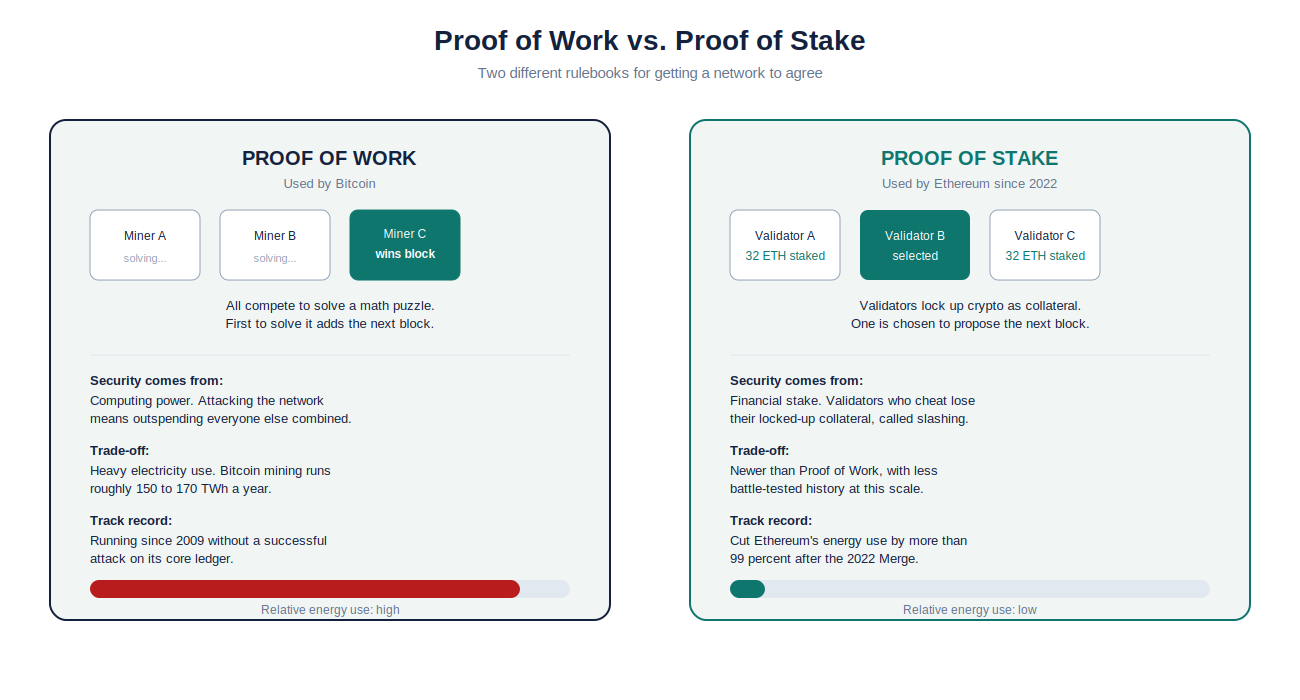
| Energy Consumption | Minimal (standard servers) | Extremely high (~150 TWh/year for Bitcoin) | Low (no mining) |
| Finality Time | 1–3 seconds (LIB) | ~60 minutes (6 confirmations) | ~12.8 minutes (2 epochs) |
| Governance Model | On-chain democratic voting | Off-chain (BIPs, social consensus) | Off-chain + on-chain signaling |
| Censorship Resistance | Low–moderate (small validator set) | Very high (massive miner distribution) | High (large validator set) |
| Barrier to Validate | Election by community vote | Expensive mining hardware (ASICs) | 32 ETH stake (~$60,000+) |
| Decentralization Level | Low (21–101 nodes) | High (thousands of miners) | High (900,000+ validators) |
FAQ
Q: What makes DPoS different from regular Proof of Stake?
In traditional PoS, any staker can potentially be selected to validate blocks proportionally to their stake. In DPoS, token holders vote for a small set of elected delegates who exclusively produce blocks. This concentrates block production for efficiency while distributing governance power through voting. DPoS trades some decentralization for significantly higher throughput and faster finality.
Q: How many block producers does a typical DPoS network have?
The number varies by implementation: EOS uses 21, TRON uses 27, Lisk uses 101, and BitShares originally used 101. The choice reflects a tradeoff between performance (fewer producers mean faster consensus) and decentralization (more producers distribute power more widely). Most DPoS chains also maintain a roster of standby delegates ready to replace underperforming active producers.
Q: Can DPoS be gamed through vote buying?
Yes, vote buying is one of the most persistent criticisms of DPoS. Delegates may offer direct financial rewards, revenue sharing, or airdrops to attract votes, distorting the election process. On EOS, multiple BP candidates were documented engaging in mutual voting cartels. Some protocols combat this through vote decay mechanisms, transparency requirements, and community watchdog organizations, but the problem remains a fundamental challenge.
Q: What happened during the Steem hostile takeover?
In February 2020, Justin Sun (founder of TRON) acquired Steemit Inc. and coordinated with major exchanges (Binance, Huobi, Poloniex) to use customer-deposited tokens to vote in a new set of witnesses loyal to his agenda. This effectively gave Sun control of the Steem network. The original community responded by forking the chain to create Hive in March 2020, excluding Sun-controlled tokens. The incident highlighted the risk of combining DPoS governance with centralized token custody on exchanges.
Q: Is DPoS suitable for DeFi applications?
DPoS chains are well-suited for certain DeFi applications, particularly those requiring high throughput and low transaction fees, such as decentralized exchanges, lending platforms, and stablecoin transfers. TRON’s DPoS architecture supports one of the highest-volume USDT transfer networks. However, DeFi protocols that prioritize maximum censorship resistance and decentralization may prefer Ethereum or other large-validator-set blockchains.
Q: How does DPoS handle malicious delegates?
DPoS relies primarily on social accountability – if a delegate acts maliciously (censoring transactions, producing invalid blocks, colluding with other delegates), the community can vote them out and replace them with a standby delegate. Some implementations also include cryptographic evidence mechanisms where provably malicious behavior triggers automatic removal. However, DPoS generally lacks the strong slashing penalties found in systems like Ethereum PoS, where validators can lose their staked ETH for misbehavior.
Q: Why do critics say DPoS is too centralized?
Critics argue that having only 21–101 block producers makes DPoS networks vulnerable to collusion, regulatory pressure, and governance capture. With Bitcoin’s hundreds of thousands of miners or Ethereum’s 900,000+ validators, coercing a majority is practically impossible. With 21 EOS block producers, a government or cartel would only need to compromise 15 nodes to control the network. The Steem incident proved this concern is not merely theoretical.
Sources
- Dan Larimer, “Delegated Proof-of-Stake (DPOS)” – https://how.bitshares.works/en/master/technology/dpos.html
- EOS Developer Documentation: Consensus Protocol – https://developers.eos.io/welcome/latest/protocol-guides/consensus_protocol
- TRON Whitepaper – https://tron.network/static/doc/white_paper_v_2_0.pdf
- Investopedia: Delegated Proof of Stake – https://www.investopedia.com/terms/d/delegated-proof-stake-dpos.asp
- Vitalik Buterin, “On Collusion” – https://vitalik.eth.limo/general/2019/04/03/collusion.html
- CoinDesk: “The Steem Takeover and What It Means for DPoS” – https://www.coindesk.com/tech/2020/03/20/hive-launches-as-steem-community-forks-away-from-justin-sun/
- Lisk Documentation: Delegated Proof of Stake – https://lisk.com/documentation/understand-blockchain/consensus/dpos.html