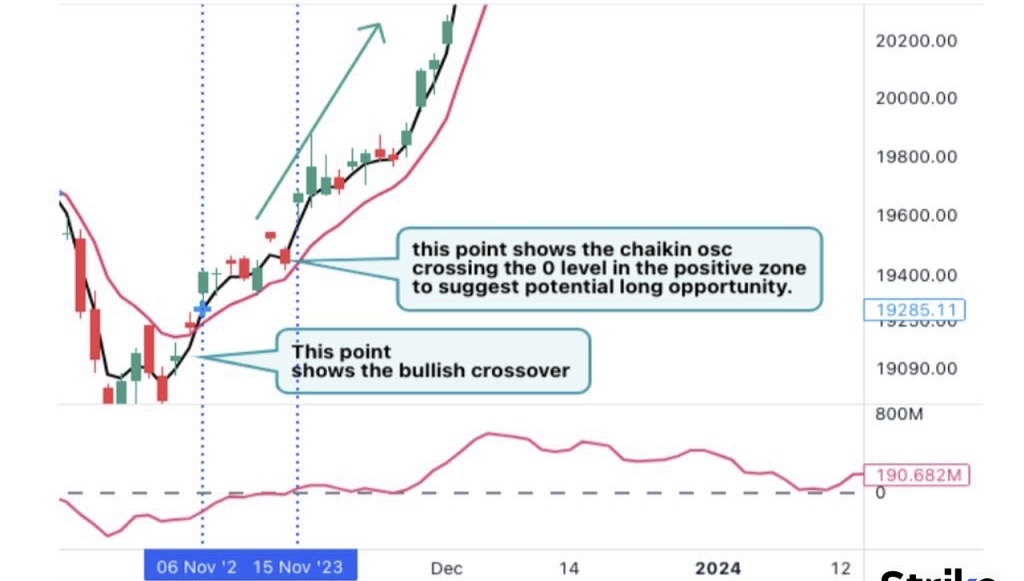
Chaikin Money Flow (CMF) ist ein volumengewichteter Oszillator, der vom Analysten Marc Chaikin entwickelt wurde und den Kauf- und Verkaufsdruck über einen festgelegten Zeitraum, typischerweise 20 oder 21 Handelssitzungen, misst.
Treten Sie UEEx bei
Erleben Sie die weltweit führende digitale Vermögensverwaltungsplattform
Dabei wird der Schlusskurs eines Vermögenswerts innerhalb seiner täglichen Handelsspanne mit dem Volumen dieser Sitzung kombiniert, um einen einzelnen Wert zwischen -1 und +1 zu erhalten.
Dieser Leitfaden erklärt detailliert die Funktionsweise, die Berechnung, die Interpretation der Signale und vor allem die Kombination mit anderen Tools für eine zuverlässigere Handelsstrategie.
Chaikin Money Flow (CMF) wurde von Marc Chaikin entwickelt, einem der frühen Pioniere der Anwendung der Geldflussanalyse auf die Finanzmärkte.
Chaikin baute auf seiner früheren Arbeit, der Akkumulations-/Distributionslinie, auf, um einen Oszillator zu entwickeln, der die Geldflussanalyse in einem kürzeren, besser handhabbaren Betrachtungszeitraum von typischerweise 20 oder 21 Perioden komprimiert.
Laut ResearchGate verlieren rund 90 % der Trader am Ende Geld. Um nicht selbst zu dieser Statistik in diesem unberechenbaren Markt zu gehören, ist es wichtig, die eigenen Kenntnisse über Trading-Tools zu verbessern und so die Gewinnchancen zu erhöhen.
Die grundlegende Erkenntnis hinter diesem Indikator ist elegant einfach: Wo ein Preis innerhalb seiner täglichen Handelsspanne schließt, kombiniert mit dem Volumen, das diesen Schlusskurs begleitete, offenbart das wahre Machtverhältnis zwischen Käufern und Verkäufern.
Ein Markt, der bei hohem Handelsvolumen regelmäßig nahe seinem oberen Ende schließt, ist ein Markt, in dem die Käufer die Oberhand haben. Ein Markt, der insbesondere bei hohem Handelsvolumen regelmäßig nahe seinem unteren Ende schließt, wird von den Verkäufern dominiert.
Treten Sie UEEx bei
Erleben Sie die weltweit führende digitale Vermögensverwaltungsplattform
CMF greift diese Logik auf und wandelt sie in eine einzige oszillierende Zahl um, die zwischen minus 1 und plus 1 schwankt, wobei Null als neutrale Trennlinie fungiert.
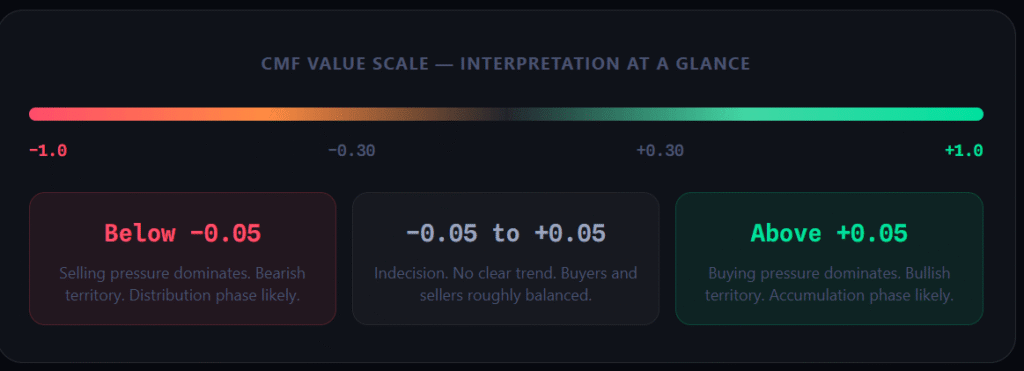
Positive Werte stehen für eine Nettoakkumulation, negative Werte für eine Nettodistribution. Je weiter der Messwert von Null entfernt ist, desto stärker ist die Überzeugung hinter dem Kauf- oder Verkaufsdruck.
Wie wird der Chaikin-Fluss berechnet?
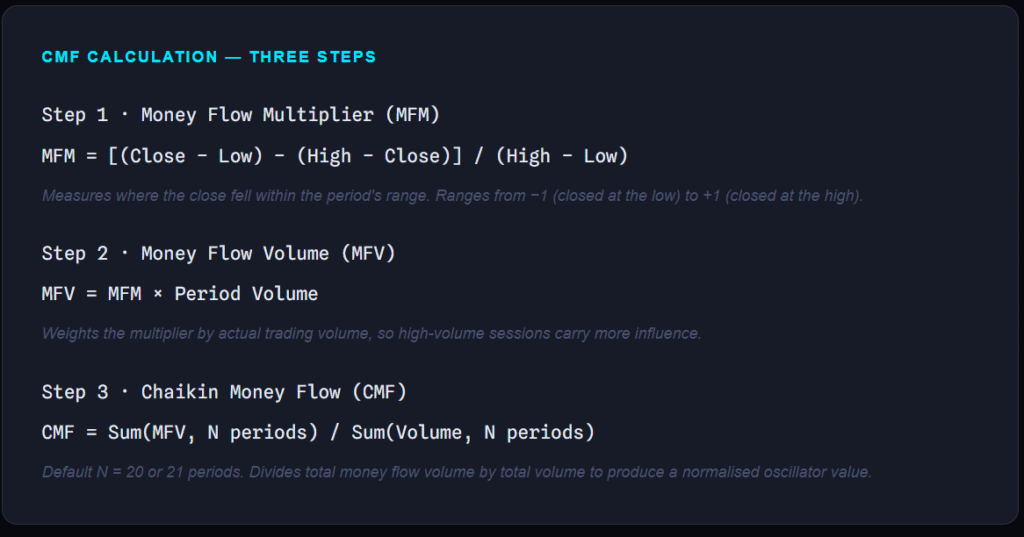
Die Berechnung erfolgt in drei aufeinanderfolgenden Schritten.
Mit dieser Formel lässt sich ein volumennormalisiertes Bild davon gewinnen, ob im gewählten Betrachtungszeitraum Geld in einen Vermögenswert hinein- oder herausgeflossen ist.
Da das Volumen als Gewichtungsfaktor wirkt, hat ein Tag mit dem Zehnfachen des durchschnittlichen Handelsvolumens den zehnfachen Einfluss auf den Endwert.
Genau das macht CMF deutlich informativer als reine Preisindikatoren; es lässt sich nicht durch Bewegungen mit geringem Volumen verfälschen.
Was ist der Standard-Rückblickzeitraum der CMF für Kryptowährungen?
Die Standardeinstellung der meisten Charting-Plattformen beträgt 20 oder 21 Perioden. Auf einem Tageschart entspricht dies ungefähr einem Monat Handelsaktivität.
Auf einem 4-Stunden-Chart werden Daten von etwa vier Tagen abgedeckt. Kürzere Zeiträume von 10 bis 14 Stunden erhöhen die Sensitivität und generieren mehr Signale, was für aktive Kurzzeithändler nützlich sein kann, aber auch das Risiko von Fehlsignalen erhöht.
Längere Zeiträume von 30 bis 50 glätten den Indikator und offenbaren breitere, sich langsamer bewegende Akkumulations- oder Distributionsmuster, die für Swing-Trader und Inhaber mittelfristiger Positionen nützlicher sind.
Insbesondere auf den Kryptomärkten, wo die Volatilität höher ist und die Handelssitzungen 24 Stunden am Tag und 7 Tage die Woche stattfinden, passen viele Händler die Standardeinstellung leicht an.
Die Verwendung von CMF mit einer 14-Perioden-Einstellung auf dem 4-Stunden-Chart für Bitcoin oder Ethereum ist im Jahr 2025 ein gängiger Ansatz, der Reaktionsfähigkeit und Rauschunterdrückung in Einklang bringt.
Wie liest man Chaikin-Flusssignale?
Anstatt jeden Nulllinien-Durchbruch als Signal zu werten, verwenden erfahrene Händler einen kleinen Puffer, der nur dann zum Einsatz kommt, wenn der CMF deutlich über +0.05 oder unter -0.05 steigt.
Dieser Filter reduziert Fehlsignale erheblich, die auf Kryptomärkten besonders häufig in Phasen geringer Überzeugung oder seitwärts gerichteter Kursbewegungen auftreten.
Wie sieht ein bullisches CMF-Signal in der Praxis aus?
Stellen Sie sich das einmal vor: Bitcoin konsolidiert sich seit zwei Wochen zwischen 90,000 und 95,000 US-Dollar. Die Kursentwicklung ist flach und unauffällig.
Ihr CMF-Indikator im Tageschart ist jedoch im gleichen Zeitraum stetig von 0 auf +0.18 gestiegen. Dies zeigt Ihnen etwas, was der Kurs allein nicht vermag: Institutionelle Käufer und große Marktteilnehmer akkumulieren während der Konsolidierung stillschweigend.
Wenn der Kurs schließlich mit hohem Volumen und einem entsprechenden CMF-Wert über +0.20 die Marke von 95,000 US-Dollar durchbricht, dann ist dieser Ausbruch von echter Überzeugung geprägt und kein bloßer Fehlalarm aufgrund geringen Volumens.
Treten Sie UEEx bei
Erleben Sie die weltweit führende digitale Vermögensverwaltungsplattform
Wie vergleicht sich der Chaikin Money Flow mit ähnlichen Indikatoren?
Der CMF wird oft mit anderen volumenbasierten Instrumenten verwechselt, insbesondere mit dem Money Flow Index und dem On-Balance Volume Indicator.
Wenn man weiß, wo die Stärken der einzelnen Instrumente liegen, kann man für jede Marktsituation das richtige Instrument auswählen.
Indikator
Was es misst
Zeitrahmen Fokus
Am besten verwendet für
Schlüsselbeschränkung
Bilanzvolumen (OBV)
Kumulierter Kauf- und Verkaufsvolumendruck über den gesamten Zeitraum
Aktuelle Perioden (20-21)
Trendbestätigung und Ausbruchsvalidierung
Berücksichtigt keine Lücken zwischen den Sitzungen
Bilanzvolumen (OBV)
Preis- und Volumendynamik über einen kurzen Zeitraum (Standardwert 14)
Langfristig kumulativ
Identifizierung einer nachhaltigen institutionellen Positionierung
Kann über längere Zeiträume vom Preis abweichen.
Geldflussindex (MFI)
Preis- und Volumendynamik über einen kurzen Zeitraum (Standardwert 14)
Kurzfristig (14 Perioden)
Überkaufte und überverkaufte Zustände erkennen
Es wird nicht unterschieden, an welcher Stelle innerhalb der Preisspanne der Schlusskurs liegt.
RSI (Relativer Stärke Index)
Nur Kursdynamik – keine Volumenkomponente
Kurzfristig (14 Perioden)
Momentum- und Umkehrsignale
Ignoriert das Volumen vollständig und kann bei Rallyes mit geringem Volumen irreführend sein.
ChaikinOszillator
Dynamik hinter der Akkumulations-/Distributionslinie
Sehr kurz (EMA-basiert)
Schnelleres Erkennen von frühen Trendumkehrungen als CMF
Anfälliger für Fehlsignale als CMF in volatilen Märkten
Die wichtigste Erkenntnis ist, dass sich der CMF hinsichtlich seines zeitlichen Fokus zwischen OBV (langfristiger Kontext) und MFI (kurzfristig überkauft/überverkauft) einordnet.
Es ist das nützlichste Instrument, wenn Sie die konkrete Frage beantworten müssen: Sind in den letzten Wochen aktiv Gelder in dieses Asset hinein oder aus diesem herausgeflossen, und wird der aktuelle Preistrend durch eine reale Volumenüberzeugung gestützt?
Wie wendet man Chaikin Money Flow in einer Krypto-Handelsstrategie an?
Die Anwendung des CMF-Modells im Live-Kryptohandel, egal ob Sie Bitcoin auf Binance, Ethereum auf Coinbase oder Altcoins auf UEEx analysieren, folgt unabhängig vom jeweiligen Asset einem einheitlichen Prozess.
Fügen Sie CMF zu Ihrem Diagramm hinzu
Öffnen Sie TradingView oder Ihr bevorzugtes Charting-Tool und wählen Sie Ihr Asset (Bitcoin, Ethereum oder eine andere liquide Anlage). altcoin) und suchen Sie in der Indikatorenbibliothek nach Chaikin Money Flow.
Stellen Sie den Zeitraum für die Standardanalyse auf 20 oder 21 ein. Er wird als Linienoszillator unterhalb des Kursdiagramms angezeigt.
Ermitteln Sie zuerst den dominanten Trend.
Bevor Sie ein CMF-Signal interpretieren, identifizieren Sie den Makrotrend anhand eines höheren Zeitrahmens. Prüfen Sie den Tages- oder Wochenchart.
Ermitteln Sie, ob sich Bitcoin oder Ihr Zielwert in einem Aufwärtstrend, Abwärtstrend oder einer Konsolidierungsphase befindet. CMF-Signale sind am zuverlässigsten, wenn sie mit der primären Trendrichtung übereinstimmen.
Achten Sie auf CMF-Überschneidungen und -Divergenzen
Achten Sie auf deutliche Überschreitungen der CMF-Linie von +0.05 nach oben für bullische Signale oder von -0.05 nach unten für bärische Signale. Prüfen Sie gleichzeitig, ob Divergenzen zwischen der CMF-Linie und der Kursentwicklung bestehen.
Eine bullische Divergenz, die sich in der Nähe eines wichtigen Unterstützungsniveaus bildet, ist eines der wahrscheinlichsten Setups, die der Indikator erzeugt.
Risikoparameter vor dem Einstieg festlegen CMF ist ein Tool zur Bestimmung von Richtung und Momentum, es bietet keine Stop-Loss-Niveaus. Setzen Sie vor der Ausführung immer einen vordefinierten Stop-Loss unterhalb des nächsten Unterstützungsniveaus und passen Sie die Positionsgröße Ihrer Risikotoleranz an.
Nutzen Sie den CMF, um den richtigen Zeitpunkt für den Einstieg zu bestimmen und Ihre Überzeugung zu bewerten, aber steuern Sie das Risiko über die Preisstruktur.
Mit einem sekundären Indikator bestätigen
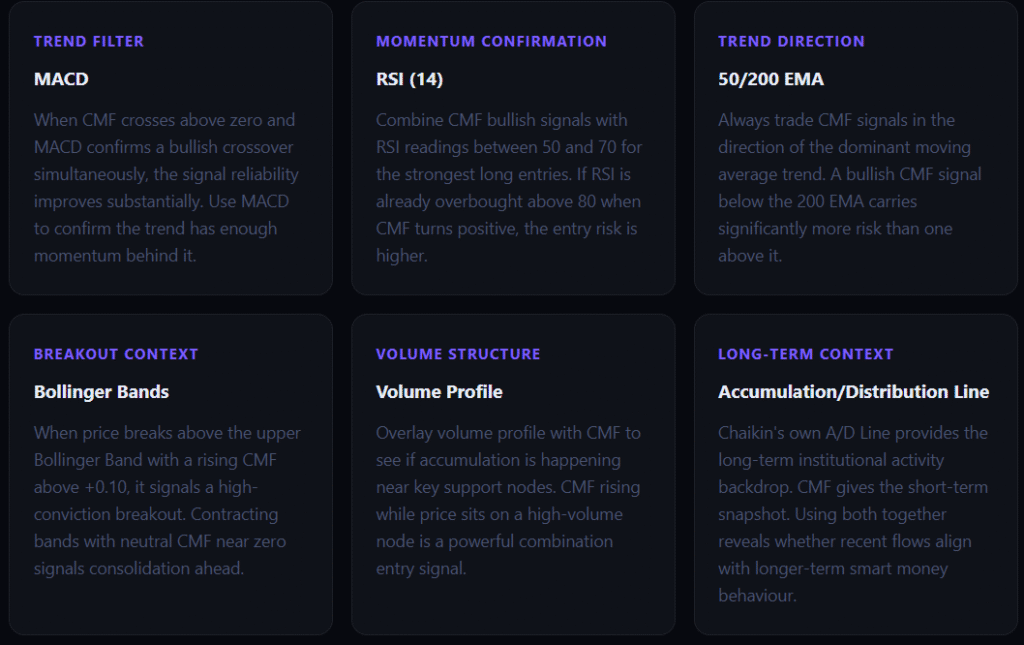
Handeln Sie niemals allein auf Basis des CMF. Verlangen Sie mindestens ein bestätigendes Signal vom RSI, MACD oder einem gleitenden Durchschnitt, bevor Sie eine Position eröffnen.
Die doppelte Bestätigung reduziert Fehlsignale erheblich, was auf Kryptomärkten, wo Volatilität kurzfristige Kursbewegungen hervorrufen kann, von entscheidender Bedeutung ist.
Treten Sie UEEx bei
Erleben Sie die weltweit führende digitale Vermögensverwaltungsplattform
Welche Indikatorkombinationen eignen sich am besten für Chaikin Money Flow?
CMF ist am wirkungsvollsten, wenn es als Bestätigungsinstrument innerhalb eines umfassenderen technischen Rahmens eingesetzt wird und nicht als eigenständiger Signalgenerator.
Fazit
Vergessen Sie alles, was Sie über Herdenverhalten gelernt haben. Wenn Sie weiterhin nur oberflächliche Kursbewegungen und Träumereien als Grundlage für Ihre Handelsentscheidungen nutzen wollen, dann ignorieren Sie ruhig weiterhin den Chaikin Money Flow.
Abeeb ist ein zielorientierter Content-Autor mit über 4 Jahren Erfahrung in der Erstellung überzeugender und aufschlussreicher Inhalte in verschiedenen Genres, darunter Technik, Nachrichten, Unterhaltung und Blockchain. Er ist bekannt für den Aufbau enger Beziehungen zu Kunden und Stakeholdern und legt Wert auf klare, prägnante und wirkungsvolle Texte, die das Publikum fesseln.
Haftungsausschluss : Dieser Artikel dient ausschließlich Informationszwecken und stellt keine Anlage- oder Handelsberatung dar. Die hierin enthaltenen Informationen sind nicht als Finanz-, Rechts- oder Steuerberatung zu verstehen. Der Handel mit Kryptowährungen birgt ein erhebliches Risiko finanzieller Verluste. Führen Sie stets eine sorgfältige Prüfung durch, bevor Sie Handels- oder Anlageentscheidungen treffen.
Handel mit Nachweis von Reserven
UEEx veröffentlicht monatliche Prüfberichte und Bestätigungen von Drittanbietern für jeden gelisteten Markt.
Wöchentlich erhalten Sie Marktanalysen, Handelsstrategien, Einblicke in den Futures-Markt und Sicherheitswarnungen. Gelesen von über 10,000 Krypto-Händlern.