A peer-to-peer (P2P) network is a distributed architecture where every connected device acts as both a client and a server, sharing resources directly with other devices without routing through a central authority. In blockchain, P2P networks are the reason Bitcoin transactions can be broadcast globally in seconds without any company in the middle. As of Q1 2026, over 22,000 reachable Bitcoin nodes span more than 181 countries, and cryptocurrency P2P transfers grew 23% year-over-year in 2026 – concrete evidence that decentralized networks have moved well beyond a theoretical idea.
What Exactly Is a Peer-to-Peer Network?
In a traditional client-server model, your laptop asks a company’s server for data, and the server responds. Every request flows through that central point. If the server goes offline, you get nothing. A P2P network eliminates that bottleneck: each participant (called a node or peer) stores data, processes requests from other peers, and forwards information onward. There is no single server to shut down, censor, or overload.
The key distinction is that nodes have gleichberechtigt. A Bitcoin full node in São Paulo has the same authority to validate transactions as one in Tokyo or Frankfurt. No node’s opinion outweighs another’s – consensus emerges from the collective.
How Did P2P Networks Develop Before Blockchain?
Jahr
Milestone
Welche Bedeutung hatte der Wiener Kongress?
1979
USENET – distributed discussion system
First large-scale P2P content distribution
1999
Napster launches
Popularized P2P file sharing; used central index (hybrid model)
Combined P2P networking with cryptographic consensus
2026
22,000+ Bitcoin nodes active; Algorand deploys go-libp2p on mainnet
P2P blockchain networks measured and upgraded at global scale
What Are the Three Main Types of P2P Network Architecture?
What Is a Structured P2P Network?
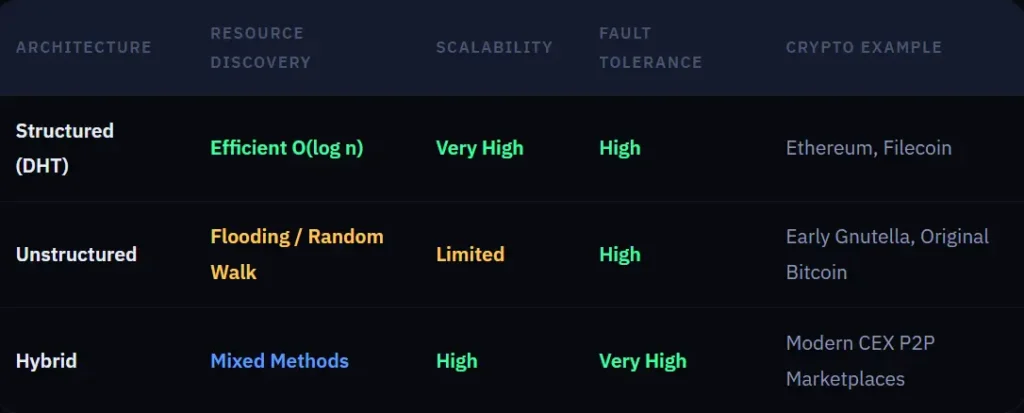
Nodes are organized according to a defined algorithm, typically using a Distributed Hash Table (DHT). Every piece of data has a deterministic location in the network, so finding a resource requires only a logarithmic number of hops – O(log n) for a network of n nodes. Examples include Chord, CAN, and Kademlia, which is used by BitTorrent’s DHT and Ethereum’s node discovery protocol.
Bestens geeignet für: Large networks where efficient lookup is more important than flexibility.
What Is an Unstructured P2P Network?
Nodes connect to peers at random and share resource lists without any predefined topology. Searches use flooding (ask all neighbors, who ask their neighbors) or random-walk algorithms. This is simple to implement but scales poorly – a popular search can generate exponential message traffic. Early Gnutella worked this way.
Bestens geeignet für: Small networks or scenarios where the data being shared is highly dynamic and hard to index in advance.
What Is a Hybrid P2P Network?
A middle ground that combines elected “super-peers” – nodes with better connectivity or more resources – that handle coordination, while regular peers handle actual data transfer. FastTrack (the protocol behind Kazaa) used this approach. Bitcoin leans hybrid in practice: certain nodes become de facto hubs due to their connectivity, even though the protocol treats all full nodes as equal.
Bitcoin’s P2P network has four primary jobs that together replace what a bank’s servers would do:
Transaction propagation.When you broadcast a transaction, your node sends it to 8–12 outbound peers. Each peer validates it and forwards it to their peers. Within seconds, the transaction has reached thousands of nodes globally through this gossip protocol. Node communication happens via TCP, optionally secured by TLS for encrypted transport.
Block propagation.When a miner finds a valid block, the same gossip mechanism distributes it. Compact block relay (BIP 152, activated 2016) lets nodes send only transaction IDs rather than full transactions, cutting relay time from seconds to milliseconds.
Consensus enforcement.Every full node independently validates every transaction and block against the protocol rules. If a miner produces an invalid block, every honest node rejects it – no central arbiter needed.
Chain storage.Full nodes maintain a complete copy of the blockchain (over 600 GB for Bitcoin as of 2026). This redundancy means the ledger cannot be deleted, altered, or seized by targeting any single location.
What Are the Real Advantages of P2P Networks Over Client-Server Models?
Vorteil
Client-Server
P2P-Netzwerk
Der Punkt des Versagens
Yes – server outage = service down
No – network functions with any subset of nodes
Zensurresistenz
Low – operator controls access
High – no operator to coerce
Skalierbarkeit
Requires expensive server upgrades
Capacity grows with each new peer
Infrastrukturkosten
Centralized – borne by operator
Distributed across all participants
Datenbeständigkeit
Depends on operator’s business continuity
Persists as long as any node remains online
Vertrauensanforderung
Must trust the operator
Trust derived from cryptography and consensus rules
What Are the Real Challenges and Security Risks in P2P Networks?
What Is a Sybil Attack?
An attacker creates a large number of fake identities (nodes) to gain disproportionate influence over the network. In Bitcoin, proof-of-work mining makes Sybil attacks on consensus economically prohibitive – you need 51% of the network’s hash rate, which cost hundreds of millions of dollars in hardware and electricity as of 2026. Sybil attacks at the network layer, where an attacker surrounds a target node with attacker-controlled peers (an eclipse attack), remain a studied concern.
What Is an Eclipse Attack?
A specific Sybil variant where an attacker monopolizes all of a target node’s peer connections, feeding it a false view of the blockchain. Bitcoin Core has added countermeasures including anchoring two connections to peers the node has previously established long-term relationships with. Maintaining geographically diverse peer connections across multiple ISPs reduces exposure further.
How Do BGP Hijacking and DDoS Threats Affect P2P Blockchains?
A well-resourced attacker who controls key internet routing infrastructure can partition a blockchain’s P2P network by intercepting traffic between geographic regions. Research has shown this is theoretically possible against Bitcoin. Practical defenses include operating nodes over Tor or I2P alongside clearnet connections, and peering with nodes in diverse jurisdictions and autonomous systems.
What Privacy Risks Exist in P2P Blockchain Networks?
When you broadcast a Bitcoin transaction from your full node, the first peers to receive it can infer it likely originated from you. Dandelion++ (proposed BIP 156) addresses this by first routing transactions through a random path before broadcasting widely, obscuring the origin node. For stronger privacy, routing your node traffic through Tor hides your IP address from all peers entirely.
How Is Artificial Intelligence Changing P2P Network Management?
AI integration in P2P systems has moved from research papers to deployed systems across three areas:
Resource optimization. Machine learning models analyze peer connectivity patterns and proactively route data through faster paths, reducing latency in large networks like IPFS und Filecoin.
Anomaly detection. ML classifiers running at the node level can identify unusual traffic patterns – spikes consistent with a DDoS, connections matching known malicious peer fingerprints, or routing behavior suggesting an eclipse attempt – and drop suspicious connections autonomously.
Federated learning. AI models can be trained collaboratively across P2P networks without any node sharing its raw data. Each node trains locally and shares only model weight updates. This approach is being explored for fraud detection in dezentrale Finanzierung (DeFi) Protokolle.
How to Strengthen Your Own P2P Node: Practical Steps
If you run a Bitcoin or Ethereum full node, these steps meaningfully improve both your security and the network’s health:
Use Bitcoin Core’s anchor connections.Enable the default anchor peer feature so your node maintains two long-standing connections that resist eclipse attempts on restart.
Route over Tor.Bitcoin Core supports native Tor integration. Running your node as a Tor hidden service hides your IP from all peers and allows you to accept inbound connections from other Tor nodes.
Set your node to accept inbound connections.Open port 8333 (Bitcoin) or 30303 (Ethereum) in your router. Nodes that only make outbound connections are less useful to the network and more vulnerable to peer manipulation.
Keep your client software updated.Each major Bitcoin Core release includes peer connection improvements, DoS protection upgrades, and often new privacy features like Dandelion++ support.
Diversify your peer geography.Use theaddnodeRPC command to manually add peers in different countries and ISPs, reducing your reliance on any single network path.
Monitor your peer list.Usegetpeerinfoin Bitcoin Core to review which nodes you are connected to. Unexpected clustering around a single IP range or ASN can indicate an eclipse in progress.
Treten Sie UEEx bei
Erleben Sie die weltweit führende digitale Vermögensverwaltungsplattform
Frequently Asked Questions About Peer-to-Peer Networks
What is the difference between a P2P network and a blockchain?
A P2P network is the communication layer – the system of rules for how nodes find each other and exchange data. A blockchain is the data structure – a chain of cryptographically linked blocks of transaction records. Blockchain runs oben auf a P2P network the same way a website runs on top of the internet. You need the P2P layer to distribute and synchronize the blockchain, but the two concepts are distinct. Bitcoin uses both: its P2P network (the gossip protocol) carries the blockchain (the ledger).
Why can’t governments simply shut down Bitcoin by targeting its P2P network?
The network spans 181+ countries with 22,000+ reachable nodes as of Q1 2026 – and those are only the publicly visible ones. Nodes can also communicate over Tor, I2P, and satellite links. Shutting down all of them simultaneously would require coordinated action from virtually every government on earth and would still likely fail, because new nodes can be brought online faster than they can be removed. China’s 2021 mining ban reduced hash rate temporarily but did not disable the P2P network at all.
What is the difference between a full node and a light node in a P2P blockchain network?
A full node downloads and independently verifies every block and transaction since the genesis block, stores the complete chain, and enforces all protocol rules. A light node (SPV client) downloads only block headers – roughly 80 bytes per block versus the full block – and uses Merkle proofs to verify that specific transactions are included. Light nodes trust the longest chain of proof-of-work rather than independently validating every rule; they are faster and cheaper to run but provide weaker security guarantees.
How does BitTorrent’s P2P model differ from Bitcoin’s?
BitTorrent uses P2P purely for data distribution efficiency – the goal is to get file pieces from as many simultaneous sources as possible to maximize download speed. There is no consensus mechanism and no shared state; two BitTorrent nodes do not need to agree on anything. Bitcoin nodes must agree on a single shared transaction history, so Bitcoin adds a consensus layer (proof-of-work) and a cryptographic integrity layer (Merkle trees, digital signatures) on top of the same basic P2P communication model both protocols share.
Can P2P networks be completely private?
Base-layer P2P networks like Bitcoin’s are pseudonymous but not private – IP addresses of nodes are visible to their peers, and transaction graph analysis can often link addresses to identities over time. Privacy can be added in layers: Tor or I2P hides the IP address of a broadcasting node; CoinJoin mixes transaction inputs to obscure ownership; Dandelion++ obfuscates which node originated a transaction. Blockchains designed with privacy as a primary goal, such as Monero and Zcash, build these protections into the protocol itself rather than relying on optional user behavior.
What makes a P2P network more or less decentralized in practice?
Theoretical decentralization (all nodes are equal) often diverges from practical decentralization. Key factors include: geographic distribution of nodes (concentration in a few countries or datacenters creates chokepoints), client diversity (if 90% of nodes run the same software, a critical bug affects them all simultaneously), infrastructure dependence (many nodes hosted on the same cloud provider means that provider has implicit leverage), and economic centralization of mining or staking (a few large pools can coordinate to influence block production). True decentralization requires diversity across all these dimensions at once.
Ayodeji Akingbade ist ein erfahrener Content-Autor, der seit Jahren komplexe Finanzthemen, Kryptowährungen und Investitionen verständlich erklärt. Seine Leidenschaft gilt der Schnittstelle zwischen Geld und Technologie und der Frage, wie Einzelpersonen ihre Ziele durch den strategischen Einsatz verfügbarer Ressourcen erreichen können.
Ayodeji ist bestrebt, informative und ansprechende Inhalte zu erstellen. Ob Kryptowährungs-Handelsstrategien oder Tipps für Immobilieninvestitionen – seine Texte vermitteln dem Leser das Gefühl, seine Zeit gut investiert zu haben. Wenn er nicht gerade schreibt, entwickelt Ayodeji gerne Verkaufsgespräche für Immobilienkunden oder feuert seine Lieblingsfußballmannschaft an.
Haftungsausschluss : Dieser Artikel dient ausschließlich Informationszwecken und stellt keine Anlage- oder Handelsberatung dar. Die hierin enthaltenen Informationen sind nicht als Finanz-, Rechts- oder Steuerberatung zu verstehen. Der Handel mit Kryptowährungen birgt ein erhebliches Risiko finanzieller Verluste. Führen Sie stets eine sorgfältige Prüfung durch, bevor Sie Handels- oder Anlageentscheidungen treffen.
Handel mit Nachweis von Reserven
UEEx veröffentlicht monatliche Prüfberichte und Bestätigungen von Drittanbietern für jeden gelisteten Markt.
Wöchentlich erhalten Sie Marktanalysen, Handelsstrategien, Einblicke in den Futures-Markt und Sicherheitswarnungen. Gelesen von über 10,000 Krypto-Händlern.