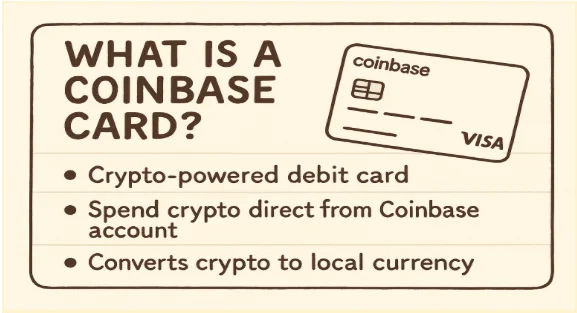
The Coinbase Card is a Visa debit card that converts any supported cryptocurrency in your Coinbase account to fiat at the point of sale, letting you spend crypto at any Visa-accepting merchant worldwide without preloading a separate wallet. It carries no annual fee for U.S. users, no foreign transaction fee on the standard Visa product, and rewards U.S. cardholders with up to 4% back in select cryptocurrencies on every eligible purchase. As of Q1 2026, Coinbase also offers the Coinbase One Card – an American Express-backed product for Coinbase One subscribers that earns up to 4% back specifically in Bitcoin.
How Does the Coinbase Card Work?
Most crypto debit cards require you to preload a separate wallet with stablecoins or fiat before spending. The Coinbase Card skips that step. When you tap or swipe, Coinbase identifies your active spending asset, converts it to local currency at the live market rate, and settles the transaction – all within the standard Visa authorization window. No manual transfer needed beforehand.
The card links directly to your Coinbase account balance. You can switch the spending asset at any time through the Coinbase app: paying a restaurant bill in Ethereum today and a grocery run in USDC tomorrow requires no extra setup beyond a few taps. The standard Visa debit card is issued in partnership with a regulated banking partner. The newer Coinbase One Card is issued through American Express and targets Coinbase One subscribers at USD 49.99 per year.
What Are the Fees on the Coinbase Card?
Fee transparency is one area where Coinbase has improved over earlier versions of the product, though the most significant charge remains easy to overlook.
Tipo di commissione
Coinbase Card (Visa Debit)
Note
Annual/monthly fee
$0 (US) / £4.95 or €4.95 issuance fee (UK/EU)
One-time physical card issuance fee outside the U.S.
Crypto-to-fiat liquidation
2.49%
Applies every time you spend crypto (not USDC)
Transaction commission
0.20%
Small flat fee on each purchase
Total domestic crypto spend cost
2.69%
Liquidation + commission combined
International purchase fee (EU/UK)
3% (on top of liquidation)
U.S. cardholders pay no FX fee
ATM withdrawal (Coinbase fee)
$0
ATM operator fees still apply separately
Sostituzione della carta
$0 standard shipping
Expedited replacement may carry a fee
The 2.49% liquidation fee is the card’s most consequential ongoing cost. It applies every time a crypto balance triggers conversion – which means every transaction unless you are spending from USDC or a fiat balance. A user spending USD 2,000 per month through crypto pays approximately USD 49.80 per month in liquidation fees alone, before any rewards offset is applied. Spending from a USDC balance eliminates this charge because no meaningful price conversion occurs.
Unisciti a UEEx
Scopri la piattaforma di gestione patrimoniale digitale leader al mondo
What Rewards Does the Coinbase Card Offer in 2026?
As of Q1 2026, rewards for U.S. users work as follows:
Chosen Reward Asset
Tasso di rimborso
Disponibilità
BTC, ETH, DOGE, DAI
1%
Solo utenti statunitensi
GRT, XLM, AMP, RLY (rotating selection)
4%
U.S. users only – asset list changes monthly
UK / EU cardholders
0%
No rewards program outside U.S.
The 4% rate on select altcoins looks strong in headline terms. The practical question is whether you want to accumulate GRT or RLY rather than BTC or ETH. Many U.S. users choose the 1% BTC or ETH rate because those assets align with their long-term holdings. The higher rate on smaller tokens is effectively a liquidity incentive – Coinbase benefits from increased trading activity in those assets. Check the current qualifying asset list in the app each month, as it rotates and may not match what was available when you first signed up.
The Coinbase One Card changes the calculus for heavier spenders. Coinbase One subscribers earn up to 4% back in Bitcoin specifically, tiered by total assets held on Coinbase. The 2% base rate requires only an active membership with no minimum asset threshold. Rates step up to 2.5%, 3%, and 4% at progressively higher asset tiers, capped at USD 10,000 in eligible purchases per calendar month (after which the rate reverts to 2%). Bitcoin rewards from this card are excluded from Coinbase’s 1099 tax reporting – a notable benefit for U.S. users managing crypto tax complexity.
Geographic availability is one of the card’s persistent limitations. As of 2026, it is supported in:
United States: All states except Hawaii
Europe: Austria, Belgium, Bulgaria, Croatia, Cyprus, Czech Republic, Denmark, Estonia, Finland, France, Germany, Greece, Hungary, Iceland, Ireland, Italy, Latvia, Liechtenstein, Lithuania, Luxembourg, Malta, Netherlands, Norway, Poland, Portugal, Romania, Slovakia, Slovenia, Spain, Sweden, and the United Kingdom
Hawaii’s exclusion is a longstanding issue tied to that state’s money transmission licensing requirements. Canada, Australia, most of Asia, and Latin America remain unsupported, making the card a non-option for a large share of the global crypto user base. European cardholders face a further disadvantage: no rewards program and a 3% international purchase fee make the card significantly less valuable compared to the U.S. version. European users would generally find better value from a Revolut or Wise card for everyday international spending.
What Are the Daily Spending and ATM Limits?
The default limits on the Coinbase Card are:
Daily purchase limit: USD 2,500
Daily ATM withdrawal limit: USD 1,000
These suit casual to moderate everyday spending. Freelancers or active traders using the card as a primary payment tool may find the daily purchase cap restrictive during higher-spend months. Coinbase’s support documentation notes limits can be reviewed by contacting the support team, though increases are not guaranteed.
How Does the Coinbase Card Compare to Competing Crypto Cards?
Carta
Rimborso massimo
Tassa annuale
È richiesto lo staking.
Svantaggio principale
Carta Coinbase (Visa)
4% (select altcoins) / 1% BTC
$0
Nona
2.49% liquidation fee on every crypto spend
Coinbase One Card (Amex)
4% BTC
$0 (requires $49.99/yr membership)
Nona
Subscription cost; Amex not accepted everywhere
Visto Crypto.com
Up to 5% (post-2024 cuts)
$0
Yes – up to ~$400,000+ CRO for top tier
Best rates require large CRO stake; benefit cuts ongoing
Carta Binance
Fino all'8% in BNB
$0
None formally, but BNB balance preferred
Regulatory uncertainty in several major markets
Carta Nexo
Up to 2% in BTC or NEXO
$0
Optional (higher NEXO tier = better rate)
Lower cashback ceiling than competitors
Carta UPay
Varia in base al livello
$20
Nona
Small annual fee; newer product
Scheda BitPay
Nona
$0
Nona
No rewards program at all
Crypto.com cut several headline perks in 2024 – Amazon Prime, Expedia, Airbnb, and X Premium rebates were removed across multiple tiers. The advertised cashback rate has also been adjusted downward from the 8% figure that featured prominently in earlier marketing. As of 2026, the Ruby tier (entry-level, no staking) offers 1% with a monthly cap; higher tiers still require significant CRO staking to unlock meaningful rates. The Coinbase Card’s no-staking structure makes it more accessible for users who do not want to lock up capital, at the cost of a lower ceiling.
Is the Coinbase Card Worth Using for International Travel?
For U.S. users traveling internationally, the card handles the basics well. No foreign transaction fee applies on the U.S. Visa debit card; it is accepted anywhere Visa is honored (130+ countries), and Coinbase charges no ATM fee – though local operators typically charge USD 2–5 per withdrawal.
Every crypto-to-fiat conversion on the card is a taxable event in the United States. Spending Bitcoin that has appreciated since purchase realizes a capital gain on that transaction. A week of international travel can generate 20–30 small taxable events. Tools like CoinTracker integrate with Coinbase automatically to track these, but the tax obligation itself does not disappear – it accumulates until settled.
Unisciti a UEEx
Scopri la piattaforma di gestione patrimoniale digitale leader al mondo
What Security Features Does the Coinbase Card Include?
Security controls are genuinely useful here. Through the Coinbase app, cardholders can:
Freeze and unfreeze the card instantly without calling customer service
Receive real-time push notifications for every transaction
Generate a virtual card number for online purchases (separate from the physical card)
Require two-factor authentication on the linked Coinbase account
Instant freeze is increasingly standard across neobanks and crypto cards, but it remains a meaningful feature when a physical card is lost or stolen abroad. The virtual card number is particularly worth enabling for e-commerce – it limits exposure if an online merchant suffers a data breach, since the virtual number is distinct from the physical card’s number.
Frequently Asked Questions About the Coinbase Card
Does the Coinbase Card have any annual or monthly fee?
The standard Coinbase Visa debit card charges no annual or monthly fee for U.S. users. European and UK applicants pay a one-time issuance fee of £4.95 or €4.95 for the physical card. The Coinbase One Card carries no separate card fee but requires a USD 49.99 per year Coinbase One subscription, which also unlocks zero-fee trading, premium support, and enhanced staking rates beyond the card rewards.
What is the actual cashback rate, and does the 2.49% fee wipe it out?
For U.S. users spending crypto, the liquidation fee of 2.49% combined with the 0.20% transaction commission totals 2.69% per transaction. Against a 1% BTC reward, that math produces a net cost of roughly 1.69% per crypto purchase. Against the 4% altcoin rate, you come out slightly ahead at about 1.31% net gain – but only on the specific rotating tokens qualifying for that rate. Spending USDC eliminates the liquidation fee and makes the 1% reward a genuine net benefit.
Is every crypto card purchase a taxable event in the U.S.?
Yes. In the United States, each crypto-to-fiat conversion triggered by a card purchase is treated as a taxable disposal. If the crypto you spend has appreciated since acquisition, you owe capital gains tax on the difference. Spending from USDC limits this exposure since stablecoins rarely have significant appreciation. Bitcoin rewards from the Coinbase One Card are currently excluded from Coinbase’s 1099 reporting, though consult a tax professional on whether they qualify as reportable income in your situation.
Which cryptocurrencies can I use as the spending source?
Any cryptocurrency held in your main Coinbase account that Coinbase supports for conversion is eligible. This includes Bitcoin, Ethereum, Solana, Litecoin, USDC, DOGE, and dozens of others. You set the active spending asset in the app and can change it at any time. Assets held in Coinbase Vault with a time-lock, staked assets in active validators, or assets in Coinbase’s advanced trading account cannot be used directly for card spending without first transferring to the main balance.
How does Coinbase compare to Crypto.com for card rewards?
Crypto.com’s highest advertised rates now sit around 5% following 2024 benefit reductions, but unlocking rates above the entry-level 1% requires staking substantial amounts of CRO tokens – the top tiers have historically required USD 50,000 or more in staked value. The Coinbase Card offers 1–4% with zero staking requirement. For users unwilling to lock up capital in a platform token, Coinbase’s structure is more accessible. For those with significant CRO positions already, Crypto.com’s mid-tier cards may offer better net rewards despite the staking barrier.
Can I use the card in countries where my Coinbase account was not originally registered?
Yes – the card functions wherever Visa is accepted as long as your Coinbase account was opened in an eligible country. The card operates as a payment instrument independent of local Coinbase exchange availability. Managing your spending asset and account settings before traveling is advisable, particularly if you expect to be in a region with unreliable app connectivity. Ensure your account verification is fully up to date before departure to avoid any access issues mid-trip.
Practical Tips for Getting the Most from the Coinbase Card
Spend USDC for everyday purchases to eliminate the liquidation fee. Route routine transactions through a USDC balance and reserve your BTC and ETH. The 1% reward on USDC spending is a net gain rather than a partial offset against a conversion charge.
Track every crypto spend transaction for tax purposes. Connect CoinTracker or Koinly to your Coinbase account immediately. Waiting until tax season to reconcile dozens of small conversions creates significant work – and potential errors that could attract scrutiny. Setting up automated sync takes about 10 minutes and runs in the background from that point forward.
Run the math on Coinbase One before signing up. At the 2% base BTC rewards rate on the One Card, you break even on the USD 49.99 annual membership fee at approximately USD 2,500 in card spending per year. Above that level, the membership pays for itself in incremental Bitcoin rewards, plus you get zero-fee trading on up to USD 10,000 in monthly volume – which, for active traders, is the more significant benefit.
Use the virtual card number for all online purchases. Generate a virtual card number in the app for any e-commerce transaction. This keeps your physical card number out of merchant databases and limits exposure from data breaches. It takes seconds to generate and costs nothing.
Check the 4% rewards asset list each month. Coinbase rotates which token qualify for the 4% rate. The selection when you sign up may differ from what qualifies six months later. Review the current list in the app at the start of each month and confirm your chosen reward asset still earns at the rate you expect – do not assume continuity without checking.
Disclaimer : Questo articolo ha scopo puramente informativo e non deve essere considerato un consiglio di trading o di investimento. Nulla di quanto contenuto nel presente documento deve essere interpretato come consulenza finanziaria, legale o fiscale. Il trading o l'investimento in criptovalute comporta un considerevole rischio di perdita finanziaria. Effettuate sempre le dovute verifiche prima di prendere qualsiasi decisione di trading o di investimento.
Scambi commerciali con prova delle riserve
UEEx pubblica audit mensili e verifiche di terze parti su ogni mercato quotato.
Analisi di mercato, strategie di trading, approfondimenti sui future e avvisi di sicurezza, consegnati settimanalmente. Letto da oltre 10,000 trader di criptovalute.
Niente spam. Puoi disiscriverti in qualsiasi momento.