LayerZero has unveiled Zero, a new blockchain architecture designed to reach up to 2 million transactions per second (TPS) per zone, marking one of the most ambitious throughput targets announced in the industry to date.
Unlike traditional blockchains that rely on full replication of execution across every validator, Zero proposes a structural shift: execution and verification are separated through zero-knowledge (ZK) proofs, and validators are split into distinct roles. The result, according to the announcement, is what the team describes as the first “multi-core world computer.”
Key Takeaways
- Zero targets up to 2 million transactions per second per zone, vastly surpassing current blockchain throughput.
- Execution and verification are separated using zero-knowledge proofs, allowing validators to operate efficiently on low-grade hardware.
- Four core bottlenecks—storage, compute, ZK proving, and networking—are addressed with QMDB, FAFO, Jolt Pro, and SVID.
- The architecture runs multiple Atomicity Zones in parallel, creating a multi-core, horizontally scalable blockchain environment.
- Ethereum-compatible smart contracts can be deployed directly, enabling global permissionless markets and high-volume payment systems.
A Break From the Single-Threaded Model
Most major blockchains today, including Ethereum, operate as single-threaded systems. Even when scaling solutions are introduced, they often fragment liquidity and state across Layer 2 networks or sovereign chains.
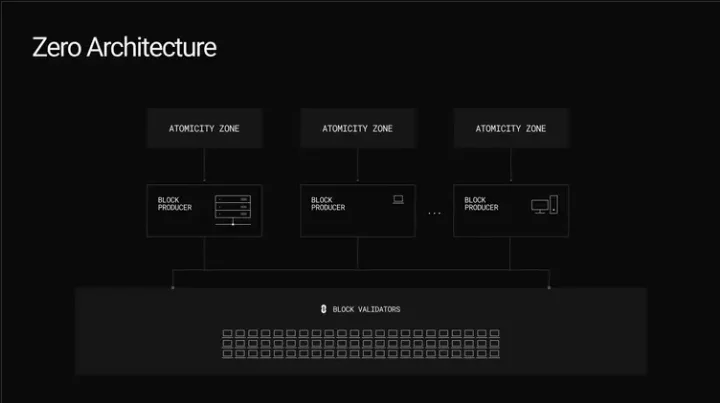
Zero takes a different route. It introduces what it calls Atomicity Zones, which function like parallel processes running on multiple cores of a CPU. These zones are not independent chains or rollups. They are governed under one unified protocol and owned by the same base network.
This horizontal scaling design enables concurrent execution across zones rather than forcing the entire system through a single execution pipeline. The ambition is clear: one blockchain, many parallel execution environments, unified state guarantees.
Targeting 2 Million TPS Per Zone
Zero’s roadmap sets an explicit goal of 2 million TPS per zone, positioning it well beyond the throughput figures typically cited by high-performance chains today. For context, most current Layer 1 blockchains operate in the hundreds to low thousands of TPS under real-world conditions.
The network also claims transaction costs could fall to fractions of a cent—described as roughly 1/10,000th of a penny per transaction to the network—dramatically reducing the need for conventional gas pricing models.
If realized, this level of performance would allow blockchain infrastructure to compete with modern web-scale applications in payments, tokenized assets, and high-frequency financial activity.
Solving the Four Bottlenecks
Zero’s architecture addresses four key constraints that traditionally limit blockchain performance: storage, compute, proving, and networking.
Storage: QMDB
State growth and write speed remain persistent issues for blockchains. Zero introduces QMDB, a new verifiable database system built to dramatically increase write throughput while preserving cryptographic guarantees. The team claims a 100x improvement over current state-of-the-art verifiable storage systems.
Compute: FAFO Scheduling
Parallelization requires careful orchestration. Zero introduces a compute scheduler known as FAFO, designed to manage concurrent execution efficiently across multiple cores without sacrificing atomicity or determinism.
ZK Proving: Jolt Pro
The network relies on real-time zero-knowledge proofs through a system referred to as Jolt Pro. By separating execution from verification, Zero reduces the need for every validator to redundantly execute every transaction. Instead, validators can verify succinct proofs.
This decoupling is central to the design. It allows the network to move away from full replication while maintaining cryptographic assurance.
Networking: SVID
High throughput requires high-bandwidth data availability. Zero introduces SVID, which separates data availability from validation duties. This ensures individual nodes are not overwhelmed even when throughput scales into the millions of transactions per second.
Together, these components form what the team describes as three 100x improvements in storage, compute, and networking — alongside a 100x end-to-end improvement in zero-knowledge proving.
A Heterogeneous Validator Model
Another major departure from traditional design is the validator structure.
Zero separates the network into two classes:
- Block Producers, which can run on higher-performance hardware.
- Block Validators, which can operate on low-grade consumer devices.
This heterogeneous approach aims to maintain decentralization without requiring every participant to run enterprise-level infrastructure. The network claims validation can run on minimal hardware, reducing the cost barrier to participation.
By contrast, many high-throughput chains have faced criticism for concentrating validation among well-funded operators due to hardware demands.
Ethereum Compatibility and Use Cases
Zero maintains compatibility with Ethereum’s smart contract environment. Developers can deploy Solidity contracts directly, positioning the network as a general-purpose computing platform rather than a niche performance chain.
The architecture is intended to support:
- Stablecoins and tokenized assets
- Global, permissionless markets
- High-volume payment systems
- Large-scale financial applications
Because zones are managed under a unified protocol rather than isolated chains, developers do not need to create or manage their own execution environments.
Competing With Cloud Infrastructure
One of the boldest claims in the announcement is that Zero could compete directly with centralized cloud providers. By removing redundant replication while retaining cryptographic verification, the team argues that decentralized infrastructure can finally achieve cloud-level performance and cost efficiency.
The key economic argument is simple: when every node no longer has to execute every transaction, resource usage drops significantly. That cost reduction, if achieved in practice, would change the economics of decentralized systems.
A High-Stakes Bet on Architecture
The blockchain industry has spent years searching for a viable path to mass adoption without sacrificing decentralization. Zero proposes that the answer is architectural rather than incremental—moving from single-threaded replication to a multi-core, proof-verified system.
The 2 million TPS target per zone sets a high bar. Achieving it in production conditions will determine whether Zero becomes a breakthrough or remains an ambitious blueprint.
For now, LayerZero’s announcement signals a shift in how scaling is being approached: not as a patchwork of rollups and sidechains, but as a unified, parallelized base layer designed to operate at internet scale.