
Ethereum exchange-traded funds (ETFs) are facing sustained selling pressure, marking a notable shift in institutional sentiment toward the second-largest cryptocurrency. After months of mixed flows, the latest data shows a persistent streak of capital exits, raising concerns about liquidity conditions and near-term price direction.
According to SoSoValue data, spot Ethereum ETFs recorded another day of net outflows on March 26, extending the current streak to eight consecutive sessions. The withdrawals reflect a broader risk-off environment driven by macroeconomic uncertainty and geopolitical tensions.
While not all funds moved in the same direction, the overall trend remains decisively negative. BlackRock’s ETHA product has been at the center of the outflows, even as its newer staking-focused counterpart, ETHB, has attracted fresh capital.
Key Takeaways
- Spot Ethereum ETFs have recorded eight consecutive days of net outflows, signaling sustained institutional selling pressure.
- BlackRock’s ETHA fund is driving most of the outflows, while its staking-focused ETHB product is attracting partial inflows.
- Broader macroeconomic uncertainty and geopolitical tensions are pushing investors away from risk assets like Ethereum.
- Continuous ETF redemptions are adding direct selling pressure on ETH, impacting price and overall market liquidity.
- Despite the outflows, declining exchange balances and analyst sentiment suggest underlying accumulation may be underway.
A Prolonged Shift in Institutional Positioning
The current streak stands out not just for its duration but for its consistency. Unlike earlier volatility driven by one-off redemptions, particularly from legacy products, this phase reflects a broader repositioning across institutional investors.
This marks a reversal from the previous trend, where ETFs experienced a six-day inflow run totaling over $386 million. Since then, sentiment has clearly shifted, with approximately $391.65 million exiting Ethereum ETFs over the past week alone.
On a monthly scale, the trend is even more pronounced. Ethereum ETFs are now on track to log their fifth consecutive month of net outflows, with nearly $2.85 billion withdrawn since November. This sustained drawdown suggests that the current movement is more than short-term profit-taking.
Rotation, Not Just Exit
Despite the headline outflows, some of the capital is not leaving the Ethereum ecosystem entirely. Instead, there are signs of internal rotation—particularly toward products offering additional yield.
This shift highlights a growing preference for yield-generating crypto exposure, especially in an environment where traditional interest rates remain elevated. ETHB’s structure allows investors to capture staking rewards, making it more attractive compared to passive spot exposure.
Still, these inflows have not been sufficient to offset the broader selling pressure.
Macro Pressures Driving the Sell-Off
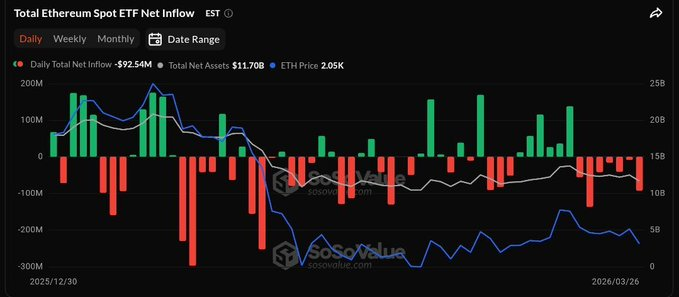
Alt text: Data showing Total Ethereum Spot ETF New Inflow
The ETF outflows are closely tied to developments beyond the crypto market. Rising geopolitical tensions, particularly between the United States and Iran, have contributed to a flight toward safer assets.
Investors are increasingly reallocating capital into gold and other traditional hedges as oil prices remain elevated, fueling inflation concerns. At the same time, expectations of interest rate cuts by the Federal Reserve have weakened, reinforcing a more cautious market stance.
Such conditions tend to disproportionately affect assets like Ethereum, which are often viewed as higher-risk compared to Bitcoin or traditional investments.
Price Impact and Liquidity Concerns
The direct relationship between ETF flows and price action is becoming more evident. As capital exits these funds, the underlying Ethereum holdings must be sold to meet redemptions, adding continuous pressure on the market.
Ethereum’s price has already reflected this dynamic. The asset has dropped more than 45% from its year-to-date high, falling to around $1,815 in late February before recovering slightly above $2,000.
The impact extends beyond price declines. Reduced liquidity can lead to wider bid-ask spreads and increased volatility, making trading conditions more challenging for both institutional and retail participants.
Institutional Footprint Still Matters
Despite the recent outflows, Ethereum ETFs still hold significant assets under management—currently around $12.33 billion. This large capital base means that even moderate daily outflows can have an outsized impact on market dynamics.
One key metric to watch is the cumulative inflow position of major funds like ETHA.
If this foundational capital begins to erode meaningfully, it could signal a deeper reassessment of Ethereum’s role in institutional portfolios.
Signs of Accumulation Beneath the Surface
Interestingly, not all indicators point to weakness. On-chain data suggests that Ethereum balances on exchanges have dropped to historic lows, typically a sign of accumulation.
This divergence—ETF outflows alongside declining exchange reserves—indicates that while institutional players may be reducing exposure, other market participants could be stepping in.
Market analysts have also begun to identify potential bottoming signals.
Tom Lee of Fundstrat has suggested that Ethereum may be nearing a cyclical low, aligning with ongoing accumulation strategies by large entities aiming to increase their share of the circulating supply.
What Comes Next
The current outflow streak has become the dominant narrative for Ethereum’s short-term outlook. Whether this trend continues will likely depend on macroeconomic developments, particularly Federal Reserve policy and geopolitical stability.
For now, ETF flows remain a critical barometer of institutional sentiment. If the outflows persist, they could continue to weigh on price and liquidity. Conversely, a reversal back to sustained inflows would signal renewed confidence and potentially mark the beginning of a recovery phase.
Until then, the market appears firmly in a cautious stance, with Ethereum caught between institutional selling pressure and emerging signs of long-term accumulation.