Polygon’s transaction activity in 2025 is forcing a rethink of how blockchain adoption is measured. This is no longer a debate about theoretical throughput or benchmark-driven TPS claims. The numbers now point clearly to sustained, real-world usage happening quietly in the background.
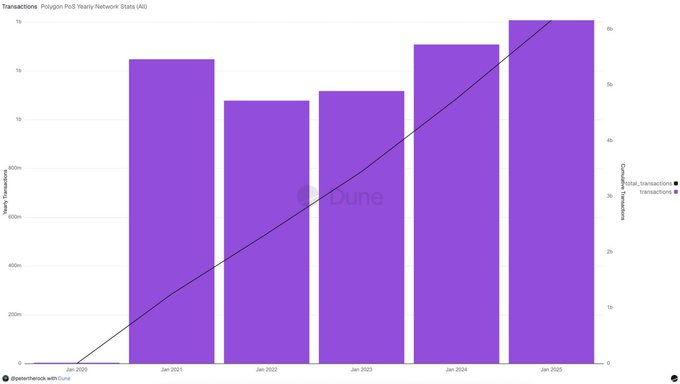
The network has crossed a major milestone this year, processing more than 1.4 billion transactions in 2025 alone, marking its strongest annual performance to date. More importantly, this surge pushes Polygon’s lifetime transaction count beyond 4.2 billion as of March 2025, underscoring years of compounding growth rather than a short-lived spike.
A Shift From Capacity to Consumption
For much of crypto’s history, scaling discussions focused on what networks could handle under ideal conditions. Polygon’s recent performance flips that narrative. The transaction volume recorded this year reflects consistent demand from applications already in use, not stress tests or isolated campaigns.
In the first half of 2025, Polygon processed 12.3 billion transactions, a figure that places it well ahead of Ethereum’s transaction volume over the same period. This comparison is notable not because it signals competition at the base layer, but because it highlights how Layer-2 and scaling-focused ecosystems are becoming the primary execution environments for users.
Behind these numbers are everyday actions: NFT mints that cost cents instead of dollars, gaming interactions executed in seconds, DeFi strategies running continuously, and enterprise integrations that require predictable fees. Many of these interactions never feel “crypto-native” to the end user, and that may be the clearest signal of maturity.
Invisible Adoption Is Still Adoption
One of the more striking implications of Polygon’s growth is how little attention it attracts outside technical circles. Users interact with games, marketplaces, loyalty programs, and payment rails without needing to know which chain is settling the transaction. Polygon’s infrastructure increasingly serves as a backend rather than a headline feature.
This raises a question that now matters more than raw transaction counts: how many users are already relying on Polygon without realizing it? As blockchain technology fades into the background, networks that prioritize low friction, stable performance, and predictable costs stand to gain the most.
Polygon’s ability to sustain high volumes without major congestion or fee shocks strengthens its position as a default choice for developers who care more about user retention than protocol branding.
What This Means Going Forward
Processing over a billion transactions in a single year is not a marketing milestone; it is an operational one. It suggests that Polygon has crossed into a phase where its success is increasingly tied to application demand rather than ecosystem incentives.
If this trajectory holds, future growth may not come from louder announcements or speculative narratives, but from continued integration into products that users already trust. The more invisible the infrastructure becomes, the harder it is to displace.
Polygon’s 2025 transaction record sends a clear message: adoption at scale is no longer theoretical. It is happening quietly, transaction by transaction, often without the user ever needing to ask which blockchain made it possible.