What if we told you that Web3 isn’t just about crypto or NFTs but about ownership, transparency, and user control baked directly into the internet’s design?
That’s exactly what it offers, a way to fix the problems we’ve accepted for years: centralized control of data, zero privacy, and platforms that profit while users stay locked out of value creation.
Now think about this: instead of relying on internet platforms to manage your identity, assets, or data, what if you manage them directly?
Web3 technology is about rethinking how we use the internet, from finance to social apps, without needing to trust gatekeepers.
This post breaks it down simply. What Web3 is, how it works, and why it actually matters.
Key Takeaways
- Web3 technology utilizes decentralization, blockchain, and smart contracts to empower users with greater control over their data, identity, and digital assets.
- Compared to Web2, Web3 offers improved data privacy, transparent automation, and community-driven governance.
- Real-world applications like DeFi, DAOs, NFTs, and decentralized social platforms are already demonstrating Web3’s practical value.
- Core technologies powering Web3 include blockchain infrastructure, IPFS, tokenization, and semantic web standards like RDF and OWL.
- Despite scalability, regulation, and user experience challenges, Web3 continues to attract innovation across finance, media, and digital identity systems.
What is Web3 Technology?

Web3 refers to the next generation of the internet, characterized by decentralization, user ownership, and blockchain-powered technology.
Unlike Web2, where platforms like Google, Facebook, or Amazon control your data and digital identity, Web3 shifts that control back to users. It’s built on decentralized protocols that let you own your assets, your identity, and your content, all without relying on a central authority.
In Web3, applications (often called dApps) run on smart contracts, and transactions are secured through distributed networks like Ethereum, Solana, or Polkadot. This means more transparency, stronger privacy, and fewer intermediaries.
Whether it’s decentralized finance (DeFi), NFTs, DAOs, or token-based economies, Web3 opens the door to a more open, trustless, and inclusive digital future.
How Does Web3 Work?
Imagine using the internet, but instead of big companies like Google, Facebook, or Amazon controlling everything, you have the power. That’s the basic idea behind Web3—the third generation of the internet.
Let’s break it down.
The Problem With Today’s Internet
In today’s internet—often called Web2—most of what we do online is controlled by a handful of big companies. These platforms offer you free services, but in return, they collect and own your data—your name, photos, email, contacts, interests, purchases, and even what you click.
Take Facebook (now Meta), for example. You can spend years posting content, growing your audience, and building your digital identity on their platform.
But one day, for reasons you might not fully understand—a flagged post, a misunderstood comment, or even a bug—your account gets deleted. Just like that, you lose everything. There’s no appeal process you can trust. You don’t own your data. They do.
Not only that, these companies can sell your information to advertisers, train AI models using your posts, and manipulate what you see online using algorithms—all without your direct permission. You don’t get a cut, a say, or control.
Another example: using a banking app. You share your personal data with a financial institution, trusting them to keep it safe. But if the system is hacked or the bank decides to freeze your account, you have little control. Your identity and funds are tied to a centralized authority.
These companies own your data, and they can decide how it’s used, shared, or even sold. You don’t have much control.
Web3 Fixes That With Decentralization
Web3 takes a different approach. Instead of your data being stored on a private server owned by a single company, it’s distributed across thousands of computers worldwide using a technology called blockchain.
Think of blockchain like a public ledger or notebook—it keeps records of digital activity, but once something is written, it can’t be secretly changed or erased. Everything is transparent and secure.
But here’s the part people often get confused about: “If my data is written on a public blockchain, doesn’t that mean everyone can see it?”
Not exactly.
In Web3, your data is encrypted, which means it’s turned into unreadable code unless you have the key to unlock it. What the public sees isn’t your personal info—they see a string of numbers (your wallet address or ID) and a record of activity without revealing your identity.
Think of it like this: your home address exists, but it’s locked behind a gate, and only you have the key. That gate is encryption. And the address isn’t tied to your name—only you know it’s yours.
In Web3, you don’t need companies to manage your interactions. Instead, smart contracts—small bits of code that live on the blockchain—automatically handle agreements and actions. They’re like digital vending machines: once the conditions are met, the contract executes—no human required.
Let’s look at this scenario, for example: You’re renting a vacation home. In Web2, you pay Airbnb, they take a cut, and the host gets the rest. In Web3, a smart contract could handle the rental. Once your payment is confirmed, the smart contract automatically sends you the door code—no Airbnb, no delays, no extra fees.
These contracts are stored on the blockchain and are trustless, meaning you don’t need to trust the other person—the system enforces the rules automatically.
Apps Without Gatekeepers: Meet DApps
In Web3, you also have DApps, or decentralized applications. These are like the apps you use on your phone, but instead of running on a company’s server, they run on the blockchain.
Examples include:
- A banking app where you can lend or borrow money without a bank
- A social app where you post content, and you actually own what you post
- A game where the characters or items you earn truly belong to you, and you can trade or sell them.
DApps give you more control, privacy, and ownership compared to traditional apps.
Enter Digital Tokens and NFTs
Another big piece of Web3 is tokenization. This means turning things into digital assets on the blockchain.
There are two main types:
- Cryptocurrencies like Bitcoin or Ethereum—digital money you can use, invest in, or send without a bank
- NFTs (Non-Fungible Tokens)—unique digital items like art, music, event tickets, or even digital ID cards
Think of it this way: if cryptocurrencies are like dollars, NFTs are like owning a signed painting—both have value, but one is one-of-a-kind.
But here’s where Web3 gets powerful. NFTs and tokens are tied to your digital wallet, which only you control. No platform can delete, restrict, or “ban” your ownership—it’s yours, on the blockchain.
Read Also: Demystifying Non-Fungible Tokens (NFTs) for Beginners
So, What’s the Big Deal?
By combining all of these—blockchain, smart contracts, DApps, and tokens—Web3 gives power back to you as the user. You control your own identity, your data, your money, and even how platforms operate (through voting systems in some Web3 communities).
It’s not just for tech experts—it’s for anyone who wants a more open, secure, and user-friendly internet.
In simpler terms,
- Web2 = You use the internet, but companies control your data
- Web3 = You use the internet, and you control your data, identity, and digital assets
From Web 1.0 to Web 3.0: A Quick History
The internet has undergone remarkable transformations since its inception, evolving through distinct phases commonly referred to as Web 1.0, Web 2.0, and now Web 3.0.
Understanding this progression is key to appreciating why Web3 technology is considered a major leap forward in how we interact online.
Web 1.0: Static Content and Read-Only Websites
The earliest version of the internet, known as Web 1.0, emerged in the 1990s. This phase was characterized primarily by static web pages that served as digital brochures or simple repositories of information.
Websites were built using basic HTML and provided read-only content, meaning users could consume information but had little to no ability to interact with it or contribute.
To visualize this era, below is a screenshot of the first-ever website: info.cern.ch, created by Tim Berners-Lee in 1991. It served as a simple, text-based page that explained what the World Wide Web was and how to use it.

Web 1.0 was highly limited in functionality:
- Content was created and controlled exclusively by website owners.
- There was no user-generated content or social features.
- Navigation was linear and often cumbersome.
- Communication was largely one-way, from site to visitor.
Despite these limitations, Web 1.0 was revolutionary in providing global access to information and laying the foundation for the internet as we know it today.
Web 2.0: User Interaction, Social Media, and Centralized Platforms
By the early 2000s, the web began to shift towards a more interactive, user-centric experience, marking the rise of Web 2.0. This era brought dynamic websites that allowed users not just to consume content but to create, share, and collaborate online.
Key features of Web 2.0 include:
- Social media platforms like Facebook, Twitter, and Instagram enabling global social interactions.
- User-generated content with blogs, forums, and video-sharing sites like YouTube.
- Rich web applications that work inside browsers without requiring downloads.
- Centralized control by tech giants who own the platforms, store user data, and control algorithms.
Web 2.0 revolutionized communication and commerce, but came with trade-offs. Centralized platforms amassed vast amounts of personal data, leading to concerns about privacy, data ownership, and censorship. Users often had little control over how their data was used or monetized.
Web 3.0: Decentralization and User Empowerment
The current wave, often called Web 3.0 or simply Web3, represents a fundamental shift towards decentralization and user empowerment. Instead of relying on centralized servers and companies, Web3 distributes power among users using blockchain and decentralized networks.
Core principles of Web3 include:
- Decentralized architecture: No single entity controls the network; data and applications run on distributed nodes.
- Trustless interactions: Through smart contracts, users can transact directly and securely without needing intermediaries.
- Data ownership: Users retain control over their identity and personal information, deciding what to share and with whom.
- Token-based economies: Cryptocurrencies and tokens incentivize participation, governance, and value exchange within digital communities.
- Interoperability: Web3 applications are designed to work seamlessly across different platforms and blockchains.
Web3 aims to fix many of the challenges in Web 2.0, like data privacy issues, lack of transparency, and centralized gatekeeping, by creating an internet where users are also owners and collaborators.
Key Technologies Powering the Web3 Ecosystem
The Web3 ecosystem is built on a collection of advanced technologies that enable decentralization, trustless transactions, data sovereignty, and programmable value exchange.
Each of these technologies plays a specific role in shaping how the next generation of the internet functions.
Below is an in-depth look at the critical components driving Web3’s evolution.
Blockchain Infrastructure
As we mentioned earlier, blockchain is a distributed ledger technology that records transactions across a network of nodes.
Each block in the chain contains a list of transactions, timestamped and cryptographically linked to the previous block. This structure ensures immutability and transparency, making it nearly impossible to tamper with data once recorded.
Popular blockchains like Ethereum, Solana, Polkadot, and Avalanche serve as the foundation for Web3 protocols.
For example, Ethereum remains the most widely adopted platform for decentralized applications, with over 4,000 active DApps as of 2025 and a market dominance of about 60% as at the time of writing in DeFi total value locked (TVL), according to DefiLlama.
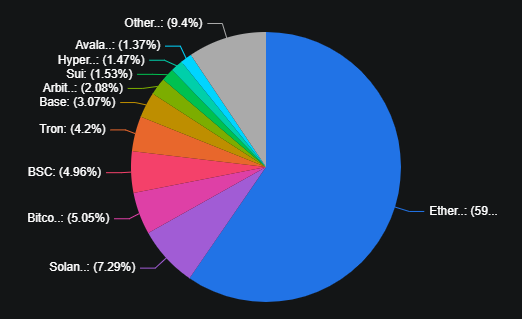
Source: DefiLlama
Blockchains enable secure value transfer, automated logic execution via smart contracts, and the decentralized storage of public data — all of which are essential to Web3 functionality.
Smart Contracts
Smart contracts are self-executing pieces of code deployed on blockchain networks. They automatically perform actions when predefined conditions are met, eliminating the need for intermediaries or manual oversight.
For instance, in a decentralized exchange like Uniswap, smart contracts enable the swapping of tokens without a third party. In 2024 alone, Uniswap processed over $1.2 trillion in trading volume, highlighting the efficiency and trust enabled by smart contracts.
Smart contracts power a wide array of applications, including decentralized finance (DeFi), NFT marketplaces, DAOs, and even decentralized insurance platforms like Nexus Mutual. Their deterministic nature ensures transparency, auditability, and high uptime reliability.
Cryptocurrencies and Tokens
Cryptocurrencies serve as the economic layer of Web3, facilitating payments, incentivizing participation, and powering on-chain governance.
- Bitcoin (BTC), as the original cryptocurrency, laid the groundwork for peer-to-peer value transfer.
- Ether (ETH) is used to pay gas fees on the Ethereum network and acts as a fuel for executing smart contracts.
- Governance tokens like UNI (Uniswap) or AAVE (Aave) give users voting power in decentralized protocols.
- Stablecoins such as USDC or DAI help mitigate volatility, making them suitable for everyday transactions in DeFi.
As of Q1 2025, over 18 million cryptocurrencies exist, with a combined market capitalization exceeding $3.84 trillion, according to CoinMarketCap.

Source: CoinMarketCap
Tokens are increasingly used not just for trading but for access control, voting, staking, and reward systems.
Decentralized Applications (DApps)
DApps are software applications that run on decentralized networks rather than centralized servers. Unlike traditional apps controlled by a single company, DApps operate through smart contracts and are often open-source, community-owned, and censorship-resistant.
Key categories of DApps include:
- Finance (e.g., Compound, Aave, Curve)
- Gaming (e.g., Axie Infinity, Illuvium)
- Marketplaces (e.g., OpenSea for NFTs)
- Social media (e.g., Lens Protocol, Farcaster)
DApps offer users greater control and transparency, as well as new monetization models like play-to-earn and decentralized creator economies.
InterPlanetary File System (IPFS)
IPFS is a peer-to-peer hypermedia protocol designed to make the web faster, safer, and more decentralized. Unlike traditional HTTP systems, which rely on central servers, IPFS uses content-addressing to locate and retrieve files.
When content is uploaded to IPFS, it’s broken into pieces, cryptographically hashed, and distributed across a network of nodes. This ensures that the same content can be accessed even if the original host goes offline — a key benefit for decentralization and data permanence.
IPFS is widely used in NFT platforms to store metadata and media off-chain. For example, OpenSea and Rarible often use IPFS to host images linked to NFTs, ensuring that digital assets remain accessible even outside their original marketplace.
Tokenization and NFTs
Tokenization refers to the process of converting rights to an asset into a digital token on the blockchain. NFTs (non-fungible tokens) represent unique, indivisible assets and have transformed digital ownership across art, gaming, music, and identity.
In 2021, NFT sales surpassed $17 billion, and although the market corrected in 2023–2024, enterprise adoption of tokenized assets grew significantly. Companies such as Propy, Async Art, GUTS Tickets, etc., use NFTs to tokenize real estate, intellectual property, and ticketing systems.
NFTs also serve as access tokens in Web3 applications, granting entry to private communities, online events, or gated content—forming the backbone of decentralized digital identity.
WebAssembly and Semantic Web Technologies
WebAssembly (Wasm) is a binary instruction format that enables high-performance code execution within web browsers. In Web3, Wasm is used to build fast, secure, and efficient smart contracts on blockchains like Polkadot, Cosmos, and Internet Computer.
It allows developers to write contracts in languages like Rust, C++, or Go, which compile to Wasm for near-native performance.
Meanwhile, Semantic Web technologies like RDF (Resource Description Framework) and OWL (Web Ontology Language) provide a framework for machines to understand and interpret web data with more intelligence. These tools enable data interoperability, automated reasoning, and linked data models that make the web more intelligent and context-aware.
For example, decentralized identity protocols leverage RDF and OWL to build interoperable profiles across multiple Web3 platforms, improving both privacy and portability of user credentials.
Advantages of Embracing Web3
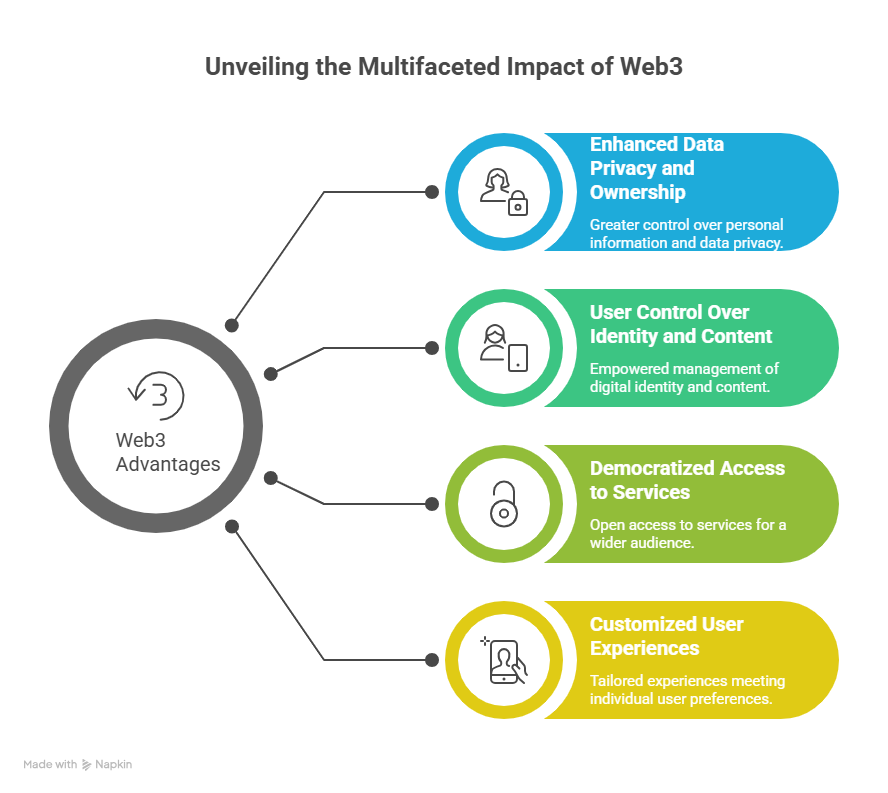
As the internet shifts from centralized control to decentralized architecture, Web3 technology introduces a series of tangible advantages for both users and developers. Unlike traditional platforms that often prioritize data monetization and walled ecosystems, Web3 reimagines how digital interactions, ownership, and trust operate online.
Here are some of the most critical benefits driving adoption in this space.
Improved Data Privacy and Ownership
One of the most pressing issues in the Web 2.0 era is the exploitation of user data. Centralized platforms collect, store, and often sell personal information without meaningful user consent. Web3 addresses this by giving individuals sovereign ownership over their data.
Through self-sovereign identity systems and decentralized storage protocols like IPFS and Filecoin, users control what data they share and with whom.
For instance, blockchain-based identity solutions such as Polygon ID and Spruce enable users to authenticate and verify credentials without exposing sensitive information.
In Web3, your data remains in your wallet or on networks you control—not on a server you can’t access.
Enhanced User Control Over Identity and Content
In Web3 ecosystems, identity is portable and persistent, not tied to a single platform. Instead of creating separate profiles for each service, users can maintain one identity across various platforms through decentralized identifiers (DIDs) and blockchain-based credentials.
This approach allows users to:
- Log in with wallets like MetaMask, Phantom, or WalletConnect instead of usernames and passwords.
- Retain access to their digital assets, social profiles, and transaction history regardless of platform shutdowns or policy changes.
- Monetize and license their content directly, without intermediaries, through NFTs or tokenized media.
This model empowers creators, professionals, and individuals to take ownership of their digital footprints and unlock new ways to monetize their content on their own terms.
Open and Democratized Access to Services
Web3 removes traditional gatekeepers, enabling permissionless participation in financial, social, and digital ecosystems. Anyone with a smartphone and internet connection can access decentralized platforms—no bank accounts, credit scores, or approvals required.
For example:
- DeFi (Decentralized Finance) platforms like Aave and Compound allow users to borrow, lend, or earn interest without third-party banks.
- DAOs (Decentralized Autonomous Organizations) enable community governance, where token holders vote on how a protocol or project evolves.
- NFT platforms give artists and creators direct access to global audiences, bypassing galleries and agencies.
This level of openness is particularly transformative for underserved regions, where access to financial services or traditional infrastructure is limited. In Web3, participation is determined by engagement and wallet ownership—not institutional affiliation.
Customized and Intelligent User Experiences
Web3 leverages semantic web technologies and machine learning to deliver smarter, more context-aware digital experiences.
Unlike static, cookie-driven personalization in Web2, Web3 applications are built to interpret meaning, preferences, and relationships between data in a more decentralized yet intelligent manner.
For instance:
- Decentralized recommendation engines can analyze user behavior across multiple platforms without compromising privacy.
- NFT-based access control allows tailored user interfaces or premium content based on ownership, reputation, or verified identity.
- Composable protocols enable users to build personalized app experiences by integrating multiple services into one dashboard or wallet.
This type of adaptability creates not just a more secure internet but a more meaningful one, where user journeys are optimized based on context, choice, and control.
Web3 Applications Making an Impact
Let’s explore some of the most transformative Web3 applications currently making a significant impact across industries and communities.
Decentralized Finance (DeFi)
Decentralized Finance, or DeFi, is one of the fastest-growing sectors within the Web3 ecosystem.
DeFi platforms use smart contracts on blockchains like Ethereum, Binance Smart Chain, and Solana to provide financial services without intermediaries such as banks or brokers. Users can lend, borrow, trade, earn interest, and even insure assets in a peer-to-peer manner.
Read Also: Decentralized Finance (Defi) in the Future
Key features and examples include:
- Lending and Borrowing: Platforms like Aave and Compound allow users to deposit crypto assets and earn interest or borrow funds using collateral — all governed by automated smart contracts.
- Decentralized Exchanges (DEXs): Uniswap and SushiSwap enable direct token swaps without centralized order books or custody.
- Yield Farming and Staking: Users can maximize returns by participating in liquidity pools or locking assets in protocols for rewards.
NFT Marketplaces
Non-Fungible Tokens (NFTs) represent unique digital assets verified on blockchains. NFT marketplaces allow creators and collectors to mint, buy, sell, and trade these one-of-a-kind tokens, covering digital art, music, virtual real estate, gaming items, and more.
Examples and Impact:
- OpenSea: The largest NFT marketplace, with billions in trading volume, hosts artworks, collectibles, and domain names.
- Rarible and Foundation: Platforms that empower artists by offering direct royalties on secondary sales.
- Gaming NFTs: Projects like Axie Infinity and Decentraland use NFTs for in-game assets, enabling players to truly own and trade their items.
NFT marketplaces foster new creator economies by removing traditional barriers and intermediaries, giving artists direct access to global markets and sustained income through programmable royalties.
Decentralized Social Platforms
Web3 also targets social media’s centralized nature, which often results in content censorship, data exploitation, and algorithmic manipulation. Decentralized social platforms aim to return control of content and interactions to users.
Notable Projects:
- Mastodon: A federated social network where users host their own servers but communicate seamlessly, offering greater control and less centralized censorship.
- Lens Protocol: Built on blockchain, it allows users to own their profiles, content, and follower relationships, which can be ported across apps.
- Steemit: Rewards users with cryptocurrency for content creation and curation, encouraging quality contributions.
By promoting open governance and content ownership, decentralized social networks help combat issues like misinformation and unfair moderation policies.
DAOs (Decentralized Autonomous Organizations)
DAOs are blockchain-based organizations governed by smart contracts and token-holder voting rather than traditional hierarchical management. They allow communities to organize collectively, making decisions transparently and democratically.
Examples of DAO Use Cases:
- Investment DAOs: Groups pool funds to invest in projects, startups, or NFTs, like The DAO or MetaCartel Ventures.
- Protocol Governance: Uniswap and Aave token holders vote on upgrades, fee structures, and other critical decisions.
- Community DAOs: Creators and fan bases organize to fund projects, distribute resources, or manage shared interests.
DAOs lower the barriers to collective action and enable stakeholders worldwide to participate in governance and benefit from their contributions, redefining organizational structures.
Digital Identity Management Systems
Managing digital identity securely and privately has long been a challenge. Web3 solutions introduce self-sovereign identity systems where individuals control their credentials without relying on centralized providers.
How They Work:
- Users create decentralized identifiers (DIDs) that exist on blockchain networks.
- Verifiable credentials issued by trusted authorities (universities, governments, employers) are stored in users’ wallets.
- Users selectively disclose identity attributes without exposing unnecessary information.
Noteworthy projects include:
- Ceramic Network: Enables decentralized data streams and identity management.
- uPort and Sovrin: Provide frameworks for self-sovereign identity and verifiable claims.
- Polygon ID: Focuses on privacy-preserving authentication for Web3 apps.
These systems improve privacy, reduce fraud risks, and simplify onboarding for services that require identity verification, such as finance, healthcare, and government interactions.
Major Challenges in Web3 Adoption
While Web3 promises to revolutionize the internet by decentralizing control, enhancing privacy, and empowering users, its widespread adoption faces several significant challenges.
These challenges are:
Scalability and Performance Limitations
One of the biggest technical hurdles for Web3 is scalability. Blockchain networks, particularly Ethereum—the most popular platform for decentralized applications (DApps)—face constraints in processing speed and transaction throughput.
For example, Ethereum currently handles about 15-30 transactions per second (TPS), compared to tens of thousands by centralized systems like Visa.
High network congestion leads to slow transaction times and exorbitant gas fees, which discourages everyday users and developers. Although Layer 2 solutions (like Optimistic Rollups and zk-Rollups) and alternative blockchains (like Solana and Avalanche) are emerging to tackle this, scaling remains an ongoing challenge for mainstream adoption.
User Experience and Accessibility
Web3 interfaces often require technical knowledge, such as managing private keys and interacting with wallets like MetaMask. This complexity poses a steep learning curve for new users unfamiliar with blockchain concepts.
Common usability issues include:
- Difficulty in securely storing and recovering private keys (losing keys means losing access permanently).
- Confusing onboarding flows and jargon-heavy interfaces.
- Lack of seamless integration with familiar web tools and services.
These barriers limit Web3’s appeal primarily to tech-savvy early adopters, slowing broader adoption among mainstream users.
Regulatory Uncertainty
Governments and regulators worldwide are still defining how to approach decentralized technologies. The legal landscape for cryptocurrencies, tokens, NFTs, and DAOs varies significantly by jurisdiction and remains fluid.
Key concerns include:
- Compliance with anti-money laundering (AML) and know-your-customer (KYC) requirements.
- Classification of tokens as securities that may trigger strict regulations.
- Tax implications for crypto transactions.
- Legal recognition and enforceability of smart contracts and DAOs.
Unclear or evolving regulations create risks for developers, investors, and users, potentially stifling innovation or leading to crackdowns on projects.
Security and Fraud Risks
While blockchain technology provides transparency and immutability, the Web3 ecosystem is not immune to security threats:
- Smart contract vulnerabilities can lead to significant financial losses, as seen in numerous DeFi hacks.
- Phishing attacks and scams exploit inexperienced users, targeting wallet keys or luring users into fraudulent projects.
- Rug pulls and exit scams, particularly in NFT markets, have eroded some trust in the space.
Robust auditing, better user education, and insurance solutions are critical to improving security and confidence.
Interoperability and Fragmentation
The Web3 landscape currently consists of multiple blockchains, protocols, and standards that do not always work seamlessly together. This fragmentation:
- Forces developers to choose between platforms, limiting network effects.
- Creates silos where assets and identities may not transfer easily across ecosystems.
- Complicates user experiences and limits the ability to build integrated applications.
Projects like Polkadot, Cosmos, and cross-chain bridges are working to improve interoperability, but achieving a unified Web3 ecosystem remains a major challenge.
Environmental Concerns
Energy consumption, especially for proof-of-work (PoW) blockchains like Bitcoin and Ethereum (until its recent transition to proof-of-stake), has drawn criticism due to environmental impact.
While many newer chains use more energy-efficient consensus mechanisms, the perception of blockchain as an “energy hog” persists, potentially limiting adoption among environmentally conscious users and businesses.
Web3 vs Web2: What Sets Them Apart

| Features | Web2 | Web3 |
| Control Over Data | Centralized platforms own and control user data | Users own and control their data via decentralized systems |
| Monetization Models | Advertising-driven; platforms take major cut | Token economies; direct monetization via smart contracts and NFTs |
| Content Moderation | Managed by centralized authorities (platforms) | Community-driven governance with decentralized moderation |
| Transparency | Proprietary, opaque algorithms and policies | Open, auditable protocols and smart contract code |
| User Identity | Platform-based accounts | Decentralized, self-sovereign digital identities |
| Security | Vulnerable to hacks on centralized servers | Enhanced security through blockchain and cryptography |
| Automation | Limited automation; reliant on intermediaries | Automated with trustless smart contracts |
| Data Storage | Centralized servers | Distributed storage systems like IPFS |
| Censorship Resistance | Subject to platform policies and potential censorship | Resistant to censorship due to decentralized networks |
| Access and Permission | Permissioned access controlled by platforms | Permissionless and open access to services and apps |
The transition from Web2 to Web3 marks a significant shift in how the internet operates, especially regarding control, monetization, governance, and transparency.
Here’s a detailed comparison of what differentiates Web3 from Web2 in key areas:
Control Over Data
In the Web2 model, centralized platforms such as Google, Facebook, and Amazon control vast amounts of user data. These companies collect, store, and monetize personal information, often without transparent user consent.
Users typically have limited control over how their data is used or shared. For example, social media platforms track browsing habits and preferences to serve targeted advertisements, creating value for the platforms but raising privacy concerns for users.
Web3 flips this dynamic by leveraging decentralized technologies like blockchain and distributed storage. Users maintain ownership of their data through cryptographic keys, deciding when and with whom to share it.
Instead of storing data on centralized servers vulnerable to hacks or misuse, data can be stored in decentralized networks such as the InterPlanetary File System (IPFS). This empowers users with sovereignty over their personal information and mitigates risks associated with data breaches and centralized surveillance.
Monetization Models
Monetization in Web2 predominantly revolves around advertising revenue and data monetization. Platforms offer “free” services but generate income by harvesting user data to sell targeted ads.
Content creators often rely on ad revenues or platform-driven monetization programs but receive a limited share, with the platform taking a substantial cut. Additionally, creators are bound by platform rules and algorithms that influence visibility and earnings.
Web3 introduces direct monetization through token economies and decentralized finance (DeFi). Creators can mint and sell digital assets like NFTs, receive tips or royalties automatically through smart contracts, and participate in decentralized marketplaces without intermediaries taking large fees.
Tokenization enables new economic models where users and creators share ownership and value creation more equitably. For example, platforms like Audius allow musicians to distribute music and earn revenue directly from fans using blockchain tokens.
Content Moderation and Censorship
Centralized control in Web2 means that content moderation is managed by platform operators who enforce community standards and policies. While necessary for removing harmful content, this model also raises concerns over censorship and lack of transparency.
Decisions about what content stays or is removed can be opaque, and policies can be inconsistently applied or influenced by external pressures, leading to accusations of bias or suppression of free speech.
Web3’s decentralized architecture limits the ability of any single entity to censor content unilaterally. Content is distributed across peer-to-peer networks, making it resistant to takedown or alteration.
Governance mechanisms in decentralized autonomous organizations (DAOs) allow communities to set moderation rules collectively, often through token-holder voting.
While this reduces centralized censorship, it also introduces new challenges in balancing freedom of expression with the need to manage harmful or illegal content in a decentralized environment.
Transparency and Automation
Transparency in Web2 platforms is limited. Algorithms that govern content ranking, ad targeting, and moderation operate as proprietary “black boxes,” often unexplained to users. This lack of transparency can undermine trust, especially when users cannot verify how their data is used or why certain content is promoted or suppressed.
Web3 leverages blockchain’s inherent transparency, where transactions, smart contract code, and governance proposals are publicly accessible and auditable. This openness enables users to verify processes such as fund allocation, voting outcomes, and contract execution without relying on intermediaries.
Automation through smart contracts ensures that predefined conditions are executed automatically without human intervention, reducing errors and bias. For example, DeFi protocols automatically distribute interest or rewards according to coded rules, eliminating the need for trusted third parties
The Future of Web3 and Its Industry Impact
Web3 is positioned to reshape not only how the internet operates but also how entire industries function, innovate, and interact with consumers.
While still emerging, its decentralized, user-centric principles promise to transform economic models, governance, and digital interactions across sectors.
Here’s a look at what the future holds for Web3 and the potential impact on various industries.
Redefining Digital Ownership and Economy
Web3’s future revolves around the concept of true digital ownership powered by blockchain and tokenization. Non-fungible tokens (NFTs) have already demonstrated how unique digital assets, from art to virtual real estate, can be owned, traded, and monetized securely and transparently.
As this concept matures, expect broader adoption across industries:
- Entertainment and Media: Artists and creators will increasingly control distribution and revenue streams, bypassing traditional intermediaries.
- Gaming: Play-to-earn models will grow, allowing gamers to earn, own, and trade in-game assets.
- Real Estate: Tokenization will enable fractional ownership and easier transfer of physical and digital properties.
This shift will democratize access to wealth-building opportunities and reshape economic incentives on the internet.
Transformation of Finance through DeFi
Decentralized Finance (DeFi) stands as one of the most disruptive applications of Web3. By removing intermediaries like banks and brokers, DeFi platforms provide services such as lending, borrowing, trading, and insurance in a transparent, permissionless manner.
The future of DeFi includes:
- Greater Integration: Traditional financial institutions adopting blockchain solutions to offer faster, cheaper services.
- Enhanced Security: Advances in smart contract auditing and insurance to mitigate risks.
- Financial Inclusion: Expanding access to financial tools for the unbanked and underserved populations worldwide.
This could fundamentally alter global finance, making it more inclusive, efficient, and resilient.
New Models of Governance and Collaboration
Decentralized Autonomous Organizations (DAOs) exemplify how Web3 is innovating governance. DAOs allow stakeholders to participate in decision-making transparently via token-based voting, eliminating centralized control.
In the future, DAOs will:
- Manage everything from investment funds and charitable organizations to corporate structures and open-source projects.
- Empower communities to self-govern and allocate resources based on collective interests.
- Challenge traditional top-down management models by promoting transparency and inclusivity.
This paradigm may redefine organizational culture and operational frameworks across industries.
Enhanced Privacy and Data Sovereignty
Privacy concerns and data misuse scandals have eroded trust in Web2 platforms. Web3’s architecture promotes data sovereignty, where users retain control over their digital identities and personal information.
Going forward, this will:
- Enable secure, user-consented data sharing across services.
- Foster new business models based on privacy-first principles.
- Drive adoption of decentralized identity management solutions, reducing fraud and enhancing user trust.
This shift can create a safer and more respectful digital ecosystem.
Integration with Emerging Technologies
Web3 will increasingly intersect with other cutting-edge technologies such as Artificial Intelligence (AI), Internet of Things (IoT), and Augmented/Virtual Reality (AR/VR).
This convergence will:
- Enable intelligent, context-aware decentralized applications.
- Support secure machine-to-machine communications with blockchain-based identities.
- Power immersive metaverse experiences where users own assets and identities across virtual worlds.
Such integrations will unlock new possibilities for innovation and user engagement across entertainment, healthcare, manufacturing, and more.
Final Thoughts
Web3 is more than just a technological shift, it redefines how we interact with the digital world by putting control back in users’ hands.
As it moves beyond theory into real-world applications, the balance of power between platforms and people is changing. This change opens new opportunities for privacy, ownership, and transparent governance, inviting everyone to participate on fairer terms.
Understanding and embracing these shifts today can unlock significant benefits tomorrow, making Web3 not just an upgrade but a foundation for the next chapter of the internet.
Frequently Asked Questions
What Is Web3 Technology Used For?
Web3 technology is used for building decentralized applications (dApps) that enable secure, user-controlled services like finance (DeFi), digital identity, NFTs, DAOs, and data ownership without relying on central intermediaries.
What Is an Example of a Web3?
An example of Web3 is Uniswap, a decentralized exchange that allows users to trade cryptocurrencies directly from their wallets without relying on a central authority.
What Is the Difference Between Web3 and Blockchain?
Web3 is the broader concept of a decentralized internet, while blockchain is the underlying technology that enables it by securely recording data and transactions.
How Does Web3 Make Money?
Web3 makes money through token-based economies, where users, developers, and platforms earn from activities like staking, trading cryptocurrencies, selling NFTs, using decentralized apps (DApps), and participating in decentralized finance (DeFi) services.
How Can I Learn Web3?
You can learn Web3 by starting with free resources, joining communities on Discord or Twitter, and taking beginner-friendly courses on platforms like Coursera, Alchemy University, or buildspace. Practice by building simple dApps and exploring tools like MetaMask, Solidity, and smart contracts on testnets.