About six in 10 Americans own stock in some form, according to the latest Gallup data. Yet if you’ve never bought a stock, you’re far from alone. Many people stay out of the market simply because no one has explained how investing works in simple terms.
That’s what this guide is here to do. We’ll cover the stock market basics every beginner needs to know, including what stocks are, how ETFs let you invest in hundreds of companies at once, how to open your first brokerage account, and how to build a simple long-term investing plan.
No jargon and no pressure to become a day trader. Just a clear path from “I don’t know where to start” to making your first investment.
关键精华
- 开始简单。 For most beginners, a low-cost S&P 500 ETF like VOO or IVV is a smarter first move than picking individual stocks.
- Invest on autopilot. Set up automatic monthly contributions and check your account quarterly, not daily. Boring and consistent beats exciting and risky.
- Time does the heavy lifting. Investing $500 a month at a 10% average annual return for 30 years grows to roughly $1.1 million. The same money sitting in a savings account earning 0.5% grows to about $194,000.
- Grab free money first. Always capture your employer’s 401(k) match before anything else. Then max out a Roth or traditional IRA if you can.
- Never panic sell. Stock market drops of 10% or more happen every year or two on average. That’s normal, not a reason to sell.
什么是股票市场?
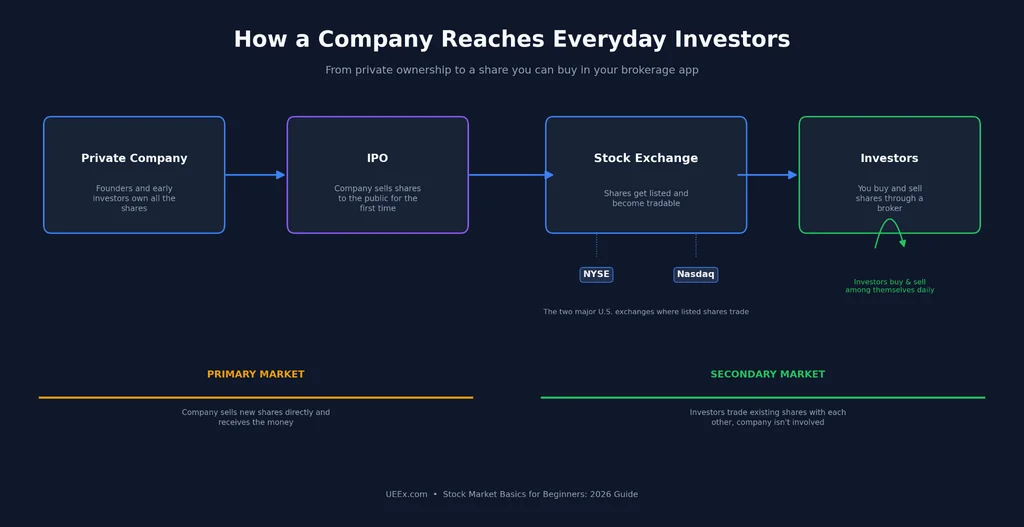
此 股市 is a system of exchanges, including the New York Stock Exchange (NYSE) and Nasdaq, where investors buy and sell shares of public companies. Owning a share gives you a small stake in that business and, in some cases, a portion of its profits through dividends.
Stock prices change throughout the day as investors respond to company earnings, economic conditions, interest rates, and supply and demand. While daily moves can be unpredictable, long-term returns have historically been strong. As of July 2026, 标普500, which tracks 500 leading U.S. companies, had delivered a 10-year annualized price return of 13.17%.
How Stock Exchanges Actually Work
You don’t need to understand the mechanics deeply to invest well, but a quick picture helps:
- 交易时间 run 9:30 a.m. to 4:00 p.m. Eastern, Monday through Friday. Some brokers now offer extended and after-hours trading, but prices move less predictably outside regular hours.
- Prices are set by supply and demand. More buyers than sellers push a price up, while more sellers than buyers push it down.
- Market makers and electronic systems match buy and sell orders in fractions of a second, which is why trades execute almost instantly.
The Major U.S. Exchanges
- 纽约证券交易所(NYSE): Home to many well-known, older companies like Disney, JPMorgan Chase, and Coca-Cola. Still has a physical trading floor in Manhattan.
- 纳斯达克: Fully electronic and tech-heavy, listing companies like Apple, Microsoft, and Amazon.
- 场外交易市场: Smaller, less-regulated companies trade here. Beginners should generally steer clear until they have more experience.
Why does any of this matter to you personally? Because stock markets are one of the main ways ordinary people build long-term wealth. Money sitting in a checking account loses value to inflation every year. However, money invested in a 多元化投资组合 has historically grown faster than inflation by a wide margin over long stretches of time.
The Building Blocks of Stock
Let’s explore what stocks are all about and how to make money from them.
What Is a Stock?
A stock is a small piece of ownership in a company. If a company has one billion shares outstanding and you own one share, you technically own one billionth of that company. That sounds tiny, and it is, but it’s also real ownership: as a shareholder, you get to vote on certain company matters, and you’re entitled to your share of profits if the company distributes them.
Here’s a concrete example: Apple has roughly 14.8 billion shares outstanding as of its most recent filings. If you bought 10 shares at around $230 each, you’d spend $2,300 and own a very small, but real, sliver of one of the world’s most valuable companies.
Common Stock vs. Preferred Stock
Almost everything a beginner buys is common stock. It gives you voting rights and the potential for the share price to rise, along with dividends if the company pays them.
On the other hand, preferred stock behaves more like a bond. It usually pays a fixed dividend, doesn’t come with voting rights, and doesn’t swing in price as much. Most beginners never need to think about preferred stock.
How Stocks Actually Make You Money
有两种方式:
- Price appreciation (capital gains): You buy a share at $100 and later sell it at $150, pocketing a $50 profit per share.
- 股息: Some companies pay shareholders a portion of profits, usually every quarter. Coca-Cola, for example, has historically paid out a dividend yield in the 2.5% to 3% range.
Put both together and you get “total return.” Say you bought Microsoft in early 2023 for around $240 a share, collected dividends along the way, and the stock climbed toward the $400s by late 2025. Your total return includes both the price gain and the dividend income, which is why total return is usually a more honest number than price alone.
Understanding Stock Types and Sectors
股票类型
- 成长股: Companies expected to grow earnings quickly, often reinvesting profits instead of paying dividends. Typically more volatile. Think Nvidia or Tesla.
- 价值股: Established companies trading at relatively low prices compared to their earnings. Often steadier. Think Berkshire Hathaway or Johnson & Johnson.
- 分红股票: Mature companies that pay out a steady stream of income, often in the 2–6% annual yield range. Popular with retirees and income-focused investors.
- Blue-chip stocks: Large, financially strong, well-established companies like Apple, Microsoft, or Visa. Often overlap with dividend stocks.
11 Stock Market Sectors
The S&P 500 is divided into 11 sectors under the Global Industry Classification Standard. As of 2026, Information Technology is by far the largest, making up roughly a third of the index, driven heavily by the AI investment boom.
Healthcare, Financials, and Consumer Discretionary follow, with Energy, Utilities, Real Estate, and Materials making up smaller slices.
You don’t need to memorize all 11. The practical takeaway is this: a broad S&P 500 ETF already spreads your money across every sector automatically, in proportion to how the real economy is weighted. That built-in diversification is one of the biggest reasons ETFs work so well for beginners.
Major Market Indices Explained
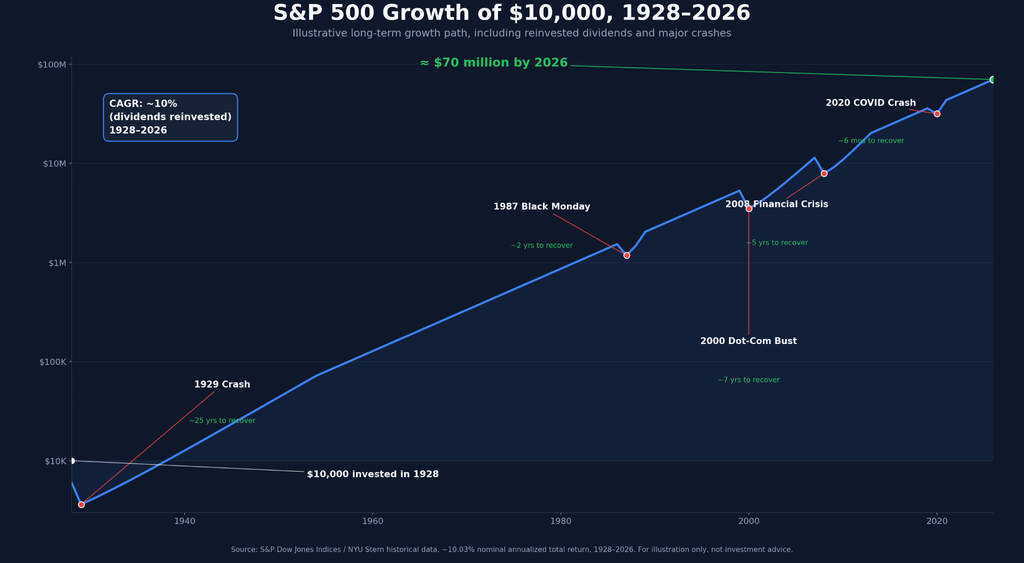
You’ll hear about “the market” constantly, but the market isn’t one thing. It’s usually shorthand for one of these:
The S&P 500: The Real Benchmark
The S&P 500 tracks the 500 largest publicly traded U.S. companies, weighted by size, and represents roughly 80% of the total value of the U.S. stock market. It’s the index most retirement funds and financial advisors compare themselves against, and it’s the one Warren Buffett has pointed everyday investors toward for decades.
As of September 2026, the index is unusually concentrated. According to 标普道琼斯指数, the top 10 companies, led by Nvidia, Apple, Microsoft, Amazon, and Alphabet, make up roughly 37–38% of the entire index’s value. That’s the highest concentration on record, driven largely by the size of a handful of tech giants.
It’s worth knowing, because when you buy an S&P 500 ETF, you’re getting more exposure to a few massive tech companies than the “500 companies” label might suggest.
道琼斯工业平均指数(DJIA)
The Dow tracks just 30 large, well-known companies, including Boeing, Disney, Goldman Sachs, and McDonald’s. It’s the oldest U.S. index, dating back to 1896, which is why it still gets so much media attention.
However, because it’s price-weighted rather than size-weighted, and it only covers 30 companies, most professionals consider it a less accurate snapshot of the overall market than the S&P 500.
纳斯达克综合指数
This index covers over 3,000 companies listed on the Nasdaq exchange and skews heavily toward technology. It tends to outperform the S&P 500 during bull markets and fall harder during downturns, since tech stocks are generally more volatile. The QQQ ETF tracks a related index, the Nasdaq-100, made up of the 100 largest non-financial Nasdaq companies.
Other Indices Worth Knowing
- 罗素2000: Tracks 2,000 smaller U.S. companies, giving you a read on “small-cap” stocks.
- Wilshire 5000: A broad measure of nearly the entire U.S. stock market.
- International indices: The FTSE 100 (UK), Nikkei 225 (Japan), and Shanghai Composite (China) track their respective countries’ major companies.
Individual Stocks vs. ETFs: What Beginners Should Actually Choose
This is the decision that matters most when you’re getting started, so it’s worth slowing down here.
什么是ETF?
An exchange-traded fund (ETF) is a basket of stocks that trades on an exchange just like a single stock does. Buy one share of an S&P 500 ETF and you instantly own a small piece of all 500 companies in the index, in the same proportions as the index itself.
The Vanguard S&P 500 ETF (VOO), for example, became the world’s first ETF to cross $1 trillion in assets under management in June 2026, according to LSEG Lipper Alpha. Its expense ratio is just 0.03% a year, meaning you’d pay about $3 annually on every $10,000 invested.
iShares Core S&P 500 ETF (IVV) and SPDR S&P 500 ETF Trust (SPY) offer similar exposure at comparably low costs.
What Are Individual Stocks?
Buying an individual stock means owning shares of one specific company. It requires real homework: reading financial statements, understanding the industry, tracking earnings reports, and staying on top of news that could move the price. The upside can be bigger.
Nvidia’s stock, for instance, has climbed thousands of percent since 2019 as AI demand exploded. Note that the downside can also be total. Companies do go bankrupt, and when they do, shareholders are usually the last people paid, if they’re paid at all.
并排比较
| 因素 | ETF | 个股 |
| 多样化 | Instant, hundreds of companies | Just one company |
| 需要研究 | 最小 | Significant, ongoing |
| Risk of total loss | 非常低 | Real, if the company fails |
| 典型成本 | 0.03%–0.20%的费用率 | $0 commission, no ongoing fee |
| 最适合 | 大多数初学者 | Experienced or highly interested investors |
该判决
For roughly 90% of people just getting started, a low-cost S&P 500 ETF is the smarter first move. It’s exactly the approach Warren Buffett has recommended to everyday investors for years.
“The know-nothing investor can actually outperform most investment professionals.”
That’s a striking thing to hear from arguably the best stock picker in history. His point wasn’t that research doesn’t matter. It’s that consistently buying a low-cost index fund beats most people’s attempts to pick winners.
If you want to add individual stocks later, a reasonable approach is to wait until you’ve been investing for six months or more, have an emergency fund in place, and are genuinely interested in researching companies, not just chasing whatever is trending.
A common structure once you’re more experienced is something like 80% in broad ETFs and 20% in individual stocks you’ve researched yourself.
How to Open Your First Brokerage Account
This section explores how you can open your first brokerage account
账户类型
Traditional online brokerages (Fidelity, Charles Schwab, E*TRADE) give you full control, $0 minimums, and $0 commissions on most stock and ETF trades. You do your own research and make your own decisions.
机器人顾问 (Betterment, Wealthfront, SoFi Automated Investing) build and manage a portfolio for you automatically, typically for an annual fee around 0.25%. Good for people who want a hands-off approach.
Full-service brokerages (Morgan Stanley, Merrill Lynch) pair you with a personal advisor but usually require six-figure account minimums and charge 1% or more of your assets annually. Not typically where beginners start.
Comparing Popular Brokers for Beginners (2026)
| 经纪人 | 最低限度 | Stock/ETF Trades | 闻名 |
| 保真度 | $0 | $0 | Strong research tools, solid customer service |
| 嘉信理财 | $0 | $0 | Well-rounded platform, good education resources |
| 前锋 | $0 | $0 | Lowest-cost index funds, built for buy-and-hold |
| 罗宾汉 | $0 | $0 | Simple mobile app, fast account setup |
| SoFi投资 | $0 | $0 | Fractional shares, bundled with other SoFi products |
Opening Your Account, Step by Step
- Pick a broker: Compare fees, mobile app quality, and research tools.
- 收集您的文件: You’ll need your Social Security number, a driver’s license, and bank account details.
- 填写申请: Expect questions about your income, employment, and investing experience. This is standard and required by regulation.
- 为账户注资: Link your bank and transfer money. Standard bank transfers usually take one to three business days.
- 验证您的身份: Most brokers confirm this instantly, within 24 hours.
- Start investing: Once funded, you’re ready to place your first trade.
Which Account Type Should You Use?
- Taxable brokerage account: Flexible, no contribution limits, but gains are taxed.
- 传统爱尔兰共和军: Contributions may be tax-deductible now; you pay tax when you withdraw in retirement. The 2026 contribution limit is $7,500, or $8,600 if you’re 50 or older, according to the 国税局.
- 罗斯爱尔兰共和军: You contribute after-tax dollars, but growth and qualified withdrawals in retirement are completely tax-free. Same 2026 limits as above.
- 401(k): Offered through an employer, often with a matching contribution. The 2026 employee contribution limit is $24,500, per the IRS.
How to Buy Your First Stock or ETF
Here’s how you can buy your first stock or ETF
资助您的帐户
Most people link a bank account and transfer money via ACH, which takes one to three business days. Meanwhile, wire transfers are faster but usually cost $25 to $30. Also, many brokers now let you start with as little as $1 to $50, thanks to fractional shares.
了解订单类型
市价单: Buy or sell immediately at the current price. Best for highly liquid ETFs and stocks where the price barely moves between clicking “buy” and the trade executing.
限价单: You set the exact price you’re willing to pay or accept, and the trade only executes at that price or better. Useful for more volatile individual stocks. For example, if Microsoft is trading at $450 and you set a limit order at $445, the trade only goes through if the price drops to $445 or lower.
止损单: An order that automatically sells if a stock falls to a price you set. This is a more advanced tool. Most beginners don’t need it for broad ETFs, since riding out volatility is usually the better move.
进行您的第一笔交易
- Log into your brokerage app.
- Search for the ticker (for example, “VOO” for the Vanguard S&P 500 ETF).
- Review the current price, expense ratio, and recent performance.
- Tap “Buy” or “Trade.”
- Enter how much you want to invest, either in whole shares or a dollar amount if fractional shares are supported.
- Choose “Market Order” for simplicity as a beginner.
- Confirm and submit. Most trades execute within seconds.
- Check your holdings to confirm the purchase went through.
After that, the most important thing you can do is set up automatic monthly investments and turn on dividend reinvestment, so any dividends you earn automatically buy more shares instead of sitting as idle cash.
For more coverage on how to start ETFs investments, our guide on Best ETFs to Buy Right Now expands on various choices.
初学者投资策略
The various investments strategies for beginners
Dollar-Cost Averaging: The Strategy Built for Beginners
Dollar-cost averaging (DCA) simply means investing a fixed amount of money on a regular schedule, regardless of what the market is doing that day. Instead of trying to guess the perfect moment to invest, you invest consistently and let the average work in your favor.
Say you invest $500 a month into an ETF for three months. In month one, the price is $500 a share, so you get one share. In month two, the price dips to $475, so your $500 buys slightly more. In month three, it rises to $525, so you get slightly less. Over time, this evens out your average cost and removes the guesswork entirely.
John Bogle, founder of Vanguard and the pioneer of index investing, put it simply:
“Time is your friend; impulse is your enemy.”
Market timing is genuinely difficult, even for professionals, and missing just the market’s best days by trying to jump in and out can meaningfully hurt long-term returns.
Buy-and-Hold Investing
The philosophy is simple: buy quality, diversified investments, and hold them for years, ideally decades, instead of reacting to every headline.
“The investor’s worst enemy is likely to be himself.”
Fear and impatience drive most bad investing decisions, not bad information. Beginners often struggle with buy-and-hold for a few predictable reasons: they panic sell during a downturn, chase whatever stock is trending, or check their portfolio so often that every small dip feels like a crisis.
The fix is almost boringly simple: automate your investing, and check your account quarterly rather than daily.
按年龄划分的资产配置
A common starting rule of thumb is “110 minus your age” equals the rough percentage you might hold in stocks, with the rest in bonds. So at 25, that suggests around 85% stocks and 15% bonds. At 65, closer to 45% stocks and 55% bonds.
Because people are living and working longer, some advisors now use “120 minus your age” instead, which leans slightly more toward stocks.
A simplified example by age range:
- 20 年代至 30 年代: 85–90% stocks, 10–15% bonds
- 40s: 70–80% stocks, 20–30% bonds
- 50 年代至 60 年代: 55–65% stocks, 35–45% bonds
- 65 +: 40–50% stocks, remainder in bonds and cash
This isn’t a rigid formula. It’s a starting point to adjust based on your own risk tolerance and goals.
再平衡
Once a year, check whether your actual mix of stocks and bonds has drifted from your target. If your target is 80% stocks and 20% bonds, but a strong stock market has pushed you to 85/15, consider selling a bit of stock and adding to bonds to get back in line. Robo-advisors typically handle this automatically.
Key Metrics Every Beginner Should Know
Understanding these key metrics make your investment journey easier
市值
This is a company’s total value: share price multiplied by total shares outstanding. Large-cap companies (generally $10 billion or more) tend to be more stable. Small-cap companies (roughly $250 million to $2 billion) carry more risk and more growth potential.
市盈率 (P/E)
The P/E shows how much investors are paying for each dollar of a company’s earnings. A stock priced at $100 with $5 in annual earnings per share has a P/E of 20. Growth-heavy tech stocks often trade at higher P/E ratios than steady, established value stocks, because investors are paying up for expected future growth.
每股收益 (EPS)
The EPS measures a company’s profit divided by its number of shares outstanding. Rising EPS over time is generally a healthy sign, since stock prices tend to track earnings growth over the long run.
股息收益率
This is the annual dividend divided by the current share price. A stock priced at $60 paying $1.80 a year in dividends has a 3% yield. Unusually high yields, above 6% or so, can sometimes signal a company is under financial stress rather than being a great deal.
测试
The beta measures how much a stock moves relative to the overall market. A beta of 1.0 means it tends to move in line with the market. A beta above 1.0 means bigger swings in both directions; below 1.0 means smaller swings. Beginners looking for a smoother ride often favor lower-beta investments.
初学者应避免的常见错误
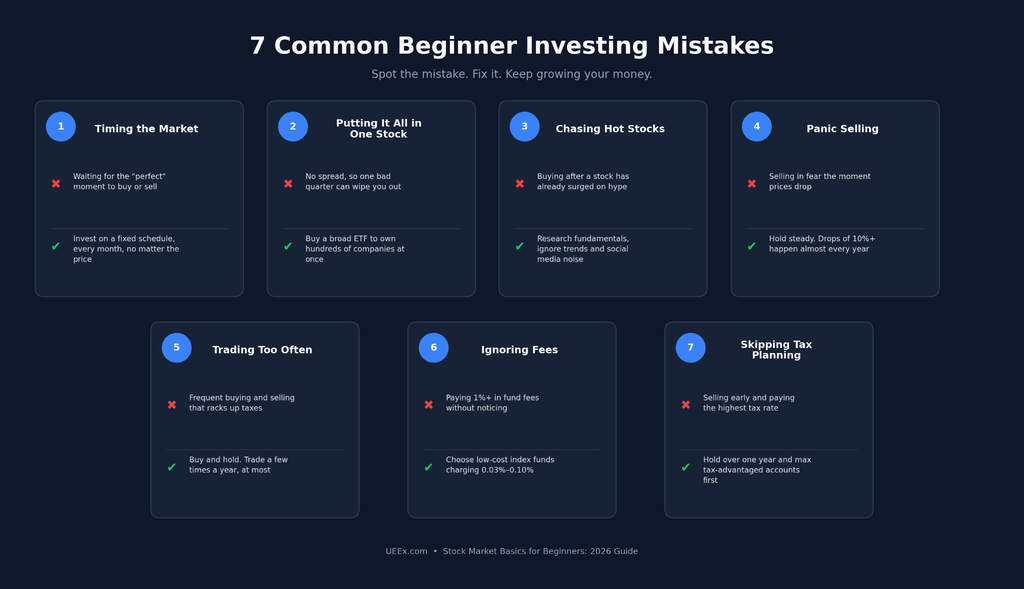
These are common mistakes every beginner should avoid
Trying to Time The Market
Waiting for the perfect moment to buy, or selling right before a feared crash, sounds smart but rarely works out, even for professionals. A consistent dollar-cost averaging approach removes this pressure entirely.
Not Diversifying
Putting a large share of your money into one stock or one sector is one of the fastest ways to take on unnecessary risk. A single ETF solves this instantly by spreading your money across hundreds of companies.
Chasing Hot Stocks
Buying something because it’s already surged and everyone’s talking about it is a common trap. By the time a stock is trending, much of the easy gain is often already behind it.
Panic Selling During Downturns
Markets drop 10% or more fairly regularly, roughly every year or two historically. Selling during a downturn locks in a loss that a patient investor might never have actually experienced.
过度交易
Frequent buying and selling adds up in taxes and often leads to worse results than simply holding. The vast majority of active, short-term traders underperform a basic buy-and-hold approach over time, according to research summarized by 晨星.
忽略费用
A 1% annual fee sounds small, but compounded over 20 years, it can quietly eat a meaningful chunk of your returns compared to a fund charging 0.03%. Always check a fund’s expense ratio before investing.
Not Thinking About Taxes
Selling an investment you’ve held for less than a year is generally taxed at your regular income tax rate. Hold for more than a year, and you typically qualify for the lower long-term capital gains rate instead. Maxing out tax-advantaged accounts like a 401(k) or IRA before investing in a taxable account is usually the smarter order of operations.
风险管理和投资组合保护
Here’s how to mange risk and protect your portfolio
了解你的风险承受能力
Ask yourself honestly: if your portfolio dropped 30% in a few months, would you sell everything, hold steady, or see it as a buying opportunity? Your answer, combined with your time horizon and how stable your income is, should shape how much of your portfolio sits in stocks versus safer assets like bonds or cash.
Build Your Emergency Fund First
Before you invest a dollar in the stock market, most financial planners recommend setting aside three to six months of living expenses in a high-yield savings account. Markets and job losses have a habit of showing up together, as they did in 2008 and 2020, so having cash on hand means you’ll never be forced to sell investments at a bad time to cover an emergency.
A reasonable sequence looks like this: build a small starter emergency fund, pay off any high-interest debt, capture your full employer 401(k) match, finish building your 3–6 month emergency fund, then start maxing out an IRA and investing beyond your retirement accounts.
位置大小
A common guideline is to avoid putting more than 5% of your portfolio into any single individual stock. This doesn’t apply to broad ETFs, since a fund like VOO is already diversified across 500 companies by design.
A simple example of a diversified $10,000 starter portfolio might look like:
- 70% in a broad U.S. stock ETF (like VOO)
- 10% in an international stock ETF
- 10% in a bond ETF
- 10% split across individual stocks you’ve researched
If you’re deciding between building this kind of stock portfolio and exploring crypto assets, our guide on 加密货币与股票:哪种投资适合您? breaks down the risk and reward tradeoffs of each.
Tax-Advantaged Investing for Beginners
401(k)计划
A 401(k) is an employer-sponsored retirement account. For 2026, employees can contribute up to $24,500, or up to $32,500 if you’re 50 or older, according to the IRS.
If your employer offers a match, say 50% of your contribution up to 6% of your salary, that’s free money. Always contribute at least enough to capture the full match before investing anywhere else.
传统个人退休账户与罗斯个人退休账户
| 特性 | 传统的IRA | 罗斯IRA |
| 供款限额 | $7,500 in 2026 ($8,600 if age 50+) | $7,500 in 2026 ($8,600 if age 50+) |
| 税收优惠 | 捐款可能可以抵税 | Contributions are made with after-tax income |
| 成长 | 延税 | 免税 |
| Qualified Withdrawal | 按普通收入征税 | 免税 |
| 收入限额 | Deduction may phase out based on income and workplace plan coverage | Contribution phases out at $153,000–$168,000 for single filers and $242,000–$252,000 for married filing jointly |
| 最适合 | People who want a potential tax deduction now and expect a lower tax rate in retirement | People who expect higher taxes later and want tax-free qualified withdrawals |
For younger investors especially, a Roth IRA can be powerful, because decades of investment growth come out completely tax-free in retirement. That said, everyone’s tax situation is different, so it’s worth weighing your own income and expected retirement bracket or speaking with a tax professional before deciding which account fits you best.
HSA: The Overlooked Triple Tax Advantage
A Health Savings Account offers a rare combination: tax-deductible contributions, tax-free growth, and tax-free withdrawals for qualifying medical expenses. For 2026, contribution limits are $4,400 for individuals and $8,300 for families.
After age 65, you can withdraw funds for any purpose without penalty, taxed like a traditional IRA. Some investors deliberately pay medical costs out of pocket and let their HSA balance grow, treating it as an extra retirement account.
另请参阅: 实用型代币与证券型代币:2026 年监管指南全文
When and How to Sell Stocks
This section covers when and how to sell your stocks
Good Reasons to Sell
- You’ve reached a specific financial goal, like a home down payment.
- Your portfolio has drifted from your target allocation and needs rebalancing.
- A company’s fundamentals have genuinely deteriorated: consistently falling market share, declining earnings across several quarters, or a serious governance issue.
Bad Reasons to Sell
- The price dropped, and nothing about the company’s fundamentals actually changed.
- The price soared, and you’re tempted to “lock in profits” without a real plan for the money.
- You’re scared because of a scary headline or a market-wide dip.
The One-Year Holding Rule
Holding an investment for more than a year before selling generally qualifies you for the lower long-term capital gains tax rate instead of the higher short-term rate, which is taxed as ordinary income.
On a meaningful gain, that difference can easily be worth over a thousand dollars, depending on your tax bracket. Unless you have a genuine emergency, it’s usually worth marking your calendar and waiting past that one-year mark.
2026 Market Trends Worth Watching
These are the current market trends investors should pay attention to
人工智能投资热潮
AI-related spending on chips and data centers has become one of the biggest forces shaping the market, with Nvidia alone growing into one of the largest weightings in the S&P 500. A broad index ETF gives you automatic exposure to this trend without needing to bet on any single company.
Fractional Shares and $0 Commissions
These two changes have quietly reshaped who can invest. You no longer need thousands of dollars to buy a share of a company like Amazon; many brokers now let you invest a specific dollar amount instead, buying a fraction of a share.
Elevated U.S. Market Concentration
With the top 10 S&P 500 companies making up roughly 37–38% of the index, some advisors, including strategists at firms like Vanguard, have pointed out that international diversification may be worth considering for investors who want to reduce reliance on a small handful of U.S. tech giants.
Sustainable and ESG Investing
Funds that screen for environmental, social, and governance factors have continued to attract meaningful assets globally. Performance has generally tracked close to the broader market, though “greenwashing” concerns remain a legitimate criticism worth researching before choosing an ESG-labeled fund.
Resources & Your Action Plan to Stock Investment
Use these plans to create a profitable investment journey
第1周: Open a brokerage account with a provider like Fidelity, Schwab, or Vanguard. Link your bank account and transfer your first $50 to $1,000.
第2周: Buy your first shares of a broad S&P 500 ETF. Set up automatic monthly contributions and turn on dividend reinvestment.
第 2-3 个月: Learn how sector weightings work. Start researching a handful of individual companies, without buying yet. Consider 读一本书 喜欢 投资常识小书 by John Bogle.
第 4-6 个月: If you’re comfortable, consider adding a small international ETF allocation. If you’re genuinely interested in a specific company, you might add one or two individual stocks, keeping them to a small slice of your overall portfolio.
年1: Build your emergency fund to a full three to six months of expenses. Confirm you’re capturing your full 401(k) match. Open a Roth IRA if you’re eligible.
Once you’re comfortable with the basics, it’s worth learning to read a company’s actual financial statements before buying individual stocks.
None of this requires you to become a market expert. It requires you to open an account, buy something broad and low-cost, keep adding to it on a schedule, and resist the urge to touch it every time the news gets loud.
另请参阅: 2026年比特币交易策略完整指南
结语
The stock market is not a get-rich-quick scheme. It is a long-term wealth-building tool that rewards patience, discipline, and consistency. As of 2026, about 58% of Americans reported owning stocks, showing how widely investing has become part of household finances.
For beginners, the key lessons are simple: historically, the S&P 500 has delivered roughly 10% annualized total returns over long periods, although individual years can vary sharply.
Rather than trying to predict every market move, focus on staying invested, using diversified index ETFs, investing consistently through dollar-cost averaging, and maintaining a long-term horizon.
Tax-advantaged accounts such as 401(k)s and IRAs can further boost compounding. The goal is not to beat the market every year, but to give your money enough time to grow.
常見問題解答
How much money do I need to start investing in stocks?
Thanks to fractional shares, many brokers now let you start investing with as little as $1 to $50. There’s no rule requiring a large sum. What matters far more than your starting amount is starting consistently and staying invested over time.
What is the difference between stocks and ETFs?
A stock is ownership in a single company. An ETF is a basket of many stocks bundled into one fund that trades like a single stock. Buying an ETF instantly diversifies your money across every company inside it, while buying an individual stock ties your outcome to just one business.
Which brokerage should I choose as a beginner?
Fidelity, Charles Schwab, and Vanguard are widely considered strong choices for beginners, thanks to $0 account minimums, $0 stock and ETF trades, and solid educational resources. Your best pick often comes down to which app and research tools feel easiest for you to use.
Should I invest in individual stocks or ETFs?
For most beginners, a low-cost S&P 500 ETF is the better starting point, since it offers instant diversification and requires far less ongoing research. Individual stocks can make sense as a smaller part of your portfolio once you have more experience, an emergency fund in place, and genuine interest in researching specific companies.