Slashing is a punitive mechanism embedded in Proof-of-Stake (PoS) and delegated Proof-of-Stake (dPoS) blockchain protocols that automatically confiscates a portion — or in severe cases the entirety — of a validator’s staked cryptocurrency when the validator is detected violating protocol rules, acting maliciously, or failing to fulfill its consensus responsibilities. The slashed tokens are typically burned (permanently removed from the circulating supply) or redistributed to a community treasury, serving as both a direct financial punishment for the offending validator and an economic deterrent against future misbehavior across the network.
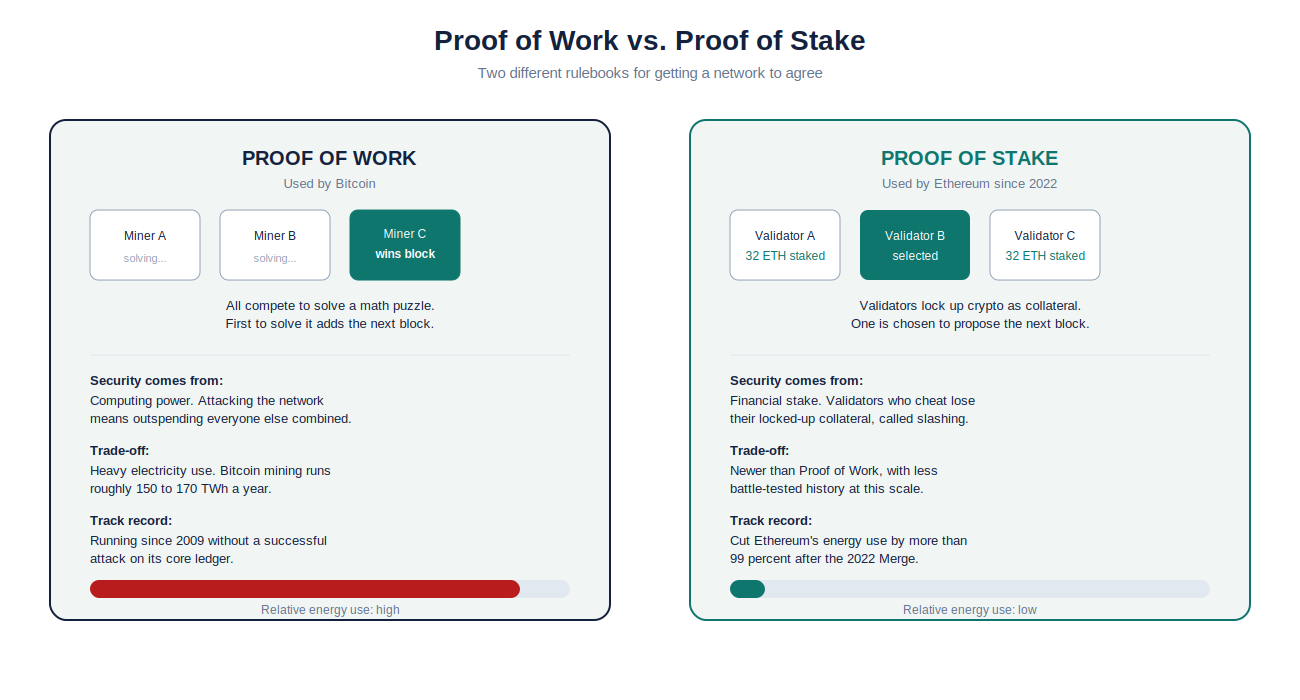
In Proof-of-Work systems, dishonest miners are punished indirectly through wasted electricity and hardware costs when their invalid blocks are rejected. Proof-of-Stake networks, however, lack this inherent economic penalty because validators do not expend significant computational resources. Slashing fills this gap by creating an explicit, protocol-enforced financial consequence for protocol violations. Without slashing, a PoS validator could attempt to double-sign blocks, censor transactions, or go offline without facing any meaningful repercussions, fundamentally undermining the security guarantees of the network.
The most common slashable offenses include double-signing (proposing or attesting to two different blocks at the same height), surround voting (casting contradictory attestation votes that could enable chain reorganizations), and prolonged downtime (going offline for an extended period, which degrades the network’s ability to reach consensus). The severity of the penalty typically scales with the perceived severity of the offense: minor downtime may result in a small percentage reduction, while provable equivocation (double signing) can result in the loss of a validator’s entire stake plus forced ejection from the validator set.
Slashing is a cornerstone of cryptoeconomic security design. It aligns the economic incentives of individual validators with the health of the network by ensuring that the cost of attacking the protocol always exceeds the potential reward. Major PoS networks that implement slashing include Ethereum (post-Merge), Cosmos (Tendermint), Polkadot, Solana, Cardano (through planned mechanisms), and numerous layer-2 and application-specific chains. As of 2025, billions of dollars in staked assets are subject to slashing conditions across the blockchain ecosystem.
Origin & History
Date
Event
2012
Peercoin, created by Sunny King and Scott Nadal, became the first blockchain to implement a hybrid PoW/PoS consensus mechanism. While Peercoin did not implement explicit slashing, it introduced the concept that staked coins should carry economic risk, laying the intellectual groundwork for future slashing designs
2014
Jae Kwon published the Tendermint whitepaper, which formalized the concept of Byzantine fault-tolerant consensus with explicit validator penalties. Tendermint’s design specified that validators caught double-signing would lose a portion of their bonded stake — one of the earliest formal slashing specifications in blockchain literature
2017
Vitalik Buterin and Virgil Griffith published “Casper the Friendly Finality Gadget” (Casper FFG) in October 2017, proposing a slashing mechanism for Ethereum’s planned PoS transition. The paper introduced the concept of “slashing conditions” — mathematically defined rules that, when violated, trigger automatic stake destruction. Casper’s design specified that at least one-third of the total staked ETH would need to be slashed to prevent finality, creating an enormous economic barrier against attacks
2019
The Cosmos Hub mainnet launched on March 13, 2019 with Tendermint BFT consensus, implementing live slashing for the first time at scale. Validators on the Cosmos Hub faced a 5% slash for double signing and a 0.01% slash per missed block for downtime, establishing real-world precedents for slashing parameter calibration
2020
Ethereum launched the Beacon Chain (Phase 0 of Ethereum 2.0) on December 1, 2020, activating slashing for Ethereum validators for the first time. The initial penalty for a single validator’s slashable offense was set at 1/32 of the validator’s stake (approximately 1 ETH from a 32 ETH deposit), with an additional correlation penalty that could increase the slash to the full stake if many validators were slashed simultaneously
2021
Polkadot activated slashing on its relay chain, implementing a nuanced system where the penalty size depended on the number of validators committing offenses concurrently. A single validator equivocating might lose only 0.1% of stake, but if 10% of validators equivocated simultaneously, the penalty would be scaled to 10% of stake — penalizing coordinated attacks far more severely than individual mistakes
2022–2023
Several high-profile slashing events occurred across major networks. On Ethereum, client software bugs (notably in the Prysm and Lodestar clients) caused accidental double-signing by validators running identical configurations, resulting in involuntary slashing. These incidents sparked significant debate about client diversity and the fairness of slashing validators for software bugs rather than intentional malice
2023–2024
Ethereum’s Shapella upgrade (April 2023) enabled staked ETH withdrawals for the first time, making slashing penalties more tangible. Liquid staking protocols like Lido, Rocket Pool, and Coinbase cbETH implemented slashing insurance mechanisms and operator selection criteria to protect delegators from validator misbehavior
2024–2025
EIP-7251 (MaxEB — increase in maximum effective balance) was proposed for Ethereum, allowing validators to stake more than 32 ETH. This raised new questions about slashing proportionality. EigenLayer launched its slashing feature in April 2025, completing its original vision and introducing the concept of “re-slashing,” where staked ETH serving as security for multiple protocols could be slashed by any of them. By early 2026, EigenLayer held over $18 billion in restaked ETH TVL
“Slashing is the key ingredient that makes Proof of Stake secure. Without it, validators could misbehave freely — with it, attacking the network requires burning real economic value.” — Vitalik Buterin, Ethereum co-founder
In Simple Terms
Imagine you are a security guard at a bank. The bank requires you to post a cash deposit as a guarantee of honest behavior. If you are caught sleeping on the job or helping robbers, the bank keeps part — or all — of your deposit. Slashing works the same way: validators put up cryptocurrency as a bond, and the network confiscates it if they break the rules.
Think of slashing like the penalty system in professional soccer. If a player commits a minor foul, they get a yellow card (small slash). If they commit a serious foul or accumulate too many yellow cards, they get a red card and are ejected from the match entirely (full slash and removal from the validator set). The penalties keep the game fair.
Picture a neighborhood watch program where every volunteer puts $1,000 into a shared pot. If a volunteer is caught vandalizing houses instead of protecting them, the group takes their $1,000 and uses it to repair the damage. This financial accountability ensures every participant has skin in the game.
Slashing is like a driver’s license point system. Minor infractions (brief downtime) cost a few points (small percentage of stake). Major violations (double-signing blocks) result in license revocation (full stake confiscation and validator ejection). The system makes reckless behavior expensive.
Consider a restaurant health inspection: the restaurant posts a bond, and if inspectors find food safety violations, part of the bond is forfeited. The bigger the violation, the bigger the penalty. This is exactly how blockchains treat validator misbehavior — automated inspections with automatic financial consequences.
Important: Not all slashing events are caused by malicious intent. Software bugs, misconfigured infrastructure, and network issues can trigger accidental slashing. Validators should run diverse client software, maintain robust monitoring systems, and use slashing protection tools (like remote signers with double-sign prevention) to minimize the risk of involuntary slashing.
Double Signing (Equivocation): A validator signs two different blocks or attestations at the same slot or height, potentially enabling a double-spend or chain split. This is the most severe slashable offense on most networks.
Surround Voting: On Ethereum, a validator produces an attestation vote that “surrounds” or is “surrounded by” a previous vote, which could be used to attack the chain’s finality mechanism. Surround votes violate Casper FFG’s safety conditions.
Downtime / Inactivity Leak: While not always classified as slashing per se, prolonged validator downtime triggers an “inactivity leak” on Ethereum, gradually draining the validator’s balance until it either comes back online or is forcibly exited. Other networks like Cosmos impose direct downtime slashing.
Invalid State Transitions: On optimistic rollup networks and proposed restaking protocols, validators can be slashed for attesting to fraudulent state roots that are later proven invalid by a fraud proof.
How Slashing Works on Ethereum:
A validator commits a slashable offense (e.g., signs two different blocks at slot 5,000,000)
Another validator or a “slasher” client detects the conflicting signatures and submits a slasher proof to the Beacon Chain
The protocol verifies the proof cryptographically — if two valid signatures from the same validator key exist for the same slot, the proof is irrefutable
An initial penalty of 1/32 of the validator’s effective balance (approximately 1 ETH from 32 ETH) is immediately deducted
The offending validator enters a “slashed” state and begins a forced exit queue, unable to propose blocks or make attestations
During a 36-day penalty period (8,192 epochs), a correlation penalty is calculated based on how many other validators were slashed in the surrounding 18-day window
If the offending validator was the only one slashed, the correlation penalty is minimal; if one-third or more of validators were slashed simultaneously, the correlation penalty can consume the entire remaining stake
After the exit queue and withdrawal delay, the validator receives whatever balance remains after all penalties
Slashing Protection Mechanisms:
Remote signing with anti-slashing databases: Tools like Web3Signer maintain a local database of all previously signed messages and refuse to sign anything that would constitute a slashable offense
Slashing protection interchange format (EIP-3076): A standardized JSON format that allows validators to export and import their signing history when migrating between client software, preventing accidental double-signing during client switches
Client diversity: Running minority consensus clients reduces the risk of correlated slashing caused by bugs in a dominant client implementation
Monitoring and alerting: Professional staking operations use real-time monitoring (e.g., beaconcha.in, rated.network) to detect anomalies before they escalate to slashing events
Correlation Penalty Design:
The correlation penalty is a core innovation of Casper FFG’s economic model
Individual mistakes are treated leniently (small penalty), while coordinated attacks are treated severely (massive penalty scaling to full stake destruction)
The formula is: additional_penalty = validator_effective_balance × 3 × fraction_of_total_validators_slashed_in_window
If 33% or more of validators are slashed, the penalty equals the validator’s entire effective balance
This design ensures that the cost of a coordinated finality attack equals the total staked value of all attacking validators
Advantages & Disadvantages
Advantages
Disadvantages
Strong Security Guarantee: Slashing creates a direct, quantifiable economic cost for attacking the network, making the cost of a 51% attack on PoS networks potentially billions of dollars
False Positives: Software bugs, misconfigured infrastructure, or network outages can trigger accidental slashing, punishing honest validators for technical failures beyond their control
Incentive Alignment: Validators are financially motivated to behave honestly, maintain uptime, and run secure infrastructure because their own capital is at risk
Complexity Barrier: The technical requirements for avoiding slashing (remote signers, anti-slashing databases, client diversity) raise the bar for solo staking, contributing to centralization through professional staking services
Deterrent Against Centralization Attacks: Correlation penalties make coordinated attacks by large staking pools exponentially more expensive than individual misbehavior
Capital Lockup Risk: Validators must lock significant capital that is subject to potential slashing, creating an opportunity cost and risk that deters smaller participants from staking
Self-Healing Network: Slashed validators are automatically ejected from the active set, removing bad actors without requiring manual intervention or governance votes
Irreversible Punishment: Once slashing is executed, there is no appeal process or mechanism to reverse the penalty, even if the offense was caused by a software bug rather than malicious intent
Deflationary Pressure: Burned slashed tokens reduce the circulating supply, creating a mild deflationary effect that benefits all remaining token holders
Client Bug Amplification: A bug in a majority consensus client could cause mass slashing of thousands of validators simultaneously, creating a systemic risk to the entire network
Transparent Enforcement: All slashing events are recorded on-chain and publicly verifiable, ensuring that penalties are applied fairly and consistently according to protocol rules
Delegator Exposure: In delegated staking systems, delegators can lose funds due to their chosen validator’s misbehavior, even though the delegators themselves did nothing wrong
Mathematically Provable Security: Casper FFG’s slashing conditions provide formal mathematical proofs of safety guarantees, allowing precise calculation of attack costs
Governance Rigidity: Changing slashing parameters requires protocol upgrades and community consensus, making it slow to adapt to evolving threats or to correct overly harsh penalties
Risk Management
Validator Operational Risk:
Run slashing protection software (Web3Signer or equivalent) at all times to prevent accidental double-signing
Never run the same validator keys on two different machines simultaneously — this is the most common cause of accidental slashing
Implement redundancy through failover systems that ensure only one instance of a validator is active at any time
Use the EIP-3076 slashing protection interchange format when migrating between client software
Client Diversity Risk:
Running a majority consensus client (e.g., if Prysm runs 60% of validators) creates correlated slashing risk: a bug in that client could slash thousands of validators simultaneously
Mitigation: choose minority clients (Lighthouse, Teku, Nimbus, Lodestar for Ethereum) to reduce correlation risk
Monitor client diversity statistics at clientdiversity.org and consider switching if your chosen client exceeds 33% network share
Delegator Risk:
Delegators on liquid staking platforms (Lido, Rocket Pool, Coinbase) are exposed to slashing risk from their validator operators
Mitigation: choose platforms with slashing insurance, diversified operator sets, and proven track records
Understand that liquid staking tokens (stETH, rETH) can temporarily depeg if a major slashing event occurs
Review the operator selection criteria and insurance mechanisms of your chosen staking provider
Key Management Risk:
Compromised validator keys can be used to commit slashable offenses on behalf of the validator
Mitigation: use hardware security modules (HSMs) or secure enclave technology for key storage
Implement key rotation policies and monitor for unauthorized signing activity
Separate withdrawal keys from validator signing keys to protect funds even if signing keys are compromised
Regulatory and Tax Risk:
Slashing losses may or may not be tax-deductible depending on jurisdiction
Some regulators may view slashing events as indicators of negligence by staking service providers
Mitigation: consult tax professionals on the treatment of slashing losses; maintain detailed records of all slashing events and their causes
Cultural Relevance
Slashing has become one of the most discussed and debated mechanisms in the cryptocurrency community, touching on fundamental questions about the fairness of automated punishment systems. The phrase “getting slashed” carries significant weight in validator communities — it represents not just a financial loss but a reputational mark that can affect a validator’s ability to attract future delegations.
The Ethereum community’s emphasis on client diversity is directly driven by slashing risk. After incidents where Prysm client bugs caused accidental slashing, the rallying cry “run minority clients” became a defining cultural movement within the Ethereum staking community. Organizations like the Ethereum Foundation and community advocates actively promote client diversity dashboards and educational materials to reduce correlated slashing risk.
In the broader DeFi ecosystem, slashing has influenced the design of restaking protocols. EigenLayer’s introduction of “restaking” — where staked ETH simultaneously secures multiple protocols — has generated heated debate about “re-slashing risk,” where a single validator’s stake could be slashed by multiple protocols for different offenses. EigenLayer launched its slashing feature in April 2025, making the risk concrete rather than theoretical. Critics argue this multiplies risk beyond what individual stakers can reasonably assess, while proponents view it as a capital-efficient extension of cryptoeconomic security.
The concept of slashing has also entered mainstream discourse around institutional staking. When major financial institutions like Coinbase, Kraken, and Fidelity offer staking services, their risk management teams must model slashing probabilities and maintain insurance reserves. This has brought traditional finance risk frameworks into contact with blockchain-native penalty mechanisms, creating a new category of operational risk that bridges both worlds.
The meme “slashed and burned” has become a cautionary tale shared in staking communities, reminding participants that PoS security comes at the cost of genuine financial risk. Unlike PoW mining, where the worst outcome is wasted electricity, PoS staking means validators can lose the very capital they put up to secure the network.
Example 1: Ethereum Beacon Chain Slashing Events (2023)
Scenario: In October 2023, a cluster of validators running on the Lido-affiliated node operator Launchnodes experienced simultaneous slashing due to a configuration error that caused multiple validator instances to run with the same signing keys on different machines.
Implementation: The Ethereum Beacon Chain’s slashing detection mechanism identified double-signed attestations from the affected validators. Other validators submitted slasher proofs to the protocol, triggering the automated penalty process. Each affected validator received an initial penalty of approximately 1 ETH (1/32 of 32 ETH), entered the exit queue, and faced a 36-day correlation penalty assessment period.
Outcome: Because the number of simultaneously slashed validators was relatively small compared to the total validator set, the correlation penalty was minimal. Each slashed validator lost approximately 1-2 ETH total. The incident prompted Lido’s node operator evaluation committee to implement stricter infrastructure requirements and slashing protection mandates for all operators.
Example 2: Cosmos Hub Double-Sign Slashing (2019)
Scenario: Shortly after the Cosmos Hub mainnet launch in March 2019, a validator was caught double-signing blocks due to running redundant validator instances without proper failover coordination.
Implementation: Tendermint’s BFT consensus protocol automatically detected the conflicting block signatures. The protocol applied a 5% slashing penalty to the validator’s total bonded ATOM (including delegated tokens), and the validator was “jailed” (temporarily removed from the active validator set) with a 21-day unbonding period before delegators could recover their remaining tokens.
Outcome: The slashing event affected not only the validator operator but also all delegators who had bonded their ATOM to that validator. This real-world consequence drove the development of delegation risk assessment tools and prompted validators to implement more robust infrastructure practices. The incident became a widely cited case study in the Cosmos ecosystem about the importance of operational security.
Example 3: Polkadot Equivocation Slashing (2022)
Scenario: A Polkadot validator produced two different blocks at the same block height during a network synchronization issue, triggering the relay chain’s equivocation detection mechanism.
Implementation: Polkadot’s GRANDPA finality gadget detected the conflicting block proposals and initiated a slashing report. Under Polkadot’s slashing model, the penalty was calculated based on the number of concurrent offenders: since only one validator was involved, the slash was set at approximately 0.1% of the validator’s staked DOT.
Outcome: The mild penalty reflected Polkadot’s design philosophy of treating isolated incidents leniently. However, the validator’s nominators (Polkadot’s equivalent of delegators) were also affected proportionally. The event highlighted how Polkadot’s progressive slashing model — where penalties scale with the number of simultaneous offenders — provides a more nuanced approach than flat-rate penalties.
Example 4: EigenLayer Restaking Slashing Goes Live (2025)
Scenario: After operating without live slashing since its launch, EigenLayer activated its slashing feature in April 2025, completing the protocol’s original vision. By early 2026, EigenLayer held over $18 billion in restaked ETH TVL across more than 39 Actively Validated Services (AVSs).
Implementation: EigenLayer’s slashing system was designed so operators can limit their exposure to individual AVSs — meaning a bad actor on one AVS would not necessarily impact operators on others. AVS teams opted into the slashing system and defined custom slashing conditions for their specific services (oracle networks, data availability layers, bridges, etc.).
Outcome: While no major re-slashing event had occurred by early 2026, the activation of live slashing made the theoretical “re-slashing” risk concrete. Liquid restaking protocols (Renzo, Puffer, EtherFi) continued refining risk stratification frameworks and diversification strategies to protect depositors. The launch of real slashing shaped broader industry thinking about the limits of capital efficiency in cryptoeconomic security.
Configurable: 0.01% to 100% of stake depending on offense and network
Fixed: the cost of mining the rejected block (electricity + opportunity cost)
Variable: ranges from mild reputation damage to complete social ostracism
Speed of Punishment
Immediate upon proof submission (seconds to minutes)
Immediate upon block rejection (seconds)
Slow, depends on community awareness and response
Reversibility
Irreversible once executed by the protocol
Irreversible (electricity already consumed)
Partially reversible through reputation recovery over time
Impact on Delegators
Delegators lose proportional share of slashed amount
Not applicable (miners operate independently)
Delegators may withdraw, causing indirect financial impact
Coordination Attack Cost
Scales super-linearly with number of attackers (correlation penalty)
Scales linearly with hash rate needed (51% of network)
No formal cost structure for coordinated attacks
Related Terms
Proof of Stake (PoS): A consensus mechanism where validators lock cryptocurrency as collateral to participate in block production, with slashing serving as the primary enforcement mechanism for honest behavior.
Validator: A node operator who stakes cryptocurrency to participate in consensus, proposes and attests to blocks, and is subject to slashing penalties for protocol violations.
Staking: The act of locking cryptocurrency in a smart contract to support network operations, earn rewards, and accept the risk of slashing for misbehavior.
Finality: The state at which a transaction is considered irreversible, guaranteed on PoS networks by the economic threat of slashing against validators who attempt to revert finalized blocks.
Casper FFG: Ethereum’s finality gadget, published by Vitalik Buterin and Virgil Griffith in October 2017, that defines the mathematical slashing conditions required to ensure that finalized blocks cannot be reverted without destroying at least one-third of all staked ETH.
Delegated Proof of Stake (dPoS): A PoS variant where token holders delegate their staking power to elected validators, sharing both rewards and slashing risk.
Liquid Staking: Staking mechanisms that issue tradable derivative tokens (stETH, rETH) representing staked assets, allowing participants to maintain liquidity while accepting slashing exposure.
Jailing: A temporary or permanent removal of a validator from the active consensus set, typically triggered alongside or instead of slashing for downtime offenses.
EigenLayer: A restaking protocol on Ethereum that allows staked ETH to simultaneously secure multiple protocols, with slashing going live in April 2025, introducing “re-slashing” risk where the same stake can be penalized by multiple services.
Client Diversity: The distribution of validators across different consensus client software implementations, critical for reducing correlated slashing risk caused by bugs in dominant clients.
Double Signing: The act of a validator signing two conflicting blocks or attestations at the same consensus slot, constituting the most severe slashable offense on most PoS networks.
Inactivity Leak: A penalty mechanism on Ethereum that gradually drains the balance of offline validators during periods when the chain fails to finalize, distinct from but related to slashing.
FAQ
Q: What is the difference between slashing and an inactivity leak? A: Slashing is a severe, one-time penalty triggered by provable malicious behavior such as double-signing or surround voting. An inactivity leak is a gradual, ongoing penalty applied to validators who are offline during periods when the network is failing to finalize. Slashing results in forced exit from the validator set, while inactivity leaks drain balance over time but allow validators to recover by coming back online. On Ethereum, slashing involves an initial penalty plus a correlation penalty over 36 days, while inactivity leaks scale gradually and can eventually drain a validator’s entire balance if the chain fails to finalize for an extended period.
Q: Can I get slashed for simply having my validator offline? A: On Ethereum, simple downtime does not trigger slashing — it triggers inactivity penalties (small attestation penalties during normal operation, or larger inactivity leak penalties if the chain is not finalizing). However, on other networks like Cosmos, prolonged downtime (e.g., missing 500 out of the last 10,000 blocks) can trigger a direct slashing penalty of 0.01% of staked tokens. The specific rules depend entirely on the blockchain you are validating.
Q: How much can a validator lose from slashing on Ethereum? A: The minimum slashing penalty on Ethereum is 1/32 of the validator’s effective balance (approximately 1 ETH from a 32 ETH stake). However, the correlation penalty — applied over the following 36 days — can increase the total penalty up to the validator’s entire effective balance if many validators are slashed simultaneously. In practice, isolated slashing events result in a loss of roughly 1-2 ETH, while a large-scale coordinated attack or client bug affecting one-third of validators could result in the loss of all 32 ETH.
Q: Does slashing affect delegators who staked through a pool? A: Yes. In most PoS networks, slashing penalties are applied to the entire staked balance associated with a validator, including delegated tokens. On Cosmos, delegators lose the same percentage as the validator. On Ethereum, liquid staking protocols like Lido and Rocket Pool have implemented insurance mechanisms and operator diversification to protect depositors, but some slashing loss may still be passed through to liquid staking token holders. Always review the slashing risk distribution policy of your staking provider.
Q: What tools can validators use to prevent accidental slashing? A: The primary tools include remote signing services with anti-slashing databases (Web3Signer, Dirk), the EIP-3076 slashing protection interchange format for safe client migrations, client diversity (running minority consensus clients), and real-time monitoring dashboards (beaconcha.in, rated.network). Validators should never run the same signing keys on multiple machines simultaneously, which is the most common cause of accidental double-signing.
Q: Has a large-scale slashing event ever occurred? A: As of early 2026, no catastrophic mass slashing event has occurred on a major network. The largest Ethereum slashing incidents involved clusters of 10-20 validators affected by client bugs or misconfiguration errors, resulting in relatively small total penalties due to the low correlation factor. However, the theoretical risk of a majority client bug causing mass slashing of thousands of validators remains one of the most discussed systemic risks in the Ethereum staking community.
Q: How does slashing relate to restaking protocols like EigenLayer? A: Restaking protocols introduce an additional layer of slashing risk. EigenLayer launched its slashing feature in April 2025, making re-slashing risk real rather than theoretical. When ETH is restaked through EigenLayer, it can be slashed by both Ethereum’s native protocol (for consensus violations) and by any Actively Validated Service (AVS) the restaker opts into (for AVS-specific rule violations). Users should carefully assess the slashing conditions of each AVS before restaking.
Sources
Ethereum Proof-of-Stake Rewards and Penalties
Vitalik Buterin and Virgil Griffith, “Casper the Friendly Finality Gadget” (October 2017)