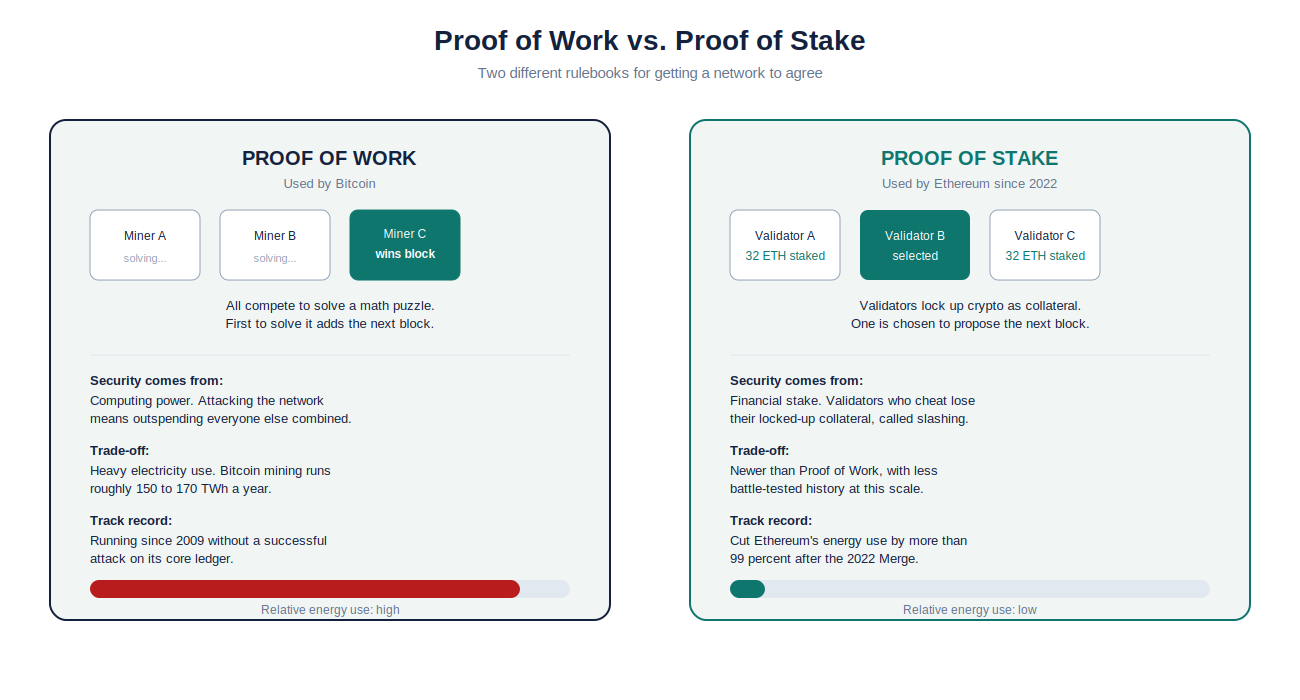
A validator is a network participant (or node operator) in a proof-of-stake (PoS) blockchain system that is responsible for proposing new blocks, verifying the validity of transactions, attesting to the correctness of blocks proposed by other validators, and maintaining consensus across the distributed network. Validators replace miners in the proof-of-stake model, performing the same essential function — securing the blockchain and ordering transactions — but using staked cryptocurrency as economic collateral rather than computational energy expenditure.
To become a validator, an entity must lock (stake) a protocol-specified minimum amount of the network’s native cryptocurrency in a smart contract as a security deposit. This stake serves as a financial guarantee of honest behavior: if the validator acts maliciously (e.g., double-signing conflicting blocks, proposing invalid transactions) or negligently (e.g., going offline for extended periods), a portion or all of their staked funds can be destroyed through a process called slashing. Conversely, validators who perform their duties correctly earn rewards in the form of newly minted tokens (block rewards) and a share of transaction fees paid by network users.
The validator model represents one of the most fundamental architectural decisions in blockchain design. In Ethereum’s proof-of-stake system (active since September 2022), validators stake 32 ETH each and participate in a two-layer consensus process: the beacon chain randomly selects one validator per slot (12 seconds) to propose a block, while committees of validators attest to the validity of proposed blocks. Other major PoS networks — Solana, Cardano, Polkadot, Cosmos, Avalanche, Tezos, and Algorand — each implement their own validator selection, reward, and penalty mechanisms, but all share the core principle of using economic stake as a Sybil resistance mechanism.
Validators differ significantly from miners in several key ways: they require minimal computational resources (a standard server or even a consumer-grade computer suffices for most networks), they consume a tiny fraction of the energy that mining requires, they can begin earning rewards immediately upon staking (no hardware procurement delay), and they can unstake their collateral to exit the network (subject to protocol-defined waiting periods). However, validators also face unique risks: their staked capital is subject to slashing penalties, they must maintain high uptime to avoid inactivity penalties, and they bear smart contract risk if the staking mechanism contains vulnerabilities.
The validator ecosystem has evolved into a sophisticated industry encompassing solo validators (individuals running their own nodes), professional validator operations (companies like Coinbase Cloud, Figment, Chorus One, and P2P Validator that operate nodes across multiple networks), liquid staking protocols (Lido, Rocket Pool, Coinbase cbETH) that tokenize staked assets to provide liquidity, and restaking platforms (EigenLayer) that allow validators to secure multiple networks simultaneously with the same staked capital.
Origin & History
2012–2013: The concept of proof-of-stake and validators originated in the cryptocurrency community as an alternative to Bitcoin’s energy-intensive proof-of-work mining. Peercoin (launched August 2012 by Sunny King and Scott Nadal) was the first cryptocurrency to implement a proof-of-stake consensus mechanism, introducing the idea that coin holders could help validate blocks based on their stake. Peercoin used a hybrid PoW/PoS design — PoW for initial coin distribution and PoS for ongoing security. The term “validator” was not yet widely used — early PoS systems referred to these participants as “minters” or “forgers.”
November 2013: The NXT blockchain launched on November 24, 2013, as the first fully pure proof-of-stake network (no proof-of-work component whatsoever), using a deterministic block selection process where validators (called “forgers”) were chosen based on their stake weighted by a randomization factor. This established the pattern of pure stake-weighted validator selection that would become standard across the industry.
2016–2017: Ethereum co-founder Vitalik Buterin and researcher Vlad Zamfir published extensive research on Casper, Ethereum’s planned proof-of-stake protocol. Their work formalized the validator concept for Ethereum, including the 32 ETH staking requirement, slashing conditions, and the two-phase approach (Casper FFG for finality, then full Casper CBC). The Cosmos whitepaper (2016) by Jae Kwon introduced Tendermint consensus, where a fixed set of validators reached consensus through a Byzantine Fault Tolerant (BFT) voting process — a model that heavily influenced subsequent blockchain designs.
2018–2019: Multiple major proof-of-stake networks launched with validator-based consensus. Tezos (mainnet September 17, 2018) introduced “bakers” (its term for validators) with a liquid proof-of-stake model. Cosmos Hub (mainnet March 13, 2019) launched with an initial cap of 100 validators using Tendermint BFT. Algorand (mainnet June 2019) implemented a pure proof-of-stake model where any token holder could participate in validation without a minimum stake. These launches established validators as a core concept in blockchain infrastructure.
2020: Ethereum’s Beacon Chain launched on December 1, 2020, marking the beginning of Ethereum’s transition to proof-of-stake. Exactly 21,063 validators had deposited 32 ETH each (524,288 ETH total, worth approximately $314 million at the time) before the genesis event. The Beacon Chain operated alongside the existing proof-of-work Ethereum chain, with validators attesting to blocks but not yet processing transactions. Solana’s mainnet beta (launched March 2020) quickly attracted hundreds of validators with its novel proof-of-history combined with proof-of-stake consensus.
2021: The validator ecosystem exploded in growth. Ethereum’s Beacon Chain grew to over 250,000 validators. Polkadot’s parachain auctions launched, requiring validators to secure both the relay chain and individual parachains. Liquid staking protocols emerged as a major category: Lido Finance rapidly grew to become the largest DeFi protocol by total value locked, allowing users to stake ETH and receive stETH tokens that could be used across DeFi while their ETH earned validator rewards.
September 15, 2022: Ethereum completed “The Merge” — the most significant validator-related event in blockchain history. The Ethereum mainnet transitioned from proof-of-work to proof-of-stake, replacing miners with validators for all block production and transaction ordering. Approximately 420,000–435,000 validators secured the network at the time of the Merge. This event reduced Ethereum’s energy consumption by an estimated 99.95% and established validators as the backbone of the world’s most widely used smart contract platform.
2023–2024: The validator market continued to evolve. Ethereum activated the Shanghai/Capella upgrade (April 12, 2023), enabling validator withdrawals for the first time and allowing validators to unstake their ETH. The number of Ethereum validators surpassed 900,000 by mid-2024. EigenLayer launched its restaking protocol, enabling Ethereum validators to opt in to securing additional “Actively Validated Services” (AVS) with their staked ETH, creating a new model of shared security. Distributed Validator Technology (DVT) emerged through projects like SSV Network and Obol, allowing multiple operators to collectively run a single validator to improve resilience and decentralization.
2026: The Ethereum validator set exceeded 1 million validators. Concerns about validator centralization intensified as Lido controlled approximately 28–30% of all staked ETH. Regulatory scrutiny of staking services increased, with the SEC’s action against Kraken’s staking service in 2023 having lasting effects on the US staking market. Validator technology continued to mature with improved client diversity (Lighthouse, Prysm, Teku, Nimbus, Lodestar), better monitoring tools, and more sophisticated MEV (Maximal Extractable Value) strategies through proposer-builder separation (PBS).
“Validators are the backbone of proof-of-stake networks. They replace the energy expenditure of miners with economic commitment — putting real capital at risk to secure the network. This creates a system where the people who have the most to lose are the ones responsible for keeping the network honest.” — Vitalik Buterin, Co-founder of Ethereum
In Simple Terms
Think of validators like jurors in a courtroom. Just as jurors are selected from the community to evaluate evidence and reach a verdict, validators are selected from the pool of stakers to evaluate transactions and confirm they are legitimate. If a juror acts dishonestly, they face legal consequences — similarly, if a validator acts dishonestly, their staked funds are slashed as a financial penalty.
Imagine a group of security guards protecting a bank vault. Each guard puts up a personal cash deposit as a guarantee that they will do their job honestly. If a guard is caught helping a robber, they lose their deposit. If they show up every day and do their job well, they earn a salary. Validators work the same way — they put up crypto as collateral and earn rewards for honestly securing the blockchain.
Picture a neighborhood watch program where homeowners take turns patrolling the streets. To join, each homeowner deposits a sum of money into a community fund. If a patroller does a good job, they receive a share of the community safety budget. If they fall asleep on the job or deliberately let criminals in, they lose their deposit. Validators patrol the blockchain in exactly this way.
Think of validators as notaries in a decentralized notary office. Each notary has put up a bond guaranteeing they will accurately verify documents. When someone submits a transaction (document), a randomly selected notary reviews it, stamps it as valid, and other notaries confirm the stamp is correct. Honest notaries earn fees; dishonest notaries lose their bond.
Important: Running a validator involves real financial risk. Staked funds can be slashed for protocol violations (even accidental ones, such as running duplicate validator keys), and inactivity penalties can gradually erode your stake if your node goes offline. Additionally, the value of staked tokens is subject to market volatility, meaning you could earn staking rewards while the underlying asset loses value. Always understand the specific slashing conditions and technical requirements of any network before becoming a validator.
Key Technical Features
Staking and Collateral Requirements
Each proof-of-stake network defines a minimum stake that validators must deposit to participate in consensus. On Ethereum, the requirement is exactly 32 ETH per validator instance. On Solana, there is no minimum stake, but validators need sufficient stake (typically delegated from token holders) to be included in the leader schedule. Cosmos Hub requires being in the top 180 validators by total stake (self-bonded plus delegated). Polkadot uses Nominated Proof-of-Stake (NPoS) where the top validators by nominated stake (currently 297 on Polkadot) enter the active set. These staking requirements serve as Sybil resistance — they make it economically expensive for an attacker to control a majority of validators.
How Validator Block Production Works (Ethereum Example)
- Time on the Beacon Chain is divided into slots (12 seconds each) and epochs (32 slots, approximately 6.4 minutes). Each slot can contain one block.
- For each slot, the protocol pseudo-randomly selects one validator as the block proposer using a RANDAO-based randomization seeded by validator signatures.
- The selected proposer collects pending transactions from the mempool (or receives a pre-built block from a builder via MEV-Boost), assembles them into a block, and broadcasts the block to the network.
- A committee of validators (a subset of the total validator set, rotated each epoch) is assigned to attest to the proposed block. Each attesting validator verifies that the block is valid (all transactions are properly formatted, no double-spends, correct state transitions) and broadcasts an attestation vote.
- When two-thirds of the committee’s attestations agree on the block, it is considered justified. After two consecutive justified epochs, the block is finalized — meaning it cannot be reverted without at least one-third of all staked ETH being slashed.
- The block proposer receives a reward (block reward plus priority fees from transactions), and attesting validators receive smaller attestation rewards proportional to their timeliness and accuracy.
Slashing Conditions and Penalties
Slashing is the punitive destruction of a portion of a validator’s staked collateral for provably malicious or dangerous behavior. On Ethereum, there are three slashable offenses: (1) Double proposing — proposing two different blocks for the same slot; (2) Surround voting — casting an attestation that surrounds or is surrounded by a previous attestation (an attempt to revert finalized blocks); and (3) Double voting — casting two attestations for the same target in the same epoch. The minimum slashing penalty is 1/32 of the validator’s stake (1 ETH for a 32 ETH validator), but if many validators are slashed simultaneously (a correlated slashing event suggesting a coordinated attack), the penalty scales up to the entire stake. Slashed validators are also forcibly exited from the validator set.
Validator Client Software and Diversity
Validators run specialized software called validator clients that implement the consensus protocol. Ethereum has five production-ready consensus clients: Prysm (developed by Prysmatic Labs), Lighthouse (Sigma Prime), Teku (ConsenSys), Nimbus (Status), and Lodestar (ChainSafe). Client diversity is critical for network resilience: if a single client has a bug and controls more than one-third of validators, it could cause those validators to be slashed. If it controls more than two-thirds, it could finalize an incorrect chain. The Ethereum community actively encourages running minority clients to prevent any single implementation from becoming a systemic risk.
Delegation and Liquid Staking
Not all token holders want to run validator infrastructure directly. Delegation allows token holders to assign their stake to a professional validator while retaining ownership of their tokens. On Cosmos-based chains, delegators share in validator rewards (minus a commission) but also share in slashing risk. Liquid staking takes this further by issuing a derivative token (stETH from Lido, rETH from Rocket Pool, cbETH from Coinbase) that represents the staked position and can be traded, used as DeFi collateral, or transferred while the underlying tokens continue earning validator rewards. As of 2026, liquid staking derivatives represent over 35% of all staked ETH.
Advantages & Disadvantages
| Aspect | Description |
|---|---|
| Advantage: Energy Efficiency | Proof-of-stake validators consume a tiny fraction of the energy required by proof-of-work miners. Ethereum’s transition to validators reduced its energy consumption by approximately 99.95%, addressing one of the most significant criticisms of blockchain technology. |
| Advantage: Lower Hardware Barriers | Unlike mining, which requires specialized ASIC hardware costing thousands of dollars, running a validator typically requires only a standard computer with modest specifications (4+ CPU cores, 16+ GB RAM, 2 TB SSD for Ethereum), making participation more accessible. |
| Advantage: Predictable Revenue | Validator rewards are more predictable than mining rewards because they are based on protocol-defined issuance schedules and attestation duties rather than the probabilistic nature of finding valid hashes in proof-of-work systems. |
| Advantage: Economic Security | The staking requirement creates a direct financial incentive for honest behavior. An attacker would need to acquire and risk an enormous amount of capital (currently over $30 billion worth of ETH) to compromise Ethereum’s validator set. |
| Advantage: Decentralized Governance | Validators often participate in network governance decisions, including protocol upgrades and parameter changes, creating a distributed decision-making structure that resists centralization. |
| Disadvantage: Capital Lock-up | Staked tokens are illiquid during the staking period. While liquid staking derivatives mitigate this, they introduce additional smart contract risk and may trade at a discount to the underlying asset during market stress. |
| Disadvantage: Slashing Risk | Validators face the risk of losing a portion or all of their staked capital due to software bugs, misconfiguration (running duplicate keys), or network issues, even without malicious intent. |
| Disadvantage: Centralization Tendencies | Large staking providers (Lido, Coinbase, Binance) control disproportionate shares of the validator set, creating centralization risks that undermine the decentralization properties that proof-of-stake is designed to provide. |
| Disadvantage: Technical Complexity | Running a validator requires maintaining server infrastructure with high uptime, keeping software updated, monitoring for issues, and understanding slashing conditions — a level of technical sophistication that excludes many potential participants. |
| Disadvantage: Regulatory Exposure | Staking services have attracted regulatory attention, with the SEC classifying some staking offerings as securities. Validators operating as businesses face uncertain regulatory obligations that vary by jurisdiction. |
Risk Management
Client Diversity Monitoring: Never run a supermajority consensus client. Check the current client distribution at clientdiversity.org and choose a minority client to reduce your risk of correlated slashing events. If the client you run has a consensus bug and controls more than one-third of validators, your stake could be slashed along with thousands of others.
Key Management Security: Validator keys are the most critical security asset. Use a hardware security module (HSM) or air-gapped machine for key generation. Never run the same validator keys on two machines simultaneously — this will result in double-signing and slashing. Implement secure key backup procedures and store mnemonic phrases in geographically distributed, physically secured locations.
Uptime and Monitoring: Deploy detailed monitoring using tools like Grafana, Prometheus, and validator-specific dashboards (beaconcha.in for Ethereum). Set up alerting for missed attestations, sync issues, and peer count drops. Maintain a secondary failover machine (but never run both simultaneously with the same keys). Target 99.9%+ uptime to maximize rewards and avoid inactivity penalties.
MEV Strategy: Understand how Maximal Extractable Value (MEV) affects your validator operation. Running MEV-Boost (for Ethereum validators) connects you to a network of block builders who construct blocks that maximize fee revenue and share the proceeds with proposers. As of 2026, validators using MEV-Boost earn significantly higher rewards than those building blocks locally. However, evaluate the trust assumptions involved in connecting to specific relays.
Diversification Across Networks: If operating validators on multiple PoS networks, diversify your stake to avoid concentration risk. Each network has different slashing conditions, reward dynamics, and technical requirements. A bug or attack on one network should not jeopardize your entire staking portfolio.
Exit Strategy Planning: Understand the withdrawal and exit procedures for each network before staking. Ethereum validators face an exit queue that can take days to weeks during periods of high exit demand. Factor in the unbonding period (21 days on Cosmos chains, variable on others) when planning liquidity needs. Never stake capital that you may need on short notice.
Cultural Relevance
Validators have become a foundational identity within the blockchain ecosystem, similar to how miners defined the Bitcoin and early Ethereum communities. The transition from “miner” to “validator” as the primary network security role marked a cultural shift in crypto from hardware-intensive, energy-consuming competition to capital-based, environmentally sustainable participation. This shift has been central to the mainstream narrative that blockchain technology can be environmentally responsible.
The validator community has developed its own culture, with dedicated Discord servers, Telegram groups, and forums where operators share best practices, alert each other to network issues, and coordinate software upgrades. Ethereum’s validator community, in particular, has cultivated an ethos of decentralization — advocating for client diversity, solo staking, and resistance to centralized staking providers. The “solo staker” has become a celebrated figure in Ethereum culture, representing the network’s decentralization ideals even as institutional staking services have grown to dominate.
Validators have also become political actors within blockchain governance. On Cosmos-based chains, validators vote on governance proposals and their voting choices influence how their delegators’ tokens are counted, giving prominent validators significant political power. On Solana, validator governance has been central to debates about inflation rates and fee distribution. This governance role has elevated validators from technical operators to community leaders and decision-makers.
The economics of validation have created an entirely new asset class and industry. Staking yields (typically 3–8% annually depending on the network) have attracted institutional capital from traditional finance, with companies like Fidelity, BlackRock, and Franklin Templeton either launching staking products or incorporating staking yields into their crypto offerings. This institutional adoption of validator economics represents a significant bridge between traditional finance and decentralized networks.
Real-World Examples
Example 1: Ethereum’s Post-Merge Validator Network
Scenario: Ethereum needed to transition from proof-of-work mining to proof-of-stake validation to address environmental concerns, improve scalability, and lay the groundwork for future protocol upgrades (sharding, danksharding) that require a validator-based architecture.
Implementation: The Ethereum Foundation and core development teams spent over seven years researching and developing the proof-of-stake transition. The Beacon Chain launched on December 1, 2020, as a parallel PoS chain where validators could begin staking 32 ETH and attesting to blocks. After two years of parallel operation and extensive testing, the Merge was executed on September 15, 2022, replacing proof-of-work block production with validator-based block production on the mainnet. The transition was smooth — no transactions were lost, no downtime occurred, and the network continued processing blocks without interruption.
Outcome: As of early 2026, Ethereum’s validator network includes over 1 million validators staking over 34 million ETH (worth approximately $85–100 billion). The network’s energy consumption dropped by 99.95% post-Merge. Validators earn approximately 3–5% annual yield on their staked ETH through block proposals, attestations, and MEV. The Shanghai/Capella upgrade (April 2023) enabled withdrawals, completing the validator lifecycle. However, concerns about centralization persist, with Lido validators controlling roughly 28–30% of staked ETH.
Example 2: Solana’s Validator Performance Architecture
Scenario: Solana required a validator architecture that could support its target throughput of thousands of transactions per second while maintaining decentralization across a geographically distributed validator set.
Implementation: Solana implemented a unique combination of Proof-of-History (PoH) and Tower BFT consensus, where validators use a verifiable delay function to create a historical record of events, reducing the communication overhead required for consensus. Validators in the leader schedule take turns producing blocks at sub-second intervals. The Solana Foundation ran a delegation program that allocated SOL stake to high-performing validators based on metrics including uptime, commission rates, and geographic distribution, bootstrapping a healthy validator ecosystem.
Outcome: By 2026, Solana operates approximately 1,500–2,000 active validators processing an average of 2,000–4,000 transactions per second in production. The network has experienced several notable outages (including a 17-hour outage in September 2021 and multiple shorter outages in 2022–2023), often attributed to validator software bugs or network congestion overwhelming the consensus mechanism. These incidents highlighted the operational challenges of maintaining a high-performance validator network and led to significant reliability improvements in subsequent software versions.
Example 3: Lido Finance and the Rise of Liquid Staking Validators
Scenario: Many Ethereum holders wanted to earn staking rewards but faced barriers: the 32 ETH minimum (approximately $50,000–100,000 depending on ETH price), the technical complexity of running a validator node, and the illiquidity of locked staked ETH (especially before the Shanghai upgrade enabled withdrawals).
Implementation: Lido Finance launched in December 2020 as a liquid staking protocol. Users deposit any amount of ETH into Lido’s smart contracts and receive stETH (staked ETH) in return — a liquid token that represents their staked position and accrues staking rewards daily. Lido distributes the deposited ETH across a curated set of approximately 30 professional node operators (including Chorus One, P2P Validator, Staking Facilities, and others) who run the actual validator infrastructure. Lido takes a 10% fee on staking rewards (split between node operators and the Lido DAO treasury).
Outcome: Lido became the largest DeFi protocol by total value locked, with over 9 million ETH staked (approximately 28–30% of all staked ETH) as of early 2026. stETH became deeply integrated across DeFi as collateral on Aave and MakerDAO, as liquidity on Curve and Uniswap, and as a base asset on multiple yield strategies. However, Lido’s dominance raised serious centralization concerns: a single protocol controlling nearly one-third of all staked ETH represents a systemic risk to Ethereum’s decentralization. This concern prompted the Ethereum community to advocate for alternative staking solutions and Lido to explore governance reforms and node operator diversification.
Example 4: Cosmos Validator Governance in Action
Scenario: The Cosmos Hub needed to make critical decisions about network inflation rates, community pool spending, and software upgrades without centralized leadership — relying entirely on validator-based governance.
Implementation: Cosmos Hub uses an on-chain governance system where any ATOM holder can submit a proposal (with a minimum deposit), and validators vote on proposals during a 14-day voting period. Validators vote with the full weight of their own stake plus all delegated stake, unless individual delegators override their validator’s vote. Proposals require a quorum of 40% of staked ATOM participation and a 50% threshold of “Yes” votes (minus abstentions) to pass, with a 33.4% “NoWithVeto” threshold that can kill a proposal and burn the deposit.
Outcome: Cosmos Hub validators have governed dozens of significant proposals, including Proposal 848 (2023) which debated reducing maximum ATOM inflation from 20% to 10%, sparking intense community debate about the trade-offs between validator incentives and token holder dilution. The proposal ultimately passed, demonstrating that validator governance can make consequential economic decisions in a decentralized manner. The Cosmos governance model has been replicated across over 50 Cosmos SDK-based chains, establishing validators as the primary governance actors in the Cosmos ecosystem.
Comparison Table
| Feature | Validator (Proof-of-Stake) | Miner (Proof-of-Work) | Delegated Validator (DPoS) |
|---|---|---|---|
| Consensus Mechanism | Proof-of-Stake (PoS) | Proof-of-Work (PoW) | Delegated Proof-of-Stake (DPoS) |
| Security Collateral | Staked cryptocurrency (e.g., 32 ETH) | Hardware investment + electricity cost | Delegated tokens from community voters |
| Hardware Requirements | Modest (standard server, 4+ cores, 16 GB RAM, SSD) | Specialized ASIC hardware or high-end GPUs | Enterprise-grade servers with high bandwidth |
| Energy Consumption | Very low (comparable to a home computer) | Extremely high (Bitcoin network uses ~120+ TWh/year) | Low to moderate |
| Penalty for Dishonesty | Slashing (loss of staked capital) | Wasted electricity and lost block reward | Vote removal by delegators, loss of position |
| Barrier to Entry | Capital requirement (32 ETH for Ethereum) | Hardware cost ($5,000–$100,000+ for competitive ASICs) | Community reputation and campaigning for votes |
| Number of Participants | Large (1M+ on Ethereum) | Concentrated (few large mining pools) | Small fixed set (21 on EOS, 101 on TRON) |
Related Terms
Proof-of-Stake (PoS) — A consensus mechanism where validators are selected to propose and attest to blocks based on the amount of cryptocurrency they have staked, replacing the energy-intensive mining of proof-of-work.
Staking — The process of locking cryptocurrency in a protocol to support network operations (validation, governance) in exchange for rewards; the economic foundation of the validator role.
Slashing — The punitive destruction of a portion of a validator’s staked collateral as penalty for provably malicious or negligent behavior, such as double-signing blocks or extended downtime.
Delegator — A token holder who assigns their stake to a validator without running node infrastructure themselves, sharing in both the validator’s rewards and slashing risks.
Liquid Staking — A mechanism where staked tokens are represented by a tradable derivative token (stETH, rETH), allowing validators and delegators to maintain liquidity while earning staking rewards.
Consensus Mechanism — The protocol by which distributed network participants agree on the state of the blockchain; validators operate within specific consensus mechanisms like Casper FFG, Tendermint BFT, or Tower BFT.
Block Proposer — The specific validator selected by the protocol to assemble and propose a new block during a given time slot, earning additional rewards for this role.
Attestation — A vote cast by a validator confirming the validity of a proposed block and the current state of the blockchain; the primary duty of validators not selected as block proposers.
MEV (Maximal Extractable Value) — The profit validators can extract by strategically ordering, including, or excluding transactions within blocks they propose, creating both opportunities and ethical concerns.
Node Operator — An entity that runs the physical or virtual server infrastructure on which validator client software executes; may operate validators on behalf of liquid staking protocols or institutional clients.
Epoch — A fixed period of time in a PoS protocol (32 slots / ~6.4 minutes on Ethereum) during which validator duties are assigned and rewards are calculated.
Restaking — A mechanism pioneered by EigenLayer where validators can opt to secure additional protocols with their already-staked ETH, earning extra rewards while taking on additional slashing risk.
FAQ
Q: How much can I earn as a validator? Validator earnings vary significantly by network. On Ethereum, validators currently earn approximately 3–5% annual percentage rate (APR) on their 32 ETH stake, which includes attestation rewards, block proposal rewards (when selected), and MEV tips (if running MEV-Boost). At an ETH price of $3,000, a solo validator earns roughly $3,000–5,000 per year. On Solana, staking yields are approximately 6–8% APR. On Cosmos Hub, ATOM validators earn 15–20% APR depending on the current inflation rate. These yields are denominated in the native token, so actual returns in fiat currency depend on price movements.
Q: What happens if my validator goes offline? If your Ethereum validator goes offline, you incur inactivity penalties (also called “inactivity leak”) that gradually reduce your staked balance. Under normal network conditions, the penalties are mild — approximately equal to the rewards you would have earned, so going offline for a day might cost you a day’s worth of rewards. However, if more than one-third of all validators go offline simultaneously (an “inactivity leak” scenario), penalties escalate dramatically to force offline validators’ balances down until the remaining online validators represent two-thirds and the chain can finalize again. This mechanism ensures the network can recover from catastrophic events.
Q: What is the difference between a validator and a delegator? A validator runs the actual node infrastructure — the server, software, and keys that propose and attest to blocks. A delegator is a token holder who assigns their stake to a validator to increase that validator’s weight in consensus, sharing in the rewards without running any infrastructure. On Ethereum, delegation works through liquid staking protocols (Lido, Rocket Pool) rather than direct on-chain delegation. On Cosmos-based chains, delegation is a native protocol feature where delegators choose validators and can redelegate at any time. Delegators typically pay a commission (5–15%) to their chosen validator.
Q: Can my staked funds be lost through slashing? Yes, slashing can result in the permanent loss of staked funds. On Ethereum, the minimum slashing penalty is 1 ETH (1/32 of the 32 ETH stake), but in correlated slashing events (where many validators are slashed simultaneously), the penalty can scale up to the entire 32 ETH stake. The most common cause of accidental slashing is running the same validator keys on two different machines simultaneously (e.g., during a migration without properly shutting down the original). This is why key management and migration procedures are critical. Some liquid staking protocols and validator insurance providers (Nexus Mutual, Unslashed Finance) offer coverage against slashing losses.
Q: Do I need 32 ETH to become a validator? To run a solo Ethereum validator, yes — you need exactly 32 ETH per validator instance. However, there are alternatives for those with less capital: (1) Liquid staking protocols (Lido, Rocket Pool) allow you to stake any amount of ETH; (2) Rocket Pool specifically allows you to run a “minipool” validator with only 8 ETH (the remaining 24 ETH comes from the protocol’s staking pool); (3) Centralized exchanges (Coinbase, Kraken, Binance) offer staking services with no minimum; (4) Staking pools aggregate smaller amounts from multiple participants. On other networks, minimum requirements vary — Solana has no minimum, while Cosmos requires being in the top validator set by total delegated stake.
Q: What hardware do I need to run a validator? For an Ethereum validator, the recommended specifications are: a quad-core CPU (Intel i5/i7 or AMD Ryzen 5/7), 16–32 GB RAM, a 2 TB NVMe SSD (SSD is critical — HDDs cannot keep up with the chain), and a stable internet connection with at least 10 Mbps upload and download. Many validators run on consumer hardware, NUC mini-PCs, or cloud instances (AWS, Hetzner, OVH). The total cost of hardware for a home validator setup ranges from $500–1,500. Cloud hosting typically costs $50–150 per month. For Solana, requirements are significantly higher: 12+ CPU cores, 128+ GB RAM, and high-bandwidth networking, making home operation impractical and cloud hosting essential.
Q: How does validator centralization affect network security? Validator centralization is one of the most pressing concerns in proof-of-stake networks. When a small number of entities (liquid staking protocols, exchanges, or professional operators) control a large percentage of the validator set, several risks emerge: (1) Censorship risk — concentrated validators could be pressured by governments to censor specific transactions; (2) Liveness risk — if a dominant provider experiences downtime, it could prevent the chain from finalizing; (3) Governance capture — concentrated voting power could push through proposals that benefit large operators at the expense of the broader community; (4) Regulatory single point of failure — a regulatory action against a dominant staking provider could impact a significant portion of the network’s security. The Ethereum community addresses this through client diversity advocacy, solo staker incentive programs, and distributed validator technology (DVT).
Sources
Ethereum.org – Proof-of-Stake — Official Ethereum Foundation documentation explaining the proof-of-stake consensus mechanism, validator roles, staking requirements, and reward mechanics.
Ethereum Launchpad – Become a Validator — Official validator onboarding guide providing step-by-step instructions for setting up an Ethereum validator, including hardware requirements and key generation.
Beaconcha.in – Ethereum Beacon Chain Explorer — Detailed Ethereum validator monitoring platform providing real-time data on validator performance, rewards, slashing events, and network statistics.
Rated Network – Validator Performance Metrics — Analytics platform tracking validator effectiveness, client diversity, entity concentration, and geographic distribution across Ethereum and other PoS networks.
Cosmos Hub Documentation – Validators — Official documentation for Cosmos Hub validators covering setup, governance participation, commission structures, and delegation mechanics.
Solana Documentation – Running a Validator — Technical guide for operating a Solana validator, including hardware requirements, vote costs, and performance optimization.
Ethereum Client Diversity – clientdiversity.org — Community resource tracking the distribution of Ethereum consensus and execution clients across the validator set, advocating for minority client usage.
EigenLayer Documentation – Restaking — Technical documentation for the restaking protocol that enables Ethereum validators to secure additional services with their staked ETH.