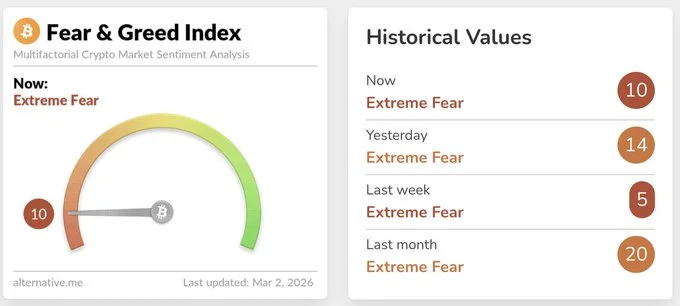
The Crypto Fear & Greed Index has dropped to 10 today, firmly placing the digital asset market in what is classified as “Extreme Fear.” Just one month ago, the index stood at 20. The sharp decline underscores how quickly sentiment has weakened amid renewed volatility and mounting macroeconomic pressure.
A reading of 10 is among the lowest levels the index can register. It signals that investors are overwhelmingly risk-averse, with panic-driven selling dominating trading activity across major cryptocurrencies.
Key Takeaways
- The Crypto Fear & Greed Index has fallen to 10, marking a significant decline from 20 last month and signaling deepening market anxiety.
- Heightened price volatility and continued macroeconomic tightening are major factors driving the current extreme fear sentiment.
- Historically, similar low index readings have often appeared near market bottoms, though they do not guarantee an immediate rebound.
- Liquidity conditions and global financial uncertainty remain key risks that could push prices lower despite already depressed sentiment.
- The market is at a critical inflection point where prolonged panic could either signal capitulation or precede a gradual recovery.
What’s Behind the Sharp Decline?
Several forces are converging to push sentiment lower.
First, volatility has intensified. Sudden price swings in large-cap cryptocurrencies have unsettled traders, eroding confidence in short-term stability. Rapid sell-offs tend to amplify uncertainty, especially in a market where leverage and derivatives trading can accelerate downward momentum.
Second, macroeconomic conditions remain restrictive. Elevated global interest rates and tighter liquidity have reduced appetite for speculative assets. When borrowing costs are high and capital is less accessible, risk assets like cryptocurrencies often face sustained pressure. Investors are increasingly cautious, preferring safer instruments over highly volatile digital tokens.
Third, sentiment itself has become a driver of further weakness. Negative headlines and social media reactions spread quickly, influencing retail traders in real time. As fear escalates, selling begets more selling. This feedback loop can deepen downturns beyond what fundamentals alone might justify.
Why Extreme Fear Deserves Attention
Historically, extreme fear readings have often appeared near market bottoms. When the majority of participants are liquidating positions in panic, much of the immediate selling pressure may already be exhausted. At that point, long-term investors sometimes begin accumulating positions quietly.
Past market cycles show that single-digit or near-single-digit readings on the Crypto Fear & Greed Index have coincided with periods of significant stress—including broad crypto downturns and macro-driven corrections. In several instances, these episodes were followed by stabilization and eventual recovery.
That said, extreme fear does not guarantee an immediate rebound. Markets can remain depressed for extended periods, particularly if macro headwinds persist. Timing a bottom in real time is notoriously difficult.
Still, professional investors monitor sentiment indicators closely. When fear is pervasive, valuations may begin to reflect worst-case scenarios. For disciplined buyers with long-term conviction, such phases can present strategic entry opportunities.
Liquidity and Macro Risks Still Loom
Despite the contrarian signal that extreme fear can represent, risks remain substantial.
Liquidity conditions are central. If global financial conditions tighten further, cryptocurrencies could experience additional downside. Reduced inflows into digital asset funds and declining trading volumes would compound weakness.
Moreover, confidence is fragile. Sentiment-driven markets require clarity and stability to rebuild momentum. Uncertainty around monetary policy, regulatory developments, or broader economic data can prolong caution among participants.
It is also worth noting that prolonged fear can dampen new capital formation in the sector. Venture funding, token launches, and speculative retail flows often slow during extended downturns, limiting near-term catalysts for recovery.
A Critical Inflection Point
With the index at 10, the market sits at a sensitive juncture. Short-term sentiment is deeply negative, but long-term structural interest in digital assets remains intact among institutional players and committed retail investors.
If macro conditions stabilize and volatility cools, confidence could gradually return. A recovery in prices would likely lift the index out of extreme fear territory, signaling improving risk appetite.
Until then, caution dominates. The current reading reflects both danger and potential. Panic has historically preceded periods of rebuilding in crypto markets, but recovery depends heavily on external economic forces and renewed investor trust.
For now, the data is clear: sentiment has deteriorated sharply over the past month, and the market remains under pressure. Whether this phase marks capitulation or the start of a deeper correction will depend on how global conditions and investor psychology unfold in the weeks ahead.