Monetizing crypto content or trading expertise has never been simple. Content creators, community leaders, and educators invest hours building trust and producing valuable insights, yet many find it challenging to turn that influence into a meaningful income stream.
With the affiliate marketing industry now exceeding $17 billion globally, the right affiliate partnership can make the difference between small referral bonuses and a consistent, scalable revenue model.
Within the crypto sector, affiliate programs have become one of the most popular monetization strategies. Exchanges like Binance, UEEx, Coinbase, and Kraken actively compete for visibility, each offering its own structures, payout models, and promotional tools.
For affiliates, this means plenty of choice, but also the challenge of identifying which platform delivers the best balance of earnings, transparency, and long-term sustainability.
The Binance Affiliate Program is one of the largest in the industry, supported by Binance’s global dominance and product range. Affiliates can earn up to 50% commission on Spot trading fees, 30% on Futures, and additional rewards such as monthly bonuses of up to $72,000.
With over 26,000 active affiliates worldwide, it’s a proven program with scale and reach. Yet, its tiered structure, strict eligibility requirements, and regional regulatory restrictions mean it might not be the perfect fit for every creator or business.
This review takes a close look at the Binance Affiliate Program, its eligibility criteria, commission structure, marketing resources, and potential drawbacks.
More importantly, we compare it against better alternatives, including programs with higher commissions, longer cookie durations, or more flexible payment options.
By the end of this guide, you’ll have the information you need to decide whether Binance is the right affiliate partner for your goals, or if one of the alternatives is a smarter move.
Key Takeaways
- Binance Affiliate Program pays up to 50% commission on Spot trading fees and 30% on Futures, with a $72,000 monthly bonus cap.
- Commissions are credited in crypto directly to your Binance account, with payouts typically available on a monthly basis.
- To qualify, individuals must have at least 5,000 followers or subscribers, while businesses need 2,000+ users or 5,000+ daily visits.
- The biggest advantage is Binance’s broad product range, allowing affiliates to earn across Spot, Futures, Pool, and other services.
- The most significant limitation is the strict eligibility and quarterly performance reviews, which can reduce commission rates if targets are not met.
- This review analyzes 10 affiliate program alternatives to compare commissions, terms, and support.
- Among the top alternatives, Bybit’s Affiliate Program stands out for its simpler entry requirements and daily payout structure.
What is the Binance Affiliate Program?
The Binance Affiliate Program is a system designed to reward individuals, content creators, businesses, and communities for referring new users to Binance, one of the largest cryptocurrency exchanges in the world.
As an affiliate, you share a personalized referral link; when someone signs up and trades using that link, you earn a percentage of the trading fees they generate, up to 50% for Spot trading and 30% for Futures.
Binance’s global reputation lends strong credibility to the affiliate program. The company supports a robust ecosystem including the exchange platform, crypto education, blockchain incubation, mobile wallet services, and more.
With daily trade volumes reaching billions of dollars and infrastructure capable of processing over 1.4 million orders per second, Binance stands out for its execution, reliability, and scope.
The program is tailored for several affiliate types. Content creators must have at least 5,000 followers/subscribers on platforms like YouTube, X (Twitter), Facebook, or Instagram.
Communities such as Telegram groups or Reddit forums must include 500+ members. Businesses or organizations qualify with 2,000+ users or 5,000+ daily visits, including media platforms, trading apps, or analytics services.
Unlike a simple referral program, which may offer a flat reward or shorter-term commission, the affiliate program offers recurring or lifetime commissions as long as the referred user is active in trading. You can choose to become a Spot affiliate, a Futures affiliate, or both, depending on your audience’s interests.
Geographically, the program is available across most of the world. However, in regions where Binance faces regulatory restrictions such as parts of the U.S., Europe, or Southeast Asia affiliate operations may be adjusted or paused. Affiliates must ensure their traffic avoids restricted jurisdictions.
Binance runs its affiliate program through its in-house system and partners with Impact, a major affiliate marketing platform, for streamlined tracking and payouts.
As an affiliate, you earn commission in cryptocurrency, directly into your Binance wallet, with payouts typically processed monthly and often with no minimum threshold for withdrawal.
Binance Affiliate Program Details
| Metric | Details |
| Commission Rate | Up to 50% on Spot trading fees, 30% on Futures, up to 30% on Pool |
| Cookie Duration | 90 days (tracking referrals for signup and trades) |
| Payment Frequency | Monthly (commissions credited directly in crypto) |
| Minimum Payout | No fixed minimum; payouts made to the affiliate’s Binance wallet |
| Payment Methods | Crypto payments directly to Binance wallet (BTC, BNB, USDT, etc.) |
| Affiliate Network | Direct via Binance, also available through the Impact network |
| Sub-affiliate Commissions | No (Binance does not currently offer multi-tier sub-affiliate earnings) |
| Available Countries | Global, but restricted in certain regions (e.g., U.S., China, Singapore, some EU markets) |
| Free to Join | Yes, no cost to apply or participate |
| Tier System | Yes – higher commission tiers for affiliates with strong performance |
How the Binance Affiliate Program Works

The Binance Affiliate Program is structured to be straightforward but selective, with clearly defined processes for application, approval, and tracking. Knowing how it works is important for affiliates to maximize results.
1. Application Process
The first step is applying through Binance’s official affiliate page. The process begins with filling out an online form where you provide your details, audience size, platform links, and business information if applicable.
Binance asks for links to your social media channels, community groups, or website, along with evidence of your follower or subscriber base.
Once you submit the form, Binance reviews your application. This review usually takes anywhere from a few days to two weeks, depending on demand and the completeness of your information.
Binance often prioritizes creators and businesses with established, engaged audiences that align with crypto education or trading.
After approval, you receive access to your affiliate dashboard and referral links. You can then begin promoting Binance services through your channels.
Not every applicant will be accepted because Binance enforces a tiered evaluation process to ensure quality referrals.
2. Approval Requirements
Binance sets clear eligibility requirements to filter for affiliates who can deliver meaningful results. For individuals, you need at least 5,000 followers or subscribers on platforms such as YouTube, X (Twitter), Facebook, or Instagram.
For communities, a minimum of 500 active members in a group such as Telegram or Discord is expected. Businesses, including trading apps, media platforms, or analytics services, must have 2,000 registered users or 5,000 daily visits to qualify.
In addition to audience size, Binance also reviews the quality of content. Affiliates must be in good standing within the crypto community, provide accurate educational or promotional material, and comply with Binance’s policies.
Any violation of terms or misleading promotion can lead to disqualification or removal from the program.
Unlike casual referral programs, the affiliate program is designed for professionals who can consistently bring active traders. This explains why Binance enforces stricter approval standards compared to many competitors.
3. Dashboard and Tracking Tools
Once accepted, affiliates gain access to a personalized dashboard. This hub includes all the key tools needed to monitor performance and earnings.
Affiliates can view the number of users who registered via their referral link, the number of active traders, trading volume generated, and total commission earned.
The dashboard also provides breakdowns by product, Spot, Futures, and Pool, so you can see which channels or promotions drive the best results. Advanced reporting tools help you analyze patterns, compare performance over time, and adjust campaigns accordingly.
Affiliates can export reports for financial tracking or campaign analysis, which is particularly useful for businesses or professional marketers. This centralized system allows affiliates to stay on top of performance without relying on third-party tools.
4. Link Generation and Management
Affiliate links are at the core of the program. Binance provides unique, trackable links that direct users to sign up or trade on the platform. Each affiliate can create multiple links tailored to different campaigns, landing pages, or audiences.
For example, you could generate one link for a YouTube video tutorial and another for a Telegram group promotion.
By doing this, you can compare which audience converts better. The dashboard records performance for each link separately, making campaign management easier and more efficient.
Affiliates also have the option to customize their links with UTM parameters. This is useful for marketers running paid ads or multiple content campaigns who want granular insights into user behavior.
5. Cookie Attribution System
The program uses a 90-day cookie duration, which is significantly longer than many competing programs. This means when someone clicks your affiliate link, Binance tracks that referral for three months. If the user signs up and starts trading within that window, you receive commission.
This long cookie period increases your chances of earning commissions from audiences who take time to explore before committing to a platform. It benefits affiliates with educational or review-driven content where users may not convert immediately but return later to trade.
However, cookie attribution is single-source. If another affiliate’s link is clicked after yours, the most recent click takes priority. This emphasizes the importance of building trust with your audience and encouraging them to register right away.
6. Performance Tracking Metrics
Performance measurement is central to the program. Binance evaluates affiliates quarterly, and your commission rate may be adjusted based on results. Metrics include the number of users referred, the percentage of users who trade actively, and the trading volume they generate.
Affiliates with strong performance can qualify for higher commission rates. For example, moving from the base 41% Spot commission to 50% requires bringing in a higher number of active traders or generating large trading volumes. Consistent underperformance, however, can reduce commissions.
On your end, you can track performance metrics in real time. This includes click-through rates, registrations, completed KYC verifications, and fee-generating trades. Together, these insights help you understand how well your campaigns convert and where to optimize.
Commission Structure of the Binance Affiliate Program
Binance rewards affiliates primarily based on trading activity, with commission rates varying by product, performance level, and quarterly results. This section breaks down each element so you can see exactly how payouts work.
Base Commission Rates
Binance offers one of the highest commission rates in the crypto exchange industry, but the percentages differ across products. For Spot trading, the base rate for approved affiliates is 41% of trading fees.
This means if a referred user makes a Spot trade and pays a $100 fee, you earn $41. The maximum Spot commission can rise to 50% if you meet certain performance thresholds.
For Futures trading, the commission structure is lower but still competitive. Affiliates earn 30% of trading fees from referred users, although this rate is typically capped at 12 months from the time the user first activates their Futures account.
In addition, referred Futures traders receive a 10% discount on their fees for the first 30 days, which makes promoting this product more appealing.
Binance Pool, which supports mining activities, has a separate affiliate structure offering up to 30% of pool fees. This gives affiliates multiple ways to monetize different segments of their audience, depending on what products they engage with most.
Tier System
Binance applies a tiered system to its affiliate program. The structure rewards affiliates who can consistently deliver new users and trading volume.
At the entry level, approved affiliates receive the base 41% commission on Spot and 30% on Futures. However, affiliates who invite more than 500 active traders or generate significant transaction volume may qualify for an upgrade to the 50% Spot rate.
This tiered structure creates a clear incentive for affiliates to scale their reach and focus on attracting higher-quality, active traders.
On the other hand, affiliates who underperform during Binance’s quarterly reviews risk being downgraded to lower commission rates. This approach keeps the program competitive and ensures Binance only rewards affiliates who bring meaningful activity to the platform.
Volume Bonuses
In addition to the base and tiered rates, Binance offers performance-based bonuses tied to transaction volume. For example, if an affiliate generates more than $14 million in Spot trading volume within 90 days, they can qualify for the top-tier 50% commission bracket.
Similarly, high-volume affiliates may receive periodic bonuses or incentives during promotional campaigns.
These bonuses are especially relevant for larger communities, trading groups, and businesses that can drive substantial user activity. Smaller affiliates may find it more challenging to reach these thresholds, which is one of the program’s limitations.
Sub-affiliate Earnings
Unlike some multi-tier affiliate programs, Binance does not currently support sub-affiliate commissions. This means you cannot recruit other affiliates under you and earn a percentage of their performance. All earnings are based solely on your direct referrals.
While this simplifies the structure, it may also be seen as a drawback compared to affiliate programs that allow second-tier earnings, as those models can create an additional passive income stream.
Special Promotions
Binance occasionally runs seasonal promotions, bonus contests, and incentive campaigns for affiliates. These can include higher commission percentages, limited-time contests for top earners, or bonuses tied to new product launches.
For instance, Binance has previously offered enhanced rewards for affiliates who promoted new features such as staking or margin trading.
These campaigns are often short-term but provide opportunities for affiliates to boost income beyond the regular commission model. Affiliates are notified of promotions via email, dashboard announcements, or Binance’s dedicated affiliate support team.
Commission Calculation Examples
To illustrate how the system works, consider a few scenarios:
Example 1: Spot Commission
If your referred user makes Spot trades that generate $2,000 in fees in a month, and your rate is 41%, you earn $820. If you qualify for the 50% tier, the same activity would earn you $1,000.
Example 2: Futures Commission
Suppose one of your referrals generates $10,000 in Futures trading fees in their first year. At 30%, your commission would be $3,000. However, after 12 months, you would no longer receive earnings from this user’s Futures activity unless Binance renews the structure.
Example 3: Mixed Product Scenario
If you refer 50 users in a quarter, generating $200,000 in Spot fees and $50,000 in Futures fees, your earnings would be:
- Spot: $200,000 × 41% = $82,000
- Futures: $50,000 × 30% = $15,000
- Total = $97,000 for that quarter, not including potential bonuses.
These examples show how performance and tier levels can significantly impact outcomes.
Payment Processing
All affiliate earnings are credited in cryptocurrency directly to your Binance wallet. Payments are processed on a monthly cycle, typically at the beginning of each new month.
Unlike some programs, Binance does not require a minimum payout threshold, so even smaller affiliates can access their commissions.
Affiliates can choose to hold their earnings in Binance or withdraw them to external wallets. Payments are usually made in the currency of the trading fees generated, commonly USDT, BNB, or BTC.
Commission Comparison Table
| Volume Level | Commission Rate | Monthly Requirement |
| Starter | 41% Spot / 30% Futures | 0 – $500,000 in referred volume |
| Bronze | 45% Spot / 30% Futures | $500,000 – $5 million in volume |
| Silver | 47% Spot / 30% Futures | $5 million – $14 million in volume |
| Gold | 50% Spot / 30% Futures | $14 million+ in 90 days |
Eligibility & Requirements of the Binance Affiliate Program
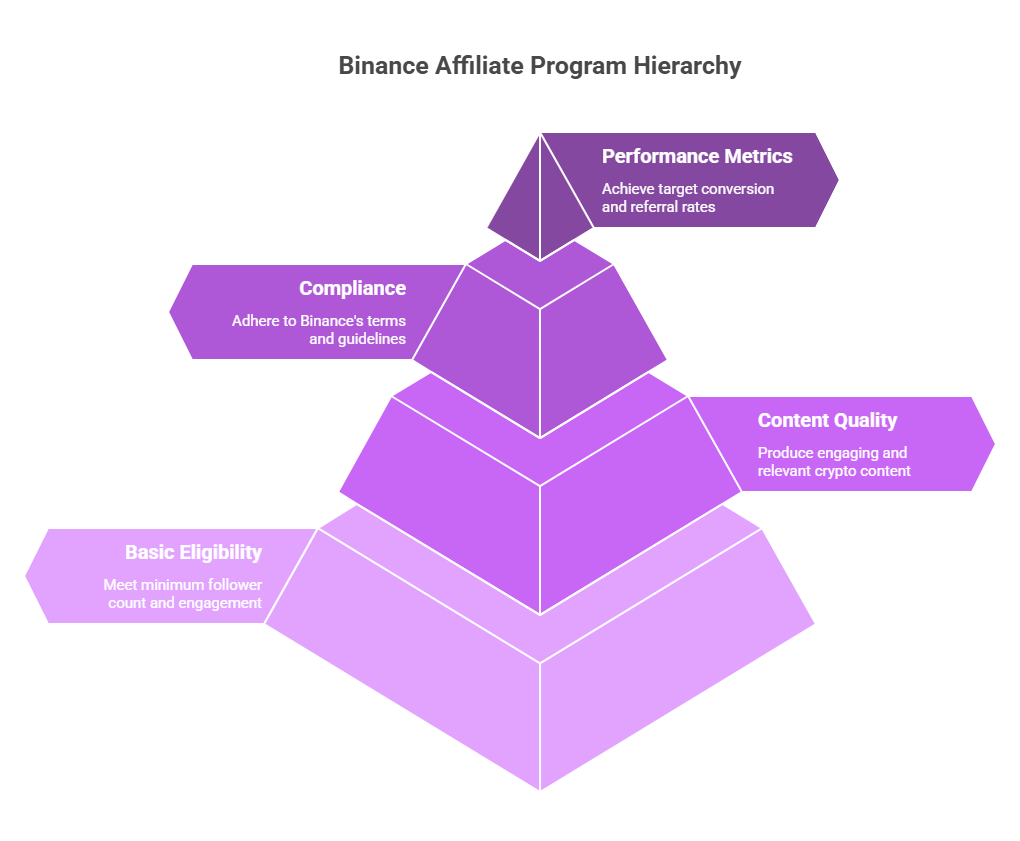
Joining the Binance Affiliate Program is not as simple as filling out a form and waiting for approval. Binance has set specific requirements designed to attract professional creators, established communities, and businesses that can consistently deliver quality users.
Content Platform Requirements
Binance evaluates affiliates based on the strength and size of their platforms. For individual creators, the minimum requirement is usually 5,000 followers or subscribers on a platform such as YouTube, Instagram, Facebook, or X (Twitter). This threshold is set to ensure affiliates already have a proven audience that can be converted into traders.
For community leaders, such as those running Telegram or Discord groups, the minimum is 500 active members. Businesses, including trading apps, media outlets, or analytical platforms, need at least 2,000 registered users or 5,000 daily visits to qualify.
Beyond raw numbers, Binance also reviews the quality of the platform. Content must be authentic, relevant to finance or technology, and demonstrate credibility in the crypto space.
For example, a YouTube channel that regularly posts trading tutorials would likely be approved, while a lifestyle blog with occasional crypto mentions may not meet the standard.
Geographic Restrictions
Binance is a global exchange, but not every country is eligible for affiliate participation due to regulatory restrictions. Affiliates cannot actively promote Binance in countries where its services are banned or limited.
These regions include the United States, Singapore, China, Malaysia, Ontario (Canada), and certain countries in Europe where regulatory frameworks are in flux. Affiliates are expected to respect these restrictions by avoiding targeted campaigns in those areas.
For applicants, this means that while your platform can be global, you need to ensure your promotional efforts are not primarily directed toward restricted jurisdictions. If most of your traffic comes from these regions, your application may not be approved.
Prohibited Promotional Methods
Binance enforces clear rules on how affiliates can promote the program. Pay-per-click (PPC) advertising targeting Binance’s brand keywords is prohibited. This prevents affiliates from competing with Binance’s own advertising campaigns.
Similarly, affiliates cannot use spam tactics such as unsolicited email blasts, automated bots, or fake accounts.
Deceptive marketing practices, including making false income claims or exaggerating potential returns, are strictly forbidden. Affiliates found violating these rules risk immediate removal from the program and forfeiture of earned commissions.
Content Guidelines
Affiliates must adhere to Binance’s broader compliance standards. Content should accurately represent Binance’s services without misleading users. For instance, an affiliate can explain how commission rates work but cannot guarantee profits to users.
Visual branding must also comply with Binance’s guidelines, meaning logos and banners provided through the affiliate dashboard should be used instead of unapproved modifications.
Affiliates are encouraged to focus on education-driven content such as how-to guides, trading tutorials, or unbiased platform reviews. Binance reviews content periodically, and violations of the guidelines can lead to warnings, commission reductions, or termination from the program.
KYC/Verification Process
To become an affiliate, you must complete Binance’s Know Your Customer (KYC) process. This involves verifying your identity with government-issued identification and, for businesses, providing proof of incorporation or business registration.
Binance uses KYC as part of its compliance with international regulations, and applications without proper verification cannot move forward.
KYC also helps prevent fraud and ensures that affiliates are operating under legitimate identities. Once completed, affiliates gain access to their dashboard and can begin generating referral links.
Account Maintenance Requirements
Approval into the program is not permanent. Binance conducts quarterly performance reviews to ensure affiliates continue to meet expectations.
These reviews measure how many active users you bring in, how much trading volume is generated, and whether your content complies with guidelines. Affiliates who fail to meet minimum thresholds may see their commission rates reduced or their accounts suspended.
To maintain eligibility, affiliates must also keep their accounts in good standing by avoiding policy violations and continuing to produce relevant, compliant content. Binance may also request updated information or additional verification documents over time, especially as regulations develop.
Binance affiliates earn rebates of 30% to 50% of the total commissions their invitees generate.
Pros of the Binance Affiliate Program
The Binance Affiliate Program comes with several advantages that make it appealing to experienced creators and large-scale affiliates.
1. High Commission Rates
One of the strongest benefits of the Binance Affiliate Program is its high payout potential. Affiliates can earn up to 50 percent on Spot trading fees and 30 percent on Futures.
This compares favorably with other platforms such as Coinbase, which offers 50 percent but only for three months.
Binance affiliates continue earning as long as their referrals remain active traders, giving them access to long-term recurring income rather than short-term bonuses.
2. Global Brand Recognition
Another advantage is the strength of the Binance brand. With daily trading volumes exceeding 60 billion dollars, Binance holds the position of the largest cryptocurrency exchange in the world.
For affiliates, this means they are not required to spend additional energy building trust with new users since the exchange already has global recognition.
Instead, affiliates can focus on creating useful content that helps audiences navigate the platform.
3. Long Cookie Duration
The program provides a 90-day cookie period for tracking referrals. This is significantly longer than the industry average, which often ranges from 30 to 60 days.
A longer attribution window increases the chance of earning commissions from users who take time to research before signing up.
This feature is particularly useful for affiliates producing educational or review-driven content where conversions may not be immediate.
4. Flexible Payouts
Binance does not impose a minimum payout threshold, which makes it easier for affiliates at all levels to receive their earnings. Payments are processed monthly and credited directly in cryptocurrency to the affiliate’s Binance wallet.
This setup benefits both smaller creators looking for quick returns and larger affiliates managing multiple revenue streams.
5. Advanced Tracking Tools
The affiliate dashboard includes detailed performance metrics and campaign management options. Affiliates can monitor registrations, trading volume, and commissions in real time.
They can also generate multiple unique links for different campaigns and compare results. For professional marketers and businesses, these tools provide actionable insights that help optimize content and promotion strategies.
Cons of the Binance Affiliate Program
Like any affiliate program, Binance comes with drawbacks that may affect earning potential and accessibility for some creators.
1. Strict Eligibility Requirements
The program is not open to everyone. Individual creators need at least 5,000 followers or subscribers, while community managers need 500 active members, and businesses must show 2,000 registered users or 5,000 daily visits.
These high entry barriers can prevent smaller or newer affiliates from participating, making the program more suitable for established platforms.
2. Geographic Restrictions
Binance cannot be promoted in several major markets, including the United States, Singapore, China, Malaysia, and Ontario in Canada.
For affiliates with a global audience, this restriction reduces the potential to convert users in key regions. While the program is technically global, regulatory bans limit its scalability in some of the most lucrative markets.
3. Quarterly Performance Reviews
Affiliates are subject to quarterly evaluations, and their commission rates can be adjusted based on performance. This ensures only high-performing affiliates retain top-tier rates, but it also creates uncertainty.
Affiliates who experience seasonal drops in traffic or trading volume may risk losing access to higher commissions, making earnings less predictable.
4. No Sub-affiliate Commissions
Unlike some other affiliate programs, Binance does not allow multi-tier earnings. Affiliates cannot recruit other affiliates and earn a share of their results.
This limits the earning potential for network marketers who prefer building referral trees. Competing programs, such as Bybit, sometimes include sub-affiliate options, giving affiliates additional passive income opportunities.
5. Limited Support for Small Affiliates
Binance provides dedicated support for top affiliates, but smaller participants often report longer response times. This can be an issue when dealing with payout questions or account concerns.
While larger affiliates may enjoy personalized account managers, newer ones may find the support system less responsive.
6. Dependence on Market Conditions
Earnings are tied directly to trading activity, which means they fluctuate with market cycles. During bull markets, trading activity increases and affiliates see higher commissions.
During bear markets, trading slows, and commissions can decline sharply. This reliance on market trends makes affiliate income less stable compared to programs tied to fixed subscriptions or services.
Real User Reviews and Feedback
User satisfaction with the Binance Affiliate Program shows a mixed pattern. Trustpilot overall ratings for Binance are low about 80% of reviews being 1-star, and only 6% are 2-star.
These figures suggest widespread frustration, though it’s important to note that Trustpilot reviews may not always focus solely on the affiliate experience.
Reddit discussions paint a more skeptical picture. One user commented bluntly:
“Definitely a scam. They are holding my money hostage after I provided video proof of ownership.” Reddit
Another user characterized Binance’s affiliate program as a pyramid:
“Influencers, referral program. It’s just a typical pyramid scheme.”
These strong opinions reflect frustration with account freezes, KYC delays, or lack of transparency, rather than the affiliate mechanics per se.
That said, there are positive signals from affiliate-focused review sites. APDB notes that affiliates can earn up to 50% commission on trades and can offer followers up to 20% trading fee discounts. While not direct testimonials, these reinforce the program’s strong earning potential.
Across platforms, common patterns emerge. Affiliates consistently praise the high commission structure, long cookie window, and tracking tools. They value having access to real-time analytics and flexible referral links. Though direct quotes are less common, these benefits are frequently cited in affiliate forums and promotional reviews.
On the flip side, frequent complaints focus on customer support responsiveness and regulatory complications. On Trustpilot, many reviewers express frustration over withdrawal delays, KYC processes, and poor customer service. These issues also surface in affiliate forums, with smaller creators noting delays in commission payouts or dashboard glitches.
Regarding response from program managers, there’s no documented public reply specifically addressing affiliate feedback. However, in general, Trustpilot commentary, Binance occasionally responds, offering troubleshooting steps or emotional reassurance. These responses, while polite, often don’t fully resolve user complaints, keeping satisfaction levels low.
Over time, sentiment appears to remain mixed. Despite Binance’s substantial growth and investment, such as the reported $2 billion injection in Abu Dhabi, affiliate satisfaction has not improved visibly in recent months. Trustpilot still shows a dominant number of low ratings, indicating that underlying frustrations remain unaddressed.
Top 8 Alternatives to the Binance Affiliate Program
Choosing the right affiliate program can shape how much you earn and how efficiently you grow your audience.
In this section, we cover eight standout options from direct crypto exchange competitors to specialized and network-based programs.
Each is described in full: who it works for, how its payouts work, its benefits and limitations, and how to get started. By comparing these alternatives side by side, you’ll be able to choose the program that best matches your goals and your audience.
Best For: Creators focused on derivatives trading and high-leverage strategies
Commission Structure
- Base Rate: 30% on trading fees
- Top Tier: Up to 50% with high performance
- Cookie Duration: Not always specified (often around 30–90 days depending on campaign)
- Payment Frequency: Typically, monthly in crypto
Key Advantages:
• Offers the same high commission potential as Binance, especially appealing for Futures-heavy audiences
• Actively supports affiliates with events and community-driven incentives
• Developer-friendly platform with a strong global derivatives user base
Limitations
• Less visibility than Binance, making conversions harder for some niches
• Terms such as cookie length or tier thresholds may not be publicly detailed
Why Choose Over Binance
If your content leans toward trading deep dives or Futures strategies, Bybit offers comparable rates with support for more niche-driven audiences.
Getting Started
You apply via Bybit’s affiliate portal, meet platform-specific criteria, and then receive banners, links, and support from dedicated account managers.
2. UPay Affiliate Program
Best For: Fintech creators and marketers promoting crypto payment tools and cards
Commission Structure
- Base Rate: 50% rebate (approx. 30 USDT per card activation)
- Top Tier: Performance-based tiers (not fully disclosed)
- Cookie Duration: Standard tracking (implied)
- Payment Frequency: Monthly payouts
Key Advantages
• Zero cost to join, no fees or hidden costs
• Strong support with promotional materials and transparency requirements
• Attractive if your audience is interested in crypto cards rather than trading
Limitations
• Less focus on trading means lower potential for high-volume commissions
• Limited documentation or reporting publicly available
Why Choose Over Binance
If your content emphasizes crypto lifestyle tools or payments, UPay offers simpler entry and solid payout without needing to cover trading behavior.
Getting Started
Sign-up is free and simple; once approved, you get your affiliate links and materials to share with your audience.
Best For: International creators targeting regions like Southeast Asia and emerging markets
Commission Structure
- Base Rate: Up to 10% on referrals
- Top Tier: Same as base in current public documentation
- Cookie Duration: Not specified
- Payment Frequency: Unknown publicly
Key Advantages
• Operates a Binance-style exchange with additional fiat banking tools for emerging markets
• Integrated fintech services like IBAN and crypto-backed loans add promotional flair
Limitations
• Lower commission rate compared to mainstream exchanges
• Lack of documentation makes long-term planning difficult
Why Choose Over Binance
Ideal if your audience resides in regions where Binance isn’t fully supported or where UEEx offers better services and localization.
Getting Started
Apply through UEEx’s affiliate or partner page; KYC and regional presence may be required.
Best For: High-volume affiliates or KOLs targeting serious traders
Commission Structure:
- Base Rate: Not directly stated
- Top Tier: Influencers can earn over $50,000/month
- Cookie Duration: Not specified
- Payment Frequency: Daily or frequent payouts implied
Key Advantages
• Massive payouts over 300 million USDT paid to affiliates globally
• Access to VIP perks, 24/7 support, exclusive AMAs, and marketing events
Limitations
• Likely suited only to top-tier affiliates with significant reach
• Less transparent tier details available publicly
Why Choose Over Binance
If you can mobilize a large, active audience, WEEX offers richer perks, higher earning ceilings, and can outperform even Binance for power users.
Getting Started
Apply via WEEX affiliate page; accepted affiliates usually get fast approval and dedicated support.
5. Coinbase Affiliate Program
Best For: Beginners or audiences new to crypto
Commission Structure:
- Base Rate: 50% of trading fees for first 3 months
- Top Tier: Same as base
- Cookie Duration: Around 30 days
- Payment Frequency: Via PayPal or bank transfer
Key Advantages
• Trusted brand and easy onboarding for new crypto users
• Ideal for mainstream audiences without deep trading experience
Limitations
• Short-lived earnings (only first three months per user)
• Lower earnings potential compared to perennial programs like Binance
Why Choose Over Binance
Great for creators targeting beginners; you’ll leverage Coinbase’s brand trust even if commissions are short-term.
Getting Started
Apply via their affiliate portal; requires simple sign-up and platform familiarity.
6. Crypto.com Affiliate Program
Best For: Audiences interested in multi-use crypto platforms (cards, DeFi, exchange)
Commission Structure
- Base Rate: Up to 25% on trading fees
- Top Tier: Performance-based increases
- Cookie Duration: Not specified
- Payment Frequency: Regular payouts (crypto/fiat)
Key Advantages
• Wide product ecosystem: exchange, NFT, card, DeFi suite
• Multiple touchpoints for affiliate promotion beyond trading
Limitations
• Lower rate than Binance
• Requires deeper product engagement from audience
Why Choose Over Binance
If your content spans lifestyle crypto services—not just trading Crypto.com offers diverse revenue opportunities.
Getting Started
Apply through Crypto.com affiliate page; likely requires basic KYC and audience metrics.
7. Coinbase Pro / Crypto Tax Tool (like CoinLedger)
Best For: Finance-focused creators covering crypto taxes or portfolio management
Commission Structure:
- Base Rate: 25% recurring commissions
- Top Tier: Likely same as base
- Cookie Duration: Not specified
- Payment Frequency: USD or crypto payouts
Key Advantages
• Recurring revenue model commissions for ongoing platform usage
• Appeals to advanced users concerned with crypto taxes or accounting
Limitations
• Lower rate and niche product
• Audience must be actively managing crypto tax matters
Why Choose Over Binance
If your niche is crypto accounting or investor education, tools like CoinLedger help monetize relevant traffic better than a trading-first platform.
Getting Started
Apply via tax software’s affiliate portal like CoinLedger; creators typically need website or content metrics.
8. Niche Platform: Ledger Affiliate Program (Hardware Wallets)
Best For: Security-focused content creators
Commission Structure:
- Base Rate: Starting at 10% per hardware sale
- Top Tier: Tiered system ensures extra perks with volume
- Cookie Duration: Not specified
- Payment Frequency: Typically fiat payouts
Key Advantages
• High conversion products. Hardware wallets remain in demand for years
• Suitable for evergreen security-related content
Limitations
• Commission per sale is lower and not volume-driven
• Audience limited to hardware advocacy niches
Why Choose Over Binance
If promoting security and crypto asset safety is your focus, you’ll add value and earn consistently with wallet sales even if commission rates are lower.
Getting Started
Join through Ledger’s affiliate portal; requires content or audience credibility.
“Affiliates get early access to new Binance products and services.”
Comprehensive Comparison Table
| Program | Commission Rate | Cookie Duration | Min Payout | Payment Frequency | Sub-Affiliates | Best Feature | Main Limitation | Rating |
| Binance | Up to 50% Spot / 30% Futures | 90 days | None | Monthly (crypto) | No | Long cookie, top-tier global brand | High entry requirements, not open in all countries | 4.2/5 |
| Bybit | 30% base, up to 50% + 10% subs | 30 days | None | Daily (crypto) | Yes (10%) | Daily payouts and sub-affiliate income | Short cookie, crypto-only payouts | 4.4/5 |
| UEEx | ~10% | Not specified | Not stated | Not disclosed | No | Emerging market fiat + crypto integration | Very low public transparency | 3.5/5 |
| UPay | ~50% rebate (≈$30 per card) | Standard (not clear) | None | Monthly (crypto/fiat) | No | Strong for payment/crypto card promotion | Lower earning potential vs exchanges | 4.0/5 |
| WEEX | High (up to $50K/mo for KOLs) | Not specified | Not disclosed | Frequent (daily implied) | Yes | VIP perks + huge payouts for top affiliates | Limited to big influencers | 4.2/5 |
| Coinbase | 50% of fees (3 months only) | 30 days | $1 | Monthly (bank/PayPal) | No | Trusted brand for beginners | Commissions expire after 3 months | 4.0/5 |
| Crypto.com | Up to 25% | Not specified | None | Monthly (crypto/fiat) | No | Broad ecosystem (exchange + DeFi + card) | Lower rates vs Binance | 3.9/5 |
| CoinLedger | 25% recurring | Not specified | Not stated | Monthly (fiat/crypto) | No | Recurring lifetime commissions | Niche appeal only for tax-focused users | 4.1/5 |
| Ledger | 10%+ per hardware wallet | Not specified | None | Monthly (fiat) | No | Evergreen demand for security hardware | Low commission % compared to exchanges | 3.8/5 |
How to Choose the Right Program
Selecting the best affiliate program is not just about commission rates. The right choice depends on your content style, your audience profile, and even how you prefer to be paid.
Below is a framework that helps you narrow down the options and choose a program that fits your specific situation.
By Content Type
YouTube creators often succeed with programs that provide high-engagement products and strong brand recognition. Binance and Bybit work well because they offer attractive rates and are highly relevant to trading tutorials, reviews, and strategy content.
For creators producing lifestyle or security content, Crypto.com or Ledger can add diversity with card services and hardware wallets.
Bloggers typically perform better with programs that have long cookie durations and evergreen products. Binance stands out with its 90-day tracking window, while CoinLedger and Ledger appeal to blogs focused on personal finance, taxes, or crypto safety.
The recurring commissions from CoinLedger are particularly valuable for bloggers who publish in-depth guides.
Social media influencers benefit most from programs with simple referral mechanics and broad appeal. Coinbase is often a good entry point thanks to its brand trust and ease of onboarding for new users.
UPay also works well for influencers highlighting crypto cards or payment tools. WEEX can be powerful for larger influencers who already have an engaged trading community.
Email marketers tend to see the strongest results from programs that reward recurring engagement. CoinLedger is a standout here because subscribers managing their portfolios or taxes often require ongoing services.
Binance can also work if emails focus on market updates and trading strategies, while UPay provides an option for fintech or card-focused newsletters.
By Audience Size
Under 1K followers usually means testing the waters with beginner-friendly programs. Coinbase and UPay are easy to join with no strict traffic requirements. Their lower barriers allow smaller creators to build momentum without needing large volumes of referrals.
1K–10K followers can start with mid-tier programs like Binance, Bybit, or Crypto.com. At this stage, creators typically have some influence and can benefit from higher commissions without strict entry requirements. UPay remains attractive here for those focusing on fintech content.
10K–100K followers opens the door to programs like WEEX, which rewards mid to large creators with additional perks, higher payouts, and event opportunities. Binance and Bybit also become more rewarding because affiliates at this scale are likely to hit higher tier thresholds.
100K+ followers are well-suited for premium programs with elite benefits. WEEX is the strongest example here, with documented six-figure monthly payouts for top influencers. Binance can also deliver significant revenue for creators at this level, especially those producing trading education or advanced content.
By Geographic Location
North America tends to favor Coinbase and Ledger due to brand trust and regulatory clarity. Binance has restrictions in the U.S., so alternatives are often necessary for American affiliates. CoinLedger also works well in this region since tax compliance is a pressing issue.
Europe affiliates can consider Binance, Crypto.com, and Ledger, which are widely accessible. UPay also has traction here, given the appetite for crypto cards and payment solutions. Regional regulations may impact availability, but most major options remain open.
Asia is a strong market for Binance and Bybit because of trading demand. WEEX and UEEx also focus heavily on Asian regions, with features and services tailored to local audiences. For affiliates in Southeast Asia, these platforms often offer localized benefits that help conversion.
Other regions such as Latin America, Africa, and the Middle East often require flexibility. UEEx and Binance work well in emerging markets, though restrictions may apply. Crypto.com and UPay are also practical choices where exchange access is limited but fintech services are growing.
By Payment Preferences
Need daily payments will find WEEX appealing, as it offers frequent payouts to high-performing affiliates. This suits influencers or traders who want faster access to their earnings.
Prefer crypto payments should look at Binance, Bybit, and UPay. All three pay commissions directly in digital assets, making them convenient for affiliates already active in crypto ecosystems.
Want high minimum thresholds may prefer platforms like WEEX, which cater to top-tier affiliates with substantial payouts, or Binance, which rewards larger creators with tiered structures. Smaller programs like Coinbase or UPay usually have lower or no thresholds, making them better for affiliates just starting.
“Binance is spending around $1 billion a year on its affiliate program, inclusive of marketing expenses and commissions.”
Tips for Maximizing Affiliate Earnings
Maximizing earnings from affiliate programs is not just about placing links in your content. Success depends on how you position your recommendations, how you drive traffic, and how effectively you convert that traffic into signups. With the right strategies, even smaller creators can see consistent income growth over time.
1. Content Optimization Strategies
The most effective affiliates create content that naturally integrates recommendations rather than forcing them. Tutorials, comparisons, and reviews often convert better than simple banners.
For example, a video explaining “How to trade Futures on Binance” with a direct signup link in the description is more persuasive than a generic ad.
You can also create case studies, walkthroughs, or success stories to show real outcomes that resonate with audiences. The goal is to make the affiliate link part of a helpful resource rather than an obvious sales pitch.
2. SEO Best Practices for Affiliate Content
Search visibility is one of the strongest drivers of consistent affiliate income. To rank, your content needs well-researched keywords, descriptive titles, and useful answers to common questions.
A blog post like “Best Crypto Affiliate Programs in 2026” can capture high-intent traffic. Use structured headings, meta descriptions, and internal links to improve discoverability.
It is also important to keep content updated, especially in fast-moving markets like crypto, where commission rates and terms often change. Search engines reward freshness and accuracy.
3. Conversion Rate Optimization Tips
Even with strong traffic, conversions depend on trust and clarity. Place affiliate links in logical spots, such as after explaining a feature or showing a benefit.
Clear call-to-action phrases like “Sign up here to start trading” work better than vague prompts. You can also test different formats such as buttons, banners, and contextual links to see what resonates with your audience.
Tracking tools can help identify which placements drive the most conversions so you can refine your approach.
4. Compliance and Disclosure Requirements
Regulations require affiliates to disclose their partnerships openly. A simple statement like “This post contains affiliate links, and we may earn a commission if you sign up” is often enough. Transparency not only keeps you compliant but also builds trust with your audience.
Avoid prohibited methods such as spam emails, misleading claims, or running paid ads on branded terms, as these can lead to program suspension or even legal consequences.
5. Tools and Resources for Tracking
Affiliate success comes down to understanding what works. Most programs, including Binance, provide dashboards with clicks, conversions, and commissions.
Beyond that, tools like Google Analytics, Voluum, or even link shorteners with tracking features can help you measure results more closely.
These tools let you track where signups are coming from, what content converts best, and which channels drive long-term value.
6. Common Mistakes to Avoid
Many affiliates fall into traps that limit earnings. One mistake is focusing only on promoting one program when diversifying could capture more of your audience’s interests.
Another is neglecting mobile optimization. Most users access crypto platforms from phones, so links and signups must work smoothly on mobile. A third mistake is ignoring content quality.
Rushed or shallow posts may generate clicks but will rarely build long-term trust or repeat traffic. Successful affiliates play the long game by providing reliable information that keeps audiences coming back.
Final Verdict and Recommendations
The Binance Affiliate Program holds one of the strongest positions in the crypto affiliate market. With commissions of up to 50 percent on Spot and 30 percent on Futures, plus a 90-day cookie duration, it remains a leading choice for affiliates who can meet its entry requirements.
Its strength comes from Binance’s global dominance in trading volume and brand recognition, which gives affiliates the advantage of promoting a platform that millions of users already trust.
However, strict eligibility rules, regulatory restrictions in several countries, and performance-based commission reviews mean it is not accessible to everyone.
The program is best suited for mid- to large-scale creators who already have a strong audience base in crypto trading. YouTube creators producing advanced tutorials, bloggers writing in-depth trading content, and social media influencers with an active finance-focused following are in the best position to maximize earnings.
Affiliates with a smaller audience, or those who focus on general finance or lifestyle niches, may struggle to meet requirements or see consistent returns, especially during market downturns.
For those seeking alternatives, three stand out as strong recommendations. Bybit offers commissions up to 50 percent, with fewer eligibility barriers and a strong appeal to affiliates with trading-focused communities. It is particularly effective for creators targeting futures traders.
CoinLedger provides recurring 25 percent lifetime commissions, making it a strong option for bloggers and email marketers who prefer evergreen products. Its tax-focused service also appeals to North American and European audiences.
UPay stands out for affiliates promoting crypto card and payment solutions. Its high rebates and broad appeal outside traditional trading circles make it ideal for influencers and fintech-focused content creators. These alternatives cover different niches, allowing affiliates to choose based on audience type and content style.
For readers ready to take action, the first step is to assess your audience and content platform. If your followers are actively engaged in trading, Binance or Bybit are likely to deliver the best returns. If your focus is on education, compliance, or lifestyle finance, programs like CoinLedger or UPay may be a better fit.
It is also wise to diversify across at least two programs to spread risk and capture more opportunities. Setting up clear tracking, testing different placements, and being transparent with disclosures should be part of the launch strategy.
Looking ahead, affiliate programs in the crypto niche will likely continue to evolve with regulation and user behavior. As compliance standards tighten, transparency and clear guidelines will become even more important.
At the same time, emerging platforms are offering competitive commissions to attract affiliates, which means creators will have more choice than ever. Those who stay flexible, adapt their content, and diversify across multiple programs will be in the best position to build sustainable affiliate income in the years to come.
Frequently Asked Questions (FAQs)
1. How does the Binance Affiliate Program compare to similar crypto affiliate programs?
Binance offers some of the highest commission rates in the industry, with up to 50 percent on Spot trades and 30 percent on Futures.
Its 90-day cookie duration also gives affiliates a longer window to earn from referred users compared to programs like Coinbase, which limit commissions to the first three months of trading activity.
However, competitors such as Bybit and WEEX provide more accessible entry requirements and sometimes more consistent payouts for smaller affiliates. The choice often comes down to audience size and the type of content you produce.
2. How often do Binance affiliates get paid?
Affiliates are typically paid monthly, with earnings credited directly to their Binance wallet in cryptocurrency. This means payouts are not subject to bank delays and are usually processed within a few days of the close of each earning cycle.
Unlike some platforms that offer daily or weekly payouts, Binance follows a monthly schedule, which suits affiliates who are comfortable with less frequent but larger payments.
3. What are the main eligibility requirements to join the program?
Binance requires affiliates to meet specific standards, especially regarding audience size and content quality.
Applicants generally need to show a strong online presence, such as a YouTube channel, blog, or social media following with an established crypto or finance audience.
KYC verification is mandatory, and Binance also reviews promotional methods to ensure they align with compliance policies.
Smaller creators may find these requirements restrictive compared to beginner-friendly programs like Coinbase or UPay.
4. What is the difference between the affiliate program and Binance’s referral program?
The referral program is designed for individual users who want to invite friends and earn a small bonus or discount.
The affiliate program is structured for content creators, businesses, and influencers who can drive larger volumes of signups and trading activity.
Affiliates have access to advanced tracking dashboards, higher commission percentages, and marketing support, while referral users are limited to basic discounts and smaller rewards.
5. Are there geographic restrictions on who can join?
Yes, Binance faces regulatory restrictions in certain countries. For example, the program is not available to U.S. residents due to compliance with local laws.
Affiliates in North America may need to look at Coinbase, CoinLedger, or UPay as alternatives.
Binance is widely accessible in Europe, Asia, Africa, and Latin America, but applicants should review local restrictions before applying.
6. Do affiliates get sub-affiliate commissions with Binance?
No, Binance does not currently offer a multi-tier or sub-affiliate structure. Some competitors, such as Bybit and WEEX, allow affiliates to earn from sub-affiliates they recruit.
Binance focuses instead on rewarding direct signups and trading activity. For affiliates seeking network-style earnings, programs integrated with platforms like ShareASale or Impact may be better suited.
7. What strategies help increase conversions with the Binance Affiliate Program?
Educational content tends to perform best. Tutorials, platform walkthroughs, and trading guides encourage users to take action and sign up through affiliate links. SEO-driven blog content, YouTube videos with clear demonstrations, and social media posts explaining benefits also convert well.
Using clear call-to-action phrases, testing link placements, and offering valuable resources such as beginner trading guides can significantly improve conversion rates.