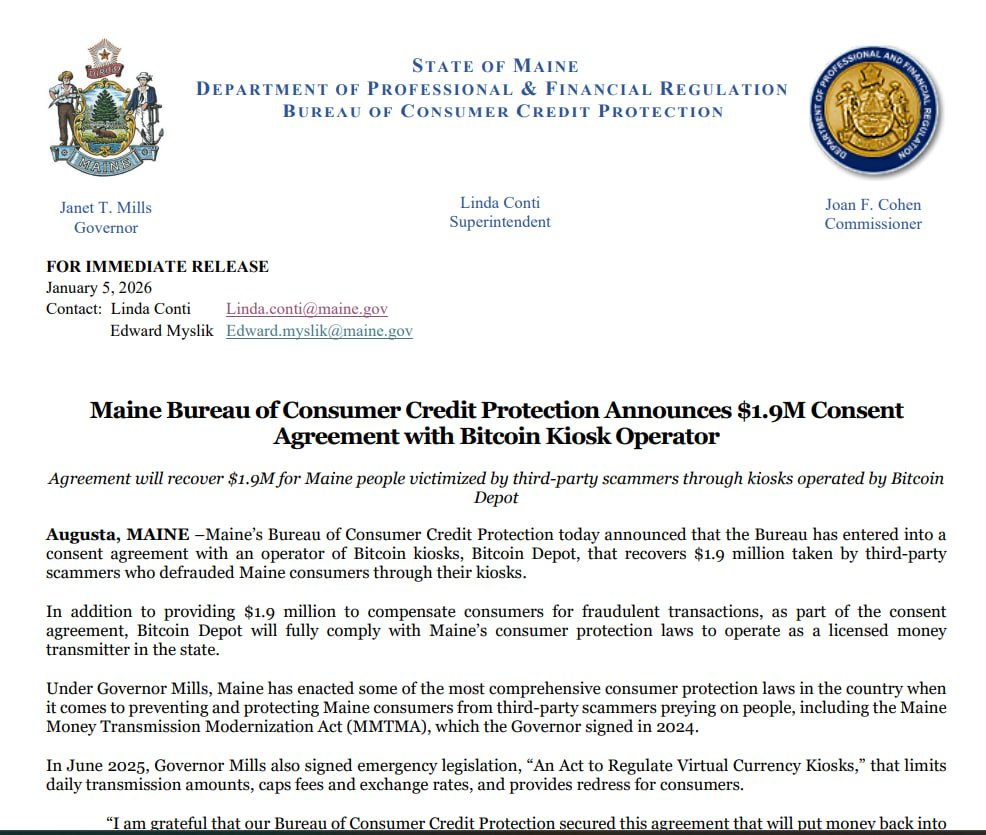
Bitcoin Depot, one of the largest cryptocurrency ATM operators in North America, has agreed to pay $1.9 million to settle allegations tied to crypto kiosk scams that affected Maine residents between 2022 and 2025.
The settlement follows a lengthy investigation by the Maine Bureau of Consumer Credit Protection, conducted in collaboration with the Office of the Maine Attorney General, and was formally signed in December before being announced publicly this week.
Under the agreement, Maine residents who lost money after being deceived into using Bitcoin Depot kiosks can seek compensation, provided they submit claims by April 1, 2026. Refunds are expected to begin in May 2026, although the exact amount each victim will receive will depend on the number of approved claims.
“We will not know how much each refund will be until we have received and reviewed all of the claims,” the bureau said in a notice published on its website.
Key Takeaways
- Bitcoin Depot will pay $1.9 million to compensate Maine residents who were scammed through its cryptocurrency kiosks between 2022 and 2025.
- Affected victims must submit claims to the Maine Bureau of Consumer Credit Protection by April 1, 2026, with refunds expected to begin in May 2026.
- The settlement followed a two-year investigation into scams where fraudsters pressured victims to send funds to unhosted wallets using Bitcoin Depot kiosks.
- Maine’s recently strengthened consumer protection and crypto ATM regulations played a central role in enabling the agreement.
- Authorities continue to investigate other crypto kiosk operators as cryptocurrency ATM fraud rises sharply nationwide.
How the Kiosk Scams Worked
The investigation found that scammers exploited Bitcoin Depot kiosks by directing victims to convert cash into cryptocurrency and send it to digital wallets controlled by fraudsters.
In most cases, the victims were instructed to deposit funds into unhosted wallets, which are wallets controlled entirely by the user and not by regulated exchanges or financial institutions.
This structure made it easier for scammers to move funds quickly and harder for victims to recover their money once the transaction was completed. According to state investigators, many victims were pressured through impersonation scams, including tech support fraud and other urgent payment schemes.
One case cited by investigators involved a Maine senior who, in 2024, was coerced by a fake tech support agent into sending funds through a Bitcoin Depot kiosk in Old Orchard Beach.
Bitcoin Depot’s Presence in Maine
Bitcoin Depot is headquartered in Atlanta and operates more than 25,000 crypto kiosks globally, including locations across the United States, Canada, Australia, Mexico, and Hong Kong. During the period under investigation, the company operated roughly 80 kiosks in Maine, primarily in York, Cumberland, Kennebec, and Penobscot counties.
Those kiosks are no longer operating in the state.
“They’ve been gone since last summer,” said Linda Conti, superintendent of the Maine Bureau of Consumer Credit Protection.
The kiosks were removed after Maine passed emergency legislation in June aimed at tightening oversight of virtual currency ATMs. While Bitcoin Depot no longer runs kiosks in the state, it remains licensed to transmit funds in Maine through online transactions.
Licensing Disputes and Regulatory Action
The settlement also addresses regulatory concerns about Bitcoin Depot’s compliance with Maine’s money transmission laws. In March 2023, bureau investigators determined that the company’s kiosks were performing money transmission activities and invited Bitcoin Depot to apply for a state license.
Although the company submitted an application that same month, regulators deemed it incomplete until February 2025. The application was ultimately denied in April 2025, a decision Bitcoin Depot appealed the following month.
In July 2025, the bureau provided the company with a list of consumer transactions where Maine residents may have suffered losses linked to third-party fraud. The $1.9 million settlement was reached soon after, without an admission of wrongdoing.
As part of the agreement, Bitcoin Depot must send the settlement funds to the Maine Attorney General’s office by February 2 and comply fully with the state’s consumer protection and money transmission laws.
Who Is Eligible for Compensation
To qualify for a share of the settlement, claimants must meet several conditions. They must have been Maine residents between 2022 and 2025, used a Bitcoin Depot kiosk located in Maine during that period, and deposited cryptocurrency into an unhosted wallet provided by a scammer or third-party fraudster.
Claims must be submitted online through the Bureau of Consumer Credit Protection. Officials emphasized that eligibility does not guarantee a full refund, as payouts will be distributed proportionally based on the total number of valid claims.
Broader Crackdown on Crypto ATMs
The Bitcoin Depot settlement comes amid heightened scrutiny of cryptocurrency kiosks across Maine. While Bitcoin Depot has exited the state, nearly 100 other crypto ATMs remain in operation, including machines run by CoinFlip, CoinStar, and Coinme.
“The kiosks are where the trouble happens,” Conti said, adding that investigations into other operators are ongoing.
Maine has taken several legislative steps to address these risks. In 2024, Governor Janet Mills signed the Maine Money Transmission Modernization Act, which expanded oversight of digital payment providers. This was followed by emergency legislation in June 2025 that specifically targeted virtual currency kiosks.
The newer rules limit daily transaction amounts, cap fees and exchange rates, and establish clearer pathways for consumer redress when fraud occurs. They also introduced an unhosted wallet provision, requiring money transmitters to adopt safeguards that ensure consumers retain genuine ownership and control of their wallets.
State Leaders Respond
Governor Janet Mills praised regulators for securing the settlement and highlighted its importance for affected residents.
“This will put money back into the pockets of Maine people who were defrauded by predatory third-party scammers,” Mills said.
She also urged residents to remain vigilant.
“I urge all Maine people to talk with their loved ones about the threats of scammers and precautions to take to avoid these cruel and often sophisticated schemes,” the governor added.
Conti echoed that sentiment, noting that regulatory tools were essential to reaching the agreement.
“Maine’s new consumer protection laws have allowed us to reach this consent agreement,” she said. “Whenever you have new technologies, you’re going to have people who are vulnerable and need to be protected.”
Rising crypto fraud nationwide
The case reflects a broader rise in crypto-related fraud across the United States. FBI data shows that Americans lost more than $333 million to cryptocurrency ATM scams between January and November 2025, a sharp increase from the $250 million reported for all of 2024.
Law enforcement agencies continue to warn that legitimate businesses and government bodies do not demand payment through cryptocurrency, gift cards, or kiosks.
Authorities are encouraging victims and concerned residents to report suspicious activity to local law enforcement or the FBI’s Internet Crime Complaint Center, as regulators push to curb abuses linked to crypto ATMs while preserving access for legitimate users.