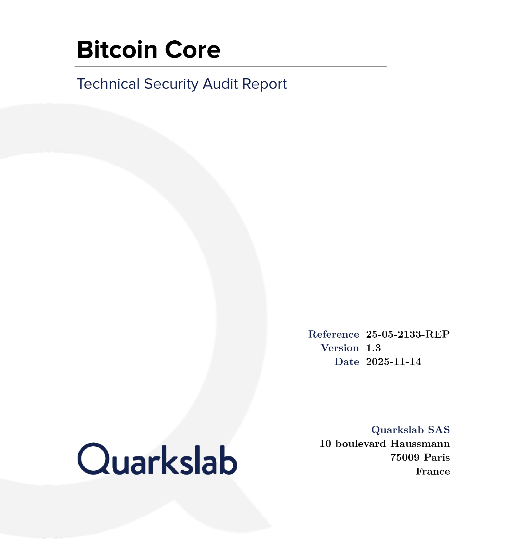
Bitcoin Core, the reference software that powers the world’s largest decentralized financial network, has completed its first-ever public third-party security audit in its 16-year history — and the results reinforce its reputation for exceptional resilience.
The review, conducted by cybersecurity firm Quarkslab and commissioned by the Open Source Technology Improvement Fund (OSTIF) with funding from Brink, found no major or critical vulnerabilities across the components that secure trillions of dollars in network value.
Key Takeaways
- Independent auditors found no major or critical vulnerabilities in Bitcoin Core after its first public third-party security review.
- The assessment highlighted the software’s maturity while identifying only two low-severity issues and several non-critical improvement suggestions.
- New fuzzing tools and testing enhancements developed during the audit are already being integrated into the Bitcoin Core codebase.
- The results reinforce confidence in Bitcoin’s underlying infrastructure at a time of heightened industry scrutiny and institutional adoption.
A Landmark Audit for Bitcoin’s Most Important Software
Despite being one of the most scrutinized open-source projects in the world, Bitcoin Core had never undergone a formal, independent security assessment. Community-led code review has traditionally carried the weight of maintaining its security.
This new audit marks a major milestone in bringing outside expertise into Bitcoin’s development process.
The assessment, which spanned roughly 100 to 104 days between May and September, focused on areas attackers are most likely to target:
- Peer-to-peer networking
- Mempool logic
- Chain-state transitions and reorganizations
- Consensus and policy validation logic
Quarkslab’s engineers — Robin David, Nicolas Surbayrole, and Mihail Kirov — worked alongside Bitcoin Core contributors Niklas Gögge (Brink) and Antoine Poinsot (Chaincode Labs).
Their methods included manual code inspection, dynamic testing, static analysis, and advanced fuzzing techniques.
Their conclusion:
“No significant security issues were identified. Most recommendations focus on refining existing fuzzing harnesses to further improve their effectiveness and coverage.”
Only Minor Findings, but Major Improvements to Testing
The audit uncovered just two low-severity issues and 13 non-classified vulnerabilities. Importantly, none of these findings affected consensus, denial-of-service resilience, transaction validation, or any of the areas that could threaten network security or stability.
Beyond identifying potential issues, Quarkslab strengthened the project’s testing infrastructure. They produced:
- New fuzz testing harnesses for block connections and chain reorganizations
- A Docker image for ensemble fuzzing campaigns
- Improvements to file system operation testing
- An experimental non-regression testing utility using Bitcoin’s tracepoints
Brink emphasized that this work is already being incorporated into the Bitcoin Core codebase, noting:
“This audit demonstrates that Bitcoin Core’s dedication to security has produced real results.”
Independent Verification Boosts Confidence Amid Industry Scrutiny
Blockchain security remains under heightened scrutiny, especially as institutional adoption grows. With more enterprises relying on Bitcoin infrastructure, the need for robust, externally verified security practices has never been greater.
Quarkslab praised the development culture behind Bitcoin Core, describing the process as:
“Both a bless by the code maturity, security culture — and a curse by the challenge it represents.”
Their findings noted that Bitcoin Core’s massive codebase — over 200,000 lines of C++ and more than 1,200 tests — is among the most mature and well-tested they have evaluated.
The audit confirmed the effectiveness of protections in the P2P networking layer, which handles block and transaction relay across roughly 125 peer connections per node. Reviewers found no scenario where malicious data could bypass validation or ban mechanisms.
Context: The Bitcoin Core vs. Knots Debate
The audit also comes amid ongoing debate between supporters of Bitcoin Core and Bitcoin Knots, sparked by the Bitcoin Core v30 update and concerns about non-financial data entering the blockchain.
While Knots advocates call for filtering such data to prevent abuse, Core developers argue that restricting data types would undermine Bitcoin’s neutrality and potentially fragment the ecosystem.
Despite the noise, institutional investors appear largely indifferent. According to Galaxy Digital researcher Alex Thorn:
- 46% were unaware of the debate
- 36% said they didn’t care
- The remaining 18% supported Bitcoin Core
The timing of the audit’s completion adds weight to Bitcoin Core’s stance by demonstrating that its existing security model remains strong.
Market Reaction: Price Swings, but Underlying Confidence
The audit was released as Bitcoin traded near $91,616, down 12% over the past week and temporarily pushing the average spot ETF investor into negative territory for 2025. Yet leading industry voices argue the price drop does not reflect a shift in fundamentals.
Bitwise CIO Matt Hougan told clients the pullback is “short-term noise,” adding that Bitcoin’s value, like that of major tech companies, ultimately depends on user demand.
Michael Saylor echoed that sentiment, explaining that institutional adoption has actually reduced volatility, not increased it. While his firm first bought Bitcoin during a period of roughly 80% annualized volatility, he estimates it has since fallen to about 50%.
“Bitcoin is stronger than ever… the company is engineered to take an 80 to 90% drawdown and keep on ticking,” Saylor said.
Meanwhile, Cameron Winklevoss suggested that Bitcoin below $90,000 may be a final opportunity for investors before the next upward cycle.
Analysts remain divided on whether current price movements represent a broader correction or temporary macro-driven pressure, but the audit adds an important layer of reassurance about Bitcoin’s long-term security.
A New Standard for Security in Open-Source Blockchains
For Bitcoin Core, the audit represents a turning point. While the project has always been rigorously reviewed by its community, formal external verification sets a stronger precedent for transparency and accountability.
As the Bitcoin ecosystem grows and regulatory expectations increase, such audits may become a standard requirement rather than an exception.
For now, the Quarkslab assessment reinforces a core message: Bitcoin’s foundational software remains robust, mature, and ready for the demands of its expanding global role.