Can we finally trust our health data to move as fast as our diagnoses? Right now, blockchain in healthcare is answering that question with real solutions.
From secure medical records to automated insurance claims, this technology is redefining how healthcare systems share, protect, and use information.
This article looks into how blockchain is being applied across the healthcare ecosystem, the benefits it brings, the real-world projects leading the shift, and the challenges that still need to be addressed for large-scale adoption.
Key Takeaways
- Blockchain helps healthcare systems share data securely, accurately, and without tampering.
- Patients can control who sees their health records using private keys.
- Hospitals and clinics can reduce costs by automating billing and claims.
- Blockchain supports better privacy and compliance with health data regulations.
- New startups and global projects are already using blockchain in real healthcare settings.
What is Blockchain Technology?

Blockchain is a type of database that stores information in a way that makes it nearly impossible to change or tamper with.
Instead of saving data in one central place, it breaks it into blocks and links them together in a chain, with each block holding a record of transactions.
These blocks are stored across a network of computers, so everyone in the network has the same version of the data. This setup makes blockchain very useful for situations where people need to share and trust the same information without relying on a single authority.
“The global blockchain in the healthcare market amount to $5.61 billion in 2025, witnessing a double-digit growth throughout the forecast period of 2018-2025.”
Key Features Relevant to Healthcare
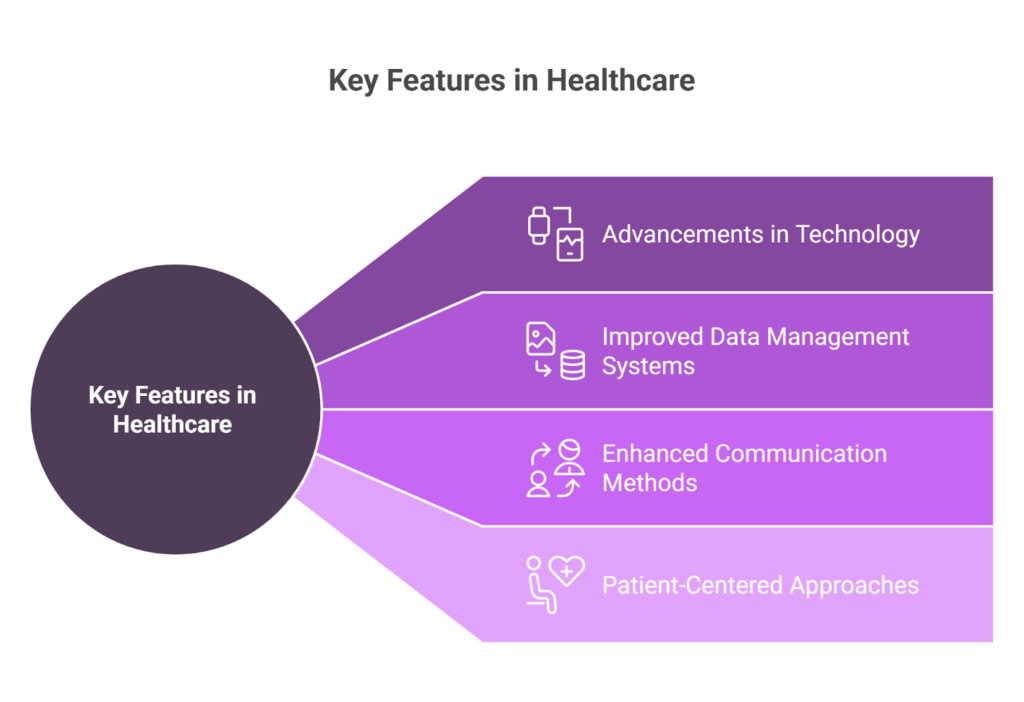
Here are the three key features of blockchain as they relate to healthcare, each explained in detail:
Decentralization
Blockchain does not rely on a central server to store data. It spreads records across many computers, or nodes, in a network. In healthcare, this means that patient records are not held by a single hospital or clinic.
Every node keeps a copy of the same information, so if one node fails or is attacked, the data is still safe and accessible.
This setup also boosts trust. Doctors, patients, labs, and insurers all see the same version of records. No single entity can alter data without the rest noticing.
Transparency and Immutability
Every record stored on a blockchain is time-stamped and linked to the previous one. Once added, a record cannot be changed or deleted. If someone tried to edit a patient’s medical history, they would need to change all the following records on enough nodes to override the system. That makes tampering nearly impossible.
In a healthcare setting, this exact feature supports auditing claims, drug supply chains, clinical research, and any other use case where trust and accuracy are essential.
Smart Contracts
Blockchain can automate agreements through smart contracts. These are programs that run automatically when certain conditions are met. In healthcare, smart contracts can handle things like insurance claims automatically.
When a patient meets treatment criteria, the contract can trigger a payment without manual review, reducing delay and fraud.
They also support consent management. Patients can grant or revoke permission to share health data with doctors or researchers with clear, recorded rules in place.
“Smart contracts account for 20 % of blockchain adoption in healthcare billing and claims”
Types of Blockchains Used in Healthcare

This section breaks down the main types of blockchains used in healthcare and how each one supports secure and efficient data management.
Public Blockchain
Public blockchains are open networks where anyone can join, read, write, or validate transactions. They rely on consensus mechanisms like proof‑of‑work or proof‑of‑stake to ensure trust. In healthcare, these blockchains can support systems such as public health data repositories or patient consent registries, where transparency is essential.
Because they are fully decentralized, public blockchains make it nearly impossible for any single entity to alter records. That ensures strong data integrity and promotes trust among participants. On the flip side, public blockchains often struggle with scalability and can be slower.
They may also raise concerns over data privacy since records are visible to all nodes. This makes them more suitable for healthcare use cases that require public verification rather than confidential patient records.
Private Blockchain
Private blockchains restrict access so that only approved participants can join and validate transactions. They are managed by a single organization, such as a hospital network using Hyperledger Fabric or Corda. This setup gives healthcare providers full control over who accesses patient information.
These blockchains are fast and scalable because the number of nodes is limited, and consensus can be streamlined. This makes them ideal for internal EHR systems, credential management, or secure data exchange among trusted partners.
However, because control is centralized, trust relies on the managing organization. Stakeholders may worry about single‑point failures or hidden changes, and these systems may lack the transparency found in open networks.
Consortium (Federated) Blockchain
Consortium blockchains are semi‑decentralized networks governed by several trusted organizations. In healthcare, this could be a network of hospitals, insurers, and labs jointly managing a shared ledger.
They balance privacy and collaboration. Each organization controls its access, but no single entity has full authority. This makes them well suited for clinical trial data sharing, supply chain tracking, and coordinated care, especially where HIPAA compliance matters.
The shared governance among institutions ensures trust and interoperability. These networks can be efficient and secure while avoiding the drawbacks of purely private or public systems. Governance complexity and decision‑making remains a challenge in consortium setups.
Hybrid Blockchain
Hybrid blockchains combine elements of both public and private models. They allow some data and transactions to stay private, while other records are visible on a public chain.
In healthcare, a hybrid setup might store confidential patient records privately while logging audit trails or drug provenance data on a public layer. This gives systems the benefits of public verification without exposing sensitive details.
Hybrid chains offer flexibility and can be tailored to a range of use cases. They still require thoughtful design to ensure the right balance between transparency, privacy, and control.
“Around 25 % of pharmaceutical firms use blockchain to track medical supplies.”
Current Challenges in the Healthcare Industry
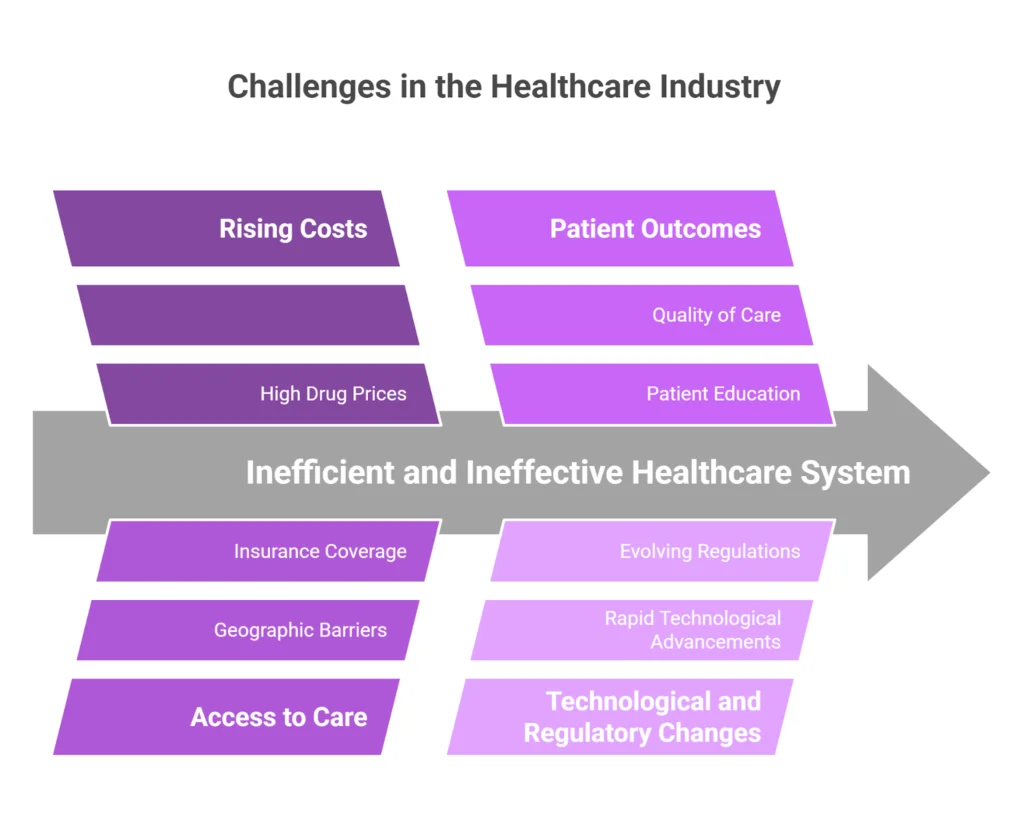
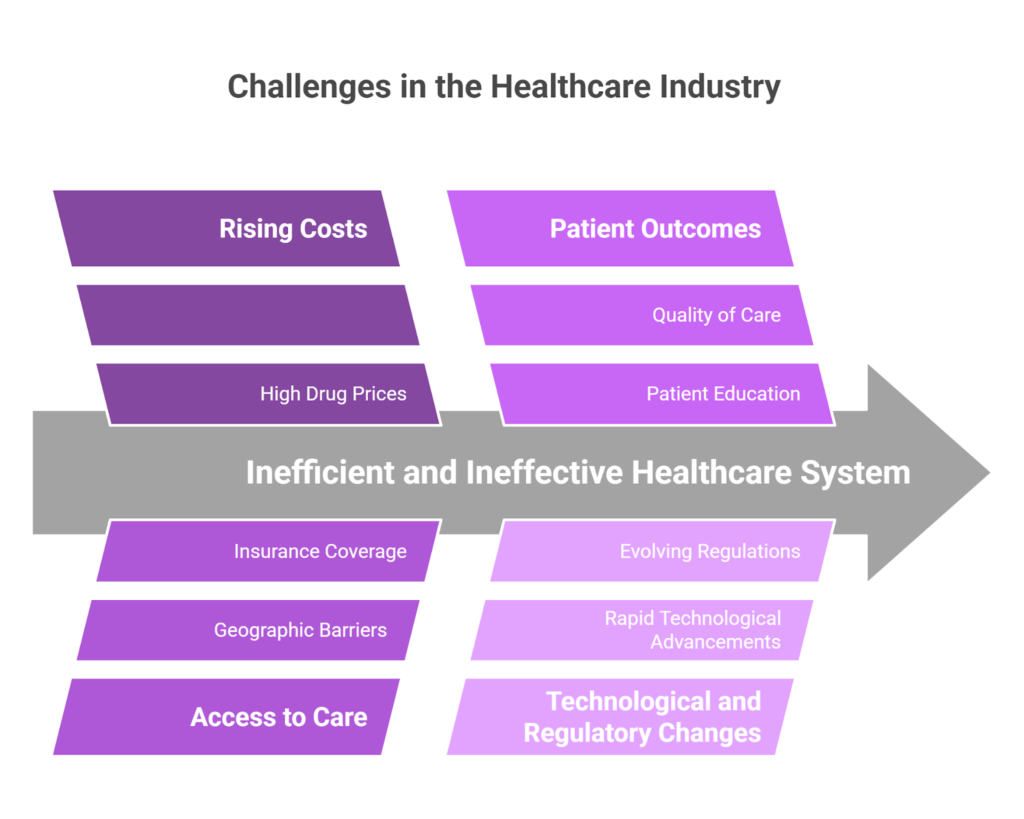
Healthcare systems around the world face long-standing issues that impact patients, providers, and all-around service delivery.
Fragmented Health Data Systems
Healthcare data is often scattered across hospitals, clinics, labs, and insurers. That creates gaps when a patient moves between providers. Their full medical history may not be easily accessible, leading to repeated tests or missed insights.
Doctors can struggle to get the full picture. This fragmentation interrupts continuity of care and can cause delays.
Many systems use different data formats and storage methods.
One clinic might use an older EHR system, while another uses a cloud-based portal. Without a unified standard, sharing data becomes a manual, error-prone process. Existing standards like FHIR help, but adoption remains uneven.
This fragmentation hinders patient safety and inflates costs. Patients may get duplicate imaging or lab work. Care coordination suffers and administrative burden grows. Finding a solution to unify data while preserving privacy is key.
Data Breaches and Cybersecurity Threats
Healthcare holds high-value personal data, making it a prime target for hackers. In 2024 and early 2025, the U.S. saw hundreds of breaches affecting millions. Ransomware, phishing, and insider threats are now daily risks.
For example, Frederick Health suffered a ransomware attack in January 2025 that exposed nearly one million patient records, including Social Security numbers and medical data.
Another major incident involved Change Healthcare, affecting over 100 million Americans and disrupting services for months.
These breaches can delay care, raise financial costs, and undermine patient trust. In 2024, the average cost of a data breach in healthcare exceeded $9 million and often caused delays in treatment. Strengthening security and protecting sensitive data are urgent priorities.
Lack of Interoperability
Interoperability means different systems can share and understand data. Many hospitals and providers still operate in silos, using proprietary formats. That slows down patient transfers and complicates care coordination.
Efforts like FHIR and Health Information Exchanges aim to address this. The U.S. has made FHIR a standard and launched statewide HIEs to streamline data flow. Yet adoption is uneven. Some regions or organizations lag in implementing these systems, leading to fragmented communication.
Without interoperability, patient data stays stuck. Doctors cannot see full histories. Labs and insurers cannot easily verify information. That leads to errors, delays, and extra work. Improved interoperability would support safer, faster care delivery.
Slow Claims Processing and Administrative Overhead
Insurance claims often require manual review, verification, and approvals. That can take weeks or months. Claims staff must verify codes and patient eligibility, which takes time and overhead.
Fraud and errors add complexity. Some claims are inflated or false. Investigating and resolving these cases drives up costs. Studies show smart contracts on blockchain could help by automating approvals and reducing delays.
For patients, these delays can mean uncertainty or paying out of pocket. For providers, they tie up revenue and cause cashflow issues. Reducing this burden could free up staff resources and speed up reimbursement.
Drug Traceability and Counterfeit Risks
The pharmaceutical supply chain moves drugs through manufacturers, distributors, pharmacies, and patients. Each step introduces risk. Counterfeit or damaged medications can enter the system.
Solutions like MediLedger and BlockPharma use blockchain to trace drugs from production to the pharmacy. In Africa, platforms like mPedigree let consumers verify drug authenticity via SMS.
Accurate tracking helps prevent counterfeit drugs and ensures recalls work fast. That boosts patient safety and trust in medication. Transparent tracking also supports regulatory oversight and accountability.
Applications of Blockchain in Healthcare
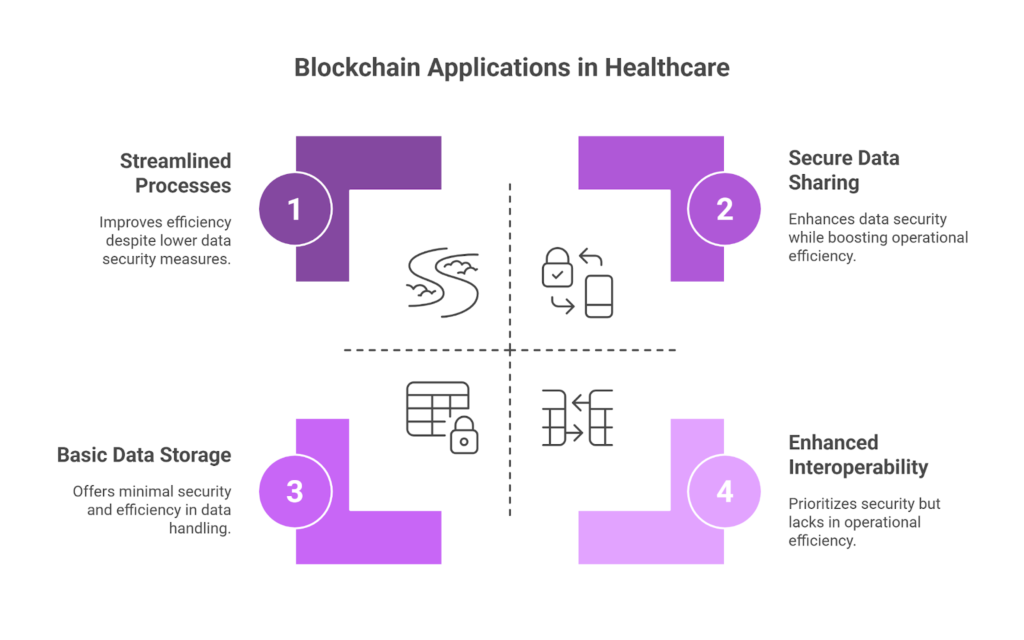
Blockchain is being applied across healthcare to solve problems around trust, data sharing, and process efficiency.
Secure Patient Data Management
Blockchain offers a single, shared ledger where patient records are stored across a network. Platforms like MedRec from MIT and Beth Israel Medical Center let patients control who can access their health history with permission-based keys.
All updates like new lab results or prescriptions are added as linked entries, so no one can alter past data without being detected.
This system gives patients direct oversight. They can grant or revoke access to doctors, labs, or specialists, ensuring only authorized people see their information. Since all records are visible to everyone on the network, providers work from the same reliable data.
That improves care and makes it easier to coordinate between clinics.
Guardtime’s platform in Estonia also uses blockchain to verify EMRs with cryptographic stamps.
This makes it easy to track any changes and pinpoint where an entry came from. This setup removes the need for repeated data transfers and cuts down administrative delays.
Clinical Trials and Research
Blockchain can store trial data in a transparent and unchangeable way. Platforms like BlockRx and tools such as SCoDES record every participant interaction, consent update, and data upload in real time.
These entries are permanent and time-stamped, which prevents issues like selective reporting or changing trial outcomes later.
Smart contracts handle consent dynamically. If a participant changes their mind, the system updates access permissions automatically. That builds trust and shows regulators that the process follows rules precisely.
LabTrace used blockchain in a Parkinson’s study at King’s College London. Their tool verified data authenticity and logging, and the university highlighted how on-chain proof improved data quality and accountability
Pharmaceutical Supply Chain Management
Tracking drugs from production through delivery helps prevent fakes and protects public health. Systems like FarmaTrust, MediLedger, Chronicled, and IBM’s Transparent Supply project use blockchain to log each handoff. Each batch gets unique identifiers and every step of its journey is recorded
When a pharmacy scans a package, they can check its origin and handling. This ability helps spot counterfeits before they reach patients. In the U.S., blockchain pilots under the DSCSA helped pharmacies verify drug history in seconds instead of days.
Smart sensors can add data like temperature or humidity during transport. If conditions fall outside safe ranges, the blockchain record flags it. This helps meet safety standards and alert authorities during a recall.
Medical Billing and Insurance Claims
Insurance claims often stall because of manual checks and paperwork. Blockchain can automate this through smart contracts. When a treatment matches coverage terms, the contract triggers automatic payment. This can reduce delay and stop billing errors.
For example, MetLife and other insurers have tested blockchain claims systems. These systems verify eligibility and trigger reimbursements faster. They also keep a clear audit trail to help resolve disputes.
Doctors and patients benefit too. Providers get faster payments and the billing team spends less time fighting paperwork. Patients get clarity on what services were covered and why some costs reached them manually.
Telemedicine and Remote Monitoring
Home monitoring devices record data like heart rate or glucose levels. When these measurements are logged on blockchain, they’re tamper-proof and secure. Platforms like Solve.Care and Akiri let doctors receive and verify this data remotely.
Blockchain also manages consent. Patients decide who can see their data and can revoke access at any time. This gives them control while doctors get trusted, accurate information.
Encrypted peer-to-peer data sharing keeps the information secure even when recorded on another node. This way clinicians can access valid data without relying on central storage.
Health Credential Verification
Verifying doctors and nurses takes time and involves checking licenses and certifications. Blockchain can store credential data securely. Platforms like ProCredEx let hospitals check staff records instantly.
No one can tamper with a credential once logged. That saves manual work and protects against fraudulent claims. Hospitals onboard staff faster and patients feel safer.
A shared credential ledger also simplifies collaboration. If a nurse moves between hospitals, their verified status moves with them.
Genomics and Personalized Medicine
Genomic data is sensitive and complex. Blockchain platforms like Nebula Genomics, EncrypGen, and Shivom let individuals store genetic information securely and control who accesses it.
Researchers can access needed data while respecting consent. They see who accessed it and for what purpose. That builds trust and protects privacy.
Some platforms let individuals license their genomic data for research. This gives people control and turns data sharing into a transparent, possibly profitable process.
Blockchain Healthcare Projects in 2025
The following projects offer a clear look at how blockchain is reshaping healthcare operations, data access, and patient experience in 2025.
Guardtime & Estonian National System
Guardtime’s Keyless Signature Infrastructure (KSI) is integrated with Estonia’s national e-health system. Every patient record is time-stamped and linked via hash, creating an unchangeable audit trail. If anyone tries to change a record, the system flags it instantly because the hash won’t match the chain.
Estonia uses this technology at scale. Over one million health records are protected across hospitals, laboratories, and clinics. The KSI network runs alongside Oracle databases, adding a layer of integrity without replacing existing systems.
Their Real World Data Engine uses blockchain to allow aggregated queries across institutions. Drug makers can verify outcomes without accessing patient-level data. It supports outcomes-based contracting with full traceability and privacy
IBM Blockchain for Healthcare
IBM offers private blockchain solutions built on Hyperledger Fabric. Its healthcare uses include secure sharing of patient records, claims workflows, and medical supply chains. This is an extension of its established Food Trust network adapted for healthcare data.
IBM also partners with platforms like QANplatform to enhance security and compliance. QAN’s tamper-proof log system is now part of IBM’s suite to help clients improve breach transparency.
Hospitals and insurers can use IBM Blockchain to track claims and provider credentials. The shared ledger allows each stakeholder to verify data without relying on a central authority. This speeds processing and keeps an audit trail.
Real‑World Case Studies
To understand the impact of blockchain in healthcare, it’s important to look at where and how it’s being used today.
Estonia’s Digital Health Success
Estonia was an early adopter of blockchain for healthcare integrity. Beginning in 2016, the state integrated Guardtime’s Keyless Signature Infrastructure (KSI) with its national EHR system.
Every change or access to a patient record is time‑stamped, hashed and verifiable. This created an immutable audit trail that made it nearly impossible to tamper with health data without detection.
The system works alongside existing databases, so hospitals and clinics did not need to overhaul their technology. Instead Guardtime adds a verification layer that checks the integrity of each transaction. Any mismatch in the hash immediately flags an issue.
Estonia now secures over one million health records this way and extends the platform to the national biobank. The Guardian system shows proof of data origin before sharing genetic or medical data for research . This has positioned Estonia as a global model for secure health data.
UnitedHealthcare Smart Claims Pilot
UnitedHealthcare partnered with blockchain developers to test using distributed ledger for insurance claims. The pilot focused on automating eligibility and claim adjudication with real‑time verification of patient coverage and treatment codes.
UnitedHealthcare could track the full claims workflow submission, approval, and payment in a transparent audit trail by logging each transaction on the chain. This reduced manual steps and streamlined dispute resolution.
The system allowed both providers and members to see claim status instantly. That cut waiting time for reimbursements and reduced administrative overhead. The pilot demonstrated how blockchain can speed up claims by sharing trusted data among stakeholders.
MediLedger in U.S. Pharma Supply Chain
MediLedger launched a blockchain network in 2019 to ensure compliance with the U.S. Drug Supply Chain Security Act. Leading manufacturers and wholesalers including Pfizer, Genentech, McKesson, and AmerisourceBergen joined the network to trace returned drugs at the package level.
The platform uses a shared ledger to track serialization events and maintain an immutable log of product movement. This single source of truth replaced manual calls and emails with real‑time verification of authenticity.
The FDA pilot found the system fast, scalable and cost‑effective. It also showed how zero‑knowledge proofs could protect sensitive supply curve data while preserving traceability. The industry hopes to use this as a model for broader drug recall and safety workflows.
Blockchain for COVID‑19 Vaccine Records
During the pandemic, blockchain platforms helped manage vaccine distribution and recordkeeping. Guardtime rolled out VaccineGuard in Estonia in 2021 to track vials from manufacturer to patient.
It created signed attestations at each step shipment, storage, administration and enabled real‑time monitoring of stock, integrity, and counterfeits.
Countries like Malaysia, Singapore and South Korea used blockchain to secure vaccination certificates. A Reddit user noted that Singapore and Malaysia adopted systems that ensured certificates could not be forged and included batch tracking details.
In India, the Maharashtra government stored a public vaccination certificate on Polygon, which users could verify by transaction ID.
EU Blockchain Observatory in Health
The EU Blockchain Observatory began exploring healthcare use cases in 2022. It published a thematic report on blockchain’s role in storing healthcare data securely, supporting pharmaceutical traceability, and improving transparency in pandemic response.
That report examined real‑world examples like VaccineGuard and suggested standards for data integrity, privacy, and consent management. It included interviews with experts on ethical and regulatory implications.
By collecting best practices and pilot outcomes, the Observatory offers guidance to EU countries evaluating blockchain in public health. That helps inform future projects on cross‑border vaccine records, drug monitoring, and patient data sharing.
Benefits of Blockchain in Healthcare

This section looks at the most important benefits of using blockchain to improve trust, efficiency, and transparency in healthcare.
Stronger Privacy and Data Security
Blockchain stores patient information in a way that blocks unauthorized changes and hides sensitive details. It encrypts every transaction and distributes copies across many nodes, making it hard for hackers to attack any single point.
This setup significantly lowers the risk of large-scale data breaches and makes unauthorized changes obvious.
Patients remain in control. They hold private keys that enable or disable access to their data. The ledger also keeps a detailed record of who accessed what and when, helping meet privacy requirements like HIPAA.
This approach turns data security from a reactive to a proactive stance. Since each access is time-stamped and recorded, organizations can identify suspicious activity quickly rather than discovering problems after the fact.
Accurate and Immutable Medical Records
Once data is written to blockchain, it can’t be altered or deleted. This immutability ensures that medical histories stay accurate and prevent fraud or tampering.
Healthcare providers see the same record regardless of where they access it. That consistency improves care coordination, avoids errors, and reduces redundant testing.
It also supports better audits. Regulators, insurers, and care teams can all review the same record knowing it represents a complete and unchanged history of events.
Lower Admin and Operational Costs
Smart contracts on blockchain automate tasks such as insurance claims verification, billing rules, and referrals. They trigger predefined actions once conditions are met, reducing manual work and errors.
Automation speeds payments and data exchanges. It minimizes time spent on paperwork and review, which in turn frees up resources. Fewer errors also translate to less time spent resolving disputes and more accurate billing.
In shared systems, multiple stakeholders (hospitals, labs, insurers) work from the same verified ledger. That eliminates duplicate efforts and associated costs
Streamlined Clinical Research and Trials
Blockchain can store clinical trial data in a transparent, organized, and unchangeable manner. Researchers, sponsors, and regulators can see each data point and timestamp without risk of tampering.
Platforms like ClinTex and Triall track consent, enrollment, outcome data, and adverse events on chain. This strengthens trust and helps ensure compliance with regulatory standards.
A pilot at King’s College London used LabTrace on Algorand to create verifiable logs in a Parkinson’s study. That pilot proved blockchain could support research quality and accountability.
Greater Transparency and Compliance
Blockchain’s public audit trails help regulators and auditors verify data quickly. Every action is logged, reducing the need for manual record review.
This feature supports compliance with laws like HIPAA and GDPR. Since data access and usage are recorded and traceable, organizations can show they meet requirements.
Clear visibility also builds trust among participants. Providers, insurers, and patients all see the same record, which means fewer disputes and faster problem resolution.
Patient Empowerment and Control
Blockchain puts patients in charge of their data. They choose who sees their records and for what purposes by granting access via blockchain keys.
They also receive a full history of data access requests. That transparency lets them audit who viewed their information and when.
Some platforms let patients monetize their genomic or health profile in research settings. They can grant consent, track use, and receive compensation all while retaining ownership.
Barriers to Adoption of Blockchain in Healthcare

Despite its promise, blockchain in healthcare still faces practical challenges that slow down widespread adoption.
Legacy Systems Integration
Many healthcare providers still rely on legacy electronic health record systems that are deeply embedded in daily operations.
These systems often use proprietary formats and lack interoperability. Integrating blockchain into such an environment requires building bridges or gateways, which means additional development work and cost.
Healthcare staff must learn new workflows and systems without disrupting patient care. That transition can slow adoption since providers are reluctant to replace systems that “work,” even if imperfect. Changing their workflow requires planning, training, and oversight.
Integration projects can stretch over months or years. Institutions must coordinate with vendors, comply with regulations, and avoid data loss. Unless integration is smooth, staff may resist the effort and delay or abandon the initiative.
Scalability Challenges
Blockchain networks often face limits in transaction speed and data volume. Healthcare generates massive amounts of records daily. Public blockchains like Bitcoin or Ethereum cannot handle that scale without slowdowns.
Private or segmented blockchains ease the load, but health systems still need fast, near‑instant updates. Ongoing research explores sidechains or layer‑2 solutions, but these add complexity and cost.
Until systems can support millions of daily transactions with no lag, healthcare providers may avoid blockchain for critical workloads. That limits its deployment to pilots or low‑volume use cases.
Cost of Implementation
Blockchain projects carry high upfront costs. Organizations must spend on infrastructure, software development, and integration. They often need to hire specialized talent with higher salaries.
Smaller clinics face tough choices since return on investment is not immediate or guaranteed. They may prefer improving current systems over adopting experimental technologies.
Governments or payers would need to subsidize pilot projects. Without an incentive, many providers may delay or avoid blockchain.
Technical Knowledge Gaps
Blockchain is still a new field. Healthcare IT teams often lack experience in smart contracts, cryptography, or distributed systems.
Training existing staff requires time and money. A network needs developers to write code, architects to design secure systems, and operations teams to maintain them.
Without internal capacity, many institutions turn to vendors with fixed solutions. That often leads to mismatched needs or overhyped expectations, undermining long‑term trust and adoption.
Storage Limitations on Chain
Blockchain networks are inefficient at storing large files like medical images, genomics, or detailed reports.
The standard approach is to store hashes on-chain and hold bulk data off-chain, often in cloud or distributed storage like IPFS. Implementing such hybrid architecture takes design effort and careful key management.
Without a resilient off-chain solution, projects risk bottlenecks, inconsistent data linkage, or security gaps. That often delays deployment.
Organizational and Cultural Resistance
Healthcare institutions are typically slow to change and risk‑averse. Stakeholders may distrust blockchain or feel it complicates workflows without proven benefits.
Leaders rarely commit resources until they see success in similar organizations. Without case studies or regulatory backing, many resist adoption.
Changing culture requires education, training, and small wins. Institutions that pilot blockchain to solve real problems and share outcomes tend to gain internal support and scale faster.
Legal, Ethical, and Regulatory Considerations

Before blockchain can scale across global healthcare, legal frameworks and ethical standards must evolve to support its use.
HIPAA and Blockchain Alignment
Blockchain fits HIPAA by offering secure storage, strong access control, and detailed audit trails. Encrypting protected health information and managing keys ensures only authorized users see data.
Every access or update is time-stamped and logged, which supports HIPAA’s requirement to track patient data usage.
Careful architecture planning is essential. Systems should use permissioned blockchains where each participant is verified and authorized. A hybrid design can keep actual health records off-chain and store only encrypted hashes on-chain. This allows updates while keeping an immutable audit trail intact.
Organizations also need compliance agreements. Covered entities must set up business associate agreements with blockchain vendors. They must control who can access data, follow the minimum necessary principle, and regularly audit their systems to meet HIPAA standards.
GDPR vs Blockchain Immutability
GDPR grants individuals rights like data access, correction, and erasure. Those rights clash with blockchain’s immutable design, where data cannot be deleted once recorded.
One solution is to avoid storing personal data on-chain. Instead systems can keep sensitive information off-chain and only store encrypted pointers or hashes on-chain. If someone needs to erase or update data, they change it off-chain and log a new pointer on-chain.
Blockchain developers must also run data protection impact assessments before collecting or storing personal data. They need clear consent mechanisms and should ensure data portability. Governance must define who is the data controller and data processor in a shared ledger setting.
Informed Consent and Data Rights
Blockchain can improve consent transparency by recording each consent event on-chain. Patients can see when consent was given and revoke it later. Smart contracts enforce these rules automatically.
Recording consent on chain ensures a verifiable trail. It can let oversight bodies check whether data uses align with patient permissions. This builds trust and accountability.
However, not everyone has equal access or understanding. Organizations must educate users about consent implications and ensure systems are easy to use. They also need to assign clear responsibility for consent management.
International Healthcare Regulations
Healthcare crosses borders, so blockchain projects must navigate rules like 42 CFR Part 2 in the U.S. and GDPR in Europe. These laws may require stricter controls on data processing or sharing.
Organizations building global systems should engage legal experts early. They must decide what data stays on-chain versus off-chain and adapt to different jurisdiction requirements around retention, access, and reporting.
Building governance frameworks is essential. Parties in a coalition need clear roles, responsibilities, and agreements covering data handling, liability, and oversight before launching a shared ledger.
AI + Blockchain Ethical Dilemmas
Combining AI with blockchain adds layers of complexity. These solutions process sensitive data that may influence clinical decisions. Ethical issues include bias in training data, transparency of AI outputs, and potential misuse.
Blockchain can help by capturing AI decision logs and data lineage. This allows audits to verify why a recommendation was made, offering explainability and trust. But immutable logs may capture sensitive details, creating new privacy challenges.
Ethical governance must address consent for AI use, data ownership, accountability, and algorithm testing. Oversight bodies should review designs to ensure fairness, accuracy, and transparency while avoiding unintended harm.
Emerging Trends in 2025
The healthcare space is developing fast, and blockchain is at the center of some of the most promising trends in 2025.
Blockchain‑AI Synergy in Predictive Healthcare
Blockchain and AI work together to analyze health data securely. Blockchain stores encrypted, immutable patient records. AI then processes that data to identify patterns like disease risk or treatment response.
Platforms like BurstIQ’s LifeGraph use blockchain to ensure data integrity while AI runs on top securely. This gives doctors insights without exposing raw patient data.
This combination aims to boost early diagnosis and personalized care. The secure infrastructure means decisions come from trusted data, making the process reliable and fair.
Mental Health and Data Privacy on Chain
Mental health data is deeply personal and needs tight protection. Blockchain offers encrypted logs and strong access control so only those with permission see sensitive details.
Projects use zero‑knowledge proofs to confirm mental health credentials or session attendance without sharing details. Apps like ZOSA encrypt therapy sessions on-chain so users can keep conversations private.
This approach boosts trust for users seeking support. People feel safer knowing control lies with them, and care providers get verified yet respectful access.
Decentralized Identity (DID) Integration
Decentralized identity systems let people verify and share credentials securely. They do not need to repeat identity checks across hospitals or insurers.
Patients use DID wallets to manage who sees EHR records. They control which doctor or app gets access. Researchers get verifiable consent with no extra logs.
This simplifies onboarding and cross‑institution interactions. It reduces duplication and lowers friction, helping systems work together better.
Tokenizing Medical Data for Research Access
Blockchain lets people tokenise their health data for research. Patients can grant access through tokens and even receive rewards.
The Decentralized Health Intelligence Network (DHIN) shows how people can share data securely, participate in AI training, and earn tokens.
This model encourages broad data sharing. Researchers get reliable datasets while participants keep control and may gain from it.
DAO‑Led Health Research Initiatives
Decentralized autonomous organizations (DAOs) run on smart contracts and let groups govern research projects. Members vote on funding and protocols.
DAOs can fund clinical pilots or drug trials in a transparent, community‑driven way. Participants see updates on chain and decisions made securely.
This creates more democratic research. Stakeholders like patients and scientists contribute directly, improving trust and relevance.
Blockchain in Global Medical Tourism
Medical tourism involves traveling for care. Patients need credential checks, health records, and billing across borders. Blockchain offers verifiable, shared records and provider IDs.
Global networks can authenticate doctor credentials with DIDs and share records across countries without repeated paperwork. Smart contracts handle payments and claims.
This setup offers safe, convenient care abroad. Patients can verify provider quality and avoid fraud while access expands in a seamless, trusted environment.
Key Stakeholders in the Ecosystem
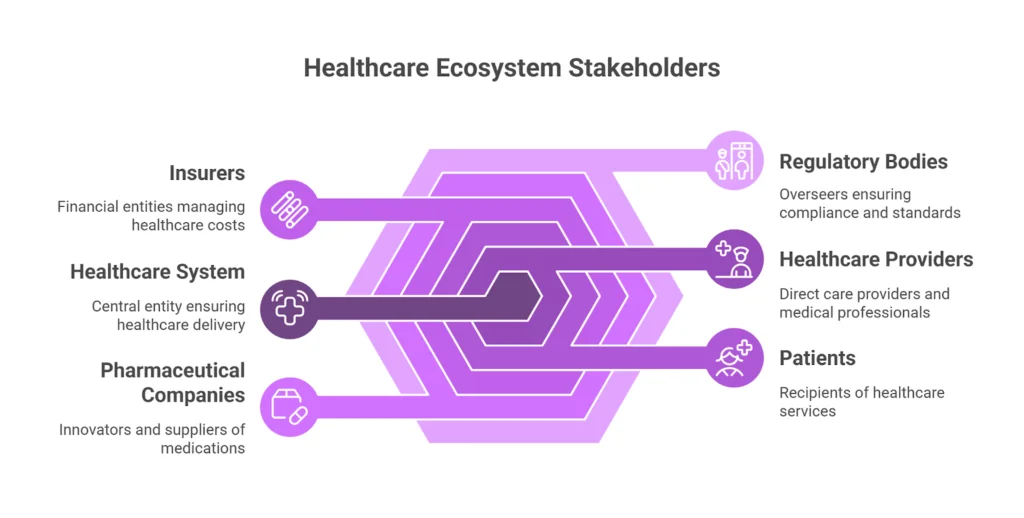
This section breaks down the main groups involved in adopting and advancing blockchain technology across healthcare.
Healthcare Providers and Hospitals
Doctors, nurses, lab technicians, and hospital administrators rely on accurate patient data to diagnose and treat effectively. Blockchain helps by creating a shared ledger where providers across clinics or hospitals can access the same verified records. This ensures they work from one source of truth rather than isolated files.
When a patient travels between facilities, blockchain ensures their history follows them. Providers don’t need to chase files or wait days for records to arrive. They can access lab results or imaging immediately, thanks to hashed records and standardized formats.
In emergencies, such instant access can mean faster treatment and fewer mistakes. The system also logs who accessed what and when, which helps maintain accountability and transparency.
Patients and Consumer Advocates
Patients are at the center of healthcare services. On blockchain platforms they can manage permissions for their health data. They hold private keys and can grant or revoke access any time.
Advocates push for transparency and data rights. They want systems that let patients audit who accessed their data and why. Blockchain delivers that with time‑stamped logs and shared visibility across providers.
This gives patients more control and trust in the system. It empowers them to share data for research or specific treatments with peace of mind.
Health Insurance Companies
Insurers process claims, verify treatments, and manage payments. They benefit from blockchain’s smart contracts. These automatically verify codes, eligibility, and care terms before releasing payment.
This cuts down manual audits and speeds claim settlement. It reduces administrative overhead and dispute resolution cycles.
The shared ledger means both providers and payers see the same claim history. That reduces the chance of fraud or duplicated claims.
Pharmaceutical Manufacturers
Drug makers track medications throughout the supply chain. Counterfeiting is a serious threat, but blockchain records each production, shipping, and storage step.
With serialized identifiers, pharmacies or hospitals scan packages and immediately verify authenticity. This increases patient safety.
Manufacturers also track adverse event data, lot numbers, and temperature logs. That supports recalls and regulatory compliance through transparent audit trails.
Regulators and Policymakers
Regulators enforce rules like HIPAA and GDPR. They require systems that secure data access and protect patient rights. Blockchain’s audit trail helps organizations prove they follow regulations.
Policymakers study pilot projects and reports to guide public investment or law updates. They look at what works, what fails, and where standards are needed.
By understanding blockchain’s capacity and limits, regulators can shape frameworks so that innovation meets trust and safety goals.
Blockchain Startups and Developers
Startups design and build blockchain tools for healthcare. Companies like Coral Health, Chronicled, and Embleema focus on interoperability, supply chain, data wallets, and clinical research platforms.
They work alongside providers and insurers to tailor solutions. They must meet strict healthcare regulations and technical specs, balancing privacy, performance, and security.
Their success drives adoption. When a startup shows real impact like reduced fraud, faster claims, or patient satisfaction it encourages others to invest and build on it.
Future Outlook of Blockchain in Healthcare 2025

This section looks at where blockchain in healthcare is heading, and what still needs to be solved.
Long‑Term Impact on Global Healthcare
Blockchain’s core strengths secure data sharing, data integrity, and transparent audit trails have the power to reshape healthcare internationally.
By 2030 blockchain healthcare spending is projected to grow from USD 17 billion in 2024 to well over USD 236 billion by 2033, showing strong market confidence and rapid expansion.
Global health systems could adopt blockchain to create unified patient records that work across borders. That would enable consistent care when people move or seek treatment abroad. It could also speed up international research collaborations by ensuring reliable data sharing.
The result would be a more connected system where providers, patients, payers, and regulators trust the same source of truth. New standards and interoperable platforms would support better outcomes and lower costs, especially in cross-border care and global public health emergencies.
Timeline for Scaled Implementation
Blockchain use in healthcare is no longer limited to small pilots. By 2025 private and hybrid blockchain models are handling large volumes of transactions at scale.
For instance enterprises now manage thousands of transactions per second and anchor public-chain records for added transparency.
Over the next two to five years, expect broader rollouts in EHR sharing, supply chain tracking, clinical trial transparency, and smart claims systems. Clinical trial blockchain systems are already valued at USD 250 million globally in 2025 with over 35 % CAGR through 2030.
Market growth forecasts show blockchain‑enabled healthcare infrastructure will reach billions over the next decade (e.g., USD 3 billion in 2025 to USD 45 billion in 2030).
That indicates healthcare organizations are readying for mid‑term implementation, moving beyond pilots to production systems.
What Needs to Be Solved Next
Scaling blockchain in healthcare requires addressing key challenges around interoperability, cost, and standards. Fragmented legacy systems remain a barrier, and institutions need shared protocols to connect networks reliably.
Cost and regulatory clarity are critical. Many providers need stronger business cases and incentive models to invest. Governments and payers may need to subsidize early adoption to unlock value at scale.
Lastly, governance frameworks for cross‑institution and cross‑border networks must be developed. This includes defining data roles (controller, processor), smart contract standards, shared liability, and ethics, especially when technologies like AI are layered on top of blockchain systems.
Conclusion
Blockchain in Healthcare 2025 shows how decentralized technology is no longer just a future concept but a working solution to real problems in the health sector.
From improving how records are stored and shared to helping patients control their own data, blockchain is driving a shift toward more secure, efficient, and transparent healthcare systems.
Global projects, government pilots, and private platforms are proving that the technology can work at scale when integrated with smart policy, strong governance, and real clinical needs.
While challenges remain around cost, regulation, and system compatibility, the progress made so far suggests that blockchain will continue to play a growing role in shaping how care is delivered, accessed, and managed in the years ahead.
Frequently Asked Questions (FAQs)
What is blockchain in healthcare?
Blockchain in healthcare refers to the use of decentralized digital ledger technology to securely manage, share, and verify health data across providers, patients, insurers, and regulators in a transparent and tamper-resistant way.
How is blockchain improving healthcare in 2025?
Blockchain is improving healthcare in 2025 by making medical records more secure, reducing fraud in drug supply chains, enabling real-time data sharing between providers, and giving patients more control over their health information.
Is blockchain secure for storing medical records?
Yes. Blockchain is secure for storing medical records because it uses cryptographic encryption, decentralized nodes, and immutable data structures to prevent tampering and unauthorized access.
Can blockchain reduce healthcare costs in 2025?
Yes. Blockchain can reduce healthcare costs by cutting administrative overhead, automating claims processing with smart contracts, and minimizing duplicate testing and record-keeping.
Does blockchain support interoperability in healthcare?
Yes. Blockchain supports interoperability by enabling secure data exchange between different healthcare systems using a common ledger that records standardized patient data.
Is blockchain compliant with healthcare regulations like HIPAA and GDPR?
Yes, but with conditions. Blockchain can be made compliant with HIPAA and GDPR through permissioned networks, off-chain storage of personal data, and built-in consent mechanisms.