The Short Answer; No, cryptocurrency is not a scam. It is a technology: a decentralized digital money system built on blockchain infrastructure. Like email, mobile payments, or online banking, the technology itself is not fraudulent. However, crypto’s characteristics attract bad actors who exploit it. Americans lost $11.4 billion to crypto-related fraud in 2025 (FBI IC3 Report). The critical distinction: separating bad actors from the technology they exploit.
Key Takeaways
- Cryptocurrency is not a scam. It is a technology built on blockchain, now processing over $32 trillion in annual stablecoin transaction volume and supporting $98.4 billion in DeFi and $103 billion in US institutional ETF assets.
- Americans lost $11.366 billion to crypto-related fraud in 2025, a 22% increase from 2024, according to the FBI’s 2025 IC3 Report. This was more than half of all $20.9 billion in total internet crime losses reported to the FBI.
- Crypto investment fraud (pig butchering) was the single largest category at $7.2 billion in 2025. Americans over 60 accounted for $4.4 billion (39%) of all crypto fraud losses, up 56% from 2024.
- Only approximately 15% of victims report fraud. Estimated true global crypto fraud losses may approach $35 billion annually.
- The FBI’s Operation Level Up prevented over $500 million in losses since its 2024 launch by contacting potential victims mid-scam. Critically, 78% of those contacted were unaware they were being scammed.
- Recovery scams targeting previous victims generated over $1.4 billion in additional losses in 2025. Be extremely cautious of any service claiming it can recover lost crypto funds.
Read Also: Cryptocurrency Security: Protecting Your Digital Assets
Why Has Crypto Become a Breeding Ground for Scams?
Cryptocurrency has unfortunately become one of the most commonly exploited vehicles for financial fraud. As the industry gains value and broader public attention, so does the number of fraudulent activities targeting new investors. Understanding why this happens is the first step toward protecting yourself.

Why Is Crypto Particularly Attractive to Scammers?
Cryptocurrency’s unique characteristics create structural advantages for fraudsters that traditional financial systems do not provide:
- Transaction irreversibility: Once a blockchain transaction is confirmed, it cannot be reversed. Unlike credit card payments or bank wires, there is no chargeback mechanism. Scammers know that a completed transfer is final, which is why they work urgently to get funds moved before victims realise what is happening.
- Pseudonymity: Crypto transactions link to wallet addresses rather than verified identities. While on-chain activity is publicly visible and increasingly traceable by blockchain analytics firms, scammers can operate anonymously long enough to extract funds and disappear before law enforcement can identify them.
- Technological knowledge gap: Many new crypto users do not fully understand wallets, private keys, smart contracts, or how exchanges work. Scammers exploit this knowledge asymmetry, using technical jargon and fabricated complexity to prevent victims from asking the questions that would expose the fraud.
- Historically uneven regulation: For much of crypto’s history, the regulatory environment was unclear or unenforced in many jurisdictions. This created a permissive environment for scammers who could operate with minimal fear of prosecution. The improving regulatory environment in 2025 is beginning to change this.
- FOMO and rapid price movements: The potential for large gains attracts people who are emotionally susceptible to urgent investment pitches. Scammers use real price movement history and fake screenshots of gains to create the emotional pressure that overrides victims’ critical judgment.
“In 2025, 78% of potential victims contacted by the FBI’s Operation Level Up had no idea they were being scammed. The fraud can be sophisticated and convincing even to financially experienced people.”
What Are the Most Notable Crypto Scams in History?
Several high-profile fraud cases have shaped public perception of cryptocurrency. Understanding them helps separate the technology from the criminals who exploited it:
OneCoin (2014 to 2019)
OneCoin remains one of the largest financial frauds in history. Masterminded by Ruja Ignatova, it promised investors extraordinary returns through a supposedly revolutionary cryptocurrency that never actually existed on any blockchain. Fuelled by aggressive multilevel marketing and charismatic leadership, OneCoin is estimated to have defrauded investors out of approximately $4 billion before collapsing in 2019. Ignatova vanished and her whereabouts remain unknown. The critical point: OneCoin was not a cryptocurrency at all. It was a Ponzi scheme using crypto terminology as a disguise.
BitConnect (2016 to 2017)
BitConnect lured victims with a lending platform that promised unsustainable returns for investors who deposited Bitcoin into its lending program. The platform operated as a pyramid scheme: early investors were paid using funds from later investors rather than from any legitimate trading operation. The scheme collapsed in 2017 when the economics became unsustainable. BitConnect’s native token fell from over $400 to near zero within days of the shutdown. The platform’s aggressive referral bonuses and guaranteed-return promises were the textbook red flags that warned of its fraudulent nature.
FTX (2019 to 2022)
FTX serves as a warning that fraud can occur even within apparently established platforms with prominent institutional backers. Founded by Sam Bankman-Fried, FTX reached a peak valuation of approximately $32 billion before collapsing in November 2022 amid revelations that customer funds had been misappropriated and used by the affiliated trading firm Alameda Research. FTX filed for bankruptcy with an estimated $8 billion hole in customer funds. Bankman-Fried was convicted on seven counts of fraud and conspiracy in November 2023 and sentenced to 25 years in prison. The lesson: exchange custody risk is real. Not your keys, not your coins.
Pig Butchering (2020 to Present)
The most financially damaging crypto fraud type of the 2020s is not a single named scheme but a category: pig butchering investment fraud. Scammers, predominantly operating from organised criminal compounds in Cambodia, Laos, and Myanmar, spend weeks or months cultivating apparent friendships or romantic relationships with victims via dating apps, LinkedIn, or WhatsApp. Once trust is established, the scammer introduces a fake crypto investment platform showing fabricated returns. Victims invest increasing sums and often borrow against their homes or 401(k) plans before the platform and scammer vanish. In 2025, pig butchering accounted for $7.2 billion in US losses alone. The US Attorney’s Office District of Columbia Scam Center Strike Force was specifically formed to investigate these networks in 2025.
What Are the 10 Most Common Types of Crypto Scams?
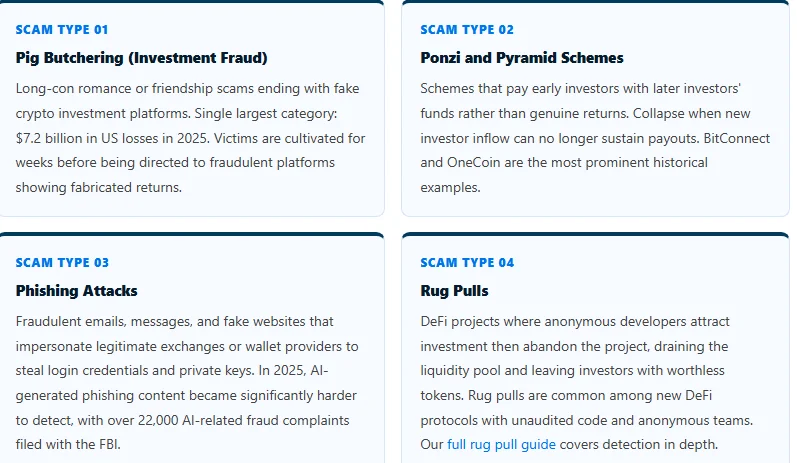
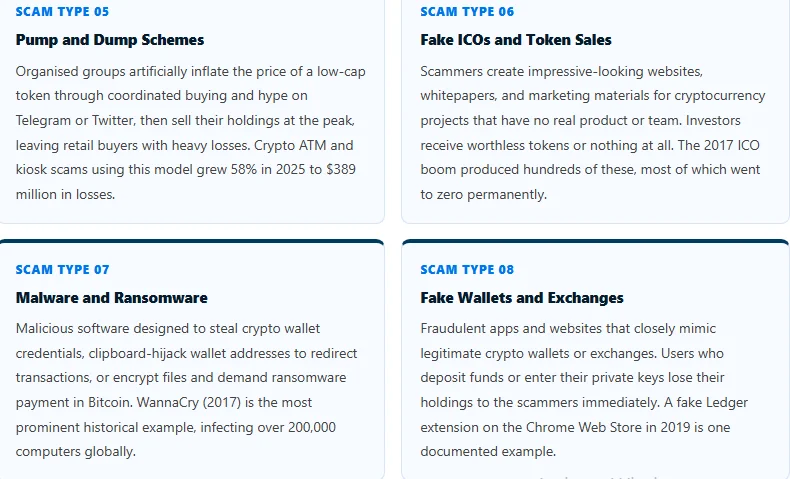
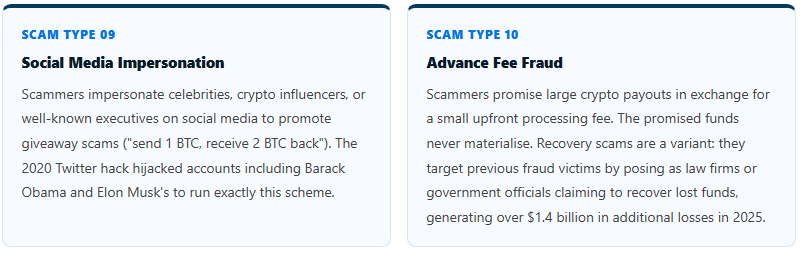
Recovery scam warning: If you have already been a victim of crypto fraud, be extremely cautious of services claiming they can recover your funds. Recovery scams generated over $1.4 billion in additional losses in 2025 by targeting known fraud victims. The FBI specifically notes that fraudsters have impersonated IC3 employees to approach previous victims. True blockchain transaction recovery is extremely difficult and rarely successful through any service.
Read Also: Rug Pulled! How to Avoid Crypto’s Most Sinister Scams
How Do You Tell a Legitimate Crypto Project from a Scam?
Differentiating legitimate crypto projects from scams is one of the most important skills for anyone participating in the crypto space. The characteristics that separate them are consistent and learnable:
Red Flags That Indicate a Potential Scam
- Promises of guaranteed returns or unusually high fixed yields with no risk disclosure
- Anonymous or unverifiable team with no professional history or real identities
- Pressure to act immediately or to recruit others to earn bonuses
- Vague or technically meaningless whitepaper with no clear use case or architecture
- No public code repository or third-party smart contract audit
- Marketing focused entirely on price appreciation rather than technology or utility
- Inability to withdraw funds without meeting increasingly complex conditions
- Unsolicited contact through dating apps, social media, or messaging platforms leading to investment discussions
- Platform or token that has existed for less than six months with no track record
- No regulatory registration or compliance disclosure in any jurisdiction
Signs of a Legitimate Crypto Project
- Named team with verifiable professional histories, LinkedIn profiles, and public track records
- Clear, technical whitepaper explaining the specific problem being solved and how
- Open-source code available on GitHub with an independent security audit from a reputable firm
- Transparent, realistic development roadmap with documented progress
- Honest risk disclosures with no promises of guaranteed returns
- Active but measured community engagement without high-pressure recruiting tactics
- Regulatory compliance or an active, documented compliance programme
- Revenue or usage metrics that justify the project’s value proposition without needing new investors to sustain existing ones
- Listed on reputable, regulated exchanges with robust KYC and AML procedures
- Smart contracts that have been formally audited by third parties like Certik, Trail of Bits, or OpenZeppelin
| Characteristic | Scam or Fraudulent Project | Legitimate Project or Platform |
|---|---|---|
| Team identity | Anonymous or unverifiable; LinkedIn profiles created recently with no history | Named, verifiable team with multi-year professional histories and public credibility |
| Returns promised | Guaranteed returns, fixed daily percentages, or dramatically above-market yields | Market-rate yields with risk disclosures; no guarantee of returns |
| Code transparency | Closed source; no audit; or audit by unknown or self-created firm | Open-source; audited by Certik, Trail of Bits, or equivalent reputable firm |
| Withdrawal conditions | Withdrawal requires paying additional fees, taxes, or meeting escalating conditions | Withdrawals processed at stated network fee cost with no additional arbitrary conditions |
| Regulatory status | No regulatory registration; no KYC/AML; often operating from offshore shell structures | Registered with relevant regulators; KYC and AML compliant; published compliance policies |
| Marketing tone | Urgency, FOMO, referral bonuses, and income claims dominate all communication | Technology and use case focused; measured community engagement; risk transparency |
What Steps Can You Take If You Have Been Scammed?
Recovering funds from a cryptocurrency scam is extremely difficult due to the irreversibility of blockchain transactions. However, the following steps maximise your chances and help protect others:
Report Immediately to Authorities
File a detailed complaint with the FBI’s Internet Crime Complaint Center at IC3.gov. Include every available detail: wallet addresses involved, transaction IDs, screenshots of all communication, and any platform URLs. The FBI uses this data to identify patterns, connect cases, and potentially freeze assets through exchanges before they are moved. Operation Level Up has prevented over $500 million in losses since its 2024 launch by acting on IC3 reports. Also file with the FTC at ReportFraud.ftc.gov.
Contact Any Exchanges Involved Immediately
If the fraudulent transactions passed through or involved known cryptocurrency exchanges, contact their compliance teams immediately. Provide full transaction details and request an account freeze on any associated wallets. Some exchanges, particularly regulated ones operating under KYC and AML requirements, have procedures for flagging and potentially reversing or freezing transfers still in settlement. Speed matters: the window for any exchange-level intervention is narrow.
Seek Legal Counsel Experienced in Crypto Fraud
Consult a lawyer who specialises in cryptocurrency and financial fraud cases. They can advise on civil litigation options, help communicate with exchanges and regulators on your behalf, and assess whether any assets might be recoverable through legal action. Some law firms specialise in tracing and recovering stolen crypto through blockchain analytics and court orders compelling exchanges to freeze wallets.
Engage Reputable Blockchain Analytics Firms
Cybersecurity professionals and blockchain analytics firms like Chainalysis, TRM Labs, and Elliptic can trace stolen funds across the blockchain and potentially identify where they were moved. While their services have cost and cannot guarantee recovery, their findings can support legal action and law enforcement investigations. Only engage firms with a documented track record and industry recognition.
Join Support Communities and Share Information
Online communities for victims of crypto fraud can provide practical guidance, moral support, and collective pressure that sometimes draws law enforcement attention to specific fraudulent operators. Sharing wallet addresses and platform names publicly also alerts others and can help blockchain analytics communities track bad actors.
Beware of recovery scams: After reporting a loss, many victims are targeted by follow-on recovery scams where fake law firms or fake government officials claim they can retrieve funds. These generated over $1.4 billion in additional losses in 2025. The FBI has confirmed that fraudsters have specifically impersonated IC3 employees to approach previous victims. Never pay upfront fees to any recovery service.
Read Also: Misconception About Crypto: Crypto Is Difficult to Understand
How Are Regulators Fighting Crypto Scams?
The regulatory response to crypto fraud has intensified significantly in 2024 and 2025, with both enforcement actions and structural improvements that are reducing the permissiveness previously enjoyed by bad actors:
US Federal Enforcement in 2025
The FBI launched Operation Level Up in 2024 to proactively identify and notify people actively falling victim to cryptocurrency investment fraud. By early 2026, the programme had notified over 8,000 victims and prevented over $500 million in losses, including $225 million in 2025 alone. The US Attorney’s Office District of Columbia Scam Center Strike Force was formed in 2025, merging resources of the US Attorney’s Office, the Department of Justice’s Criminal Division, the FBI, and the Secret Service specifically to target and disrupt pig butchering compounds in Southeast Asia.
Regulatory Frameworks That Reduce Scam Opportunities
The GENIUS Act of 2025 established the first US federal stablecoin framework, requiring stablecoin issuers to maintain full reserves and comply with AML and KYC obligations. The OCC granted national bank trust charters to digital asset custodians. The SEC’s streamlined ETF approval framework reduced the opportunity for unregulated fake investment products to masquerade as legitimate regulated vehicles. In Europe, MiCA (Markets in Crypto Assets) regulation brought all crypto service providers under licensing requirements across 27 EU member states from late 2024. These frameworks raise the compliance floor and make it harder for fraudulent operators to present as legitimate businesses.
| Regulatory Action | Date / Status | Impact on Fraud Prevention |
|---|---|---|
| FBI Operation Level Up | Launched 2024; active 2025 | Prevented $500M+ in losses; notified 8,000+ active victims; 78% were unaware of the scam |
| US Scam Center Strike Force | Formed 2025 | Targets pig butchering networks in Southeast Asia; disrupts US-based infrastructure supporting scam operations |
| GENIUS Act (US) | Passed 2025 | Federal stablecoin framework with reserve, KYC, and AML requirements; reduces fake stablecoin scam vectors |
| MiCA (EU) | Full force December 2024 | Licensing requirements across 27 EU member states; unregulated exchanges and issuers must comply or exit EU markets |
| Financial Fraud Kill Chain (FFKC) | Active and expanded in 2025 | FBI mechanism to reverse domestic wire transfers to foreign accounts; used multiple times to stop in-progress crypto fraud transfers |
How Do You Protect Your Crypto Investments?

Protection starts with understanding that the primary attack surface is you, not the blockchain. Virtually all successful crypto theft involves either deceiving the user or exploiting poor security practices rather than breaking the underlying protocol:
- Research and due diligence first: Before investing in any cryptocurrency, evaluate the project’s whitepaper, named team, open-source code, audit history, use case, and actual user adoption. If you cannot clearly explain what the project does and why it has value, do not invest.
- Use reputable, regulated exchanges: Trade and store crypto on exchanges with a strong track record, transparent proof of reserves, robust KYC and AML programmes, and regulatory registration in your jurisdiction. Verify the exchange’s URL directly rather than clicking links from emails or social media.
- Self-custody significant holdings: For any meaningful long-term holdings, use a hardware wallet such as a Ledger or Trezor device where only you control the private key. Never store large amounts on centralised exchanges indefinitely. The FTX collapse is the definitive reminder of what exchange custody risk means in practice.
- Protect your seed phrase absolutely: Your seed phrase is the master key to your wallet. Store it offline, physically, in a secure location. Never photograph it, store it digitally, or share it with anyone under any circumstances. No legitimate service or support team will ever ask for your seed phrase.
- Enable two-factor authentication: Use an authenticator app (Google Authenticator, Authy) rather than SMS-based 2FA, which is vulnerable to SIM-swapping attacks. Enable 2FA on every exchange and email account associated with your crypto activity.
- Be sceptical of unsolicited contact: If anyone contacts you out of the blue through social media, messaging apps, or dating platforms and eventually steers the conversation toward a crypto investment opportunity, you are almost certainly being set up for a pig butchering scam. This is the FBI’s single largest fraud category in 2025.
- Set realistic expectations: If any opportunity promises guaranteed returns, fixed daily percentages, or returns dramatically above what legitimate DeFi or staking protocols offer, it is almost certainly a scam. Risk and return are inseparable in any legitimate investment.
- Monitor your investments but do not obsess: Check your holdings regularly and set price alerts for significant movements. Stay informed about security incidents affecting platforms you use. But constant emotional monitoring increases the risk of impulsive decisions and vulnerability to social engineering.
Read Also: Major Security Concerns in Crypto
Frequently Asked Questions
Is cryptocurrency a scam?
No, cryptocurrency is not a scam. It is a technology: a decentralised digital money system built on blockchain infrastructure. Like email, mobile payments, or online banking, the technology itself is not fraudulent. The stablecoin market settled over $32 trillion in transaction volume in 2025 and $103 billion sits in US institutional Bitcoin ETFs. However, crypto’s characteristics attract bad actors. The correct frame is separating bad actors who exploit the technology from the technology itself, just as email fraud does not make email a scam.
How much money is lost to crypto scams each year?
According to the FBI’s 2025 Internet Crime Report, Americans alone lost $11.366 billion to cryptocurrency-related fraud in 2025, a 22% increase from 2024 and an all-time record, representing more than half of the $20.9 billion in total internet crime losses. Crypto investment fraud (pig butchering) was the single largest category at $7.2 billion. However, only approximately 15% of victims report fraud to authorities. TRM Labs’ Global Head of Policy estimates true global losses may approach $35 billion annually.
What are the most common crypto scams to watch out for?
The most common crypto scams in 2025 are: pig butchering investment fraud (long-con romance or friendship scams ending with fake platforms, $7.2 billion in US losses in 2025); phishing attacks targeting exchange credentials and wallet seed phrases; rug pulls by anonymous DeFi developers who disappear with investor funds; pump-and-dump schemes on social media; fake exchanges and wallets that steal deposits; social media impersonation scams; crypto ATM fraud (up 58% in 2025 to $389 million); and advance-fee and recovery scams ($1.4 billion in 2025).
How can you tell if a crypto project is legitimate?
Legitimate crypto projects have a named, verifiable team with real professional histories; a clear whitepaper explaining a genuine use case; open-source code with an independent security audit from a reputable firm; transparent, realistic development progress; no promises of guaranteed returns; measured community engagement without pressure tactics; regulatory compliance or an active compliance roadmap; and a business model that makes sense without relying on a constant flow of new investors. If even one or two of these characteristics is absent, investigate very carefully before committing any funds.
What should you do if you have been scammed by a crypto fraud?
Report immediately to the FBI’s IC3.gov with all details including wallet addresses and transaction IDs. Report to the FTC at ReportFraud.ftc.gov. Contact any exchanges involved to request a freeze on associated accounts. Preserve all communications and evidence. Consult a lawyer experienced in financial fraud. Be extremely cautious of recovery scam services: these generated over $1.4 billion in additional losses in 2025 by targeting previous victims. True blockchain transaction recovery from a completed fraud is extremely difficult.
What is pig butchering and how does it work?
Pig butchering is a long-con investment scam where fraudsters spend weeks or months building a genuine-seeming friendship or romantic relationship with victims through dating apps, LinkedIn, or WhatsApp, before introducing a fake cryptocurrency investment platform showing fabricated returns. Once victims invest large amounts, sometimes borrowing against retirement accounts or home equity, the platform and scammer vanish. In 2025, pig butchering accounted for $7.2 billion in US losses alone, making it the single largest crypto fraud category by total financial damage.