For most of crypto’s history, privacy was treated as a fringe concern, the domain of cypher-punks and idealists rather than mainstream investors.
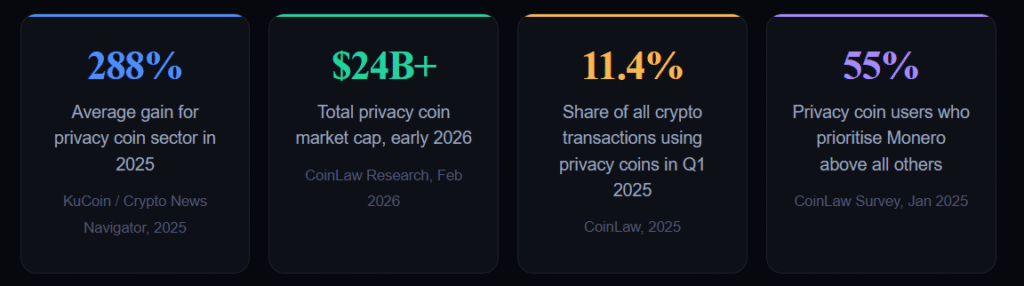
Privacy focused cryptocurrency became one of the year’s standout investment narratives, with Zcash surging over 860%, Monero hitting its highest price since 2018, and the total market cap for the privacy coin sector exceeding $24 billion by early 2026.
We’re breaking down what privacy-focused crypto actually looks like today from how the tech really works to the projects leading the charge
Related Reads: Crypto Is Just a Digital Currency, Crypto Volatility Explained
Key Takeaways
- What Exactly Is Privacy Focused Cryptocurrency?
- Leading Privacy Focused Cryptocurrencies
- How Do Privacy Coins Compare, on Technology, Regulation, and Risk?
- What Does the Regulatory Environment Mean for Privacy Focused Cryptocurrency?
- Risks associated with Investing in Privacy Focused Cryptocurrency
What Exactly Is Privacy Focused Cryptocurrency?
A privacy focused cryptocurrency is a digital asset specifically engineered to conceal transaction details including the sender, the recipient, and the amount transferred from public view on the blockchain.
Standard blockchains like Bitcoin and Ethereum record every transaction on a publicly accessible ledger.
While addresses are pseudonymous rather than named, the full transaction history of any wallet address is visible to anyone who looks.
Chain analysis firms and government agencies have become highly adept at linking those addresses to real identities.
Privacy coins solve this through cryptographic techniques that make transactions mathematically untraceable.
The goal is not to enable crime, as critics often claim, but to restore the basic financial confidentiality that physical cash has always provided.
When you hand someone a £20 note, no permanent public record of that transaction exists.
Privacy focused cryptocurrency attempts to replicate that property in digital form.
Which Are the Leading Privacy Focused Cryptocurrencies
The privacy coin sector is not monolithic.
Different projects make different trade-offs between maximum privacy, regulatory compatibility, usability, and decentralisation.
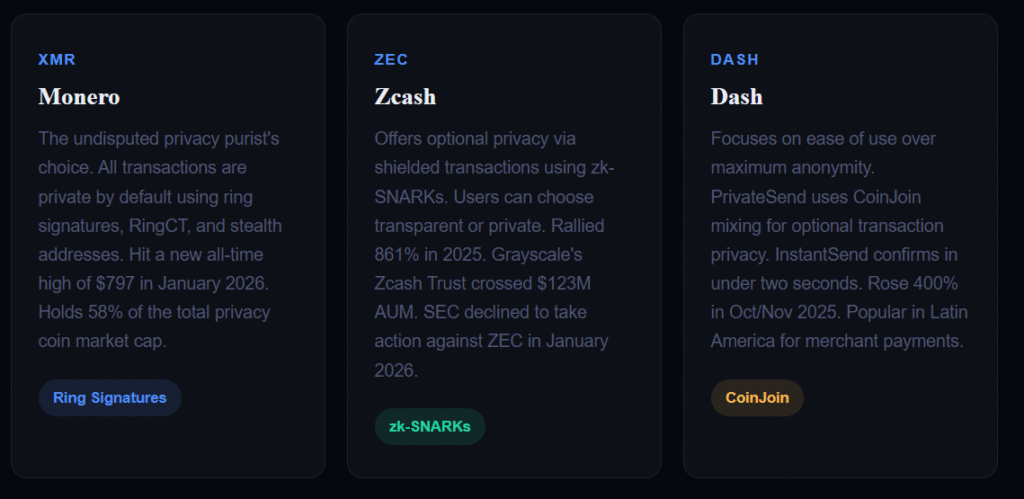
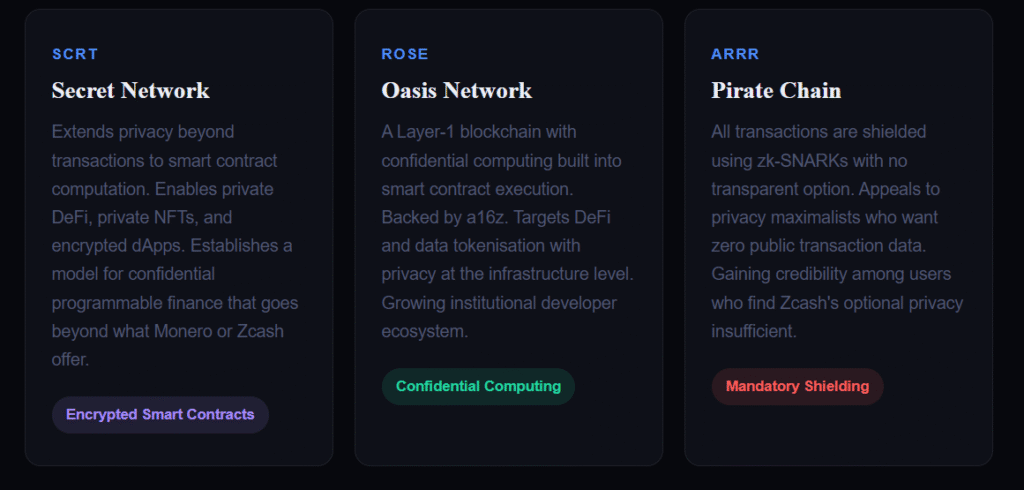
Here is a clear breakdown of the leading assets.
How Do Privacy Coins Compare, on Technology, Regulation, and Risk?
| Coin | Privacy Method | Default Private? | Regulatory Risk | Exchange Availability |
| Monero (XMR) | Ring Signatures, RingCT, Stealth Addresses | Always | High | Shrinking; primarily DEX |
| Zcash (ZEC) | zk-SNARKs (Halo 2), Shielded Pool | Optional | Medium | Multiple major exchanges |
| Dash (DASH) | CoinJoin via PrivateSend | Optional | Low | Wide availability |
| Secret Network (SCRT) | Encrypted Smart Contracts (SGX) | Always | Evolving | Selected exchanges |
| Pirate Chain (ARRR) | Mandatory zk-SNARKs | Always | High | Limited; DEX-focused |
The 2025 Privacy Coin Resurgence
- Surveillance Backlash: The 2025 rally was a direct response to aggressive monitoring (EU’s MiCA and the US GENIUS Act).
As chain analysis made Bitcoin transactions transparent, users shifted to privacy-focused cryptocurrency to protect legitimate business and personal data. - Institutional Green Light: The sector shed its fringe reputation as Grayscale expanded its Zcash Trust to over $123 million in AUM and a16z Crypto declared privacy a core pilla of future infrastructure.
- Default Privacy Tech: Adoption spiked because privacy became easy.
Zcash’s Zashi wallet enforced shield before spend, and Monero’s Jamtis protocol simplified multi-sig and transaction privacy, making sophisticated tech accessible to the average user.
What Does the Regulatory Environment Mean for Privacy Focused Cryptocurrency?
The primary regulatory pressure comes from Anti-Money Laundering (AML) and Know Your Customer (KYC) frameworks.
The FATF Travel Rule requires exchanges to collect and share sender and recipient information for transfers above certain thresholds, a requirement that is structurally incompatible with default-private coins like Monero.
Trading has migrated to decentralised exchanges and atomic swap platforms where no intermediary collects identity data.
Zcash occupies a more defensible regulatory position. Its selective disclosure feature viewing keys that allow users to share transaction details with specific parties such as auditors or tax authorities gives it a compliance pathway that Monero’s mandatory privacy model cannot offer.
The SEC completed a review of Zcash in January 2026 and declined to take enforcement action, a meaningful signal for institutional and retail holders alike
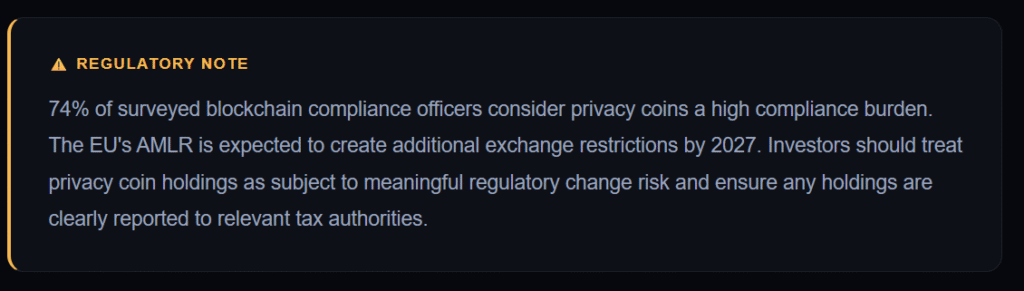
However, the EU’s Anti-Money Laundering Regulation (AMLR), currently scheduled for implementation in 2027, would restrict privacy coin support on regulated European exchanges, creating continued uncertainty.
What Are the Real Risks of Investing in Privacy Focused Cryptocurrency?
1. The Liquidity Trap:
Delistings from major exchanges aren’t just a rumour, they are a structural hurdle.
When coins like Monero move to peer-to-peer only, it creates friction that scares off casual buyers and tanks liquidity.
2. Extreme Volatility:
These assets are policy-sensitive.
In early 2026, Monero and Zcash saw massive drawdowns (over 50%) in just weeks, triggered more by regulatory headlines than actual tech performance.
3. The Complexity Tax:
Newer programmable privacy platforms like Secret or Oasis add a layer of confidential computing that is notoriously difficult to audit. More code layers mean more attack surfaces for smart contract exploits.
Who Actually Uses Privacy Focused Cryptocurrency and Why?
The popular misconception is that privacy coins are primarily used for illicit purposes.
The data does not support this. A January 2025 survey found that 61% of privacy coin users cite financial privacy as their primary reason for using them, while 27% point to investment potential.
The use cases are overwhelmingly legitimate.
Businesses in competitive industries use privacy coins to prevent competitors from monitoring their supplier payments and business relationships on a public ledger.
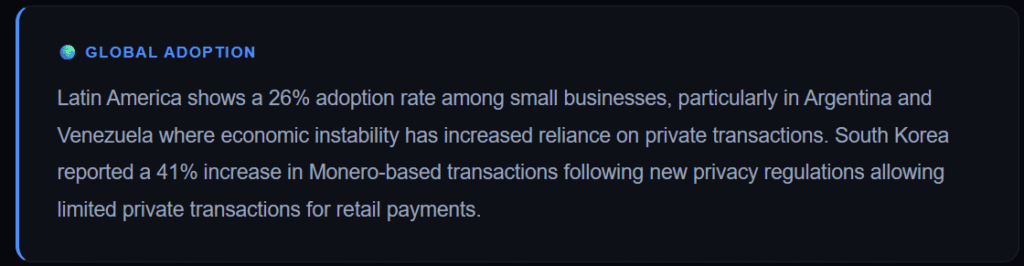
Individuals in high-inflation economies particularly across Latin America and Africa use privacy-preserving transactions to protect savings from government surveillance and potential asset seizure.
Africa saw a 37% year-over-year increase in privacy coin usage in 2025, driven largely by demand for anonymous remittances and low-cost cross-border transfers.
Journalists, activists, and NGO workers operating in restrictive jurisdictions use these tools to receive funding without exposing donors to reprisal.
Asia-Pacific leads globally in privacy coin adoption, with 29% of crypto traders reporting regular use of privacy-focused assets in 2025.
In North America, 18% of crypto users report holding at least one privacy-focused asset, up from 14% in 2023.
The growth trajectory is consistent across every region surveyed.
How Can You Safely Store and Manage Privacy Coin Holdings?
1. Use a Non-Custodial Wallet
Privacy coins are most securely held in wallets where you control your private keys. For Monero, the official GUI wallet or Cake Wallet provide strong options.
For Zcash, the Zashi wallet now makes shielded transactions the default and is developed by the Electric Coin Company.
2. Consider Hardware Wallet Storage
For significant holdings, hardware wallets like Ledger or Trezor provide an additional layer of security by keeping private keys offline.
Check compatibility with your specific privacy coin before purchasing, as not all hardware wallets support all privacy protocols.
3. Back Up Your Seed Phrase Securely
Your seed phrase is the master key to your funds. Store it in multiple physical locations.
Never digitise it, never photograph it, and never share it with any service or individual no legitimate platform will ever request it.
4. Use Reputable Exchanges for Conversion
When converting to or from privacy coins, use regulated platforms with strong security records.
For a full-service trading and payment experience, UEEX provides a secure environment with institutional-grade custody infrastructure.
5. Maintain Accurate Tax Records
The privacy of the transaction on-chain does not reduce your legal reporting obligations.
In most jurisdictions, all cryptocurrency disposals including privacy coins, are taxable events. Keep records of your acquisition costs and disposal dates for every transaction.
Frequently Asked Questions
Is Monero or Zcash the better privacy?
It depends entirely on your priorities. Monero offers stronger default privacy with every transaction protected automatically, making it the choice for privacy maximalists.
Zcash provides optional privacy with superior regulatory compatibility, viewing keys for selective disclosure, and better exchange availability including Grayscale institutional products.
Conclusion
That $24 billion market cap isn’t a spike, it’s a wake-up call. Privacy focused cryptocurrency has officially moved from a niche experiment to the backbone of the digital economy.
Let’s face it, in a world where every single transaction is being tracked, keeping your financial business private isn’t just a nice-to-have feature anymore.
Feel free to browse around for a bit. If you found this useful, you’ll probably like our guides on misconception about crypto, how to buy cryptocurrency anonymously?